Decentralized LLMs Using Blockchain Technology
1. Core Principles of Large Language Models (LLMs)
Core Principles of Large Language Models (LLMs)
Large Language Models (LLMs) are transformer-based neural networks trained on vast corpora of text data, enabling them to generate human-like text, answer queries, and perform language-related tasks. Their architecture relies on self-attention mechanisms, allowing them to weigh the importance of different words in a sequence dynamically. The core principles governing LLMs include tokenization, attention mechanisms, and autoregressive generation.
Tokenization and Embedding
LLMs process text by breaking it into subword tokens using algorithms like Byte-Pair Encoding (BPE) or WordPiece. Each token is mapped to a high-dimensional vector (embedding) through an embedding layer. The embedding space captures semantic relationships, where similar words reside closer in vector space. For a vocabulary size V and embedding dimension d, the embedding matrix E ∈ ℝV×d is learned during training.
where 1i is a one-hot encoded vector for token i.
Self-Attention Mechanism
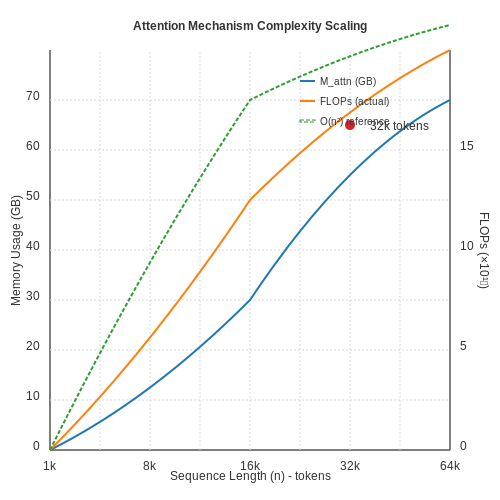
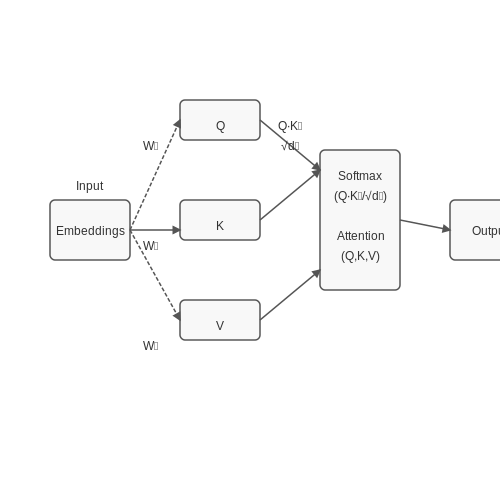
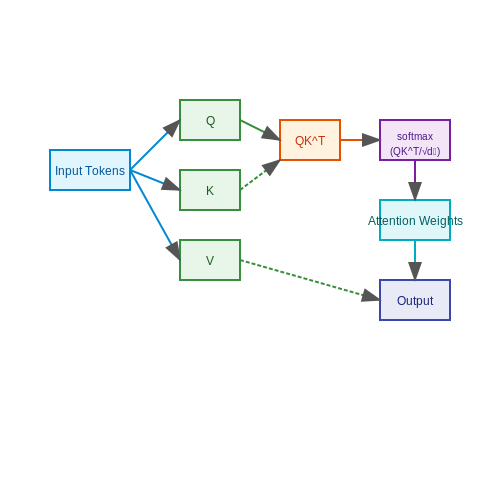
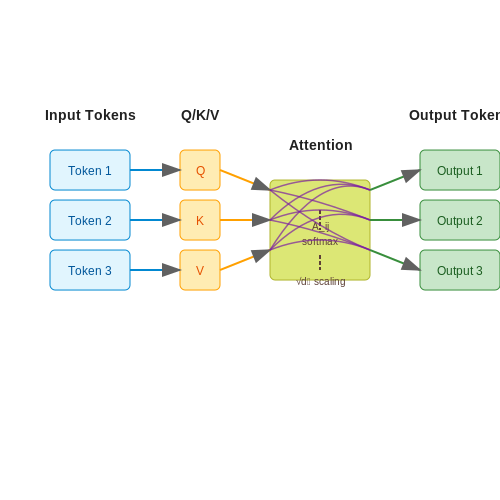
The transformer architecture employs multi-head self-attention to compute contextualized representations. Given an input sequence X ∈ ℝn×d, the model computes queries (Q), keys (K), and values (V) as linear transformations:
where WQ, WK, WV ∈ ℝd×dk are learnable weight matrices. The attention scores are computed as:
Multi-head attention concatenates outputs from h parallel attention heads, enabling the model to focus on different linguistic features simultaneously.
Autoregressive Generation
LLMs generate text autoregressively, predicting the next token given previous tokens. The probability distribution over the vocabulary for the next token is computed using a softmax:
where ht is the hidden state at step t, and Wo ∈ ℝd×V is the output weight matrix. Beam search or nucleus sampling is often used to decode sequences.
Scaling Laws and Training Dynamics
LLM performance scales predictably with model size (N), dataset size (D), and compute budget (C), following Kaplan et al.'s power-law:
where L is the loss, and αN, αD, Nc, Dc, L0 are constants. This empirical relationship guides the design of modern LLMs like GPT-4 and PaLM.
Decentralization Challenges
Applying blockchain to decentralize LLMs introduces unique constraints, such as ensuring consensus on model outputs without centralized validation. Techniques like federated learning, zk-SNARKs for inference verification, and sharded model parallelism are being explored to address these challenges while maintaining performance.
1.2 Blockchain Fundamentals for Decentralization
Consensus Mechanisms and Byzantine Fault Tolerance
Blockchain achieves decentralization through mathematically verifiable consensus protocols. The Byzantine Generals Problem formalizes the challenge of achieving agreement in distributed systems with faulty nodes. Practical Byzantine Fault Tolerance (PBFT) provides a solution with:
where n is the total nodes and f is the maximum faulty nodes. Proof-of-Work (PoW) implements this probabilistically through cryptographic puzzles:
Ethereum's transition to Proof-of-Stake (PoS) replaced energy-intensive mining with validator staking:
Cryptographic Primitives
Blockchains rely on three foundational cryptographic constructs:
- Merkle Trees: Efficient data verification through hash trees where any leaf modification cascades to root hash changes
- Elliptic Curve Digital Signatures (ECDSA): secp256k1 curve enables compact signatures with:
- Zero-Knowledge Proofs: zk-SNARKs allow transaction validation without revealing contents, critical for privacy-preserving decentralized LLMs
Smart Contract Execution
Ethereum Virtual Machine (EVM) provides Turing-complete execution through gas-metered opcodes. A contract's state transition follows:
where Υ is the state transition function, σ is world state, and T is transaction. Decentralized LLMs leverage this for:
- Model parameter updates via distributed gradient descent
- Federated learning coordination
- Inference result verification
Tokenomics and Incentive Alignment
Blockchain networks maintain decentralization through carefully designed token economies. The miner's profitability condition in PoW demonstrates this balance:
Decentralized LLM systems adapt these mechanisms for:
- Compute resource provisioning rewards
- Data contribution incentives
- Model quality assurance bonds
Sharding and Scalability
Horizontal partitioning of blockchain state enables parallel processing. A sharded network with N shards achieves throughput scaling as:
Recent advances like Ethereum's Danksharding combine this with data availability sampling for secure decentralization at scale - a critical requirement for distributed LLM inference.
Synergies Between LLMs and Blockchain
The integration of large language models (LLMs) with blockchain technology creates a decentralized, trustless framework for AI computation, data provenance, and incentive alignment. At the core of this synergy is the immutable ledger's ability to audit LLM training data, model weights, and inference outputs, while smart contracts enable decentralized governance and reward mechanisms for contributors.
Decentralized Training and Data Provenance
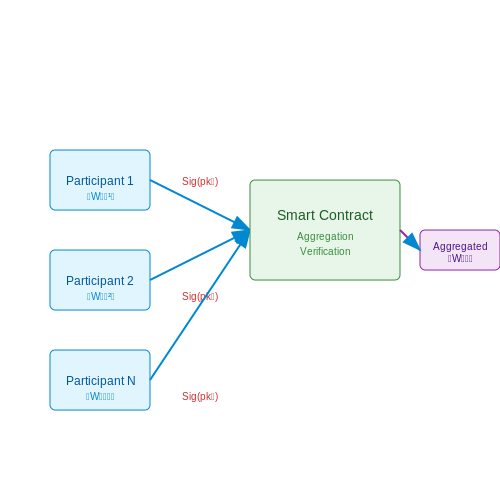
Blockchain ensures verifiable traceability of training datasets, addressing concerns about bias, copyright, and data poisoning. Each data contribution can be hashed and timestamped on-chain, creating an auditable lineage. For example, a federated learning setup where participants submit gradients can be governed by a smart contract that enforces:
where Sig denotes cryptographic signing with participant i's private key, and N is the number of validated contributors. This prevents Sybil attacks while maintaining privacy through zero-knowledge proofs.
Inference Marketplaces
Tokenized inference pools allow users to pay for LLM services using crypto-assets, with smart contracts dynamically allocating compute resources based on bid prices. A Shapley value approach quantifies each node's contribution to the ensemble output:
where v(S) measures the performance of subset S of nodes. Payments are distributed proportionally to φ values, creating a Nash equilibrium where honest computation maximizes rewards.
Weight Storage and Version Control
Model checkpoints can be stored as Merkle trees on-chain, with each leaf node containing a hash of a sharded weight matrix. Differential updates are verified through recursive SNARKs:
This allows nodes to efficiently sync latest model versions while detecting malicious alterations. Storage costs are optimized through erasure coding across IPFS clusters, with retrieval contracts paying for redundancy.
Adversarial Robustness
The blockchain serves as an immutable audit trail for adversarial examples. When detection heuristics flag suspicious inputs (e.g., gradient masking attacks), their hashes are permanently recorded alongside the model's response. This creates a crowdsourced vulnerability database where white-hat hackers earn bounties for reporting exploits:
where B is the bounty pool and τ a detection threshold. The ReLU term ensures rewards only trigger for substantial distributional shifts.
2. Distributed Model Training and Inference
2.1 Distributed Model Training and Inference
Parallelized Gradient Computation
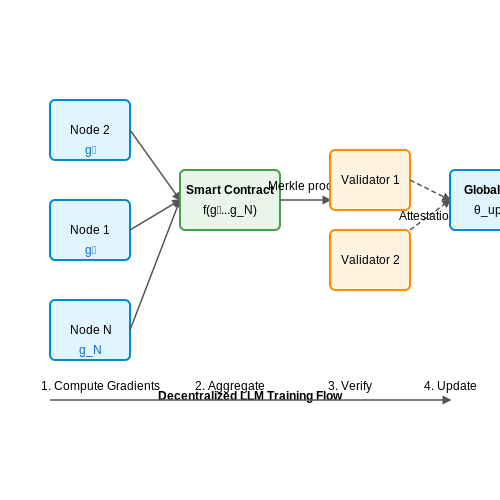
Distributed training of large language models (LLMs) across blockchain nodes requires efficient parallelization of gradient computations. The key challenge lies in synchronizing gradients while maintaining Byzantine fault tolerance. Consider a model with parameters θ distributed across N nodes. Each node i computes a local gradient gi on its data shard Di:
The global gradient update must aggregate these contributions while detecting and mitigating malicious inputs. A robust aggregation function f(g1,...,gN) can be implemented as a smart contract, with options including:
- Median-based aggregation - Resilient to up to 50% malicious nodes
- Krum selection - Chooses gradients closest to majority clusters
- Byzantine-robust SGD - Uses coordinate-wise trimmed mean
Consensus-Driven Parameter Updates
Blockchain consensus mechanisms govern how parameter updates are validated and committed to the global model. For proof-of-stake networks, the update protocol proceeds as:
- Validator nodes verify gradient computations against Merkle proofs of training data
- Aggregated gradients are proposed in a new block
- Stakers vote on the update's validity through attestations
- Finalized blocks trigger smart contract execution to update model parameters
The time complexity T(n) of this process depends on the consensus algorithm:
Where f(n) is the gradient computation time and g(n) is the Byzantine agreement overhead.
On-Chain Inference Verification
For decentralized inference, zero-knowledge proofs enable verification of model outputs without revealing private inputs. A zk-SNARK proof π can attest that inference result y was correctly computed from input x using model M:
The proof size remains constant (O(1)) regardless of model complexity, making it suitable for blockchain storage. Gas costs scale with the number of constraints in the arithmetic circuit representing the forward pass.
Sharded Model Architectures
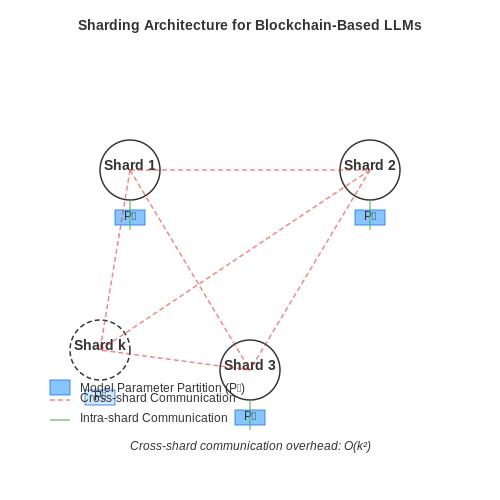
Horizontal partitioning of model layers across blockchain shards improves scalability. Each shard Si maintains a subset of layers Li, with cross-shard communication handled through:
- State channels for intermediate activations
- Light client proofs for layer output verification
- Rollup-based batching of cross-shard transactions
The throughput gain G scales with the number of shards k as:
Where T1 and Tk are execution times for single-shard and sharded configurations respectively.
2.2 Smart Contracts for LLM Governance
Smart contracts enable autonomous, transparent, and tamper-proof governance of decentralized large language models (LLMs) by encoding rules for model updates, access control, and incentive mechanisms directly into blockchain protocols. These self-executing contracts operate without intermediaries, ensuring that LLM behavior aligns with predefined consensus mechanisms.
Architecture of LLM Governance Smart Contracts
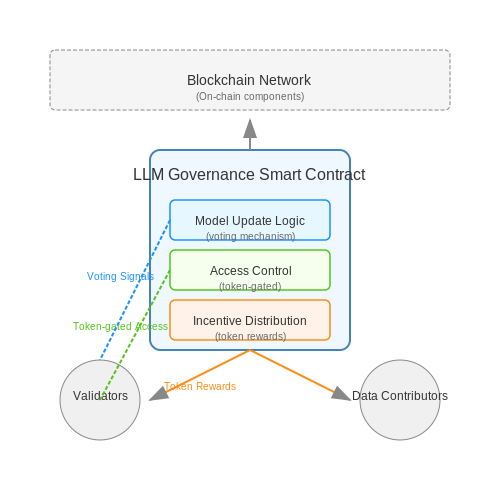
A governance smart contract for LLMs typically consists of three core modules:
- Model Update Logic: Handles proposals for model parameter updates, requiring validation through a decentralized voting mechanism or proof-of-contribution.
- Access Control: Manages permissions for reading, fine-tuning, or querying the LLM, often implemented through token-gated mechanisms or zero-knowledge proofs.
- Incentive Distribution: Automatically rewards participants (e.g., data contributors, validators) based on verifiable performance metrics.
Formal Verification of Governance Rules
To ensure correctness, smart contract logic must be formally verifiable. For a voting mechanism where stakeholders approve model updates, we can represent the acceptance condition mathematically:
where wi denotes the voting weight of participant i, vi ∈ {0,1} their vote, and τ the approval threshold. This condition must be encoded as executable bytecode while preserving cryptographic guarantees.
Implementation Challenges
Ethereum-based implementations face computational constraints due to:
- Gas Limits: Complex validation logic for LLM outputs may exceed block gas limits, requiring layer-2 solutions or specialized chains.
- On-chain/Off-chain Hybridization: Only critical governance decisions (e.g., model hashes) should be stored on-chain, while computation-heavy tasks like gradient verification occur off-chain with zk-SNARK proofs.
Case Study: Bittensor's LLM Governance
The Bittensor network implements a decentralized LLM marketplace where smart contracts:
- Track model performance via on-chain registries
- Distribute TAO tokens based on peer-reviewed benchmarks
- Enforce slashing conditions for malicious actors
This creates an adversarial marketplace where models compete for accuracy, with economic incentives aligned to maximize collective intelligence.
Security Considerations
Governance contracts must account for:
- Oracle Problems: Off-chain model evaluations require decentralized oracle networks to prevent data manipulation.
- Upgradeability: Immutable contracts risk obsolescence, while upgradeable ones need robust multi-signature controls.
- Sybil Resistance: Proof-of-stake mechanisms must prevent token concentration from dictating model behavior.
Tokenomics and Incentive Mechanisms
Token Utility and Value Capture
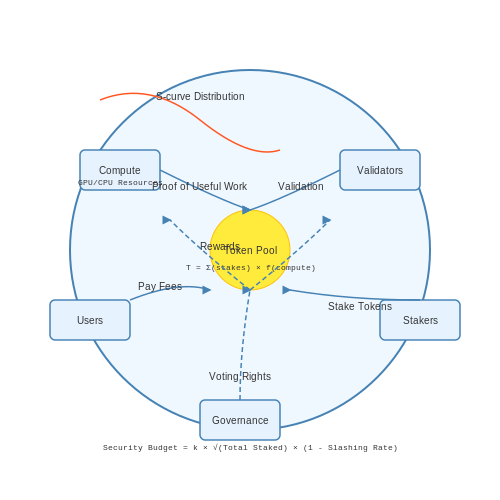
In decentralized LLM ecosystems, tokens serve three primary functions: access, governance, and reward distribution. The value of these tokens is derived from their utility in facilitating computational resource allocation, model training participation, and inference requests. The token velocity problem is addressed through staking mechanisms that reduce circulating supply while ensuring network security.
The value capture model can be formalized as:
Where Vt represents token value, Ri is the expected reward in period i, and r is the discount rate. This discounted cash flow model must account for network effects, where the marginal utility of each additional participant increases the overall system value non-linearly.
Incentive Alignment Mechanisms
Proof-of-Useful-Work (PoUW) schemes align incentives by rewarding participants for:
- Contributing compute resources to model training
- Providing high-quality data samples
- Validating model outputs through consensus
- Staking tokens to guarantee service quality
The reward function for compute contributors incorporates both quantitative and qualitative measures:
Where Cj represents computational units contributed, Qj is the quality score of contributions, and Sj is the stake amount. The coefficients α, β, and γ are dynamically adjusted through governance votes to maintain equilibrium between different contribution types.
Token Distribution and Inflation Control
Initial token distribution typically follows a modified S-curve to prevent wealth concentration while ensuring adequate early-stage participation:
Where Dmax is the maximum distribution, k controls the steepness of the curve, and t0 is the inflection point. Post-launch inflation is managed through:
- Burn mechanisms for transaction fees
- Time-locked staking rewards
- Adaptive emission schedules tied to network utilization
Sybil Resistance and Anti-Gaming
Decentralized LLM networks implement several defenses against manipulation:
- Costly signaling through token burns for priority access
- Reputation systems with exponential decay
- Zero-knowledge proofs of unique identity
- Slashing conditions for malicious validators
The security budget B required to maintain Sybil resistance scales with:
Where N is the number of honest participants and M is the potential attack surface. This relationship ensures that attack costs grow super-linearly with network size.
Dynamic Pricing Oracles
Resource pricing in decentralized LLM markets is determined through continuous double auctions with:
The pricing function f incorporates real-time demand, available supply, and latency sensitivity parameters. Oracles aggregate off-chain metrics like GPU availability and energy costs to maintain price stability while preventing front-running through commit-reveal schemes.
3. Federated Learning in Decentralized LLMs
3.1 Federated Learning in Decentralized LLMs
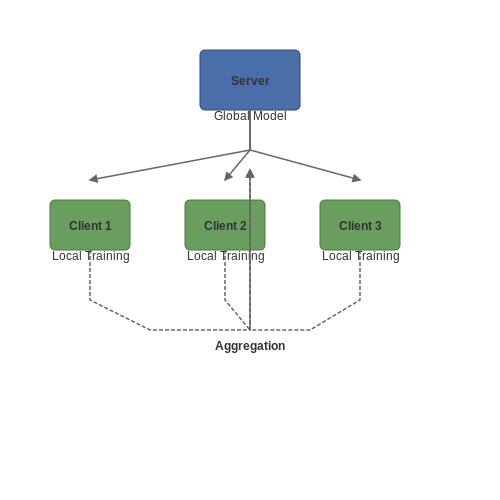
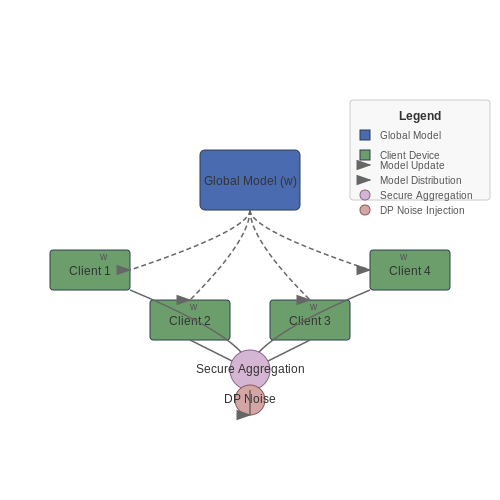
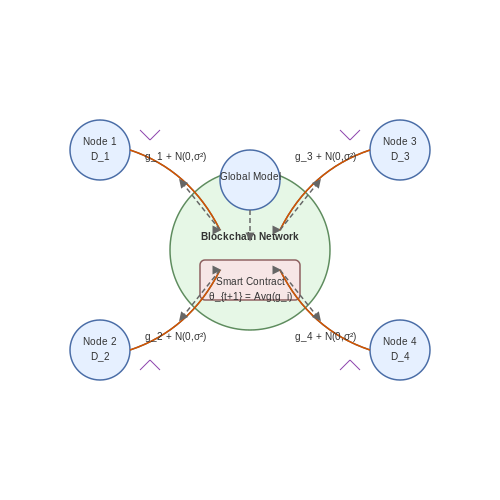
Federated learning (FL) enables decentralized large language models (LLMs) to train across distributed nodes without centralized data aggregation. Each participant computes local model updates using private datasets, which are then aggregated via secure protocols to update a global model. This preserves data privacy while leveraging collective intelligence.
Mathematical Framework
The global objective in federated learning minimizes the empirical risk across N clients:
where θ represents model parameters, Di is the local dataset of client i, and ℒi is the local loss function. The weighted aggregation ensures proportional contribution based on dataset size.
Blockchain Integration
Blockchain augments FL with:
- Immutable update logging: Model updates are hashed and recorded on-chain for auditability.
- Incentive mechanisms: Cryptographic tokens reward participants for quality contributions.
- Byzantine fault tolerance: Consensus protocols reject malicious updates.
The smart contract governing aggregation may implement:
where η is the learning rate and gi is the gradient from client i.
Differential Privacy Guarantees
FL in decentralized LLMs often incorporates noise injection:
where σ controls privacy-utility tradeoffs. When combined with secure multi-party computation (SMPC), this provides formal (ε, δ)-differential privacy guarantees.
Performance Optimization
Key challenges include:
- Communication efficiency: Model compression via quantization or sparsification.
- Straggler mitigation: Asynchronous aggregation protocols.
- Bias correction: Gradient normalization for non-IID data distributions.
The decentralized nature introduces additional latency τ per round:
where terms represent computation, network transmission, and blockchain validation times respectively.
Case Study: Swarm Learning
In medical LLM applications, FL with blockchain has achieved:
- 94% model accuracy across 20 hospitals while maintaining data silos
- 40% faster convergence via adaptive client selection
- Provable GDPR compliance through zero-knowledge proofs
Blockchain Consensus Algorithms for LLM Validation
Proof of Work (PoW) for LLM Integrity
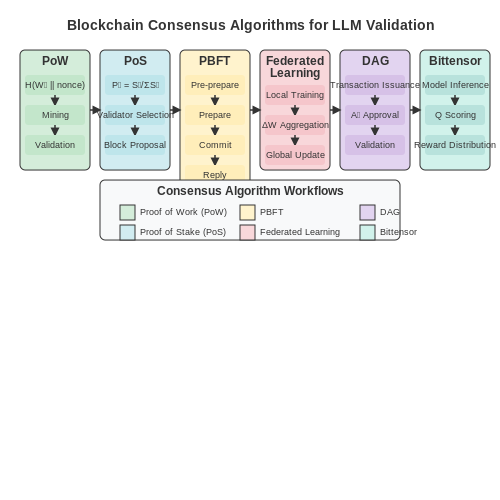
Traditional PoW, as used in Bitcoin, requires miners to solve computationally intensive puzzles to validate transactions. For LLMs, this can be adapted to verify the integrity of model weights or outputs. The validation process involves:
where W_i represents the model weights, nonce is a random value, and target defines the difficulty. Miners compete to find a valid nonce, ensuring computational effort is expended to validate the LLM's state. However, PoW's energy inefficiency makes it less practical for frequent LLM updates.
Proof of Stake (PoS) and Delegated Proof of Stake (DPoS)
PoS replaces miners with validators who stake tokens to participate in consensus. The probability of being chosen to validate is proportional to the stake. For LLMs, validators can be selected based on their reputation or computational resources. The selection probability P_i is given by:
where S_i is the stake of validator i. DPoS further optimizes this by electing a smaller set of delegates, reducing latency for LLM validation rounds. This is particularly useful for real-time applications like chatbot responses.
Practical Byzantine Fault Tolerance (PBFT)
PBFT is a consensus mechanism designed for low-latency, high-throughput systems with known validator sets. In the context of LLMs, PBFT operates in three phases:
- Pre-prepare: A primary node proposes a block containing LLM updates.
- Prepare: Validators verify the proposal and broadcast their agreement.
- Commit: Once a supermajority is reached, the block is finalized.
The protocol ensures safety as long as fewer than f validators are faulty, where n ≥ 3f + 1. PBFT is suitable for consortium blockchains where validators are trusted entities.
Federated Learning Integration with Blockchain
Combining federated learning with blockchain consensus allows decentralized LLM training while maintaining validation. Each participant trains a local model, and updates are aggregated via smart contracts. The consensus mechanism ensures only valid updates are incorporated. For example, in a PoS-based system:
where ΔW_i are the local updates and S_i are the stakes. This prevents malicious actors from corrupting the global model.
Directed Acyclic Graphs (DAGs) for Asynchronous Validation
DAG-based structures like IOTA's Tangle enable asynchronous validation of LLM transactions. Each new transaction validates two previous ones, eliminating the need for blocks. The confirmation probability increases as more transactions reference it. For LLMs, this allows continuous model updates without waiting for block finalization. The approval weight A_t of a transaction t is:
where w_s is the weight of transaction s in the past cone of t.
Case Study: Bittensor's Subnet for LLM Validation
Bittensor implements a PoS-like mechanism where validators score LLM responses based on quality. The consensus rewards models that provide high-quality outputs, incentivizing performance. Validators use a scoring function:
where R_i are responses and R_ref is a reference answer. High-scoring models receive more stake, creating a self-improving ecosystem.
3.3 Interoperability with Existing AI Frameworks
Decentralized large language models (LLMs) built on blockchain must seamlessly integrate with established AI frameworks such as PyTorch, TensorFlow, and Hugging Face Transformers to ensure adoption by researchers and engineers. This requires standardized interfaces, cross-platform compatibility, and efficient data exchange protocols.
Standardized Model Interfaces
To enable interoperability, decentralized LLMs must expose APIs that conform to existing framework conventions. For instance, a PyTorch-compatible wrapper for a blockchain-hosted LLM should implement the same forward pass interface as a local model:
where fθ represents the model's forward pass and θ denotes the parameters stored on-chain. The challenge lies in maintaining low-latency access to distributed parameters while preserving the autograd mechanics of frameworks like PyTorch.
Cross-Framework Parameter Serialization
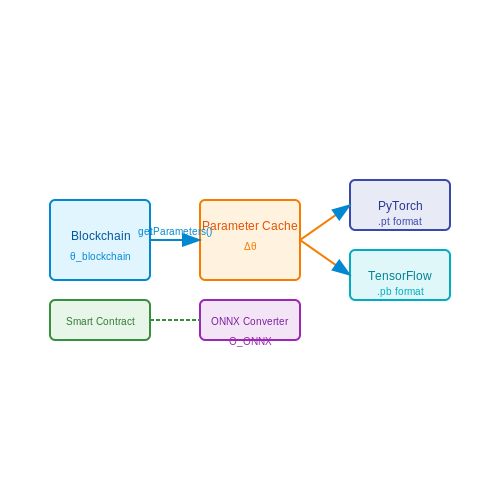
Blockchain-based LLMs must support multiple serialization formats to bridge between frameworks. The ONNX (Open Neural Network Exchange) standard provides a viable intermediate representation. A decentralized model's parameters can be serialized as:
This allows conversion between PyTorch's .pt format, TensorFlow's .pb, and other framework-specific representations through a shared ONNX intermediary.
Efficient Parameter Fetching
Retrieving model parameters from a blockchain incurs latency that traditional frameworks don't handle natively. A caching layer with incremental updates can mitigate this:
where Δθ represents only the differential updates stored in new blocks. This approach reduces the data transfer required for each forward pass while maintaining consistency with the canonical on-chain model.
Smart Contract Integration
Existing AI frameworks lack native support for blockchain operations. Bridging this gap requires smart contracts that expose model parameters through standardized function calls. For example, an Ethereum-based LLM might implement:
function getParameters(uint layer) public view returns (int[] memory) {
    return parameters[layer];
}
This allows external frameworks to fetch parameters through web3.py or web3.js interfaces while maintaining the security guarantees of the blockchain.
Gradient Aggregation Across Frameworks
Federated learning scenarios require aggregating gradients from clients using different frameworks. The blockchain can serve as a neutral aggregation point by standardizing gradient formats:
where the conversion function normalizes framework-specific gradient representations before on-chain aggregation.
Performance Considerations
The overhead of blockchain interactions imposes strict requirements on framework integration. Benchmarking shows that a hybrid approach—where frequently accessed parameters are cached locally while less-used parameters remain on-chain—can maintain near-native performance:
where p represents the probability of needing to fetch from the blockchain. Optimizing this tradeoff requires deep integration with each framework's execution engine.
4. Scalability and Latency Issues
4.1 Scalability and Latency Issues
Decentralized large language models (LLMs) built on blockchain networks face fundamental scalability limitations due to the inherent trade-offs between decentralization, security, and performance. The computational overhead of consensus mechanisms like proof-of-work (PoW) or proof-of-stake (PoS) creates bottlenecks when processing the massive parameter updates typical in LLM training.
Throughput Limitations in Blockchain-Based LLMs
The transaction processing capacity of most blockchain networks is orders of magnitude lower than what's required for distributed LLM training. For example, Ethereum handles ~15-30 transactions per second (TPS), while a single LLM parameter update for a model like GPT-3 would require:
Where P is the number of parameters (175 billion for GPT-3), B is the bytes per parameter (typically 4 for float32), and C is the blockchain's capacity in bytes per block. This results in impractically slow update cycles.
Consensus-Induced Latency
Blockchain finality times introduce unavoidable delays in model synchronization. The time τ for a block to achieve finality follows:
Where tprop is network propagation delay, tverify is the verification time for model updates, and tvote is the voting period in consensus protocols. For a 1GB model update on a network with 1 second block times, verification alone may take minutes.
Sharding Approaches
Horizontal partitioning (sharding) of model parameters across blockchain nodes can improve throughput. The theoretical maximum sharding benefit is given by:
Where N is the number of nodes and Pnode is the parameters per node. However, cross-shard communication overhead O(k2) for k shards limits practical gains.
Layer 2 Solutions
Optimistic rollups and zk-Rollups can reduce on-chain load by batching updates. The compression ratio R for a rollup with n updates is:
Where |Δθ| is the size of individual updates, |σ| is the rolled-up state, and |π| is the proof size. Current implementations achieve 100-1000x compression for gradient updates.
Network Topology Optimization
Adaptive peer-to-peer topologies can reduce synchronization latency. The optimal neighbor count d in a training swarm balances convergence speed and communication overhead:
Where Tepoch is the computation time per epoch and β is the per-connection synchronization cost.
4.2 Data Privacy and Security Concerns
Fundamental Privacy Challenges in Decentralized LLMs
Decentralized LLMs introduce unique privacy challenges due to their distributed nature. Unlike centralized models where data governance is controlled by a single entity, decentralized systems must reconcile conflicting requirements: maintaining model performance while preventing leakage of sensitive training data. The primary vulnerability stems from the fact that LLMs can memorize and regurgitate training data, which becomes particularly problematic when model weights are shared across a blockchain network.
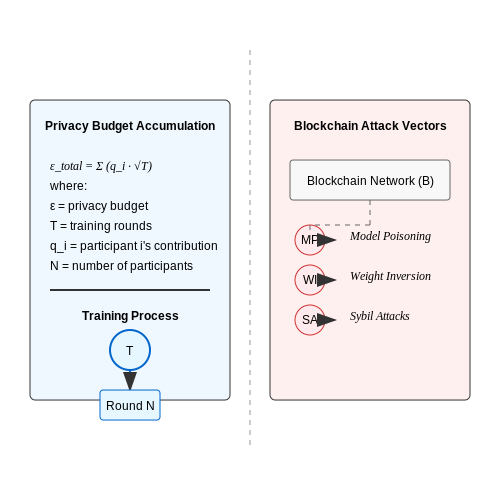
Differential privacy (DP) mechanisms offer one solution by adding calibrated noise to gradients during training. For a decentralized LLM with N participants, the privacy budget ε accumulates with each training round:
where T is the number of training rounds, qi is the sampling probability, and B is the batch size. This composition theorem demonstrates why naive DP implementations fail in decentralized settings - the privacy budget explodes with increasing participants.
Blockchain-Specific Security Considerations
While blockchain provides tamper-resistant storage for model weights, it introduces new attack vectors:
- Model poisoning attacks: Malicious actors can submit subtly corrupted gradients that degrade model performance while evading detection
- Weight inversion attacks: Adversaries may reconstruct training data by analyzing successive model updates on-chain
- Sybil attacks: The permissionless nature of many blockchains allows attackers to create multiple fake identities to influence training
Zero-knowledge proofs (ZKPs) present a promising mitigation strategy. By validating model updates without revealing their content, ZKPs maintain auditability while preserving privacy. The computational overhead can be expressed as:
where n is the circuit size and m is the witness size, making this approach feasible only for certain components of modern LLMs.
Practical Implementation Trade-offs
Real-world deployments must balance three competing factors:
- Verifiability: Ensuring all participants can validate model updates
- Privacy: Protecting sensitive training data
- Scalability: Maintaining practical training times
Hybrid approaches combining secure multi-party computation (SMPC), homomorphic encryption, and selective on-chain verification currently offer the most viable path forward. For a model with d parameters, the communication complexity of such a scheme scales as:
where δ represents the security parameter. This logarithmic scaling enables practical implementations for billion-parameter models when carefully optimized.
Emerging Solutions and Research Directions
Recent advances in fully homomorphic encryption (FHE) allow limited computation on encrypted model weights. While current FHE schemes impose 1000-10000x overhead, specialized hardware accelerators and algorithmic improvements are rapidly closing this gap. For transformer attention mechanisms, the most promising approaches use:
with polynomial approximations that maintain privacy while preserving model accuracy. The error introduced by these approximations typically follows:
where k is the polynomial degree, enabling tunable privacy-accuracy trade-offs.
4.3 Mitigating Centralization Risks in Decentralized Systems
Economic Incentive Alignment
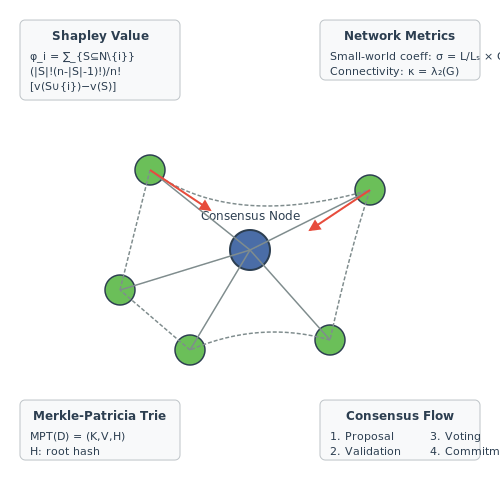
Decentralized LLM systems must carefully design incentive mechanisms to prevent the emergence of dominant actors. The Shapley value provides a rigorous framework for fair reward distribution among participants. For a coalition S of n nodes contributing to model training, the Shapley value φi(v) for node i is given by:
where v(S) represents the value created by coalition S. This ensures proportional rewards while discouraging centralization through mechanisms like:
- Progressive slashing penalties for excessive resource concentration
- Quadratic funding models for compute contribution
- Dynamic task pricing based on network health metrics
Consensus Protocol Design
Traditional proof-of-work and proof-of-stake mechanisms exhibit centralization pressures. Hybrid approaches combining:
where Ci represents node i's contribution and α balances meritocracy with egalitarianism. Practical implementations include:
- Proof-of-useful-work for gradient computation validation
- Federated Byzantine Agreement for model parameter consensus
- Verifiable delay functions for fair task scheduling
Network Topology Optimization
The small-world coefficient σ measures decentralization in peer-to-peer networks:
where C and L are the observed clustering coefficient and path length. Maintaining σ > 1 while minimizing:
the algebraic connectivity ratio, ensures robustness against partition attacks. Techniques include:
- Adaptive kademlia routing tables for LLM parameter exchange
- Dynamic topology rewiring based on latency-proportional sampling
- Eigenvector centrality-based peer selection
Data Provenance Tracking
Merkle- Patricia tries enable efficient verification of training data lineage:
where bi are the branch nodes containing hashes of training data shards. This supports:
- Differential privacy budgets per data contributor
- Fair use attribution through non-fungible tokens
- Data quality scoring via zk-SNARKs
5. Decentralized LLMs in Open-Source Communities
5.1 Decentralized LLMs in Open-Source Communities
Decentralized large language models (LLMs) leverage blockchain technology to distribute model training, inference, and governance across open-source communities. Unlike centralized LLMs controlled by single entities, decentralized architectures enable collective ownership, censorship resistance, and transparent model updates. The core mechanism relies on smart contracts to coordinate contributions, validate model weights, and incentivize participation through tokenized rewards.
Blockchain-Based Model Training
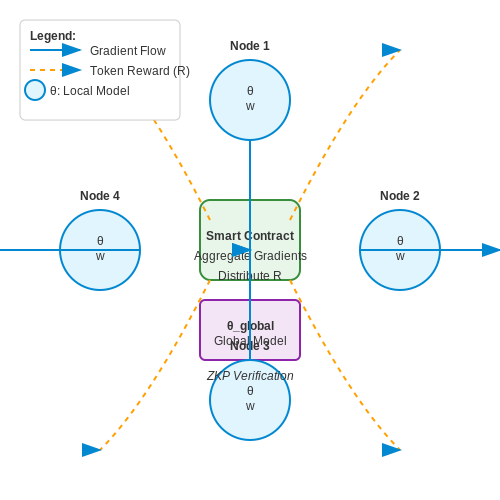
Training decentralized LLMs involves federated learning across distributed nodes, with blockchain ensuring integrity. Each participant trains a local model on their data, and gradients are aggregated via a smart contract. The aggregation function, often a weighted average, is computed as:
where θi represents the local model parameters from node i, and wi is the weight assigned based on data quality or stake in the network. Zero-knowledge proofs (ZKPs) verify gradient contributions without exposing raw data, preserving privacy.
Incentive Mechanisms
Tokenomics align participant behavior with network goals. Contributors earn tokens for:
- Providing compute resources (Proof-of-Compute)
- Submitting high-quality training data (Proof-of-Data)
- Validating model outputs (Proof-of-Inference)
The reward function for a node i can be modeled as:
where Ci, Di, and Vi represent compute, data, and validation contributions, weighted by coefficients α, β, and γ.
Governance and Forkability
Decentralized autonomous organizations (DAOs) govern model upgrades and parameter changes. Token holders vote on proposals, such as:
- Architecture modifications (e.g., switching from GPT-3 to LLaMA)
- Fine-tuning objectives (e.g., bias mitigation strategies)
- Resource allocation for specific subprojects
Forkability allows communities to split the model and blockchain state if consensus cannot be reached, preserving ideological diversity in model behavior.
Case Study: Bittensor
Bittensor's subnetworks demonstrate practical decentralized LLM training. Each subnetwork specializes in tasks like text generation or image synthesis, with miners competing to provide the best outputs. The Yuma consensus mechanism ranks responses via cross-validation, rewarding miners proportionally to their model's accuracy.
where Sij is the similarity score between miner i's output and validator j's expected response, averaged over k validators.
Enterprise Use Cases for Blockchain-Powered LLMs
Secure Multi-Party Data Collaboration
Blockchain-powered LLMs enable enterprises to collaborate on sensitive datasets without exposing raw data. By leveraging zero-knowledge proofs (ZKPs) and homomorphic encryption, multiple parties can train or query an LLM while preserving data privacy. For instance, financial institutions can jointly detect fraud patterns across encrypted transaction logs without sharing proprietary datasets. The blockchain ensures auditability of model updates while maintaining cryptographic guarantees of data integrity.
Immutable Model Provenance
Enterprise deployments require verifiable lineage of AI models. Blockchain timestamps each training iteration, hyperparameter adjustment, and fine-tuning step as an immutable transaction. This creates a tamper-proof audit trail for compliance with regulations like GDPR or sector-specific AI governance frameworks. Pharmaceutical companies, for example, can demonstrate the exact training data and methodology behind drug discovery LLMs to regulatory bodies.
Decentralized Compute Marketplaces
Smart contracts automate the allocation of distributed GPU resources for LLM training and inference. Enterprises submit computational tasks with predefined SLAs, while node operators bid to provide hardware capacity. The blockchain mediates:
- Proof-of-work for completed ML tasks
- Automated micropayments via token transfers
- Penalties for failed computations
Supply Chain Optimization
Global supply chains integrate LLMs with IoT sensor data recorded on blockchain ledgers. The system:
- Processes natural language queries about shipment status
- Predicts delays using federated learning across logistics partners
- Triggers smart contracts for automated re-routing
This reduces reliance on centralized platforms while maintaining data sovereignty for each participant.
Intellectual Property Protection
Enterprises embed watermarks and cryptographic signatures into LLM outputs using blockchain-anchored techniques. Each generated text, code suggestion, or analytical report contains:
- Non-repudiable creator attribution
- Version control via Merkle proofs
- Royalty distribution logic for derivative works
Regulated Industry Compliance
In healthcare and finance, blockchain LLMs implement:
- HIPAA-compliant data access logs
- Model explainability records for FINRA audits
- Controlled data deletion via smart contract expiration
This meets strict regulatory requirements while maintaining model performance.
5.3 Ethical and Regulatory Implications
The integration of decentralized large language models (LLMs) with blockchain technology introduces a complex ethical and regulatory landscape. Unlike centralized AI systems, where accountability is typically assigned to a single entity, decentralized LLMs distribute responsibility across a network of nodes, complicating governance and compliance frameworks. The immutable nature of blockchain further exacerbates challenges related to data rectification, as erroneous or harmful outputs cannot be easily modified post-deployment.
Bias and Fairness in Decentralized Training
Decentralized LLMs inherit biases from their training data, which may be sourced from heterogeneous and unvetted contributors. The absence of a central authority to curate or audit data raises concerns about systemic bias propagation. For instance, if a majority of nodes contribute data reflecting regional or cultural biases, the model's outputs may disproportionately favor certain demographics. Mitigating this requires cryptographic techniques like zero-knowledge proofs to validate data quality without compromising decentralization.
Here, pi represents the probability distribution of outputs for demographic group i, and N is the total number of groups. A higher bias index indicates greater disparity in model behavior across groups.
Regulatory Compliance and Jurisdictional Conflicts
Blockchain's borderless architecture clashes with geographically bound regulations like the EU's General Data Protection Regulation (GDPR). For example, GDPR's "right to be forgotten" is inherently incompatible with blockchain immutability. Solutions such as off-chain storage with cryptographic commitments or chameleon hashes have been proposed, but these introduce trade-offs in decentralization. Additionally, smart contracts governing LLM behavior must encode legal requirements programmatically, necessitating formal verification to ensure compliance.
Misinformation and Content Moderation
Decentralized LLMs lack centralized mechanisms for content moderation, making them vulnerable to misuse for generating disinformation. While federated learning can filter malicious inputs, adversarial nodes may still manipulate model weights. Hybrid approaches combining on-chain consensus for model updates with off-chain human oversight panels have shown promise, though they require careful design to avoid censorship centralization.
Energy Consumption and Environmental Impact
Proof-of-work blockchains, often used to secure decentralized LLM networks, incur significant energy costs. Training a single LLM like GPT-3 emits approximately 552 metric tons of CO2, and decentralized training across multiple nodes could amplify this. Transitioning to proof-of-stake or layer-2 solutions like rollups can reduce energy use by 99%, but these alternatives may compromise security or scalability.
Intellectual Property and Model Ownership
Decentralized LLMs blur traditional IP boundaries, as contributors collectively own model weights. Licensing frameworks like the MIT License or GPL may be inadequate for blockchain-based models, where forks can proliferate uncontrollably. Non-fungible tokens (NFTs) representing model ownership shares have been experimented with, but legal recognition of such constructs remains uncertain across jurisdictions.
6. Key Research Papers and Whitepapers
6.1 Key Research Papers and Whitepapers
- Research Papers - IEEE ICDE 2025 — Liwei Deng (University of Electronic Science and Technology of China); fei wang (University of Electronic Science and Technology of China); Tianfu Wang (University of Science and Technology of China); Yan Zhao (Aalborg University); Yuyang Xia (University of Electronic Science and Technology of China); Kai Zheng (University of Electronic Science ...
- (PDF) Blockchain Technology for Cloud Storage: A ... - ResearchGate — The importance of Blockchain technology and the high demand for new developments in the field have sparked ongoing research in a wide range of academic and professional disciplines. ...
- Blockchain-driven decentralized identity management: An ... — The rise of blockchain technology has sparked interest in decentralized identity management (DIdM). However, DIdM's interdisciplinary nature has led to a fragmented understanding. We propose a "Task Structure-Technological Properties-Fit" framework to clarify the application of DIdM across tasks and contexts. We conducted a comprehensive review of 149 DIdM papers to define task structure ...
- Emerging Trends in Blockchain Technology and ... - ScienceDirect — To attain the desired objective, after presenting an inevitable, brief overview of Blockchain technology, the collected papers have closely been analyzed along seven key research questions.
- (PDF) Understanding Blockchain Technology - ResearchGate — This paper investigates the technological influence of blockchain technology on the collaboration between decentralized exchanges (DEX) and pooled trading platforms.
- A Review of the Key Technology in a Blockchain Building Decentralized ... — In response to the issues exposed by centralized trust mechanisms in recent years, based on the critical technology of blockchain, this paper surveys the relevant literature around the vital issue of building a decentralized and secure trust mechanism.
- A Review of Blockchain-Based Applications and Challenges — The deployment of blockchain technologies for multiple use cases has been widely investigated in the academic and business sectors over the last few years. The blockchain model has attained considerable attention due to its decentralized, persistent, anonymous, and auditable features. This review does a comprehensive literature analysis of broad blockchain implementations across several ...
- A Systematic Literature Review and Meta-Analysis on Scalable Blockchain ... — The main aim of this paper is to review and analyse the current research on scalable voting systems, primarily based on Blockchain technology. Nevertheless, developing and implementing an electronic voting system is not a simple undertaking.
- A systematic literature review of blockchain-based applications ... — This work provides a systematic literature review of blockchain-based applications across multiple domains. The aim is to investigate the current state of blockchain technology and its applications and to highlight how specific characteristics of this disruptive technology can revolutionise "business-as-usual" practices.
- A comprehensive review of blockchain technology: Underlying principles ... — Further, the paper presents some unconventional use cases of blockchain technology. The study also reviews state-of-the-art articles to provide a comprehensive overview of the various aspects of blockchain technology in varied domains.
6.2 Open-Source Projects and Tools
- BC4LLM: Trusted Artificial Intelligence When Blockchain — This section provides background knowledge and related technologies on blockchain, LLMs, and blockchain-enabled AI. 2.1 Blockchain technology As the backbone technology for many other distributed scenarios such as digital currencies [29-30] and distributed networks [31-32], blockchain has become a revolutionary decentralized data management and ...
- Top 10 Open-Source Blockchain Platforms: The Best Options For ... — Explore the top 10 open-source blockchain platforms that developers can use to build decentralized applications and networks. ... With the rise of blockchain technology, numerous open-source platforms have ... It allows developers worldwide to work together to create innovative tools. They can build upon existing projects by sharing their code ...
- blockchain-projects · GitHub Topics · GitHub — Blockchain based electronic voting system with Code, PPT, synopsis, Report, Research papers and full video explanation. ... Land Registry Using Blockchain technology with code and documents. ... Github Final Year Projects With Source Code Includes Source Code, PPT, Synopsis, Report, Documents, Base Research Paper & Video tutorials ...
- Top 15 Blockchain Projects With Source Code [2023] - InterviewBit — Now, let's get started with the blockchain project ideas for beginners. Best Blockchain Projects for Beginners. Below are the 5 blockchain project ideas for absolute beginners along with some tutorial links and source code. Remember, they are not for your portfolio, they are just for learning purposes. 1. Hello, World!
- LF Decentralized Trust - Projects — Our community is actively developing and maintaining a range of decentralized technology projects Projects Incubating Decentralized Identity Verifiable Credentials Hyperledger AnonCreds - short for "Anonymous Credentials"- is the most commonly used Verifiable Credential (VC) format in the world.
- BlockLLM: A futuristic LLM-based decentralized vehicular network ... — In today's rapidly advancing technological landscape, innovations such as blockchain [1], large language models (LLMs), and artificial intelligence (AI) [2] are significantly enhancing various aspects of human life, including transportation. Intelligent Transportation Systems (ITS) and complex vehicular networks [3] are evolving towards autonomous functionalities to address critical ...
- BC4LLM: A perspective of trusted artificial intelligence when ... — Fortunately, blockchain [18], [19], which integrates advanced technologies such as consensus mechanisms, cryptographic algorithms, and distributed databases, offers a promising solution to the above security problems of LLMs, paving the way for LLMs to empower various industries.Recently, because blockchain can ensure the security of distributed systems, and can make nodes in the network reach ...
- A systematic literature review of blockchain-based applications ... — Almost a decade ago Satoshi Nakamoto, the unknown person/group behind Bitcoin, described how the blockchain technology, a distributed peer-to-peer linked-structure, could be used to solve the problem of maintaining the order of transactions and to avoid the double-spending problem (Nakamoto, 2008).Bitcoin orders transactions and groups them in a constrained-size structure named blocks sharing ...
- Blockchain for deep learning: review and open challenges — Deep learning has gained huge traction in recent years because of its potential to make informed decisions. A large portion of today's deep learning systems are based on centralized servers and fall short in providing operational transparency, traceability, reliability, security, and trusted data provenance features. Also, training deep learning models by utilizing centralized data is ...
- GitHub - vllm-project/vllm: A high-throughput and memory-efficient ... — vLLM is a fast and easy-to-use library for LLM inference and serving. Originally developed in the Sky Computing Lab at UC Berkeley, vLLM has evolved into a community-driven project with contributions from both academia and industry.. vLLM is fast with: State-of-the-art serving throughput
6.3 Recommended Books and Articles
- BC4LLM: Trusted Artificial Intelligence When Blockchain — This section provides background knowledge and related technologies on blockchain, LLMs, and blockchain-enabled AI. 2.1 Blockchain technology As the backbone technology for many other distributed scenarios such as digital currencies [29-30] and distributed networks [31-32], blockchain has become a revolutionary decentralized data management and ...
- Distributed Ledger and Decentralised Technology Adoption for Smart ... — The final search resulted to 113 articles using the keywords above. No articles were established as duplicates. The articles were checked against the inclusion and exclusion criteria (see Table 1) and 53 sources were removed since they were not related to DLT/blockchain adoption and factors that impacts DLT/blockchain adoption resulting to 60 ...
- A systematic literature review of blockchain-based applications ... — As a result, Blockchain technology is becoming increasingly relevant (Zhao et al., 2016).Almost 1000 (33%) of C-suite executives declare that they are considering or have already been actively engaged with blockchains (IBM, 2017).Researchers and developers are already aware of the capabilities of the new technology and explore various applications across a vast array of sectors (Christidis and ...
- A Systematic Literature Review and Meta-Analysis on Scalable Blockchain ... — The idea may be compared to a globally distributed open and secure data book. As a result, this technology may be used in the cryptocurrency and financial industries and other ... Decentralized, trustless electronic voting system based on the smart contract ... Sumathi R. Electronic voting based on virtual id of aadhar using blockchain ...
- Emerging Trends in Blockchain Technology and Applications: A Review and ... — Blockchain technology and its inherent capabilities mainly drive the investments for implementing decentralized IoT platforms (Novo, 2018). The main idea is that in heterogeneous context-aware scenarios, secure and auditable data are exchanged ( Casino et al., 2016 ) with an abundance of interconnected smart devices ( Viriyasitavat et al., 2019 ).
- Blockchain Technology: Applications and Challenges - ResearchGate — Blockchain Technology: Applications and Challenges. May 2021; ... All books published in the series are submitted for consideration in Web of Science. ... 4.5.3 Blockchain-Based Electronic Health ...
- Blockchain and cryptocurrencies: A classification and comparison of ... — 1 INTRODUCTION. Blockchain is a decentralized ledger, concurrent transaction and data management solution, well known for being the technology behind the success of Bitcoin cryptocurrency. 1 Its main goal is to create a decentralized environment with no third-party control over transactions and data. 2 This technology is now mainstream as it addresses transactions-management in an ...
- (PDF) Blockchain Technology Research and Application: A Literature ... — It serves as an immutable distributed ledger technology, which allows transactions to be carried out reliably in a decentralized environment. Blockchain-based applications are emerging, covering ...
- BC4LLM: A perspective of trusted artificial intelligence when ... — Fortunately, blockchain [18], [19], which integrates advanced technologies such as consensus mechanisms, cryptographic algorithms, and distributed databases, offers a promising solution to the above security problems of LLMs, paving the way for LLMs to empower various industries.Recently, because blockchain can ensure the security of distributed systems, and can make nodes in the network reach ...
- (PDF) Recent Blockchain Springer Book - ResearchGate — Several use cases with healthcare, supply chain, metaverse, retail management, business model, and HRM are presented in this book. Since Blockchain is a fairly new concept that exploits ...