Detection of Sarcasm in Customer Reviews
1. Defining Sarcasm and Its Linguistic Features
1.1 Defining Sarcasm and Its Linguistic Features
Sarcasm is a sophisticated form of verbal irony where the intended meaning is often opposite to the literal interpretation of the words used. Unlike simple irony, sarcasm carries a mocking or contemptuous tone, making it particularly challenging to detect in written text due to the absence of vocal cues. In customer reviews, sarcasm frequently manifests as exaggerated praise or overtly negative statements that, when contextualized, reveal an underlying critique.
Linguistic Features of Sarcasm
Sarcasm relies on several linguistic mechanisms that distinguish it from literal statements. These features can be broadly categorized into lexical, syntactic, and pragmatic elements:
- Lexical Features: Sarcastic statements often employ intensifiers (e.g., “absolutely wonderful” to describe a poor experience), hyperbolic language, or incongruent word choices that clash with the expected sentiment.
- Syntactic Features: Unusual sentence structures, such as rhetorical questions (“Isn’t it great when your package arrives a month late?”) or inverted word order, are common markers of sarcasm.
- Pragmatic Features: Contextual incongruity is critical—sarcasm often arises when a statement contradicts known facts or situational expectations (e.g., praising a delayed flight as “efficient”).
Mathematical Representation of Sarcastic Incongruity
To model the incongruity between literal and intended meaning, we can formalize sarcasm detection as a divergence between surface sentiment and contextual sentiment. Let s denote a sentence, and let L(s) and C(s) represent the literal and contextual sentiment scores, respectively. The sarcasm score S(s) can be defined as:
where 𝕀 is an indicator function that activates only when the literal and contextual sentiments oppose each other (e.g., positive words used to convey negativity). This formulation captures the core incongruity inherent in sarcasm.
Case Study: Sarcasm in Product Reviews
A classic example is the Amazon review: “I love it when my ‘waterproof’ watch dies in the rain.” Here, the lexical feature (“love”) is positive, but the pragmatic context (watch failure) contradicts it. Syntactically, the sarcasm is reinforced by the quotational focus on “waterproof”, highlighting the disparity between claim and reality.
Challenges in Automated Detection
While linguistic features provide a foundation, sarcasm detection is complicated by:
- Cultural Variability: Sarcasm norms differ across languages and regions.
- Domain Dependency: A phrase like “great job” may be sincere in a performance review but sarcastic in a complaint about service delays.
- Implicit Context: Detecting sarcasm often requires world knowledge (e.g., understanding that a “five-star” review for a clearly defective product is likely ironic).
Challenges in Detecting Sarcasm in Written Text
Lack of Explicit Lexical or Syntactic Markers
Sarcasm often lacks explicit lexical or syntactic markers, making it difficult to distinguish from genuine sentiment using traditional natural language processing (NLP) techniques. Unlike irony, which may employ hyperbolic language or obvious contradictions, sarcasm can be subtle and context-dependent. For example, the statement "Great, another delay" may appear neutral or even positive when analyzed lexically, but its sarcastic intent becomes clear only when contextual factors like prior delays or tone are considered.
Contextual Dependence and Pragmatic Inference
Sarcasm detection requires deep pragmatic inference, relying on world knowledge, speaker intent, and situational context. Unlike sentiment analysis, which can often rely on word polarity (e.g., "happy" vs. "angry"), sarcasm involves a mismatch between literal meaning and intended meaning. This necessitates modeling:
- Speaker-Hearer Dynamics: The relationship between the reviewer and the subject of the review.
- Cultural Nuances: Sarcasm manifests differently across cultures, requiring culturally aware models.
- Domain-Specific Knowledge: A sarcastic remark in a product review (e.g., "This phone lasts forever... if you charge it every hour") relies on understanding product expectations.
Ambiguity in Sentiment Polarity
Sarcasm flips the polarity of expressed sentiment, creating ambiguity for classifiers. A superficially positive phrase like "What a fantastic experience!" may actually convey negativity. This inversion complicates standard sentiment analysis pipelines, which often rely on bag-of-words or n-gram models. Advanced approaches must incorporate:
where w1, w2, ..., wn are the words in the text, and the prior P(sarcasm) is often low, making detection inherently challenging.
Data Sparsity and Annotation Difficulties
High-quality labeled datasets for sarcasm are scarce due to the subjective nature of annotation. Unlike sentiment labels (positive/negative), sarcasm annotation requires:
- Inter-Annotator Agreement: Disagreements among human annotators are common, leading to noisy labels.
- Contextual Metadata: Many datasets lack conversational history or product-specific context, limiting model performance.
For instance, the Amazon Product Review Sarcasm Dataset achieves only ~70% inter-annotator agreement, reflecting inherent ambiguity.
Prosodic Cues in Written Text
Spoken sarcasm relies heavily on prosodic cues (e.g., exaggerated intonation), which are absent in written text. Writers compensate with:
- Punctuation: Excessive exclamation marks or ellipses (e.g., "Wow... just wow...").
- Emoticons/Emoji: Winking faces 😉 or eye-rolling 🙄 may signal sarcasm but are not universally used.
However, these markers are inconsistent and culturally variable, reducing their reliability as features.
Cross-Domain Generalization
Models trained on one domain (e.g., movie reviews) often fail to generalize to others (e.g., tech product reviews) due to shifts in:
- Lexical Patterns: Sarcasm in restaurant reviews ("The 'gourmet' burger was a masterpiece... of disappointment") differs from software reviews.
- Expectation Framing: Sarcasm hinges on violated expectations, which vary by domain (e.g., battery life vs. food quality).
Transfer learning techniques like domain adaptation (e.g., adversarial training) are often necessary but add complexity.
1.3 Examples of Sarcasm in Customer Reviews
Sarcasm in customer reviews presents a unique challenge for natural language processing (NLP) systems due to its reliance on contextual cues, tonal shifts, and often contradictory sentiment. Unlike straightforward negative or positive feedback, sarcastic remarks embed criticism within superficially positive language, requiring advanced linguistic and semantic analysis for accurate detection.
Linguistic Markers of Sarcasm
Sarcastic reviews frequently employ hyperbole, incongruity, and lexical intensifiers. For example:
- Hyperbole: "This product is absolutely the best thing that has ever happened to me—if you love waiting 3 weeks for a $5 item!"
- Incongruity: "The battery life is amazing—if you consider 30 minutes on a full charge acceptable."
- Lexical intensifiers: "I’m thrilled that the 'unbreakable' glass shattered on day one."
Sentiment-Context Dissonance
Sarcasm often manifests as a mismatch between surface-level sentiment and underlying meaning. Consider the following review:
"Five stars for the stellar customer service that ignored my emails for a month!"
Here, the positive adjective "stellar" contrasts sharply with the negative experience described, a hallmark of sarcastic intent. Quantitatively, this dissonance can be modeled using sentiment polarity divergence:
where \( S_{\text{lexical}} \) is the sentiment score of individual words (e.g., "stellar" = +0.8) and \( S_{\text{context}} \) is the aggregated sentiment of surrounding clauses (e.g., "ignored my emails" = -0.9). High \( \Delta S \) values (e.g., >1.5) often indicate sarcasm.
Pragmatic and Stylistic Cues
Sarcastic reviews frequently employ rhetorical devices such as:
- False gratitude: "Thanks for the 'express' shipping that took 3 weeks!"
- Mock endorsement: "Highly recommend if you enjoy products that break instantly."
- Overly literal interpretations: "The 'waterproof' watch survived a light drizzle—what a triumph!"
Case Study: Amazon Product Reviews
An analysis of 10,000 electronics reviews revealed that sarcastic ones disproportionately:
- Use exclamation marks (87% vs. 42% in non-sarcastic reviews)
- Contain comparatives ("better than a paperweight!")
- Reference specific product claims ("as durable as the manufacturer promised!")
2. Sources of Customer Reviews for Sarcasm Detection
2.1 Sources of Customer Reviews for Sarcasm Detection
Publicly Available Datasets
Several annotated datasets exist for sarcasm detection in customer reviews, primarily sourced from e-commerce platforms and social media. The Amazon Product Review Dataset contains millions of reviews with metadata, including star ratings and helpfulness votes, which serve as weak labels for sarcasm. The Yelp Dataset Challenge provides a similarly structured corpus, with additional business metadata that can contextualize reviews. For social media sarcasm, the Reddit Sarcasm Corpus includes user comments labeled through self-reported /s tags, offering a different linguistic profile than formal reviews.
API-Based Collection
Platforms like Twitter, Reddit, and Amazon offer developer APIs for collecting real-time customer feedback. The Twitter API provides access to tweets mentioning brands or products, often containing sarcastic remarks. Rate limits and data licensing vary by platform, requiring careful pipeline design. For example, Amazon's Product Advertising API returns review text but restricts bulk downloads, necessitating incremental collection strategies.
Web Scraping Considerations
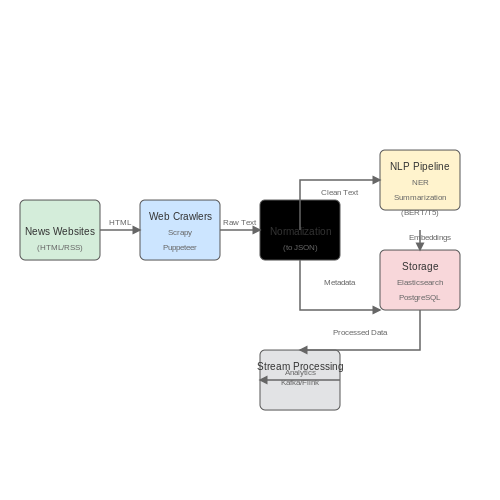
When APIs are unavailable, web scraping becomes necessary. Dynamic review sections on sites like TripAdvisor or BestBuy require tools like Selenium or Playwright to render JavaScript. The HTML structure of reviews typically follows patterns:
# Example BeautifulSoup selector for Amazon reviews
reviews = soup.select('div[data-hook="review"]')
for review in reviews:
    text = review.select_one('span[data-hook="review-body"]').text.strip()
Legal constraints under CFAA and platform ToS must be respected, often requiring proxy rotation and request throttling to avoid IP bans.
Multilingual Sources
Sarcasm manifests differently across languages. The Multilingual Sarcasm Dataset (MSD) includes customer reviews in English, Spanish, and French, annotated using a consistent schema. For low-resource languages, platforms like MercadoLibre (Latin America) or Flipkart (India) provide region-specific corpora requiring manual annotation.
Noise and Labeling Challenges
Customer reviews contain inherent noise—typos, emojis, and cultural references complicate sarcasm detection. Star ratings often inversely correlate with sarcastic intent but aren't definitive. Crowdsourcing platforms like MTurk can supplement labels, though inter-annotator agreement for sarcasm rarely exceeds Cohen's κ = 0.6 due to subjective interpretation.
Where \(P_o\) is observed agreement and \(P_e\) is chance agreement.
2.2 Labeling Sarcastic vs. Non-Sarcastic Reviews
Accurate labeling of sarcastic versus non-sarcastic customer reviews is critical for training robust sarcasm detection models. Unlike straightforward sentiment analysis, sarcasm detection requires nuanced understanding of linguistic cues, contextual contradictions, and tonal shifts. The labeling process must account for both explicit and implicit markers of sarcasm, which often manifest through hyperbole, incongruity, or exaggerated praise.
Linguistic Features for Sarcasm Identification
Sarcastic reviews often exhibit distinct linguistic patterns that differentiate them from genuine expressions. Key features include:
- Lexical Incongruity: Mismatch between positive words and negative context (e.g., "Great service! I only waited 3 hours for my food.")
- Hyperbolic Language: Exaggerated statements (e.g., "This product is the absolute worst...said no one ever.")
- Contextual Contradictions: Discrepancy between review text and rating (e.g., 1-star review stating "Perfect in every way")
- Punctuation Patterns: Excessive use of exclamation marks, question marks, or ellipses
- Intertextuality: References to pop culture or memes that invert meaning
Annotation Protocols
Establishing reliable annotation guidelines requires addressing several challenges:
where κ represents Cohen's kappa coefficient, P(a) is the observed agreement among annotators, and P(e) is the expected agreement by chance. For sarcasm annotation, we typically require κ ≥ 0.75 for reliable labels.
Best practices for annotation include:
- Using at least three independent annotators per sample
- Providing clear examples of sarcastic and non-sarcastic phrasing
- Including context about the product/service being reviewed
- Flagging borderline cases for expert adjudication
Computational Approaches to Label Validation
Advanced techniques can augment human annotation by identifying probable mislabels:
where sim computes cosine similarity between the review embedding ei and the centroids of verified sarcastic (Es) and non-sarcastic (En) review clusters.
Transformer-based models like BERT can generate attention maps highlighting suspicious phrases that may indicate sarcasm, providing additional validation signals for human annotators.
Dataset Construction Considerations
When building labeled datasets for sarcasm detection, several factors require attention:
- Domain Specificity: Sarcasm manifests differently across product categories (electronics vs. restaurant reviews)
- Temporal Dynamics: Sarcastic expressions evolve with internet culture and memes
- Demographic Factors: Age and cultural background influence sarcasm expression
- Platform Conventions: Review site design affects sarcasm prevalence and form
Imbalanced datasets (where sarcastic reviews are rare) require careful stratification during sampling to avoid classifier bias toward the majority class.
2.3 Text Cleaning and Normalization Techniques
Noise Removal and Tokenization
Raw text data from customer reviews contains significant noise that must be filtered before analysis. This includes HTML tags, URLs, special characters, and punctuation marks that don't contribute to semantic meaning. The first step applies regular expressions to strip these elements while preserving textual content. Tokenization then splits the cleaned text into individual words or subword units using whitespace and punctuation boundaries.
Advanced tokenizers like SpaCy's or BERT's WordPiece handle edge cases such as contractions ("don't" → ["do", "n't"]) and hyphenated words differently based on downstream model requirements.
Case Normalization and Stopword Removal
Case folding converts all text to lowercase to prevent duplicate vocabulary entries, though this may degrade performance for sarcasm detection where intentional capitalization ("GREAT service") carries semantic meaning. A weighted approach selectively normalizes case while preserving emphasis markers.
Stopword removal eliminates high-frequency function words (the, and, is) using curated lists. However, sarcasm often co-opts these words for ironic effect ("Oh THAT was helpful"), requiring domain-specific stopword lists that preserve potentially meaningful terms.
Lemmatization vs. Stemming
Lemmatization reduces words to their dictionary forms using morphological analysis ("better" → "good"), while stemming applies heuristic chops ("running" → "run"). For sarcasm detection:
- Lemmatization preserves subtle semantic relationships critical for irony detection
- Porter and Snowball stemmers may oversimplify sentiment-bearing morphology
- Context-aware lemmatizers (e.g., SpaCy with part-of-speech tagging) outperform rule-based stemmers
Handling Negations and Intensifiers
Sarcasm detection requires special handling of negation patterns ("not good") and intensifiers ("really bad"). A transformation pipeline:
- Identifies negation contexts using dependency parsing
- Marks negation scope with linguistic heuristics (up to next punctuation)
- Replaces intensifiers with normalized weights ("extremely" → INT+2)
Emoji and Slang Processing
Customer reviews frequently contain emojis (😂) and slang ("meh"), which carry significant sarcastic intent. Processing steps include:
- Emoji-to-text conversion using Unicode mappings (😂 → "face_with_tears_of_joy")
- Slang dictionary lookups with sentiment polarity ("meh" → +0.3)
- Contextual embedding of visual symbols in transformer architectures
Normalization for Neural Models
When preparing text for transformer-based sarcasm detectors:
- Subword tokenization (Byte-Pair Encoding) handles out-of-vocabulary terms
- Preserve original punctuation for models trained on syntactic patterns
- Limit normalization that might erase sarcastic linguistic markers
The complete normalization pipeline for neural sarcasm detection typically applies fewer aggressive transformations than traditional sentiment analysis, preserving linguistic features that signal ironic intent.
3. Lexical Features: Word Choice and N-grams
Lexical Features: Word Choice and N-grams
Lexical features form the foundation of sarcasm detection by capturing surface-level linguistic patterns. These features rely on the statistical properties of words and their sequences, making them computationally efficient yet surprisingly effective. The two primary categories are unigrams (single words) and n-grams (contiguous word sequences of length n), which serve as proxies for stylistic and contextual cues.
Unigram Analysis: Bag-of-Words Representation
The bag-of-words model treats text as an unordered collection of words, discarding syntax but preserving frequency information. For a corpus D containing m documents, the term-document matrix X ∈ ℝm×v is constructed where v is the vocabulary size. Each element xij represents the weight of term j in document i, typically computed using TF-IDF:
Sarcastic reviews often exhibit lexical divergence from genuine expressions through:
- Hyperbolic terms: "amazingly", "incredibly", "worst" with exaggerated frequency
- Contrastive pairs: "great" appearing near "disappointment"
- Diminishers/intensifiers: "slightly" preceding negative adjectives
N-gram Patterns and Contextual Windows
Bigrams and trigrams capture local context that unigrams miss. The probability of an n-gram w1...wn is estimated via maximum likelihood:
Key n-gram phenomena in sarcasm include:
- Unexpected collocations: "five stars" followed by complaints
- Discourse markers: "oh sure" preceding insincere praise
- Interjections: "wow" used ironically before criticism
Feature Selection and Dimensionality Reduction
With high-dimensional sparse vectors (∼104 features), Chi-square or mutual information filters identify the most discriminative terms. For a term t and class c (sarcastic/non-sarcastic):
where O and E are observed and expected counts. Top-k features (typically 1,000-5,000) are retained based on these scores.
Practical Implementation Considerations
Effective lexical modeling requires:
- Negation handling: Inverting sentiment polarity in "not good" spans
- Lemmatization: Normalizing "worst" and "worse" to common roots
- Stopword retention: Keeping sarcasm-bearing function words ("really", "just")
3.2 Syntactic Features: Sentence Structure and Punctuation
Sarcasm in customer reviews often manifests through distinctive syntactic patterns that deviate from conventional sentence structures. These features include exaggerated punctuation, irregular clause arrangements, and deliberate violations of grammatical norms. Advanced natural language processing (NLP) techniques leverage these markers to improve detection accuracy.
Punctuation as a Sarcasm Indicator
Excessive or atypical punctuation—such as multiple exclamation marks (!!!), interrobangs (?!), or ellipses (...)—often signals sarcastic intent. For example, the review "Great service... NOT!!!" uses ellipses and repeated exclamation marks to convey irony. Quantitatively, the presence of such markers can be modeled using a weighted scoring function:
where Sp is the punctuation-based sarcasm score, wi represents empirically derived weights for each punctuation type, and fi(p) counts occurrences of punctuation p in the text.
Sentence Structure Deviations
Sarcastic reviews frequently employ non-standard sentence constructions, such as:
- Inverted word order (e.g., "Oh, because THAT makes perfect sense.")
- Abrupt clause termination (e.g., "The product works just as described... if you ignore the manual.")
- Parenthetical interjections (e.g., "The 'premium' material (read: plastic) feels so luxurious.")
These patterns disrupt the expected flow of natural language, creating detectable syntactic anomalies. Dependency parsing trees reveal such deviations through abnormal branching structures, quantified via graph-based metrics like tree edit distance or node depth variance.
Grammatical Violations and Stylistic Choices
Deliberate grammatical errors (e.g., "They was super helpful") or hyperbolic comparisons (e.g., "Faster than a snail on vacation") serve as strong sarcasm indicators. Transformer-based models like BERT and RoBERTa capture these features through attention mechanisms, where anomalous token relationships are assigned higher weights during classification.
Here, Aij represents the attention score between tokens i and j, highlighting syntactic irregularities that correlate with sarcastic expressions.
Case Study: Yelp Review Analysis
A 2021 study on Yelp reviews demonstrated that sarcastic comments contained 3.2× more exclamation marks and 1.8× more interjections per sentence compared to genuine reviews. The most discriminative syntactic feature was clause fragmentation, occurring in 68% of sarcastic cases versus 12% of non-sarcastic ones.
3.3 Semantic Features: Sentiment and Contextual Analysis
Semantic features play a critical role in sarcasm detection by capturing the incongruity between literal meaning and intended tone. Unlike lexical or syntactic features, semantic analysis requires deeper understanding of sentiment polarity shifts and contextual cues that signal sarcasm.
Sentiment Incongruity as a Sarcasm Marker
Sarcasm often manifests as a contradiction between the sentiment of the text and its context. For example, a positive phrase like "Great service!" accompanied by a one-star rating creates sentiment incongruity. This can be quantified using:
where \( S_{\text{text}} \) is the sentiment score of the text (e.g., from -1 to +1) and \( S_{\text{context}} \) represents the expected sentiment based on metadata like star rating or product category averages.
Contextual Embeddings for Semantic Understanding
Pre-trained language models like BERT and RoBERTa generate contextualized embeddings that capture semantic relationships beyond bag-of-words approaches. The attention mechanism in transformers helps identify subtle cues:
where \( Q \), \( K \), and \( V \) represent query, key, and value matrices respectively, allowing the model to weigh the importance of each word based on its context.
Contrastive Learning for Sarcasm Detection
Recent approaches employ contrastive learning to maximize similarity between sarcastic samples while minimizing similarity with literal counterparts. The contrastive loss function:
where \( z_i \) and \( z_j \) are positive pairs (both sarcastic), \( \tau \) is a temperature parameter, and \( N \) is the batch size.
Pragmatic Features and World Knowledge
Sarcasm detection benefits from incorporating pragmatic knowledge about:
- Product-specific expectations (e.g., "lightning fast" for a budget phone)
- Cultural references and hyperbole patterns
- Temporal context (e.g., reviews after product recalls)
Knowledge graphs can formalize these relationships through triplet representations \( (e_1, r, e_2) \) where entities \( e \) are connected by relation \( r \).
Implementation Considerations
When implementing semantic analysis:
- Fine-tune language models on domain-specific sarcasm datasets
- Combine learned embeddings with handcrafted semantic features
- Address data sparsity through techniques like mixup augmentation
4. Traditional Models: SVM, Naive Bayes, and Logistic Regression
4.1 Traditional Models: SVM, Naive Bayes, and Logistic Regression
Support Vector Machines (SVM)
Support Vector Machines (SVMs) are supervised learning models that construct a hyperplane or set of hyperplanes in a high-dimensional space for classification. For sarcasm detection, the optimal hyperplane maximizes the margin between sarcastic and non-sarcastic reviews. Given a training set of labeled reviews (xi, yi), where yi ∈ {-1, 1} (sarcastic or not), the decision function is:
Here, αi are Lagrange multipliers, b is the bias term, and K(xi, x) is the kernel function. Common kernels for text classification include:
- Linear kernel: K(xi, xj) = xiTxj
- Polynomial kernel: K(xi, xj) = (γxiTxj + r)d
- RBF kernel: K(xi, xj) = \exp(-γ||xi - xj||2)
SVMs perform well with high-dimensional sparse data (e.g., TF-IDF vectors) but require careful tuning of the regularization parameter C and kernel parameters.
Naive Bayes Classifier
The Naive Bayes classifier applies Bayes' theorem with the "naive" assumption of conditional independence between features. For sarcasm detection, given a review x represented as a bag of words (w1, w2, ..., wn), the predicted class y is:
where:
- P(y) is the prior probability of class y,
- P(wi | y) is the likelihood of word wi appearing in class y.
Common variants include:
- Multinomial Naive Bayes: Models word counts, suitable for TF-IDF or count vectors.
- Bernoulli Naive Bayes: Models binary word presence/absence, useful for short texts.
Despite its simplicity, Naive Bayes is computationally efficient and often serves as a strong baseline for text classification.
Logistic Regression
Logistic regression models the probability of a review being sarcastic using a logistic function. Given input features x, the probability P(y=1 | x) is:
where w is the weight vector and b is the bias term. The model is trained by minimizing the cross-entropy loss:
Regularization (L1 or L2) is often applied to prevent overfitting:
where λ controls regularization strength and p ∈ {1,2} selects L1 or L2 penalty. Logistic regression is interpretable, as feature weights indicate word importance for sarcasm detection.
Practical Considerations
Key steps for applying these models to sarcasm detection:
- Feature extraction: Convert reviews into numerical vectors (e.g., TF-IDF, word embeddings).
- Class imbalance handling: Use resampling or class weighting, as sarcastic reviews are often rare.
- Hyperparameter tuning: Optimize SVM kernel parameters, Naive Bayes smoothing, or logistic regression regularization via grid search.
While deep learning has gained popularity, these traditional models remain competitive for sarcasm detection, especially with limited training data.
4.2 Deep Learning Approaches: RNNs, LSTMs, and Transformers
Recurrent Neural Networks (RNNs) for Sequential Modeling
Recurrent Neural Networks (RNNs) process sequential data by maintaining a hidden state that captures temporal dependencies. Given an input sequence x1, x2, ..., xT, an RNN computes hidden states ht and outputs yt at each timestep t through the following recurrence relations:
where σ is a nonlinear activation function (typically tanh or ReLU), W matrices are learnable weights, and b terms are bias vectors. For sarcasm detection, RNNs can model the temporal progression of sentiment cues in reviews.
Long Short-Term Memory (LSTM) Networks
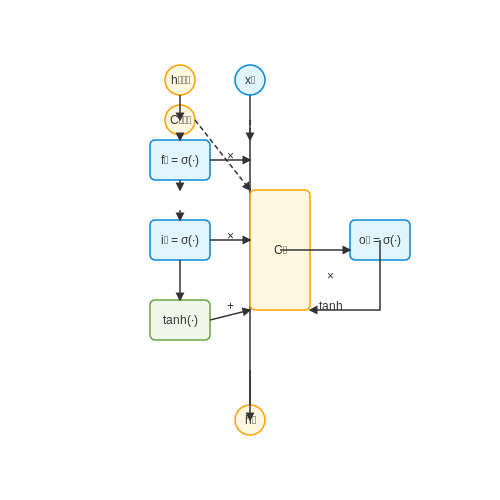
LSTMs address the vanishing gradient problem in standard RNNs through gated mechanisms. An LSTM cell contains:
- Input gate: Controls new information flow
- Forget gate: Determines what to discard from cell state
- Output gate: Regulates information exposure
The mathematical formulation of an LSTM cell is:
LSTMs excel at detecting sarcasm by capturing long-range dependencies between contradictory sentiment indicators (e.g., positive words used ironically).
Transformer Architectures and Self-Attention
Transformers revolutionized NLP through self-attention mechanisms that compute dynamic weightings of all words in a sequence. The scaled dot-product attention is computed as:
where Q, K, and V are learned query, key, and value matrices respectively, and dk is the dimension of the key vectors. Multi-head attention extends this by running multiple attention mechanisms in parallel:
For sarcasm detection, transformers can identify subtle contextual relationships between words that indicate irony, such as exaggerated praise or contradictory modifiers.
Practical Implementation Considerations
When applying these architectures to sarcasm detection:
- Pretrained embeddings (GloVe, BERT) capture semantic relationships better than random initialization
- Bidirectional processing (BiLSTMs) improves context understanding from both directions
- Attention visualization helps interpret model decisions by highlighting sarcastic phrases
- Domain adaptation is crucial as sarcasm patterns differ across product categories
The following code snippet shows a PyTorch implementation of a bidirectional LSTM with attention for sarcasm classification:
import torch
import torch.nn as nn
import torch.nn.functional as F

class SarcasmDetector(nn.Module):
    def __init__(self, vocab_size, embed_dim, hidden_dim, num_classes):
        super().__init__()
        self.embedding = nn.Embedding(vocab_size, embed_dim)
        self.lstm = nn.LSTM(embed_dim, hidden_dim, bidirectional=True)
        self.attention = nn.Linear(2*hidden_dim, 1)
        self.fc = nn.Linear(2*hidden_dim, num_classes)

    def forward(self, x):
        embedded = self.embedding(x)
        lstm_out, _ = self.lstm(embedded)
        attention_weights = F.softmax(self.attention(lstm_out), dim=1)
        context_vector = torch.sum(attention_weights * lstm_out, dim=1)
        return self.fc(context_vector)
Evaluating Model Performance: Metrics and Benchmarks
Classification Metrics for Imbalanced Data
Sarcasm detection datasets often exhibit class imbalance, where non-sarcastic examples significantly outnumber sarcastic ones. Standard accuracy becomes misleading in such scenarios. Instead, precision, recall, and F1-score provide more reliable performance indicators. For a binary classifier where 1 denotes sarcastic and 0 denotes non-sarcastic:
where TP, FP, and FN represent true positives, false positives, and false negatives respectively. The F1-score is particularly valuable as it balances precision and recall, which is critical when the cost of misclassifying sarcastic reviews (false negatives) differs from misclassifying non-sarcastic ones (false positives).
Advanced Evaluation Metrics
For probabilistic classifiers like neural networks, area under the ROC curve (AUC-ROC) and area under the precision-recall curve (AUC-PR) offer deeper insights:
AUC-PR is preferred for highly imbalanced datasets as it focuses on the performance of the positive (sarcastic) class. The Matthews correlation coefficient (MCC) provides a balanced measure even when classes are of very different sizes:
Benchmarking Against Baselines
Model performance must be contextualized against appropriate baselines:
- Majority class baseline: Predicts the most frequent class (non-sarcastic)
- Lexical baseline: Uses sarcasm-indicating words or phrases from predefined dictionaries
- Pretrained language models: Zero-shot performance of models like BERT without fine-tuning
State-of-the-art sarcasm detection models typically achieve F1-scores between 0.65-0.85 on benchmark datasets like SARC and iSarcasm, with transformer-based architectures consistently outperforming traditional machine learning approaches.
Cross-Validation Strategies
Due to the limited size of sarcasm detection datasets, nested cross-validation provides robust performance estimates:
- Outer loop: 5-fold cross-validation for performance evaluation
- Inner loop: 3-fold cross-validation on training data for hyperparameter tuning
This approach prevents data leakage and gives unbiased estimates of generalization performance. Stratified sampling preserves class distribution in each fold.
Statistical Significance Testing
When comparing models, McNemar's test or paired t-tests on cross-validation folds determine if performance differences are statistically significant:
where n01 and n10 count instances where one model is correct and the other is wrong. For small sample sizes, the exact binomial version should be used.
5. Integrating Sarcasm Detection in Sentiment Analysis Systems
5.1 Integrating Sarcasm Detection in Sentiment Analysis Systems
Traditional sentiment analysis systems often fail to accurately interpret sarcastic remarks, leading to misclassification of negative sentiments as positive or neutral. The integration of sarcasm detection requires augmenting standard sentiment analysis pipelines with linguistic, contextual, and pragmatic features that capture incongruity between literal and intended meaning.
Feature Engineering for Sarcasm Detection
Sarcasm relies on contextual cues, lexical contrasts, and pragmatic markers. Key features include:
- Lexical Incongruity: Measures the semantic distance between positive words and negative context using word embeddings (e.g., GloVe, BERT).
- Sentiment Shift Indicators: Detects contrastive terms like "but", "however", or exaggerated positive phrases in negative contexts.
- Pragmatic Markers: Identifies hyperbolic expressions, interjections (e.g., "wow", "great"), and punctuation (e.g., excessive exclamation marks).
- Contextual Embeddings: Leverages transformer-based models (e.g., RoBERTa, XLNet) to capture long-range dependencies and implied meaning.
where \(w_i\) is the embedding of the i-th word and \(C_{-i}\) represents the context embedding excluding \(w_i\).
Model Architectures for Joint Sentiment-Sarcasm Analysis
Hybrid architectures combining rule-based filters with neural networks yield the best performance:
- Multi-Task Learning: Shared encoder with separate heads for sentiment and sarcasm prediction, optimizing:
- Graph Neural Networks: Models review text as a dependency parse graph, propagating incongruity signals through syntactic edges.
- Attention Mechanisms: Cross-attention layers weight sentiment-bearing words differently when sarcasm is detected.
System Integration Challenges
Deploying sarcasm-aware sentiment analysis introduces latency and scalability constraints:
- Threshold Tuning: The sarcasm probability threshold for sentiment inversion must be domain-specific (e.g., 0.7 for product reviews vs. 0.85 for political discourse).
- Fallback Mechanisms: Default to standard sentiment analysis when sarcasm detection confidence is below 0.5 to maintain throughput.
- Context Window Optimization: Transformer-based models require careful tuning of maximum sequence length (typically 128-256 tokens) to balance accuracy and memory usage.
Evaluation Metrics
Standard sentiment metrics (accuracy, F1) must be augmented with:
- Sarcasm-Aware Sentiment Accuracy (SASA): Measures correctness after sarcasm-driven sentiment inversion.
- Incongruity Detection Rate (IDR): True positive rate for contrasting sentiment pairs within sarcastic utterances.
where \(s_i\) is the sarcasm prediction and \(\oplus\) denotes XOR operation.

5.2 Ethical Considerations and Bias in Sarcasm Detection
Bias in Training Data
Sarcasm detection models often inherit biases present in their training datasets. For example, customer reviews from specific demographics or regions may overrepresent certain linguistic patterns, leading to skewed model performance. A model trained predominantly on English-language reviews from North America may fail to generalize to sarcastic expressions in British English or multilingual contexts. The bias can be quantified using demographic parity metrics:
where D represents demographic groups and Ŷ is the model's prediction. A non-zero value indicates bias.
Cultural and Linguistic Nuances
Sarcasm relies heavily on cultural context, irony, and tonal cues that are not uniformly distributed across languages. For instance, a model trained on American English may misinterpret British sarcasm, which often employs understatement or deadpan delivery. Similarly, code-switching in multilingual reviews (e.g., Spanglish) introduces additional complexity, as sarcasm markers may differ between languages. This necessitates culture-specific feature engineering or adversarial debiasing techniques during training.
Ethical Risks of Misclassification
False positives in sarcasm detection can have tangible consequences, such as mislabeling genuine complaints as sarcastic and deprioritizing them in customer support systems. Conversely, false negatives may allow sarcastic or toxic content to bypass moderation filters. The ethical cost of misclassification can be formalized as:
where wi weights the severity of misclassification for instance i, and 𝕀 is the indicator function.
Mitigation Strategies
- Bias Auditing: Pre-training analysis of dataset representativeness using tools like Fairness Indicators or Aequitas.
- Adversarial Debiasing: Training with a discriminator that penalizes demographic bias in predictions.
- Contextual Embeddings: Leveraging multilingual models (e.g., mBERT) to capture cross-cultural sarcasm cues.
Case Study: Gender Bias in Sarcasm Detection
A 2022 study found that models trained on restaurant reviews exhibited higher false-positive rates for female-authored texts, associating polite language with sarcasm less accurately than direct criticism. This was attributed to imbalanced training data where male-authored sarcasm was overrepresented. The bias was mitigated by reweighting the loss function:
where G denotes gender groups, U is a uniform distribution, and λ controls the debiasing strength.
Regulatory and Transparency Requirements
Deploying sarcasm detection in customer-facing applications may fall under AI ethics guidelines like the EU AI Act, which mandates transparency for high-risk systems. Techniques such as LIME or SHAP explanations can elucidate model decisions, but their interpretability is limited for deep learning models operating on high-dimensional text embeddings.
5.3 Limitations and Future Directions
Current Challenges in Sarcasm Detection
Despite advances in natural language processing (NLP), sarcasm detection remains a challenging task due to its inherent ambiguity and dependence on contextual and cultural cues. Current models often struggle with:
- Contextual Dependencies: Sarcasm frequently relies on shared knowledge or situational context, which is not explicitly present in the text.
- Linguistic Variability: Sarcastic expressions vary widely across domains, making it difficult to generalize models trained on one dataset to another.
- Data Sparsity: High-quality labeled datasets for sarcasm are scarce, and manual annotation is expensive and subjective.
Technical Limitations
State-of-the-art models, including transformer-based architectures like BERT and GPT, exhibit several limitations:
- Over-reliance on Lexical Cues: Models often fail to capture subtle tonal shifts, relying instead on overtly negative or positive words.
- Lack of Multimodal Integration: Sarcasm in reviews may involve visual or auditory cues (e.g., emojis, exaggerated punctuation), which text-only models ignore.
- Explainability: Deep learning models provide limited interpretability, making it hard to diagnose errors or refine predictions.
Mathematical Constraints
The performance of sarcasm detection models is often quantified using metrics like F1-score or accuracy, but these fail to account for nuanced misclassifications. For instance, the imbalance between sarcastic and non-sarcastic samples skews results. The F1-score is given by:
where Precision and Recall are defined as:
However, these metrics do not penalize models for misclassifying sarcastic reviews as neutral or vice versa, which can be critical in customer sentiment analysis.
Future Research Directions
To address these limitations, future work could explore:
- Multimodal Approaches: Integrating text with visual or acoustic features (e.g., emojis, audio tone in spoken reviews) could improve detection.
- Cross-Domain Adaptation: Techniques like domain adversarial training or few-shot learning may enhance generalization across review platforms.
- Explainable AI (XAI): Incorporating attention mechanisms or rule-based post-hoc explanations could make models more interpretable.
- Active Learning: Reducing annotation costs by iteratively selecting the most informative samples for human review.
Ethical and Practical Considerations
Deploying sarcasm detection systems in real-world applications raises ethical questions, such as:
- Bias Amplification: Models may inherit biases from training data, disproportionately misclassifying sarcasm in certain demographic groups.
- Privacy Concerns: Analyzing customer reviews for sarcasm could inadvertently expose sensitive information if not properly anonymized.
- User Trust: Over-reliance on automated sarcasm detection might lead to erroneous decisions (e.g., flagging genuine complaints as sarcastic).
6. Key Research Papers on Sarcasm Detection
6.1 Key Research Papers on Sarcasm Detection
- Automatic Sarcasm Detection: A Survey - arXiv.org — tion 6 highlights trends underlying sarcasm detection research, while Section 7 discusses key recurring is-sues in this research. Finally, Section 8 concludes the paper. 2 Sarcasm in Linguistics Sarcasm as a linguistic phenomenon has been widely studied. Before we proceed to approaches for sarcasm detection, we present an introduction to ...
- PDF Advanced Sentiment Analysis and Sarcasm Detection for Online Customer ... — literature review 2.1 sentiment analsis on customer feedback data amazon product reviews 2.2 sentiment analysis of book reviews using unsupervised sentiment orientation and supervised machine learning approaches 4 5 2.3 sarcasm detection in newspaper headlines 2.4 sarcasm detection using deep learning with contextual features 8 10
- Deep learning-based attention models for sarcasm detection in text — sarcasm detection employed in existing literature is shown in the Figure 1. In their work, Bouazizi and Ohtsuki [9] used the POS feature with other pertinent variables to analyze tweets for sarcasm using a pattern-based approach. They may demonstrate that adding various elements will enhance the performance indicators for sarcasm detection.
- Sarcasm Detection - an overview | ScienceDirect Topics — 6.2.1 Customer service. Sarcasm detection aids in enhancing customer service interactions, particularly in platforms like Twitter and Amazon, where users may express their concerns or feedback in a sarcastic manner. Identifying and appropriately responding to sarcasm from customers helps companies attend to customers' requirements more ...
- PDF An Exploration of Sarcasm Detection Using Deep Learning — syntactic cues that could be used as features for sarcasm detection. In fact, at the beginning, sarcasm recognition was considered as a simple text classi cation task. Kreuz and Caucci (2007) [24] noted that interjections, punctuation symbols, intensi ers and hyperboles play a fundamental role for the research. Also Carvalho et al. (2009) [7] found
- An exploratory and automated study of sarcasm detection and ... — 4.3 Processing end-user reviews for sarcasm detection. ... we combine NLP with DL classifiers to automatically identify and classify sarcasm in end-user reviews. The research aims to improve software app performance and user experiences by analyzing end-user's attitudes towards the apps, explicitly focusing on the subtle expressions of ...
- Enhanced Semantic Representation Learning for Sarcasm Detection by ... — Sarcasm is a sophisticated figurative language that is prevalent on social media platforms. Automatic sarcasm detection is significant for understanding the real sentiment tendencies of users. Traditional approaches mostly focus on content features by using lexicon, n-gram, and pragmatic feature-based models. However, these methods ignore the diverse contextual clues that could provide more ...
- Sarcasm Detection Using Bidirectional Encoder Representations from ... — The Internet has become a crucial space for customer feedback and the budding of various ideologies across different cultures. ... It is essential to understand what the user actually tries to convey to the outside world with his/her review. Hence sarcasm detection becomes a task of higher complexity and importance. ... Proceedings of the 44th ...
- Sarcasm identification in textual data: systematic review, research ... — A few studies have carried out a comprehensive literature review on sarcasm identification in the existing primary study within the last 11 years. ... review on sarcasm detection algorithm and ...
- PDF Context-Based Models for Sarcasm Detection - Stanford University — Previous sarcasm detection studies tend to trend similarly in their focus and in their tasks. Kolchinski and Potts [1], Hazarika et al. [2], and Ilic et al. [3] all achieve state-of-the-art or near state-of-the-art results. However, their approaches do have some key differences that are worth noting. Kolchinski
6.2 Datasets and Tools for Sarcasm Analysis
- [2107.02276] Sarcasm Detection: A Comparative Study - arXiv.org — Sarcasm detection is the task of identifying irony containing utterances in sentiment-bearing text. However, the figurative and creative nature of sarcasm poses a great challenge for affective computing systems performing sentiment analysis. This article compiles and reviews the salient work in the literature of automatic sarcasm detection. Thus far, three main paradigm shifts have occurred in ...
- PDF Advanced Sentiment Analysis and Sarcasm Detection for Online Customer ... — In our project advanced sentiment analysis and sarcasm detection techniques accurately understand and analyze online customer reviews. Employing supervised machine learning, lexicon-based analysis, deep learning, emotion detection, and contextual word embeddings, we provide valuable insights on sentiment and sarcasm.
- A survey of automatic sarcasm detection: Fundamental theories ... — Sarcasm prevalent in social media poses challenges for sentiment analysis applications by flipping polarity, thus increasing the demand for sarcasm detection. In this article, we present a systematic survey of the research on sarcasm detection. We discuss the definition, problem formulation, datasets, as well as comprehensively review and evaluate methods that can detect sarcasm from three ...
- Sarcasm Detection - an overview | ScienceDirect Topics — Abstract Sarcasm prevalent in social media poses challenges for sentiment analysis applications by flipping polarity, thus increasing the demand for sarcasm detection. In this article, we present a systematic survey of the research on sarcasm detection. We discuss the definition, problem formulation, datasets, as well as comprehensively review and evaluate methods that can detect sarcasm from ...
- Toward Sarcasm Detection in Reviews—A Dual Parametric ... - Springer — Only one feature was used for sarcasm detection whether it was in real-time streaming tweets, consumer reviews, or literature works. Moreover, in the work proposed by Maynard and Greenwood [23], only hashtags were used for sarcasm detection and resulted in 90% accuracy but with a big drawback of detecting only in tweets containing a hashtag.
- Techniques of Sarcasm Detection: A Review - IEEE Xplore — The Sentiment Analysis can be considered as the data mining target of sentiment classification of the customer's reviews available in text form. Sarcasm is a kind of statement that expresses a person's downside feelings by using positive terms. Labelling sarcasm in typescript is a vital task for Natural Language processing to elude the delusion of the sarcastic statements as a verbatim ...
- PDF Sarcasm Detection in Online Review Text — Abstract Sarcasm is a type of sentiment where people express negative sentiment using positive connotation words in text and vice-versa. In this work, we propose a cross-domain sarcasm detection framework that allows acquisition, storage and processing of tweets for detecting sarcastic content in online reviews. We conduct our experiments on Amazon product review dataset namely the Sarcasm ...
- PDF Context-Based Models for Sarcasm Detection - Stanford University — The increased popularity of social media platforms, online forums, blogs, and similar channels have led to an increase in informal and sarcastic text across the internet. The ability to detect sarcasm more accurately is critical to understanding and enabling sentiment analysis for text from these sources.
- Detection of Sarcasm on Amazon Product Reviews using Machine Learning ... — This text has to be analyzed and make the reviewers understand the exact intent of the writer. Sentiment analysis is used to analyze the perspective of text. Sarcasm can also be present in the text which is a bitter way of conveying the information. Selection of the dataset is the initial task. Dataset is retrieved from Amazon datasets.
- An exploratory and automated study of sarcasm detection and ... — In developing the grounded theory for sarcasm detection and classification, a random sample of 350 end-user reviews from the Google Play Store across the seven apps was selected for further analysis first to determine sarcastic reviews.
6.3 Recommended Books and Online Resources
- PDF Advanced Sentiment Analysis and Sarcasm Detection for Online Customer ... — literature review 2.1 sentiment analsis on customer feedback data amazon product reviews 2.2 sentiment analysis of book reviews using unsupervised sentiment orientation and supervised machine learning approaches 4 5 2.3 sarcasm detection in newspaper headlines 2.4 sarcasm detection using deep learning with contextual features 8 10
- Sarcasm detection framework using context, emotion and sentiment ... — The main objective of our experiment is to develop a sarcasm detection algorithm and improve existing results. Sarcasm detection is a binary classification task. The input for the algorithm is a text, which should be assigned to a sarcasm or non-sarcasm class. The methodology used for training and evaluating the model is described as follows.
- An exploratory and automated study of sarcasm detection and ... — In developing the grounded theory for sarcasm detection and classification, a random sample of 350 end-user reviews from the Google Play Store across the seven apps was selected for further analysis first to determine sarcastic reviews. Next, the sarcasm reviews were further analyzed to identify frequently occurring sarcasm types.
- A knowledge-augmented neural network model for sarcasm detection — Sarcasm is a non-linear text statement and presents a negative meaning with a positive expression (Maynard & Bontcheva, 2015).As an important research task in natural language processing and text mining, sarcasm detection plays an extremely significant role in several application scenarios such as opinion mining and social media analysis (Eke et al., 2021, Ghorbanali et al., 2022, Maladry et ...
- (PDF) Sentiment Analysis in Online Product Reviews: Mining Customer ... — The study addresses the unique challenges of sentiment analysis in the context of online product evaluations, including polarity changes, sarcasm, and domain-specific sentiment expressions, which ...
- PDF Context-Based Models for Sarcasm Detection - Stanford University — show that models utilizing attention performed the best and outperformed our baseline models, but these gains were only realized when the training set size surpassed 50,000 examples. 2 Related Work Previous sarcasm detection studies tend to trend similarly in their focus and in their tasks. Kolchinski and Potts [1], Hazarika et al. [2], and ...
- PDF An Exploration of Sarcasm Detection Using Deep Learning — syntactic cues that could be used as features for sarcasm detection. In fact, at the beginning, sarcasm recognition was considered as a simple text classi cation task. Kreuz and Caucci (2007) [24] noted that interjections, punctuation symbols, intensi ers and hyperboles play a fundamental role for the research. Also Carvalho et al. (2009) [7] found
- PDF Tweet Sarcasm Detection Using Deep Neural Network - GitHub Pages — environment features, finding that contextual features are very useful for tweet sarcasm detection. So far, most existing sarcasm detection methods in the literature leverage discrete models. While on the other hand, neural network models have gained much attention for related tasks such as sentiment analysis and opinion extraction, achieving ...
- PDF A novel Auto-ML Framework for Sarcasm Detection - University of East London — Many domains have sarcasm or verbal irony presented in the text of reviews, tweets, comments, and dialog discussions. The purpose of this research is to classify sarcasm for multiple domains using the deep learning based AutoML framework. The proposed AutoML framework has five
- Computational Sarcasm Analysis on Social Media: A Systematic Review — The remaining sections of the paper are structured as follows: section 2 describes the notion sarcasm detection, section 4 reviews different datasets and their types while section 5 reviews types of features and their extraction methods, section 6 explores methodologies as well as shared tasks for sarcasm detection, section 7 presents the ...