
What is Cross-Attention?
1. Basic Concepts of Attention in Neural Networks
1.1 Basic Concepts of Attention in Neural Networks
Attention mechanisms in neural networks dynamically weigh the importance of input elements, allowing models to focus on relevant parts of the data. The core idea stems from the human cognitive process of selectively concentrating on specific stimuli while ignoring others. Mathematically, attention computes a weighted sum of input features, where the weights are learned through a compatibility function.
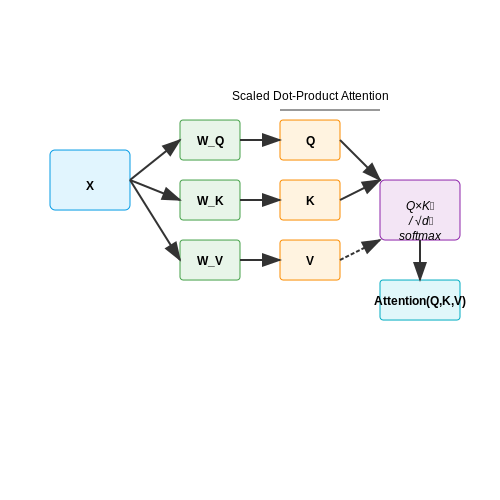
Scaled Dot-Product Attention
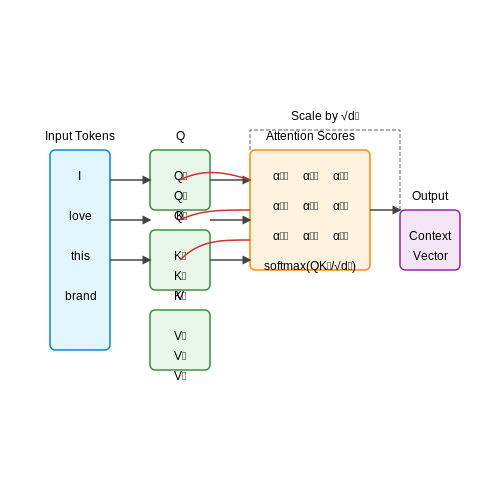
The foundational attention mechanism, introduced in the Transformer architecture, is scaled dot-product attention. Given queries Q, keys K, and values V, the attention weights are computed as:
Here, dk is the dimension of the keys, and the scaling factor 1/√dk prevents the dot products from growing too large in magnitude, which would push the softmax into regions of extremely small gradients.
Multi-Head Attention
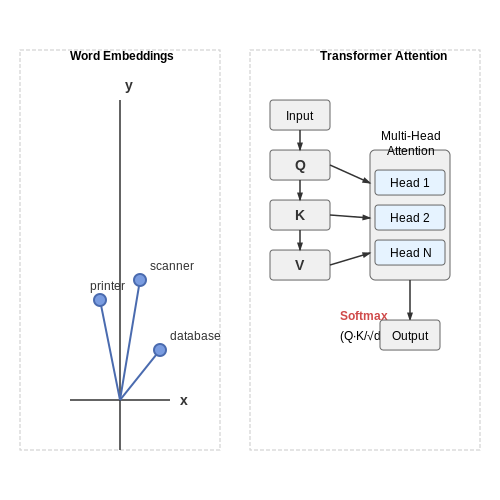
Multi-head attention extends this by applying the attention mechanism in parallel over h different learned linear projections of the queries, keys, and values:
where each head is computed as:
The projections WiQ, WiK, WiV allow the model to jointly attend to information from different representation subspaces.
Self-Attention vs. Cross-Attention
In self-attention, the queries, keys, and values all come from the same sequence, enabling the model to capture intra-sequence dependencies. Cross-attention differs by computing attention between two distinct sequences - for example, between decoder queries and encoder outputs in sequence-to-sequence tasks. The mathematical formulation remains identical, but the source of Q differs from K and V.
Computational Complexity
The attention mechanism's complexity is quadratic in the sequence length n due to the QKT matrix multiplication. For sequences of length n and embedding dimension d, the complexity is O(n2d). This becomes a bottleneck for long sequences, motivating research into more efficient attention variants like sparse attention or linear attention.
Practical Applications
Attention mechanisms have become ubiquitous in modern architectures:
- Transformers use self-attention for machine translation and text generation
- Vision Transformers apply attention to image patches for computer vision
- Cross-attention enables multimodal learning between text and images
- Memory networks use attention to interface with external knowledge bases
Self-Attention and Its Role in Transformers
Mechanism of Self-Attention
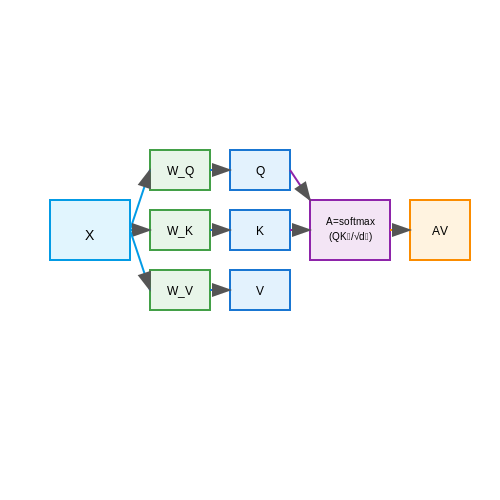
Self-attention computes a weighted sum of input representations, where the weights are dynamically derived from pairwise interactions between elements. Given an input sequence X ∈ ℝn×d (where n is sequence length and d is embedding dimension), the mechanism projects X into query (Q), key (K), and value (V) matrices:
where WQ, WK, WV ∈ ℝd×dk are learnable projection matrices. The attention scores A are computed as scaled dot-products between queries and keys:
The scaling factor √dk prevents gradient saturation in the softmax. The output is a convex combination of values weighted by A:
Role in Transformer Architecture
Self-attention enables Transformers to model long-range dependencies without sequential computation. Unlike RNNs, it processes all positions in parallel with O(1) operations between any pair of tokens. Key properties include:
- Permutation equivariance: Output is invariant to input token order (positional encodings break this symmetry).
- Dynamic weight assignment: Attention patterns adapt to input content rather than using fixed recurrence patterns.
- Explicit relational modeling: Pairwise attention scores form an interpretable n×n interaction matrix.
Multi-Head Attention
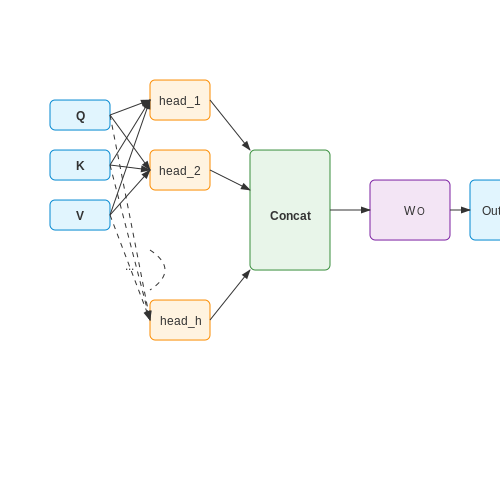
Transformers extend this mechanism via multi-head attention, which applies h independent attention heads in parallel:
Each head learns distinct projection matrices WQ(i), WK(i), WV(i), allowing the model to jointly attend to information from different representation subspaces. The output dimensionality remains d through the learnable matrix WO ∈ ℝhdv×d.
Computational Complexity
Self-attention has O(n2d) time and space complexity due to the QKT computation. This quadratic scaling motivates research into sparse attention variants (e.g., Longformer, BigBird) for long sequences.
Practical Implementation
Efficient implementations leverage batch matrix multiplication and mask invalid positions (e.g., future tokens in decoder self-attention). The following PyTorch snippet illustrates masked multi-head attention:
import torch
import torch.nn.functional as F

def scaled_dot_product_attention(Q, K, V, mask=None):
    d_k = Q.size(-1)
    scores = torch.matmul(Q, K.transpose(-2, -1)) / (d_k ** 0.5)
    if mask is not None:
        scores = scores.masked_fill(mask == 0, -1e9)
    weights = F.softmax(scores, dim=-1)
    return torch.matmul(weights, V)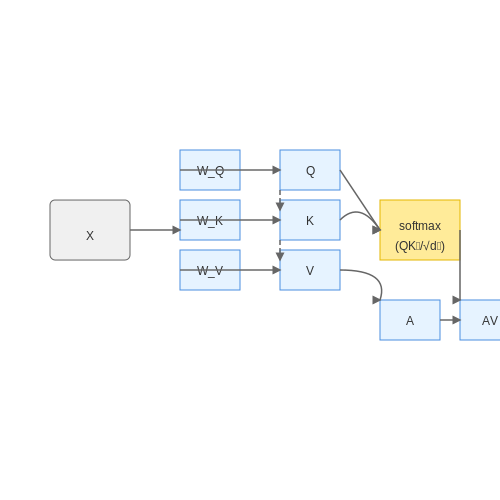
Key Differences Between Self-Attention and Cross-Attention
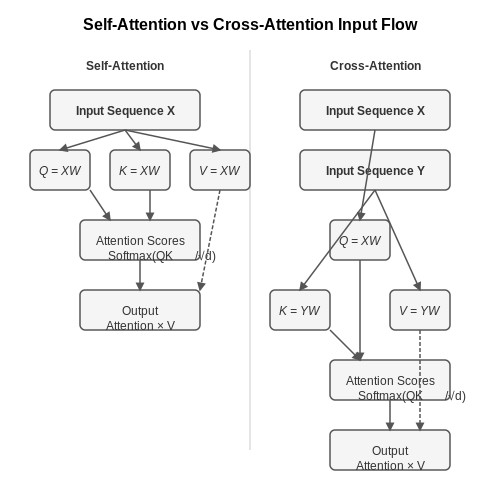
Self-attention and cross-attention are both fundamental mechanisms in transformer architectures, but they serve distinct purposes and operate on different input structures. The primary distinction lies in their input dependencies: self-attention operates on a single sequence, while cross-attention dynamically combines information from two distinct sequences.
Input-Output Relationships
In self-attention, the query (Q), key (K), and value (V) matrices are derived from the same input sequence X:
Cross-attention, however, computes Q from one sequence (X) and K, V from another (Y), enabling inter-sequence information flow:
Information Flow Patterns
Self-attention captures intra-sequence relationships, making it ideal for tasks like language modeling where contextual dependencies within a single text are critical. Cross-attention facilitates inter-sequence alignment, which is essential for machine translation (source-target sentence pairs) or multimodal tasks (e.g., image-text fusion in CLIP).
Computational Complexity
For sequences of length n (for X) and m (for Y), self-attention scales as O(n²) due to pairwise token interactions within X. Cross-attention scales as O(nm), where n and m may differ (e.g., short queries against long document contexts).
Architectural Roles
Self-attention layers dominate transformer encoders (e.g., BERT), while cross-attention appears in decoder modules (e.g., GPT-3’s masked self-attention followed by encoder-decoder cross-attention). Hybrid architectures like T5 use both: self-attention for input encoding and cross-attention for conditional generation.
Practical Implications
- Self-Attention: Contextual embedding refinement, coreference resolution.
- Cross-Attention: Sequence-to-sequence tasks, retrieval-augmented generation, multimodal fusion.
2. Definition and Core Principles of Cross-Attention
2.1 Definition and Core Principles of Cross-Attention
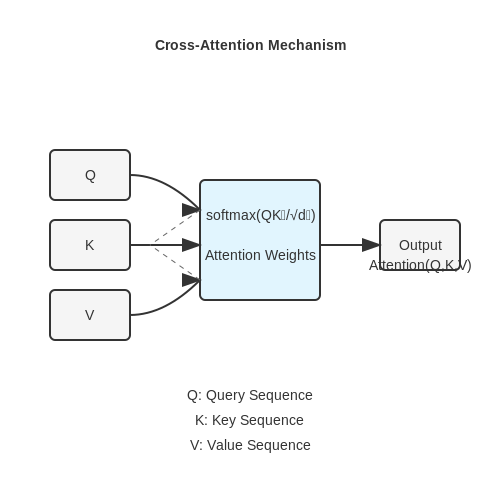
Cross-attention is a mechanism in neural networks that enables one sequence to dynamically attend to another sequence, allowing information to flow between them. Unlike self-attention, where queries, keys, and values are derived from the same input, cross-attention computes attention scores between two distinct sequences—typically referred to as the query sequence and the key-value sequence. This mechanism is fundamental in encoder-decoder architectures, where the decoder attends to the encoder's output to generate context-aware predictions.
Mathematical Formulation
Given a query sequence Q ∈ ℝn×d and a key-value sequence K, V ∈ ℝm×d, cross-attention computes a weighted sum of values based on the compatibility between queries and keys. The attention weights are derived using the scaled dot-product formulation:
Here, dk is the dimension of the key vectors, and the scaling factor √dk prevents gradient saturation in the softmax function. The softmax operation ensures that the attention weights sum to one, making them interpretable as probabilities.
Core Principles
- Bidirectional Information Flow: Cross-attention allows one sequence to condition its representations on another, enabling tasks like machine translation, where the decoder must align with the encoder's context.
- Dynamic Weighting: Unlike fixed-weight mechanisms (e.g., averaging), cross-attention dynamically prioritizes relevant parts of the key-value sequence for each query.
- Scalability: The mechanism is parallelizable, making it efficient for large sequences when combined with optimizations like multi-head attention.
Multi-Head Cross-Attention
To capture diverse relationships, cross-attention is often extended to multiple heads, where each head learns independent attention patterns:
Each head computes attention in a lower-dimensional subspace (dk = d/h), and the outputs are concatenated and linearly transformed by WO ∈ ℝd×d.
Applications
Cross-attention is pivotal in:
- Transformer-based models: Used in BERT, GPT, and T5 for tasks like text summarization and question answering.
- Multimodal learning: Enables image-to-text (e.g., CLIP) or text-to-image (e.g., DALL·E) alignment by attending across modalities.
- Memory-augmented networks: Allows models to retrieve information from external memory, as in Neural Turing Machines.
2.2 Mathematical Formulation of Cross-Attention
Cross-attention extends the standard self-attention mechanism by computing attention scores between two distinct sequences, often referred to as the query sequence and the key-value sequence. Given an input query sequence Q ∈ ℝn×d and a key-value sequence K, V ∈ ℝm×d, where n and m are sequence lengths and d is the embedding dimension, the cross-attention operation computes a weighted sum of values based on the compatibility between queries and keys.
Attention Score Computation
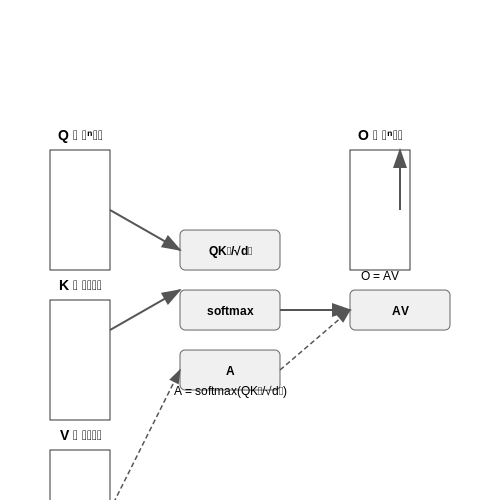
The attention scores A ∈ ℝn×m are derived using scaled dot-product attention:
Here, dk is the dimension of the key vectors, and the scaling factor 1/√dk prevents gradient saturation in the softmax. The softmax ensures the attention weights sum to 1 along the key dimension, making them interpretable as probabilities.
Weighted Value Aggregation
The output of cross-attention O ∈ ℝn×d is computed as a weighted sum of the value vectors:
Each row of O represents a contextualized embedding for a query token, where the context is derived from the key-value sequence. This mechanism allows the model to dynamically focus on relevant parts of the key-value sequence when processing each query token.
Multi-Head Cross-Attention
To capture diverse attention patterns, cross-attention is often extended to multiple heads. For h heads, the queries, keys, and values are linearly projected into h subspaces:
where WiQ, WiK, WiV ∈ ℝd×d/h are learnable projection matrices for head i. The outputs of all heads are concatenated and projected back to the original dimension:
Here, WO ∈ ℝd×d is a learnable output projection matrix. Multi-head attention enables the model to jointly attend to information from different representation subspaces.
Practical Considerations
In practice, cross-attention is implemented efficiently using batched matrix operations, with masking applied to handle variable sequence lengths or enforce causal constraints. The computational complexity is O(nm), making it expensive for long sequences. Techniques like sparse attention or memory-efficient variants are often employed to mitigate this cost.
2.3 How Cross-Attention Enables Interaction Between Sequences
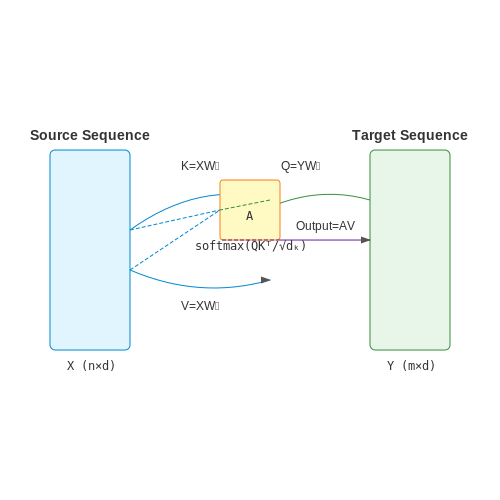
Cross-attention mechanisms facilitate dynamic information exchange between two distinct sequences by computing attention scores across their elements. Unlike self-attention, where queries, keys, and values originate from the same sequence, cross-attention derives queries from one sequence and keys/values from another. This asymmetric computation allows the model to condition one sequence's representations on another, enabling tasks like machine translation or multimodal fusion.
Mathematical Formulation
Given a source sequence X ∈ ℝn×d and target sequence Y ∈ ℝm×d, cross-attention computes:
where:
- Q = YWQ (queries from target sequence)
- K = XWK, V = XWV (keys/values from source sequence)
- dk is the dimension of key vectors
Information Flow Dynamics
The attention matrix A = softmax(QKT/√dk) creates a differentiable mapping where each target token attends to relevant source tokens. This produces:
- Selective filtering: Irrelevant source information gets attenuated via softmax normalization
- Content-based addressing: The dot product QKT implements a learned similarity metric
- Dynamic weighting: Each target position computes a unique convex combination of source values
Architectural Implementation
In transformer decoders, cross-attention layers typically sit between self-attention and feedforward blocks. The decoder's self-attention output becomes the query input, while the encoder's final representations supply keys and values. This architecture enables:
- Autoregressive decoding while maintaining awareness of encoder states
- Iterative refinement of attention patterns during generation
- Multi-head extensions for learning diverse alignment strategies
Gradient Pathways
The cross-attention gradients ∂L/∂X flow through two paths:
This dual pathway allows simultaneous learning of:
- What information to retrieve (via key gradients)
- How to transform retrieved content (via value gradients)
Advanced Variants
Recent innovations enhance cross-attention's capabilities:
- Sparse cross-attention: Reduces O(nm) complexity via learned or fixed sparsity patterns
- Memory-efficient forms: Approximates softmax with kernel methods or low-rank projections
- Cross-modal attention: Aligns heterogeneous sequences (e.g., text-video) through modality-specific projections
In vision-language models like CLIP, cross-attention layers create latent alignment between image patches and text tokens, enabling zero-shot transfer. The attention patterns often reveal interpretable cross-modal relationships, such as noun-phrase to object correspondences.
3. Cross-Attention in Machine Translation
3.1 Cross-Attention in Machine Translation
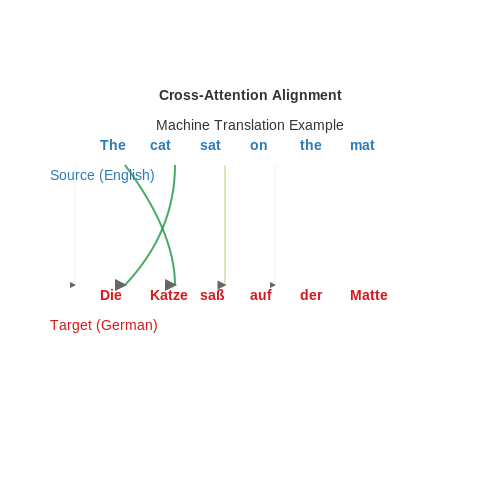
Cross-attention is a fundamental mechanism in sequence-to-sequence models, particularly in neural machine translation (NMT). Unlike self-attention, which computes relationships within a single sequence, cross-attention dynamically aligns and transfers information between two distinct sequences—typically the source and target sequences in translation tasks. The mechanism enables the decoder to focus on relevant parts of the encoded source sequence while generating each token in the target language.
Mathematical Formulation
Given an encoded source sequence X ∈ ℝn×d (where n is the sequence length and d is the embedding dimension) and a target sequence Y ∈ ℝm×d, cross-attention computes a context vector for each target position by attending to all source positions. The process involves three learnable matrices: WQ, WK, and WV.
The attention scores are computed as scaled dot-products between the target queries Q and source keys K, followed by a softmax operation:
Here, dk is the dimension of the key vectors, and scaling by 1/√dk prevents gradient saturation in the softmax. The resulting context vectors are then combined with the decoder’s hidden states to predict the next token.
Practical Implementation in Transformers
In the Transformer architecture, cross-attention is implemented as part of the decoder layer. The decoder receives:
- Encoder output: The source sequence representations after being processed by the encoder stack.
- Target embeddings: The shifted-right target sequence (for autoregressive generation).
The decoder’s multi-head cross-attention mechanism splits Q, K, and V into h heads, computes attention in parallel, and concatenates the results:
where each head is computed as headi = Attention(QWQi, KWKi, VWVi).
Case Study: Cross-Attention in Google’s Neural Machine Translation
Google’s 2017 Transformer-based NMT system demonstrated the effectiveness of cross-attention for multilingual translation. The model’s decoder attends to the entire source sentence while generating each target word, enabling it to handle long-range dependencies and complex syntactic reordering. For example, when translating English to German, the decoder might focus on the verb in the source sentence early in the generation process, even if the target language requires the verb to appear later.
Extensions and Variants
Recent advancements have introduced sparse cross-attention to reduce computational overhead and memory usage. For instance, the Longformer and BigBird models use sliding-window attention combined with global tokens, enabling efficient processing of long sequences. Another variant, conditional cross-attention, dynamically adjusts the attention mechanism based on auxiliary inputs such as language embeddings or domain-specific signals.
Cross-Attention in Multimodal Learning (Text-Image, Text-Audio)
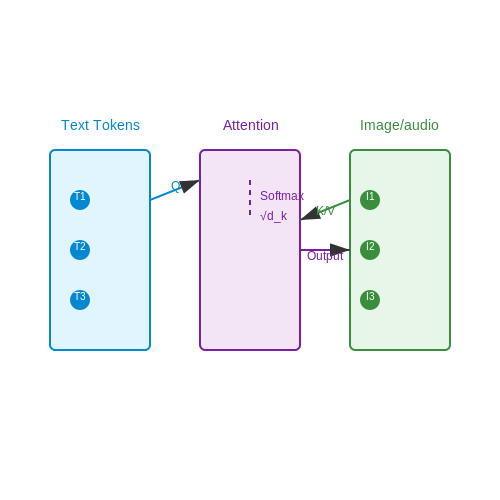
Cross-attention mechanisms enable interactions between different modalities by computing attention scores across their feature spaces. In multimodal learning, this allows one modality (e.g., text) to dynamically attend to relevant regions in another (e.g., image or audio). The key mathematical formulation involves projecting queries from one modality and keys/values from another:
Here, Q is derived from the first modality (e.g., text tokens), while K and V come from the second modality (e.g., image patches or audio spectrograms). The scaling factor √dk stabilizes gradients during training.
Text-Image Cross-Attention
In vision-language models like CLIP or Flamingo, text-to-image cross-attention aligns linguistic concepts with visual regions. Given text embeddings T ∈ ℝL×d and image features I ∈ ℝH×W×d, the process unfolds as:
- Flatten spatial dimensions of I to ℝHW×d
- Compute attention scores between text queries and image keys
- Attend to image values based on text relevance
This enables zero-shot capabilities where text queries like "a red balloon" can localize corresponding regions in novel images without explicit training.
Text-Audio Cross-Attention
For audio-text tasks like speech recognition or audio captioning, cross-attention operates on:
- Text queries: Word or subword token embeddings
- Audio keys/values: Spectral features (Mel-spectrograms) or learned audio representations
The attention weights highlight phonetically relevant time-frequency bins for each text token. In transformer-based ASR systems, this replaces traditional alignment models with dynamic attention.
Bidirectional Cross-Attention
Advanced architectures like Perceiver IO implement bidirectional cross-attention, allowing both modalities to mutually influence each other. The general form becomes:
where A and B represent different modalities. This symmetry enables richer interactions, as seen in models like ALIGN that jointly optimize image-text embeddings.
Implementation Considerations
Practical implementations must address:
- Dimensionality mismatch: Modalities often have different sequence lengths (e.g., 256 image patches vs. 32 text tokens)
- Computational cost: Attention over high-resolution modalities requires memory-efficient variants like linear attention
- Normalization: Layer normalization strategies differ across modalities due to varying feature distributions
Recent work like CoCa demonstrates that careful initialization of cross-attention layers significantly improves multimodal fusion performance.
3.3 Cross-Attention in Retrieval-Augmented Models
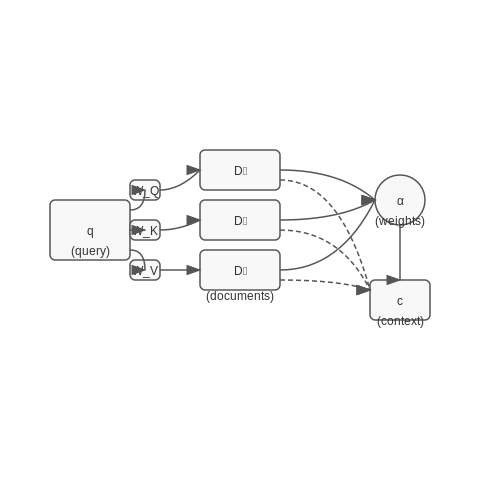
Retrieval-augmented models integrate external knowledge sources with transformer-based architectures, leveraging cross-attention to dynamically condition generation or prediction on retrieved documents. Unlike standard self-attention, where queries, keys, and values originate from the same sequence, cross-attention in these models computes attention scores between a query representation (e.g., decoder hidden states) and retrieved key-value pairs (e.g., encoded document embeddings). This mechanism enables the model to attend to relevant passages from a knowledge corpus, enhancing factual consistency and reducing hallucination.
Mathematical Formulation
Given a query vector q (e.g., decoder state) and a set of retrieved document embeddings D = {d1, ..., dk}, cross-attention computes a context vector c as a weighted sum of document values. The attention weights αi are derived from scaled dot-product similarity:
Here, WQ, WK, WV are learned projection matrices, and dk is the key dimension for scaling. The retrieved documents di are typically encoded using a separate transformer (e.g., DPR or T5), and their embeddings are cached for efficiency during inference.
Architectural Integration
In models like RAG (Retrieval-Augmented Generation), cross-attention operates in two phases:
- Retrieval: A dense retriever (e.g., FAISS-indexed BERT embeddings) fetches top-k documents relevant to the input query.
- Fusion: The generator (e.g., BART or T5) uses cross-attention to blend retrieved information into its hidden states. The decoder attends to both its previous states (self-attention) and document embeddings (cross-attention), with layer normalization applied between the two attention layers.
Practical Considerations
Key challenges include:
- Latency: Retrieval and cross-attention add overhead. Solutions include asynchronous retrieval or pre-fetching documents during beam search.
- Noisy Retrieval: Irrelevant documents may degrade performance. Techniques like maximum inner product search (MIPS) filtering or learned retrieval thresholds mitigate this.
- Memory: Storing document embeddings requires significant RAM. Compression methods (e.g., PQ-quantization) or hybrid dense-sparse indexes are often employed.
Case Study: REALM
REALM (Retrieval-Enhanced Language Models) pre-trains a retriever and reader end-to-end by masking spans in the input and learning to retrieve documents that help predict them. Its cross-attention uses a salience score combining lexical overlap (BM25) and neural relevance, demonstrating how hybrid retrieval-augmented systems can outperform pure neural approaches on knowledge-intensive tasks like open-domain QA.
where λ is a learned mixing coefficient and NN is a neural relevance scorer.
4. Step-by-Step Implementation in PyTorch
4.1 Step-by-Step Implementation in PyTorch
Cross-attention enables dynamic interaction between two distinct sequences by computing attention scores across their elements. In PyTorch, this is implemented using multi-head attention mechanisms with separate query, key, and value projections for each sequence.
Key Components
The implementation requires:
- Linear Projections: Separate weight matrices for queries (Q), keys (K), and values (V).
- Scaled Dot-Product Attention: Computes attention scores using softmax over the dot product of Q and K.
- Multi-Head Mechanism: Splits the attention computation into parallel heads for richer representations.
Mathematical Formulation
Given input sequences X (source) and Y (target), the cross-attention output is computed as:
where Q = XWQ, K = YWK, and V = YWV are learned projections, and dk is the dimension of the key vectors.
PyTorch Implementation
The following code demonstrates a complete cross-attention layer:
import torch
import torch.nn as nn
import torch.nn.functional as F

class CrossAttention(nn.Module):
    def __init__(self, embed_dim, num_heads):
        super().__init__()
        self.embed_dim = embed_dim
        self.num_heads = num_heads
        self.head_dim = embed_dim // num_heads

        assert self.head_dim * num_heads == embed_dim, "Embedding dimension must be divisible by num_heads"

        self.q_proj = nn.Linear(embed_dim, embed_dim)
        self.k_proj = nn.Linear(embed_dim, embed_dim)
        self.v_proj = nn.Linear(embed_dim, embed_dim)
        self.out_proj = nn.Linear(embed_dim, embed_dim)

    def forward(self, x, y):
        batch_size = x.size(0)

        # Project queries (x), keys (y), values (y)
        q = self.q_proj(x).view(batch_size, -1, self.num_heads, self.head_dim).transpose(1, 2)
        k = self.k_proj(y).view(batch_size, -1, self.num_heads, self.head_dim).transpose(1, 2)
        v = self.v_proj(y).view(batch_size, -1, self.num_heads, self.head_dim).transpose(1, 2)

        # Scaled dot-product attention
        attn_scores = torch.matmul(q, k.transpose(-2, -1)) / (self.head_dim ** 0.5)
        attn_weights = F.softmax(attn_scores, dim=-1)
        output = torch.matmul(attn_weights, v)

        # Concatenate heads and apply final projection
        output = output.transpose(1, 2).contiguous().view(batch_size, -1, self.embed_dim)
        return self.out_proj(output)
Practical Considerations
- Memory Efficiency: For long sequences, consider using memory-efficient attention variants like FlashAttention.
- Gradient Flow: Layer normalization and residual connections help stabilize training.
- Batch Processing: The implementation supports batched inputs for parallel computation.
Integration with Transformer Architectures
In encoder-decoder transformers, cross-attention typically connects the decoder to the encoder's output. The decoder generates queries while the encoder provides keys and values:
class TransformerDecoderLayer(nn.Module):
    def __init__(self, embed_dim, num_heads, ...):
        super().__init__()
        self.self_attn = MultiheadAttention(embed_dim, num_heads)  # Self-attention
        self.cross_attn = CrossAttention(embed_dim, num_heads)     # Cross-attention
        # ... (feedforward, normalization layers)

    def forward(self, x, encoder_output):
        x = self.self_attn(x, x, x)  # Self-attention
        x = self.cross_attn(x, encoder_output)  # Cross-attention
        # ... (rest of the layer)
        return x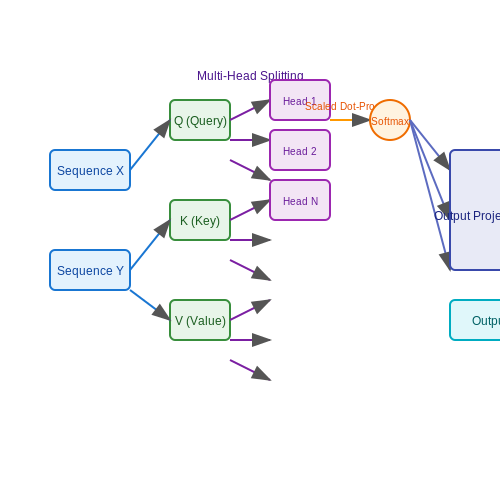
4.2 Common Pitfalls and Debugging Tips
Numerical Instability in Attention Scores
Cross-attention mechanisms often compute attention scores using softmax over large dot products, which can lead to numerical instability due to floating-point overflow or underflow. For queries Q and keys K with dimension d_k, the raw attention scores are computed as:
If Q or K contains large values, the exponential terms in softmax can explode. A practical solution is to subtract the maximum value before exponentiation (log-sum-exp trick):
Gradient Vanishing in Deep Cross-Attention Layers
Deep cross-attention stacks (e.g., in Transformer decoders) can suffer from gradient vanishing due to repeated softmax normalization. This manifests as:
- Diminished gradient flow through attention heads in later layers.
- Over-smoothing of attention weights, reducing model discriminability.
Debugging strategies include:
- Monitoring gradient norms per layer with tools like torchviz or TensorBoard.
- Using residual connections with properly initialized scaling (e.g., α = 1/√L for L layers).
Memory Bottlenecks in Long Sequences
The O(n²) memory complexity of cross-attention becomes prohibitive for long sequences (e.g., >10k tokens). Common failure modes:
- CUDA out-of-memory errors during training.
- Truncated attention when using naive windowing.
Advanced mitigation approaches:
- Memory-efficient attention: FlashAttention or block-sparse patterns.
- Approximate methods: Performer’s FAVOR+ algorithm with random features.
Misalignment in Cross-Modal Settings
When applying cross-attention between heterogeneous modalities (e.g., text-to-image), mismatched embedding spaces can cause:
- Attention collapse (all mass on one token).
- Semantic drift in learned representations.
Debugging tools:
- Visualize attention maps with tools like BertViz.
- Monitor the effective rank of attention matrices:
where σ_i are singular values of the attention matrix A.
Hardware-Specific Optimization Pitfalls
On modern accelerators (TPUs/GPUs), suboptimal implementation choices can degrade performance:
- Non-contiguous memory layouts causing inefficient memory access.
- Kernel fusion failures in custom attention implementations.
Profiling recommendations:
- Use NVIDIA Nsight or PyTorch Profiler to identify memory-bound operations.
- Leverage compiler optimizations (e.g., XLA for TPUs, Triton for GPUs).
4.3 Optimizing Cross-Attention for Efficiency
Memory and Computational Bottlenecks
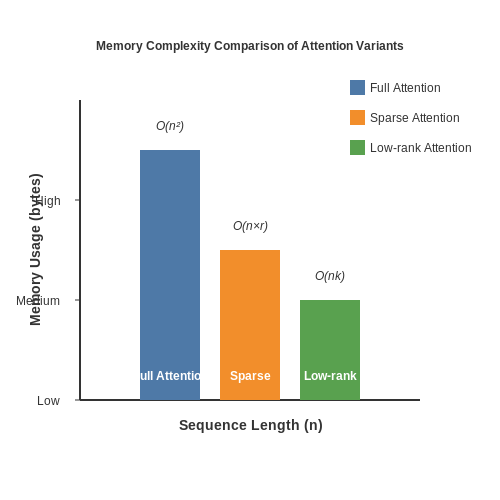
The standard cross-attention mechanism computes pairwise interactions between all elements in the query and key sequences, resulting in O(n²) time and space complexity for sequence length n. For long sequences (e.g., high-resolution images or documents), this becomes prohibitively expensive. The memory footprint grows quadratically, limiting practical applications.
Sparse Attention Patterns
One optimization approach replaces the full attention matrix with sparse approximations. The local windowed attention restricts each query to attend only to keys within a fixed radius r, reducing complexity to O(n×r). Alternatively, block-sparse attention divides the sequence into chunks and computes attention only between selected blocks.
Low-Rank Approximations
Another strategy exploits the observation that attention matrices often have low effective rank. The Linformer approach projects keys and values to a lower-dimensional space (dimension k ≪ n) using learned linear transformations:
where E ∈ ℝn×k and F ∈ ℝk×n are projection matrices. This reduces memory from O(n²) to O(nk).
Kernel-Based Approximations
The Performer architecture replaces the softmax attention with a generalized attention mechanism using random feature maps. The key insight is that the softmax can be expressed as a dot product in a high-dimensional space, approximated via random Fourier features:
where ϕ(·) is a random feature map. This enables linear O(n) complexity while maintaining expressiveness.
Memory-Efficient Implementations
Modern frameworks optimize memory usage through:
- Gradient checkpointing: Recomputes intermediate activations during backward pass instead of storing them
- FlashAttention: Uses tiling to reduce memory reads/writes between GPU memory hierarchies
- Mixed precision training: Stores attention weights in lower precision (e.g., bfloat16) with master weights in float32
Hardware-Specific Optimizations
On TPUs and GPUs, attention computation can be accelerated by:
- Leveraging tensor cores for mixed-precision matrix multiplications
- Using specialized instructions like NVIDIA's TensorFloat-32 format
- Optimizing memory access patterns to reduce cache misses
Trade-offs and Empirical Results
Experiments on the Long-Range Arena benchmark show that efficient attention variants can achieve 90-95% of full attention accuracy while reducing memory usage by 10-100×. The optimal method depends on sequence length - kernel methods excel for very long sequences (>4K tokens), while low-rank approximations work better for moderate lengths (512-2K tokens).
5. Sparse Cross-Attention Mechanisms
5.1 Sparse Cross-Attention Mechanisms
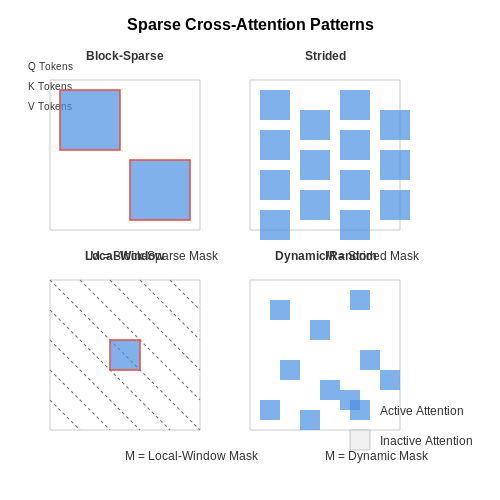
Sparse cross-attention mechanisms reduce computational complexity by selectively attending to a subset of input tokens rather than computing full pairwise attention. This is achieved through sparsity patterns that enforce a fixed or dynamic structure on the attention matrix, limiting interactions between tokens while preserving model performance.
Mathematical Formulation
Given query Q, key K, and value V matrices, standard cross-attention computes:
In sparse cross-attention, a binary mask M with sparsity pattern is applied:
where ⊙ denotes element-wise multiplication and M ∈ {0,1}n×m enforces the sparsity constraint.
Sparsity Patterns
Common sparsity patterns include:
- Fixed Patterns: Block-sparse, strided, or local-window attention where only nearby tokens interact.
- Dynamic Patterns: Learned or input-dependent sparsity, such as routing tokens via clustering or hashing.
- Random Patterns: Stochastic attention where a random subset of edges is activated per layer.
Efficiency Gains
Sparse attention reduces memory from O(n²) to O(n√n) or O(n log n) and compute from O(n²d) to sub-quadratic. For example, in Longformer, dilated sliding windows achieve O(n) complexity while maintaining performance on long sequences.
Practical Implementations
Sparse attention is implemented via:
- Custom CUDA kernels for efficient sparse matrix multiplication.
- Top-k selection or thresholding to prune attention weights.
- Hierarchical attention for multi-scale sparsity.
In PyTorch, a sparse attention mask can be applied as follows:
import torch
import torch.nn.functional as F

def sparse_attention(Q, K, V, mask):
    scores = torch.matmul(Q, K.transpose(-2, -1)) / (Q.size(-1) ** 0.5
    scores = scores.masked_fill(mask == 0, -1e9)
    weights = F.softmax(scores, dim=-1)
    return torch.matmul(weights, V)
Applications
Sparse cross-attention is critical in:
- Long-sequence modeling (e.g., DNA, high-resolution images).
- Multi-modal tasks where only specific cross-modal interactions are relevant.
- Edge devices with memory constraints.
5.2 Cross-Attention in Large-Scale Models (e.g., GPT, BERT)
Cross-attention mechanisms in large-scale transformer models like GPT and BERT enable dynamic interaction between distinct sequences or modalities. Unlike self-attention, where queries, keys, and values originate from the same input sequence, cross-attention computes attention scores between two different sequences, allowing one sequence to attend to another. This is particularly useful in tasks like machine translation, where the decoder attends to the encoder's output, or in multimodal models where text attends to image features.
Mathematical Formulation
Given two input sequences X (source) and Y (target), cross-attention computes:
where:
- Q (Queries) are derived from Y: \( Q = YW_Q \)
- K (Keys) and V (Values) are derived from X: \( K = XW_K \), \( V = XW_V \)
- \( d_k \) is the dimension of the key vectors, used to scale the dot products.
Role in GPT and BERT
In autoregressive models like GPT, cross-attention is used in decoder-only architectures for tasks like text generation. The model attends to its own previous outputs (self-attention) but can also incorporate cross-attention when conditioned on external data (e.g., in image captioning). In BERT, cross-attention appears in extensions like BERT for multimodal tasks, where text tokens attend to visual features from a convolutional network.
Example: Cross-Attention in GPT-3
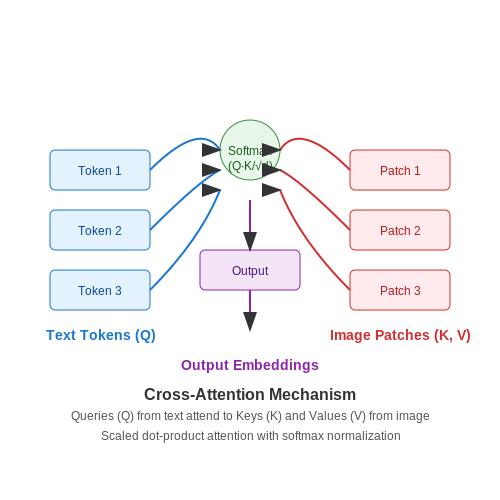
GPT-3 primarily uses self-attention, but variants like GPT-3 with cross-modal capabilities employ cross-attention layers to process paired data (e.g., text-image pairs). Here, the text tokens generate queries, while image patches provide keys and values. The attention weights determine which image regions are most relevant for each word.
Efficiency Considerations
Cross-attention introduces computational overhead, especially when one sequence is significantly longer than the other (e.g., high-resolution images with short text descriptions). To mitigate this, large-scale models often use:
- Sparse attention: Limiting the attention span to a local window or predefined stride.
- Memory-efficient variants: Such as linear attention or low-rank approximations.
- Hierarchical attention: First attending to coarse-grained features, then refining.
Case Study: Vision-Language Models
Models like CLIP and Flamingo leverage cross-attention to align visual and textual representations. For instance, in CLIP, image embeddings (from a ViT) and text embeddings (from a transformer) interact through cross-attention to compute similarity scores. The attention map reveals which image regions contribute most to a given text token, enabling interpretability.
where I and T are image and text embeddings, respectively.
Challenges and Trade-offs
While powerful, cross-attention in large models faces challenges:
- Scalability: Quadratic complexity with respect to sequence length.
- Training stability: Requires careful initialization and normalization to avoid vanishing gradients.
- Modality gaps: Aligning heterogeneous data (e.g., text and images) demands extensive pretraining.
5.3 Combining Cross-Attention with Other Attention Variants
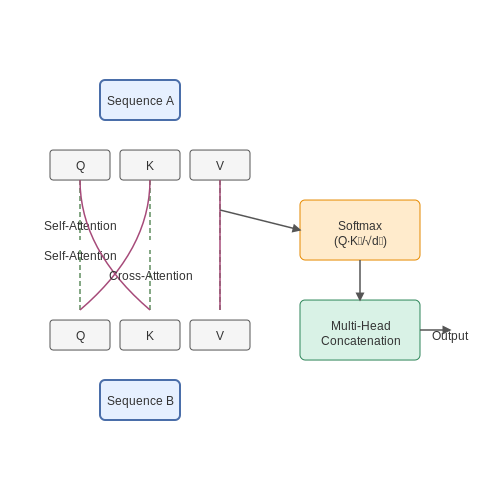
Cross-attention mechanisms are rarely used in isolation—they are often integrated with other attention variants to enhance model performance. One common approach is combining cross-attention with self-attention, where the model attends to both intra-sequence relationships (self-attention) and inter-sequence relationships (cross-attention). The hybrid attention score for a query Q can be formulated as:
where K and V may come from either the same sequence (self-attention) or a different sequence (cross-attention). The Transformer architecture typically implements this through multi-head attention:
Cross-Attention with Sparse Attention
To improve computational efficiency, cross-attention can be combined with sparse attention patterns. For instance, in Longformer or BigBird architectures, global tokens maintain cross-sequence attention while local tokens use windowed self-attention. The attention matrix A becomes:
where 𝒩(i) defines the sparse neighborhood for token i.
Cross-Attention in Memory-Augmented Networks
When combined with memory-compressed attention, cross-attention can operate on latent representations rather than raw sequences. The Key-Value memory network first compresses the source sequence into fixed-size memory slots M:
then performs cross-attention between the target sequence and memory slots:
Cross-Attention with Relative Positional Encoding
Incorporating relative positional information enhances cross-attention when sequence alignment matters (e.g., machine translation). The attention scores are modified as:
where ri-j is the relative position embedding between positions i and j.
Practical Implementations
Modern architectures employ these combinations in various ways:
- Perceiver IO: Uses cross-attention to project inputs into a latent space followed by self-attention
- Flamingo: Alternates cross-attention (image-to-text) and self-attention (text-to-text) layers
- Gato: Employs modality-specific encoders with shared cross-attention heads
The choice of combination depends on the task requirements—cross-modal tasks benefit from memory compression, while sequence-to-sequence tasks often use relative positional variants.
6. Key Research Papers on Cross-Attention
6.1 Key Research Papers on Cross-Attention
- PDF CrossViT: Cross-Attention Multi-Scale Vision Transformer for Image ... — e.g., SENet [18] uses channel-attention, CBAM [41] adds the spatial attention and ECANet [37] proposes an effi-cient channel attention to further improve SENet. There has also been a lot of interest in combining CNNs with different forms of self-attention [2,32,48,31,3,17,39]. SASA [31] and SAN [48] deploy a local-attention layer
- Cross-attention interaction learning network for multi-model image ... — To overcome the aforementioned limitations, this paper introduces a cross-attention interaction learning network for multi-modal image fusion, referred to as CrossATF, with its detailed workflow illustrated in Fig. 1, Fig. 2.Inspired by the viability of the vision transformer (ViT), a generator network is constructed, which is based on the transformer architecture, comprising two encoders and ...
- Textmatcher: cross-attentional neural network to compare ... - Springer — A key peculiarity of the cross-attention component is that it helps the model to specialize to the distribution of specific errors to be recognized. The three blocks in the overall TextMatcher model (i.e., image embedding, text embedding, and cross-attention mechanism) are jointly trained in an end-to-end fashion, via a contrastive loss function.
- Regularizing cross-attention learning for end-to-end speech translation ... — The cross-attention mechanism enables Transformer to capture correspondences between the input and output. However, in the domain of end-to-end (E2E) speech-to-text translation (ST), the learned cross-attention weights often struggle to accurately correspond with actual alignments, given the need to align speech and text across different modalities and languages.
- PDF FACT: Frame-Action Cross-Attention Temporal Modeling for Efficient ... — Paper Contributions. We propose a new framework for action segmentation, referred to as Frame-Action Cross-attention Temporal modeling (FACT), where our key idea is to learn a temporal model with both frame and action features, and conduct bidirectional information transfer be-tween these features to refine them. Specifically, the FACT
- PDF Attribution with Cross-Attention Guidance — These attention weights are used to create an attention-modulated embedding E m, which dynamically high-lights features in E m based on their relevance to Z m. The cross-attention mechanism is formalized as E m = softmax Q(Z m; A)K(E m; A)T dk V(E m; A), (4) where Q, K and V represent the query, key, and value matrices respectively, and d k the
- (PDF) CrossViT: Cross-Attention Multi-Scale Vision ... - ResearchGate — (d) Cross-attention, where CLS token from one br anch and patch tokens from another br anch are fused together. Effective feature fusion is the key for learning multi- scale feature representatio ns.
- CabViT: Cross Attention among Blocks for Vision Transformer - ResearchGate — Specifically, we propose cross attention among blocks of ViT (CabViT), which uses tokens from previous blocks in the same stage as extra input to the multi-head attention of transformers.
- CMDAF: Cross-Modality Dual-Attention Fusion Network for ... - MDPI — Multimodal sentiment analysis (MSA) seeks to predict subjective human sentiments by utilizing information from multiple modalities. It has been applied in diverse scenarios. Recent studies suggest that MSA benefits from integrating diverse modalities, emphasizing the fusion of multimodal information at different levels and the joint learning of modality-consistent and modality-inconsistent ...
- Masked cross-attention and multi-head channel attention guiding single ... — Although the text-to-image model aims to generate realistic images that correspond to the text description, generating high-quality, and accurate images remains a significant challenge. Most existing text-to-image methods are implemented through a two-stage stacking model, where the generation process is initiated by creating an initial image with a basic outline and subsequently refined to ...
6.2 Recommended Books and Tutorials
- Unveiling and Mitigating Memorization in Text-to-Image ... - Springer — In this work, we introduce a novel perspective to understand memorization via the behavior of "cross-attention".Cross attention has been widely used by text-to-image diffusion models, serving as the primary mechanism of selecting information from the prompts to guide diffusion generation process[16, 26,27,28].Given that the memorized training images are usually triggered by the memorized ...
- Cross-Attention-Based Reflection-Aware 6D Pose Estimation ... - MDPI — Six-dimensional pose estimation for non-Lambertian objects, such as metal parts, is essential in intelligent manufacturing. Current methods pay much less attention to the influence of the surface reflection problem in 6D pose estimation. In this paper, we propose a cross-attention-based reflection-aware 6D pose estimation network (CAR6D) for solving the surface reflection problem in 6D pose ...
- PDF Practical Electronics Handbook — from printing data books at all. This book, now in its sixth edition, has been extensively revised, with a large amount of new material added, to serve the needs of both the professional and the enthusiast. It combines data and explanations in a way that is not served by websites. Although the book is not intended as a form of beginners ...
- Home | X12 — Established more than 40 years ago, X12 is a non-profit, ANSI-accredited, cross-industry standards development organization whose work is used by an overwhelming percentage of business-to-business transactions upholding America's electronic information exchange.
- PDF Volume II: appendices to guide for mapping types of information and ... — This document is intended as a reference resource rather than as a tutorial. Not all of the material will be relevant to all agencies. This document includes two volumes, a basic guideline and a volume of appendices. Users should review the guidelines provided in Volume I, then
- Gated Cross-Attention for Universal Speaker Extraction: Toward Real ... — Current target-speaker extraction (TSE) models have achieved good performance in separating target speech from highly overlapped multi-talker speech. However, in real-world applications, multi-talker speech is often sparsely overlapped, and the target speaker may be absent from the speech mixture, making it difficult for the model to extract the desired speech in such situations. To optimize ...
- CK12-Foundation — CK-12 Physics FlexBook® covers essential physics concepts with interactive simulations, practical examples, and engaging videos to enhance understanding.
- Student Guide - Instructure Community — Topics for All Users For general information, feature descriptions, and details on topics such as Canvas Mobile, Help, Calendar, Courses, Dashboard, ePortfolios, Files, Global Navigation, Inbox, Profile and User Settings, Rich Content Editor, and Web Services, visit the Canvas Basics Guide for all user roles.
- 7.5 Electronic Communication - Introduction to Communications — Electronic mail, usually called email, has largely replaced print. ... Email can be very useful for messages that have slightly more content than a text message, but it is still best used for fairly brief messages. Emails may be informal in personal contexts, but business communication requires attention to detail, an awareness that your email ...
- Technical resources - NHBC — Technical disclaimer. Any technical information contained on this website is produced by NHBC as guidance solely for all our builder customers as to how to interpret the technical requirements in relation to the warranty cover provided by NHBC under its Buildmark, Buildmark Choice, Buildmark Link, Buildmark Solo, Buildmark Connect or any similar product from time to time.
6.3 Open-Source Implementations and Libraries
- PDF CrossViT: Cross-Attention Multi-Scale Vision Transformer for Image ... — e.g., SENet [18] uses channel-attention, CBAM [41] adds the spatial attention and ECANet [37] proposes an effi-cient channel attention to further improve SENet. There has also been a lot of interest in combining CNNs with different forms of self-attention [2,32,48,31,3,17,39]. SASA [31] and SAN [48] deploy a local-attention layer
- Visualizing Attention, a Transformer's Heart - 3Blue1Brown — In the last chapter, you and I started to step through the internal workings of a transformer, the key piece of technology inside large language models.Transformers first hit the scene in a (now-famous) paper called Attention is All You Need, and in this chapter you and I will dig into what this attention mechanism is, by visualizing how it processes data.
- PDF Cross-Modal Learning with 3D Deformable Attention for ... - CVF Open Access — stride attention is applied to spatially combine attention and pose tokens. Temporal stride attention temporally reduces the number of input tokens in the attention module and sup-ports temporal expression learning without the simultane-ous use of all tokens. The deformable transformer iterates L-times and combines the last cross-modal token ...
- GitHub - Dao-AILab/flash-attention: Fast and memory-efficient exact ... — Supports multi-query and grouped-query attention (MQA/GQA) by passing in KV with fewer heads than Q. Note that the number of heads in Q must be divisible by the number of heads in KV. For example, if Q has 6 heads and K, V have 2 heads, head 0, 1, 2 of Q will attention to head 0 of K, V, and head 3, 4, 5 of Q will attention to head 1 of K, V.
- Lightweight Vision Transformer with Cross Feature Attention — Recent advances in vision transformers (ViTs) have achieved great performance in visual recognition tasks. Convolutional neural networks (CNNs) exploit spatial inductive bias to learn visual representations, but these networks are spatially local. ViTs can learn global representations with their self-attention mechanism, but they are usually heavy-weight and unsuitable for mobile devices. In ...
- 11. Attention Mechanisms and Transformers — Dive into Deep ... - D2L — In translation tasks, attention models often assigned high attention weights to cross-lingual synonyms when generating the corresponding words in the target language. For example, when translating the sentence "my feet hurt" to "j'ai mal au pieds", the neural network might assign high attention weights to the representation of "feet ...
- Tree Cross Attention - arXiv.org — Abstract. Cross Attention is a popular method for retrieving information from a set of context tokens for making predictions. At inference time, for each prediction, Cross Attention scans the full set of 𝒪 (N) 𝒪 𝑁 \mathcal{O}(N) caligraphic_O ( italic_N ) tokens. In practice, however, often only a small subset of tokens are required for good performance.
- GitHub - kailums/flash-attention-rocm: Fast and memory-efficient exact ... — We also provide optimized implementations of other layers (e.g., MLP, LayerNorm, cross-entropy loss, rotary embedding). Overall this speeds up training by 3-5x compared to the baseline implementation from Huggingface, reaching up to 225 TFLOPs/sec per A100, equivalent to 72% model FLOPs utilization (we don't need any activation checkpointing).
- PDF PEAL: Prior-Embedded Explicit Attention Learning for Low-Overlap Point ... — a self-attention module to learn intra-point-cloud features first, then utilizes a cross-attention module to perform fea-ture exchange between input point clouds. The advan-tage of Transformer models mainly benefits from the use of self-attention to capture the global correlations in fea-ture space. However, these global correlations may in-
- CUDA Deep Neural Network (cuDNN) | NVIDIA Developer — NVIDIA's GPU-accelerated deep learning frameworks speed up training time for these technologies, reducing multi-day sessions to just a few hours. cuDNN supplies foundational libraries needed for high-performance, low-latency inference for deep neural networks in the cloud, on embedded devices, and in self-driving cars.