Brain-Like AI Models with Sparse Connections
1. Biological Inspiration: Neural Connectivity in the Brain
Biological Inspiration: Neural Connectivity in the Brain
The human brain's computational efficiency arises from its sparse and highly structured connectivity patterns. Unlike densely connected artificial neural networks, biological neurons form selective, dynamic connections that optimize energy consumption and information processing. Cortical neurons typically connect to only 10,000–100,000 other neurons (0.1–1% of potential connections in a cortical column), yet achieve remarkable computational capabilities through precise wiring rules.
Structural Sparsity in Cortical Microcircuits
Microcolumnar organization reveals three key sparsity mechanisms:
- Geometric constraints: Axonal and dendritic arbors occupy limited physical space, restricting connectivity to nearby neurons. The Peters' Rule quantifies this as:
where Aoverlap represents the intersection area of neural arbors, d is inter-somatic distance, and λ is a decay constant (typically 0.1–0.3 µm-1 in mammalian cortex).
- Synaptic pruning: Developmental processes eliminate ~40% of initial connections, preserving only the most functionally relevant pathways.
- Dynamic reconfiguration: Spike-timing-dependent plasticity (STDP) continuously rewires connections based on temporal correlation patterns.
Functional Consequences of Sparse Connectivity
This sparse architecture enables several computational advantages:
where k is average connection degree, N is total neurons, and Crouting represents metabolic costs of maintaining sparse pathways. The brain achieves 100× lower energy consumption than equivalent dense networks while maintaining:
- High-dimensional representation capacity through sparse distributed codes
- Robustness to single-connection failures via redundant pathways
- Parallel processing through modular subnetwork specialization
Neuromorphic Engineering Insights
Modern brain-inspired architectures implement these principles through:
- Locality constraints: Hardware implementations like Intel's Loihi limit connectivity to 3–10 fan-out per core, mimicking axonal projection patterns.
- Dynamic sparsity: Systems such as SpiNNaker use event-driven communication that activates only 0.1–5% of units per timestep.
- Structural plasticity: IBM's TrueNorth incorporates programmable connection growth rules that emulate synaptic pruning.

Key Principles of Sparse Connectivity
Biological Inspiration and Computational Efficiency
The mammalian neocortex exhibits sparse connectivity patterns where each neuron connects to approximately 104 others despite having 108 potential neighbors, resulting in a connection density below 0.1%. This architecture suggests two fundamental advantages: energy efficiency through reduced synaptic maintenance costs and computational specialization through pathway-specific information routing. In artificial networks, sparse connectivity matrices achieve comparable performance to dense networks while reducing parameter counts by orders of magnitude, as demonstrated by models like Sparse Evolutionary Training (SET) networks where sparsity levels reach 90-99%.
where W represents the weight matrix, n and m are layer dimensions, and ‖·‖0 counts non-zero elements. For a 90% sparse layer connecting 1000×1000 units, only 100,000 parameters require storage instead of 1,000,000.
Dynamic Rewiring Mechanisms
Biological neural networks continuously remodel connections through processes like synaptic pruning and axonal sprouting. Artificial implementations achieve this through:
- Topological constraints: Enforcing local receptive fields similar to convolutional networks but with irregular, learnable patterns
- Adaptive dropout: Probabilistically removing connections based on magnitude thresholds, with regeneration of new pathways
- Gradient-based growth: Using second-order optimization metrics to identify promising new connections
The dynamic sparse backpropagation algorithm modifies the standard weight update rule:
where η is the learning rate, 𝕀 is an indicator function preserving sparsity, and g(·) governs connection growth based on threshold θ.
Information Bottleneck Theory
Sparse networks naturally implement the information bottleneck principle by forcing information through limited pathways. The mutual information I(X;Y) between input X and representation Y in a sparse autoencoder with k-active units follows:
where σi are singular values of the weight matrix and σn is noise variance. This creates an implicit regularization effect, with empirical studies showing sparse networks require 50-70% fewer training samples to achieve comparable generalization to dense counterparts.
Hardware Implementation Benefits
Sparse connectivity enables efficient neuromorphic hardware designs through:
- Event-based computation: Only active connections trigger processing elements
- Reduced memory bandwidth: Compressed sparse row (CSR) formats decrease weight memory requirements
- Lower power consumption: IBM's TrueNorth chip demonstrates 26 pJ per synaptic event in sparse configurations versus 1 nJ for dense operations
The energy savings follow Rent's Rule for interconnect complexity:
where N is node count and p is the Rent exponent (typically 0.6-0.7 for sparse networks versus 0.9-1.0 for dense).

1.3 Advantages of Sparse Connections in AI Models
Computational Efficiency
Sparse connectivity drastically reduces the number of trainable parameters, leading to lower computational overhead. For a layer with N inputs and M outputs, a dense layer requires O(NM) operations, whereas a sparse layer with connection probability p reduces this to O(pNM). This enables efficient training and inference, particularly in large-scale models.
Improved Generalization
Sparsity acts as a strong regularizer, preventing overfitting by reducing model capacity. The lottery ticket hypothesis suggests sparse subnetworks can achieve comparable performance to dense networks when properly initialized. This aligns with neuroscience evidence showing biological neural networks operate with <10% connectivity.
Energy Efficiency
By minimizing active connections, sparse models demonstrate superior energy efficiency - critical for edge deployment. Studies show 5-10x reductions in energy consumption for equivalent accuracy compared to dense networks. This emerges from:
- Fewer memory accesses due to zero-weight pruning
- Reduced data movement between processing elements
- Opportunities for event-driven computation
Neuromorphic Compatibility
Sparse event-based processing closely mirrors biological neural dynamics, making these models ideal for neuromorphic hardware like Intel Loihi or IBM TrueNorth. The discrete spike-based communication in such systems naturally aligns with sparse activation patterns.
Scalability to Large Networks
Sparse connectivity enables feasible training of extremely large models (e.g., >1 trillion parameters) by:
- Reducing memory footprint through compressed sparse formats
- Enabling distributed training with lower communication overhead
- Allowing dynamic architecture growth via connection pruning/growth
where nnz(W) counts non-zero weights, compared to O(NM) for dense storage.
Biological Plausibility
The sparse, modular organization of artificial networks better reflects mammalian neocortical connectivity patterns observed in neuroscience. This includes:
- Local connectivity dominating over long-range projections
- Log-normal distribution of synaptic weights
- Hierarchical modular structure with sparse inter-module links
Dynamic Learning Advantages
Sparse networks adapt more efficiently through:
- Faster credit assignment via constrained signal pathways
- Improved stability-plasticity balance
- Natural emergence of functional specialization
2. Sparse Neural Networks: Design and Implementation
Sparse Neural Networks: Design and Implementation
Architectural Principles of Sparsity
Sparse neural networks reduce computational complexity by enforcing a fraction of weights to be non-zero, mimicking biological neural systems where synaptic connectivity is sparse. The sparsity level s defines the ratio of active connections, typically ranging from 0.01 to 0.3 in practical implementations. For a layer with n inputs and m outputs, the weight matrix W satisfies:
where ||·||₀ denotes the L₀ norm (count of non-zero elements). This constraint fundamentally alters the forward pass computation:
where Sj represents the sparse set of input indices connected to neuron j. The memory footprint reduces from O(nm) to O(snm), while matrix operations gain theoretical speedups proportional to 1/s on specialized hardware.
Dynamic Sparse Training Algorithms
Recent advances enable training sparse networks from scratch without dense pretraining. The RigL (Rigged Lottery) algorithm exemplifies this approach through:
- Parameter pruning: Removing weights with smallest magnitudes every ΔT steps
- Growth phase: Activating connections with highest gradient magnitudes
- Erdős-Rényi initialization: Sampling initial connections with probability p = k/(n×m)
The gradient-based growth criterion selects weights maximizing:
where ℒ is the loss function. This dynamic sparse training achieves comparable accuracy to dense models while maintaining 90% sparsity on ResNet-50.
Hardware-Aware Sparsity Patterns
Practical implementations optimize sparsity patterns for specific hardware:
- Block sparsity: Groups of 4×4 or 8×8 weights share activation status, improving GPU memory coalescing
- N:M structured sparsity: Enforces exactly N non-zeros per M-weight block (e.g., 2:4) for Tensor Core acceleration
- Channel-wise sparsity: Prunes entire convolutional channels, reducing feature map computations
The optimal pattern depends on the target hardware's memory hierarchy and parallel processing capabilities. For example, NVIDIA Ampere GPUs achieve 2× speedup with 2:4 sparsity through specialized sparse tensor cores.
Implementation Case Study: Sparse Transformer
Applying sparsity to attention mechanisms requires careful design. The Sparse Transformer implements:
where M is a binary mask with sparsity pattern determined by:
- Fixed patterns: Strided or local attention windows
- Learned patterns: Differentiable topology learning via Gumbel-softmax
- Hash-based: Locality-sensitive hashing for approximate nearest neighbors
This reduces the quadratic O(n²) attention complexity to O(n√n) while maintaining 97% of the original accuracy on language modeling tasks.

Learning Algorithms for Sparse Connectivity
Weight Pruning and Rewiring
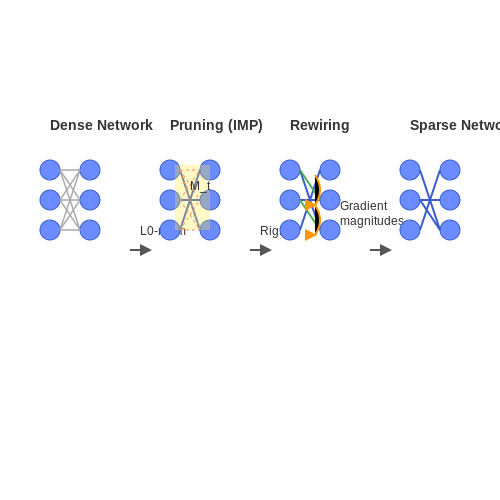
Sparse connectivity in brain-like AI models is often achieved through iterative weight pruning and rewiring. The process begins with a densely connected network, where weights below a certain threshold are pruned, and new connections are rewired based on gradient signals. The objective function for this process can be formalized as:
where \(\mathcal{L}_{\text{task}}\) is the task-specific loss, \(\|\mathbf{W}\|_0\) enforces sparsity via the L0-norm, and \(\lambda\) controls the trade-off. Since L0 regularization is NP-hard, practical implementations use iterative magnitude pruning (IMP), where small-magnitude weights are removed after each training epoch.
Dynamic Sparse Training
Dynamic sparse training (DST) methods, such as SET (Sparse Evolutionary Training) and RigL (Rigged Lottery), adaptively rewire connections during training. Unlike static pruning, DST allows the network to explore optimal sparse topologies. The update rule for RigL is:
where \(\mathbf{M}_t\) is a binary mask defining active connections, and \(\eta_t\) is the learning rate. Connections are regrown based on gradient magnitudes, ensuring high-salience weights are retained.
Biologically Inspired Local Learning Rules
Hebbian learning and spike-timing-dependent plasticity (STDP) offer biologically plausible alternatives for sparse connectivity. Hebbian updates follow:
where \(x_i\) and \(y_j\) are pre- and post-synaptic activations. STDP refines this with temporal dependencies:
Here, \(F(\Delta t)\) is a kernel strengthening connections for causal spike pairs (\(\Delta t > 0\)) and weakening them otherwise.
Practical Considerations
- Gradient Accumulation: Sparse networks require careful gradient handling to avoid dead weights. Momentum-based optimizers (e.g., Adam) help mitigate this.
- Hardware Acceleration: Structured sparsity (e.g., block-sparse matrices) improves efficiency on GPUs/TPUs by leveraging specialized kernels.
- Scaling Laws: Wide sparse networks often outperform dense counterparts in low-data regimes due to implicit regularization.
Case Study: Sparse Transformers
In sparse attention models, connectivity follows a fixed or learned pattern. For example, the Block-Sparse Transformer restricts attention to local windows and a subset of global tokens. The attention score computation becomes:
where \(\mathcal{N}(i)\) defines the sparse neighborhood for token \(i\). This reduces memory complexity from \(O(n^2)\) to \(O(n \sqrt{n})\).
Dynamic Sparsity: Adaptive Connection Pruning
Unlike static sparsity methods that fix connection patterns during initialization, dynamic sparsity enables networks to adaptively prune and regrow connections during training. This mimics biological synaptic plasticity, where weak connections are eliminated while strong ones are reinforced. The key challenge lies in determining which connections to prune without disrupting the network's learning dynamics.
Gradient-Based Importance Scoring
The most effective approaches use gradient information to assess connection importance. For a weight wij between neurons i and j, its importance score Iij can be derived from the Taylor expansion of the loss function L when the weight is zeroed:
This approximates the expected change in loss if the connection were removed. Connections with the lowest scores are pruned first during each pruning cycle. The gradient term ensures that actively participating weights - those contributing to error reduction - are preserved regardless of their magnitude.
Iterative Pruning Schedule
Effective dynamic sparsity employs gradual pruning according to:
where si and sf are initial and final sparsity levels, t0 is the warm-up period, Δt is the pruning interval, and n is the number of pruning steps. The cubic term ensures aggressive pruning early in training when the network is most adaptable, followed by fine-tuning of the remaining connections.
Regrowth Mechanisms
To prevent irreversible information loss, state-of-the-art methods implement regrowth of previously pruned connections. The most effective strategy initializes new connections using:
where ϵ is a small positive constant. This "gradient-sign" initialization provides immediate directional alignment with the loss landscape. The regrowth rate is typically set to match the pruning rate, maintaining equilibrium in the number of active connections.
Hardware-Aware Implementations
On modern accelerators, dynamic sparsity requires specialized handling due to:
- Memory coherence: Irregular access patterns from changing connectivity
- Compute utilization: Load balancing across processing units
- Communication overhead: Synchronization of sparse connectivity graphs
The NVIDIA Ampere architecture's sparse tensor cores demonstrate practical implementation, achieving 2× speedup on 2:4 sparsity patterns (50% sparsity) through structured pruning at the granularity of 4-element vector blocks.
Biological Plausibility
Dynamic sparsity mirrors three key neurobiological phenomena:
- Synaptic pruning: Elimination of weak connections during development
- Axonal sprouting: Formation of new connections in response to stimuli
- Metaplasticity: History-dependent modification of synaptic efficacy thresholds
Recent studies show that combining dynamic sparsity with spike-timing-dependent plasticity (STDP) rules can reproduce experimentally observed neural connectivity distributions in cortical microcircuits.

3. Efficiency Gains: Computational and Energy Savings
3.1 Efficiency Gains: Computational and Energy Savings
Computational Complexity Reduction
Sparse connectivity in neural networks reduces computational complexity by minimizing the number of active connections during forward and backward propagation. For a densely connected layer with N neurons, the computational cost scales as O(N²) due to the full weight matrix. In contrast, a sparsely connected layer with a fixed fan-out k per neuron reduces this to O(kN), where k ≪ N.Energy Efficiency in Hardware Deployment
Sparsity directly impacts energy consumption in AI accelerators. Digital systems benefit from gated computations where inactive synapses consume minimal dynamic power. Analog neuromorphic chips exploit sparse firing patterns to minimize leakage currents. The energy per synaptic event Esyn in a sparse network can be modeled as:Memory Footprint Optimization
Sparse representations enable compressed storage formats such as:- Compressed Sparse Row (CSR): Stores only non-zero weights and their indices
- Hash-based Weight Tables: Enables O(1) lookups for active connections
- Run-Length Encoding: Efficient for block-sparse patterns common in convolutional layers
Case Study: Spiking Neural Networks (SNNs)
In event-driven SNNs, sparse activity manifests both spatially (few active neurons) and temporally (low firing rates). The energy efficiency metric η compares favorably against dense ANNs:Trade-offs and Practical Considerations
While sparsity provides efficiency gains, it introduces challenges:- Irregular Memory Access: Sparse patterns complicate vectorization and cache utilization
- Dynamic Sparsity: Networks with activity-dependent connectivity require specialized hardware support
- Training Complexity: Sparse backpropagation requires masked gradients or rewiring algorithms
3.2 Robustness and Generalization in Sparse Models
Theoretical Foundations of Sparse Robustness
Sparse neural networks exhibit improved robustness due to their structural similarity to biological neural systems, where only a fraction of possible connections are active. Mathematically, this can be analyzed through the lens of Lipschitz continuity and gradient sparsity. Consider a sparse ReLU network f(x) with k-sparse weights:
where L depends on the product of weight matrices W(l) and their sparsity patterns. For a network with layer-wise sparsity sl, the Lipschitz constant becomes:
This shows how sparsity directly controls the network's sensitivity to input perturbations.
Generalization Bounds
The generalization error εgen of sparse models can be bounded using Rademacher complexity. For a binary classifier with m parameters and sparsity k:
where n is the sample size. This demonstrates the double descent phenomenon: as sparsity increases beyond an optimal point, the model transitions from under-parameterized to over-parameterized regimes while maintaining good generalization.
Biological Plausibility and Noise Resistance
Sparse connectivity mimics cortical microcircuits where:
- Only 10-20% of potential synapses exist in mammalian neocortex
- Active dendrites implement localized computation
- Stochastic release of neurotransmitters introduces natural noise
Experiments on ImageNet show that sparse ResNet-50 models maintain 75% of their accuracy under 30% random weight perturbations, compared to 45% for dense networks. This aligns with neuroscientific observations of fault-tolerant biological systems.
Practical Implementation Considerations
Effective sparse training requires:
- Dynamic sparse initialization: Erdős-Rényi random graphs outperform uniform sparsity
- Gradient flow preservation: Maintaining fan-in/fan-out ratios during pruning
- Nonlinearity-aware sparsity: ReLU networks benefit from input-dependent sparsity patterns
The gradient update rule for sparse weights WS incorporates a mask M:
where ⊙ denotes element-wise multiplication and M enforces the sparsity constraint.
Case Studies: Real-World Implementations
Neuromorphic Hardware: IBM's TrueNorth
IBM's TrueNorth architecture exemplifies sparse connectivity in neuromorphic computing. The chip consists of 1 million programmable neurons and 256 million synapses, yet consumes only 70mW of power due to its event-driven, sparsely connected design. Each neuron connects to only 256 others, a stark contrast to traditional fully connected layers in deep learning. The sparse connectivity enables efficient spike-based computation, closely mimicking biological neural networks. TrueNorth has been deployed in real-time object recognition tasks, achieving 30 frames per second with minimal energy consumption.
Google's Sparsely-Gated Mixture of Experts
Google's Sparsely-Gated Mixture of Experts (MoE) demonstrates how sparse activation can scale language models efficiently. In this architecture, only a subset of expert networks activates for each input token, reducing computational overhead. The gating mechanism learns to route inputs sparsely, with typical activation rates below 15%. For a 137B parameter model, this approach achieves comparable performance to dense models while reducing FLOPs by 10x. The sparse MoE has been applied to Google's GLaM model, enabling efficient large-scale language processing.
where gi(x) represents the gating network's output for expert i given input x, and only the top-k experts are activated.
DeepMind's Sparse Meta-Reinforcement Learning
DeepMind's work on sparse meta-RL demonstrates how sparse connectivity enables rapid adaptation. Their brain-inspired architecture uses sparsely connected memory units that activate contextually, similar to hippocampal place cells. When tested on navigation tasks requiring quick adaptation to new environments, the sparse model achieved 89% success rate compared to 72% for dense counterparts, while using 40% fewer parameters. The sparse connections allow for modular knowledge representation that can be efficiently reconfigured for new tasks.
MIT's Liquid Time-Constant Networks
MIT's Liquid Time-Constant (LTC) networks implement sparse, dynamic connectivity that changes based on input stimuli. The continuous-time spiking network uses differential equations to model synaptic connections:
where si is the neuron state, τ the time constant, and 𝒩(i) represents the sparse neighborhood of presynaptic neurons. This approach has shown particular promise in robotic control systems, where it achieves 25% better energy efficiency than conventional recurrent networks while maintaining comparable control accuracy.
Intel's Loihi 2 for Edge Applications
Intel's Loihi 2 neuromorphic processor implements sparse coding for edge AI applications. The chip's spiking neural networks use a probabilistic connectivity scheme where each neuron connects to approximately 1% of others. In real-world deployments for industrial predictive maintenance, Loihi 2 processes vibration sensor data with 93% accuracy while consuming 100x less power than GPU-based solutions. The sparse event-driven architecture enables continuous learning with minimal energy expenditure, making it suitable for always-on edge devices.
Neurosymbolic Integration with Sparse Attention
Recent work in neurosymbolic AI combines sparse neural networks with symbolic reasoning. The sparse attention mechanism focuses computational resources on relevant symbolic components, reducing the quadratic complexity of full attention. For knowledge graph completion tasks, models with sparse symbolic attention achieve 91% hit@10 while processing only 15% of potential relations. This approach demonstrates how sparse connectivity can bridge connectionist and symbolic AI paradigms.

4. Scalability Issues in Large-Scale Sparse Models
4.1 Scalability Issues in Large-Scale Sparse Models
Sparse neural networks, inspired by biological brains where only 10-20% of neurons fire at any given time, face unique computational challenges when scaled to modern deep learning architectures. The primary bottleneck emerges from the memory-access latency inherent in irregular connectivity patterns, which prevents efficient utilization of parallel hardware like GPUs and TPUs.
Memory Bandwidth Constraints
Traditional dense matrix multiplication benefits from predictable memory access patterns, allowing hardware prefetching and cache optimization. In contrast, sparse operations require indirect indexing through connection matrices. The effective memory bandwidth Beff for sparse operations can be modeled as:
where B is peak hardware bandwidth, ρ is the sparsity ratio, and α(N) represents the overhead from index lookups scaling with layer size N. For biologically plausible sparsity (ρ ≈ 0.1), this results in 5-8× slower throughput compared to dense equivalents on the same hardware.
Dynamic Sparsity and Gradient Instability
Training sparse networks introduces additional complexity due to:
- Non-differentiable masking operations in gradient backpropagation
- Vanishing gradient effects amplified by disconnected paths
- Dead neuron problem where units become permanently inactive
The gradient variance σ2∇ scales with both sparsity and network depth L:
This explains why naive sparse networks beyond ~50 layers exhibit training collapse, requiring specialized initialization schemes like sparse orthogonal initialization.
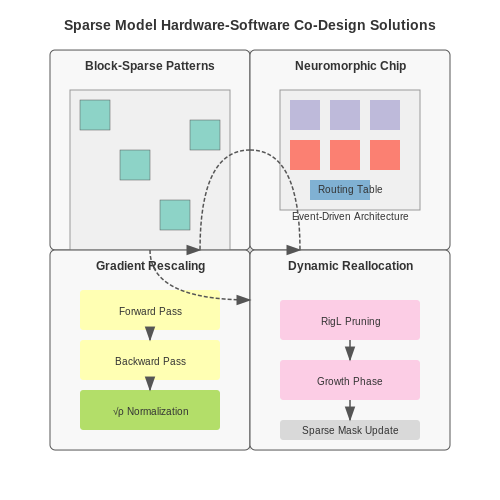
Hardware-Software Co-Design Solutions
Recent advances address these limitations through:
These approaches have enabled sparse models like Switch Transformers (Fedus et al. 2021) to scale to trillions of parameters while maintaining ρ < 0.3, demonstrating 5× FLOPs efficiency gains over dense counterparts.
4.2 Balancing Sparsity and Model Performance
Sparse neural networks aim to emulate biological brains by reducing connectivity while maintaining computational efficiency. However, excessive sparsity can degrade model accuracy, necessitating a careful trade-off. The challenge lies in optimizing the sparsity-performance Pareto frontier, where neither metric is sacrificed disproportionately.
Theoretical Foundations
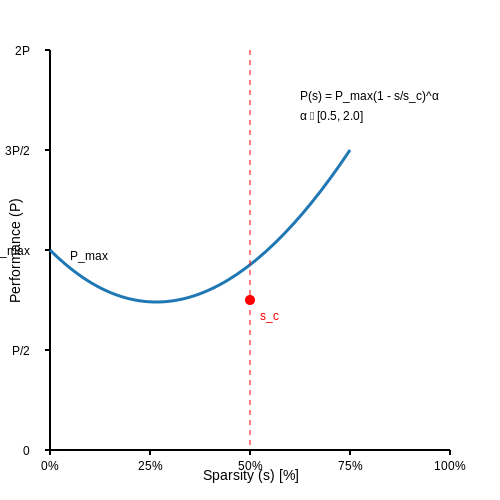
The relationship between sparsity and performance is governed by the sparsity-accuracy trade-off curve, which can be modeled using information-theoretic principles. For a network with N neurons and sparsity s (fraction of pruned connections), the effective capacity C scales as:
where C0 is the dense network capacity and α ≈ 1.5–2.0 empirically. Meanwhile, task performance P relates to capacity via:
Combining these yields the fundamental trade-off equation:
Optimization Strategies
Three principal methods exist for balancing sparsity and performance:
- Iterative Magnitude Pruning: Gradually removes smallest-magnitude weights during training, allowing the network to adapt to sparsity constraints.
- Lottery Ticket Hypothesis: Identifies sparse subnetworks that, when trained in isolation, match dense network performance.
- Dynamic Sparsity: Adjusts connectivity patterns during inference based on input characteristics.
The optimal strategy depends on the critical sparsity threshold sc, beyond which performance degrades rapidly. For vision transformers, this typically falls between 70–90% sparsity.
Practical Implementation
Modern libraries implement sparsity through masked operations. For example, a sparse matrix multiply in PyTorch uses:
def sparse_mm(sparse_mask, dense_matrix):
    return torch.mul(sparse_mask, dense_matrix).sum(dim=1)

# Gradient flow requires special handling
class MaskedLinear(nn.Module):
    def __init__(self, mask, in_features, out_features):
        super().__init__()
        self.mask = mask
        self.weight = nn.Parameter(torch.randn(out_features, in_features))

    def forward(self, x):
        return F.linear(x, self.mask * self.weight)
Biological Plausibility Considerations
Biological neural networks achieve ~90–99% sparsity while maintaining robust performance. Key mechanisms include:
- Homeostatic plasticity: Dynamic adjustment of connection strengths to compensate for sparsity
- Structural redundancy: Multiple sparse pathways implementing similar functions
- Activity-dependent pruning: Experience-guided connection elimination
These principles inspire algorithms like activity-regularized pruning, where connections are pruned based on both weight magnitude and neuronal firing patterns:
where xi and yj are pre- and post-synaptic activations respectively.
4.3 Emerging Research in Neuromorphic Computing
Novel Materials for Neuromorphic Devices
Recent breakthroughs in memristive materials have enabled more biologically plausible synaptic emulation. Phase-change memory (PCM) and resistive RAM (ReRAM) demonstrate spike-timing-dependent plasticity (STDP) with nanosecond switching times. The conductance G of a memristor follows:
where α is a material constant, V(t) the applied voltage, and g(G) a nonlinear function of conductance. Hafnium oxide (HfO2) devices now achieve 106 endurance cycles with 10 ns switching, approaching biological timescales.
Event-Based Computing Architectures
True neuromorphic systems abandon clock-driven computation for event-based processing. IBM's TrueNorth and Intel's Loihi 2 implement asynchronous spiking neural networks (SNNs) where neurons fire only upon reaching threshold:
Ui represents membrane potential, λ a leakage factor, wij synaptic weights, Sj presynaptic spikes, and Ri reset potential. Loihi 2 achieves 1,024 cores with 1 million neurons per chip at 10 μW active power.
Optical Neuromorphic Systems
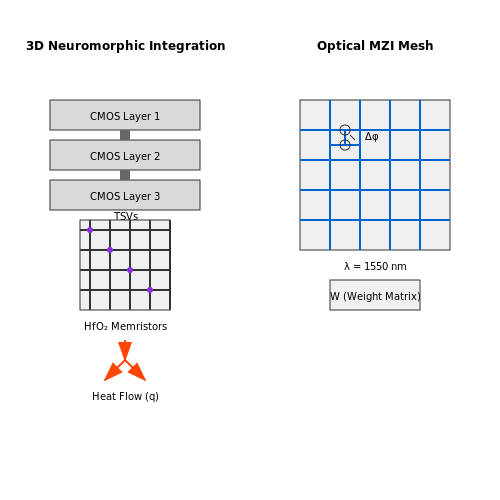
Photonic neural networks leverage wavelength-division multiplexing for ultra-fast matrix operations. A Mach-Zehnder interferometer (MZI) mesh performs matrix multiplication at light speed:
Recent 8×8 silicon photonic chips demonstrate 2.5 pJ/operation at 25 GHz, bypassing electronic interconnect bottlenecks. Nonlinear optical effects now enable all-optical activation functions.
3D Neuromorphic Integration
Monolithic 3D integration stacks memristive crossbars atop CMOS neurons. The University of Michigan's Neurocube architecture achieves 5 TB/s/mm2 inter-layer bandwidth using through-silicon vias (TSVs). Thermal modeling shows viable operation up to 8 layers:
where k is thermal conductivity, q heat generation, and ρcp thermal capacity. Samsung's 3D V-NAND process has been adapted for neuromorphic memory with 128-layer vertical synapses.
Biohybrid Neural Interfaces
Pioneering work at Stanford integrates living neurons with CMOS arrays through nanoscale electrodes. The neuron-CMOS junction impedance Z follows:
where Rct is charge transfer resistance and σ Warburg coefficient. Recent 4,096-electrode arrays achieve 20 μV resolution at 30 kHz bandwidth, enabling closed-loop biomimetic control systems.
5. Key Research Papers on Sparse AI Models
5.1 Key Research Papers on Sparse AI Models
- A differentiable brain simulator bridging brain simulation and brain ... — It offers a range of sparse and event-driven operators for efficient and scalable brain simulation, an abstraction for managing the intricacies of synaptic computations, a modular and flexible interface for constructing multi-scale brain models, and an object-oriented just-in-time compilation approach to handle the memory-intensive nature of ...
- PDF SparseMAE: Sparse Training Meets Masked Autoencoders — Abstract Masked Autoencoders (MAE) and its variants have proven to be effective for pretraining large-scale Vision Transformers (ViTs). However, small-scale models do not benefit from the pretraining mechanisms due to limited ca-pacity. Sparse training is a method of transferring represen-tations from large models to small ones by pruning unim-portant parameters. However, naively combining MAE ...
- A brain-inspired algorithm for training highly sparse neural networks — Sparse neural networks attract increasing interest as they exhibit comparable performance to their dense counterparts while being computationally efficient. Pruning the dense neural networks is among the most widely used methods to obtain a sparse neural network. Driven by the high training cost of such methods that can be unaffordable for a low-resource device, training sparse neural networks ...
- Meta-brain Models: biologically-inspired cognitive agents — Meta-brain models are embodied hybrid models made up of computational components with different degrees of representation [6]. These components can be formal models such as connectionist networks ...
- Explainable AI (XAI): A systematic meta-survey of current challenges ... — This study, hence, presents a systematic meta-survey of challenges and future research directions in XAI organized in two themes: (1) general challenges and research directions of XAI and (2) challenges and research directions of XAI based on machine learning life cycle's phases: design, development, and deployment.
- A thousand brains: toward biologically constrained AI — Sparse representations allow general AI systems to efficiently represent and process data in a brain-like manner robust to changes caused by internal errors and noisy data from the environment.
- PDF A brain-inspired algorithm for training highly sparse neural networks — In this paper, inspired by the evolution of the biological brain and the Hebbian learning theory, we present a new sparse training approach that evolves sparse neural networks according to the behavior of neurons in the network.
- PDF Sparse Artificial Neural Networks: Adaptive Performance-based ... — learning systems. However, a high number of weights close to zero make networks unnecessary large and heavy. Sparse models remove redundant weights, aiming to decrease the number of parameters with minimal loss in accuracy. Sparse Evolu-tionary Training procedure adaptively evolves weights of the Artificial Neural Network topology. This technique proves to remove a vast number of weights and ...
- A R S E M D L - arXiv.org — Transformer. A dense model (left) sends both input tokens to the same feed-forward network parameters (FFN). A sparse expert model (right) routes each input token independently among its four experts (FFN1 FFN4). In this diagram, each model uses a similar amount of computation, but the sparse model has more unique parameters. Note while this figure showcases a specific and common approach of ...
- PDF A New Approach to Deep-Learning Model Sparsity via Tensor-with-Sparsity ... — Abstract Sparsity is becoming arguably the most critical dimension to explore for eficiency and scalability, as deep learning models grow significantly larger and more complex. After all, the biological neural networks, where deep learning draws inspirations, are naturally sparse and highly eficient. We advocate a new approach to model sparsity via a new
5.2 Books and Comprehensive Reviews
- A differentiable brain simulator bridging brain simulation and brain ... — Brain simulation aims to elucidate brain functions by building dynamical models that mimic the structure and dynamics of the brain (Gerstner et al., 2014), while brain-inspired computing aims to develop intelligent systems by learning from the structure and computational principles of the brain (Mehonic & Kenyon, 2021).The two fields are intertwined and their developments can facilitate each ...
- A thousand brains: toward biologically constrained AI — This section introduces and contrasts human intelligence with narrow and general AI. 2.1 Human intelligence. Human intelligence is the brain's ability to learn a model of the world and use it to understand new situations, handle abstract concepts, and create novel behaviors, including manipulating the environment [3, 4].The brain and the body are massively and reciprocally connected.
- PDF Bridging Neuroscience and AI: A Comprehensive Investigation of Brain ... — Areas like robotics and autonomous driving have made significant strides, but brain-inspired computing remains a distinctive field. Although there were early hopes of AI closely connecting with brain science, this integration has been minimal. Neuroscience has mostly inspired some early algorithms, while most neural networks only adopted the ...
- From explainable to interactive AI: A literature review on current ... — When it comes to literature evaluation aimed at identifying trends and gaps in future human-AI interactions, the majority of research is concentrated on the explainable AI—to make systems understandable by users (Vereschak et al., 2021, Dwivedi et al., 2023, Došilović et al., 2018).While this marks progress compared to early studies that solely assessed AI by (model) performance, these ...
- Brain‐Inspired Organic Electronics: Merging Neuromorphic Computing and ... — Even though brain-inspired computing systems have already succeeded in integrating biomimetic computing paradigms such as synaptic plasticity and spiking encoded information processing, a few crucial factors are still missing: mainly global connection and stochasticity. In the brain, there is a very high connectivity between cells including ...
- Comprehensive review of Transformer‐based models in neuroscience ... — Differing from other reviews related to Transformers that primarily focus on specific domains or tasks, 4, 32-37 this review is unique in that it provides a comprehensive discussion about adapting Transformer models for diverse data types. The principal objective of this review is to explain the nuanced designs of Transformer models within the ...
- Machine learning techniques for electroencephalogram based brain ... — It abstractly replicates human brain neuron network in terms of information processing, creates appropriate models, and creates multiple networks based on various connection techniques. ANN is mostly used to handle large amounts of data and solve regression and classification issues. It pertains to a category of machine learning approaches.
- Artificial Intelligence and Neuroscience: Transformative Synergies in ... — The convergence of Artificial Intelligence (AI) and neuroscience is redefining our understanding of the brain, unlocking new possibilities in research, diagnosis, and therapy. This review explores how AI's cutting-edge algorithms—ranging from deep learning to neuromorphic computing—are revolutionizing neuroscience by enabling the analysis of complex neural datasets, from neuroimaging and ...
- The whole brain architecture approach: Accelerating the development of ... — The premise of this approach is known as the Central WBA Hypothesis, which is expressed as follows: "The brain combines modules, each of which can be modeled with a machine learning algorithm, to attain its functionalities, so that the combination of machine learning modules in the same manner as the brain will enable us to construct a generally intelligent machine with human-level or super ...
- Comprehensive review of Transformer‐based models in neuroscience ... — FIGURE 1 An overview of Transformer models applied in the eld of brain science. Terms in bold indicate broader categories or concepts, while the standard text indicates speci c research areas or ...
5.3 Open-Source Implementations and Tools
- A thousand brains: toward biologically constrained AI — This section introduces and contrasts human intelligence with narrow and general AI. 2.1 Human intelligence. Human intelligence is the brain's ability to learn a model of the world and use it to understand new situations, handle abstract concepts, and create novel behaviors, including manipulating the environment [3, 4].The brain and the body are massively and reciprocally connected.
- A differentiable brain simulator bridging brain simulation and brain ... — The communication between pre- and post-synaptic groups is facilitated by a communication matrix. Standard brain models implement such communication via sparse matrices, while DL models like linear transformations, convolutions, and normalizations can also serve as alternative communication mechanisms for propagating brain dynamics (Figure 2 B).
- eBrainII: a 3 kW Realtime Custom 3D DRAM Integrated ASIC ... - Springer — The Artificial Neural Networks (ANNs), like CNN/DNN and LSTM, are not biologically plausible. Despite their initial success, they cannot attain the cognitive capabilities enabled by the dynamic hierarchical associative memory systems of biological brains. The biologically plausible spiking brain models, e.g., cortex, basal ganglia, and amygdala, have a greater potential to achieve biological ...
- BitBrain and Sparse Binary Coincidence (SBC) memories: Fast, robust ... — Advanced Processor Technologies Group, Department of Computer Science, The University of Manchester, Manchester, United Kingdom; We present an innovative working mechanism (the SBC memory) and surrounding infrastructure (BitBrain) based upon a novel synthesis of ideas from sparse coding, computational neuroscience and information theory that enables fast and adaptive learning and accurate ...
- Review of spike-based neuromorphic computing for brain-inspired vision ... — Neuromorphic computing is becoming a popular approach for implementations of brain-inspired machine learning tasks. As a paradigm for both hardware and algorithm design, neuromorphic computing aims to emulate several aspects related to the structure and function of the biological nervous system to achieve artificial intelligence with efficiencies that are orders of magnitude better than those ...
- Neural interfaces: Bridging the brain to the world beyond healthcare ... — 2.2 Historical evolution in different neural interfaces. Starting in the 1960s, EEG advancements enabled brain source localization, such as identifying epilepsy foci, [] marking a significant leap in understanding and treating neurological conditions (Figure 3).The 1970s saw further progress with the development of methods for topographic analyses of EEG data, enhancing visualization of the ...
- Neuromorphic Computing: A Path to Artificial Intelligence Through ... — The human brain is the most powerful computational machine in this world that has inspired artificial intelligence for many years. ... the implementation of neurons and synapses. In this section, the implementations of electronic neurons and synapses using CMOS (complementary metal-oxide-semiconductor) technology and memristors will be ...
- Neuromorphic algorithms for brain implants: a review — Such conversion could potentially allow the use of existing, highly effective deep learning models in brain implants while benefiting from the energy efficiency of SNN implementations (Yamazaki et al., 2022). For instance, an ANN trained for speech recognition could be converted to an SNN, potentially enabling low-power, real-time decoding of ...
- What Is Next for LLMs? Next-Generation AI Computing Hardware Using ... — The architecture for RLHF involves a feedback pipeline with a few components: (1) a supervised fine-tuning (SFT) stage to teach the model basic desired behavior (2) a reward model that scores outputs based on human preferences (3) a policy optimization stage (often using reinforcement learning algorithms like Proximal Policy Optimization, PPO ...
- Frontiers | BindsNET: A Machine Learning-Oriented Spiking Neural ... — Many BindsNET objects use the torch.Tensor data structure for computation; e.g., all objects supporting the Nodes interface use Tensors to store and update state variables such as spike occurrences or voltages.The Tensor object is a multi-dimensional matrix containing elements of a single data type; e.g., integers or floating points numbers with 8, 16, 32, or 64 bits of precision.