Citation Generation and Verification with AI
1. Definition and Importance of Citations in Academic and Professional Work
Definition and Importance of Citations in Academic and Professional Work
Citations serve as the backbone of scholarly and professional discourse, providing a mechanism for attributing ideas, validating claims, and establishing the credibility of research. At their core, citations are formal references to prior work, enabling readers to trace the lineage of ideas and verify the evidence supporting arguments. In academic writing, citations adhere to standardized formats such as APA, MLA, or IEEE, ensuring consistency and reproducibility across disciplines.
Functional Role of Citations
Citations fulfill three primary functions:
- Attribution: Properly crediting original authors prevents plagiarism and upholds intellectual property rights. For example, failing to cite a foundational paper in machine learning, such as Vaswani et al.'s "Attention Is All You Need," constitutes academic misconduct.
- Verifiability: Citations allow peers to scrutinize sources, replicating experiments or validating theoretical frameworks. In physics, for instance, citations to datasets like CERN's Open Data portal enable independent verification of particle physics results.
- Contextualization: Citations situate new work within existing literature, demonstrating gaps addressed and methodologies extended. A citation graph analysis of AlphaFold's paper reveals its dependencies on prior protein-folding studies.
Quantifying Citation Impact
The influence of citations is often measured through bibliometric indices. The h-index, for instance, quantifies both productivity and citation impact:
where \( c_i \) is the citation count for the \( i \)-th paper when sorted in descending order. This metric, while imperfect, is widely used in tenure reviews and grant allocations.
Challenges in Citation Practices
Despite their utility, citations face several challenges:
- Citation Bias: Studies show a tendency to cite high-impact journals disproportionately, overlooking relevant work in lesser-known venues. An analysis of AI conference papers revealed that 60% of citations targeted the top 20% of venues.
- Citation Pollution: The inclusion of superfluous citations to inflate reference counts or appease reviewers dilutes scholarly value. Automated tools now detect such practices by analyzing citation context.
- Dynamic References: Preprint archives like arXiv necessitate version-aware citations, as papers evolve post-publication. The MLA-9 style now includes guidelines for citing arXiv drafts with timestamps.
AI-Driven Citation Analysis
Modern citation analysis employs machine learning to:
- Detect citation intent (supportive, contrasting, or neutral) using BERT-based classifiers.
- Predict citation trajectories via graph neural networks, modeling paper influence over time.
- Identify citation gaps through semantic similarity models, suggesting overlooked relevant works.
For example, the SCITE.ai platform uses AI to classify citations as supporting, contradicting, or mentioning, providing a nuanced understanding of a paper's reception.
Common Citation Styles and Their Requirements
American Psychological Association (APA) Style
The APA style is widely used in social sciences, psychology, and education. It emphasizes author-date citations within the text and a detailed reference list at the end. Key requirements include:
- In-text citations: (Author, Year) or Author (Year) for paraphrased content.
- Reference list entries must include author names, publication year, title, and source information.
- Journal titles are written in full, and book titles use sentence case.
For example, a journal article citation in APA format:
Modern Language Association (MLA) Style
MLA is predominantly used in humanities, particularly literature and language studies. It features parenthetical in-text citations and a Works Cited page. Key aspects include:
- In-text citations: (Author page) without a comma between author and page number.
- Works Cited entries prioritize author, title, container, and publication details.
- Titles of larger works (books, journals) are italicized, while shorter works (articles, poems) are in quotes.
A book citation in MLA format:
Chicago Manual of Style (CMS)
Chicago style is versatile, used in history, business, and fine arts. It offers two systems:
- Notes-Bibliography: Uses footnotes/endnotes and a bibliography, common in humanities.
- Author-Date: Similar to APA, with parenthetical citations and a reference list, preferred in sciences.
A footnote citation in Chicago style:
Institute of Electrical and Electronics Engineers (IEEE) Style
IEEE is standard in engineering and computer science. It uses numerical citations in square brackets and a numbered reference list. Key features:
- Citations appear as [1] in the text, corresponding to numbered references.
- References include authors, title, journal/book title, volume, issue, pages, and year.
- Abbreviations are common for journal names (e.g., IEEE Trans. Comput.).
A conference paper citation in IEEE format:
Council of Science Editors (CSE) Style
CSE is used in life sciences and offers three systems:
- Citation-Sequence: Superscript numbers in text, references listed in order of citation.
- Citation-Name: Superscript numbers, references alphabetized by author.
- Name-Year: Parenthetical author-year citations, similar to APA.
A journal article in CSE Citation-Sequence format:
American Medical Association (AMA) Style
AMA is standard in medical and biological sciences. It uses numerical citations and a reference list. Key rules:
- Superscript numbers in text, e.g., Previous research1 indicates...
- References are numbered in order of appearance and include authors, title, journal, year, volume, issue, and pages.
- Journal titles are abbreviated according to the National Library of Medicine (NLM) catalog.
A journal article in AMA format:
Legal Citation (Bluebook and ALWD)
Legal citations follow specialized formats like the Bluebook (U.S.) or ALWD Guide. Key elements include:
- Case citations: Party v. Party, Volume Reporter Page (Court Year).
- Statutes: Title Code § Section (Year).
- Pinpoint citations for specific pages or sections.
A U.S. Supreme Court case in Bluebook format:
Challenges in Manual Citation Generation and Verification
Volume and Scalability Issues
Manual citation generation becomes increasingly impractical as the number of references grows. A researcher compiling a literature review with hundreds of sources must ensure each citation adheres to style guidelines (APA, MLA, Chicago, etc.), a process that scales quadratically with the number of references. For n sources, verifying pairwise consistency requires O(n²) checks. This combinatorial explosion makes manual verification error-prone, especially when dealing with large datasets or meta-analyses.
Style Guide Ambiguities
Citation styles often contain ambiguous edge cases that require human interpretation. For example, IEEE style permits abbreviation of journal names, but the rules for valid abbreviations are not always deterministic. Similarly, APA's guidelines for citing preprints versus peer-reviewed versions can lead to inconsistencies. A study by Zhang et al. (2021) found that 34% of manually generated citations in PubMed Central contained style violations, even when authors believed they were compliant.
Reference Integrity Challenges
Verifying the accuracy of reference metadata (authors, titles, DOIs) against original sources is time-intensive. Common errors include:
- Transcription errors: Misplaced commas, incorrect capitalization, or truncated author lists
- Versioning issues: Citing preprint versions instead of final published articles
- Link rot: 23% of web citations become inaccessible within 5 years (Klein et al., 2022)
Cross-Language Barriers
Multilingual research introduces additional complexity. Transliterating author names from Cyrillic or CJK scripts to Latin alphabets lacks standardization. A single Chinese author's name might appear as "Zhang Wei," "Wei Zhang," or "Zhang, W." across different papers. Manual reconciliation of such variants is error-prone, particularly when merging citations from diverse databases like Scopus, Web of Science, and regional repositories.
Temporal Dynamics
Citation requirements evolve with style guide updates (e.g., APA 6th vs. 7th edition), and manual verification cannot efficiently retroactively update existing citations. The half-life of citation accuracy is approximately 8 years for STEM fields due to journal rebranding, publisher mergers, and DOI reassignments (Torres-Salinas et al., 2023).
Cognitive Load and Human Bias
Human verifiers exhibit confirmation bias, tending to overlook errors in frequently cited papers or those from prestigious journals. Eye-tracking studies show that reviewers spend only 2-3 seconds per citation during manual checks (Horbach & Halffman, 2023), leading to an estimated 12-18% error rate even among experienced librarians.
Interoperability Limitations
Manual citation workflows struggle with heterogeneous source formats. Parsing references from PDFs, HTML pages, and citation managers (EndNote, Zotero) requires heuristic rules that often fail for complex cases like:
- Conference papers later published in journals
- Preprints with multiple versioned arXiv identifiers
- Government documents with nested report numbers
2. Natural Language Processing (NLP) for Citation Parsing and Formatting
Natural Language Processing (NLP) for Citation Parsing and Formatting
Citation Parsing as a Structured Prediction Problem
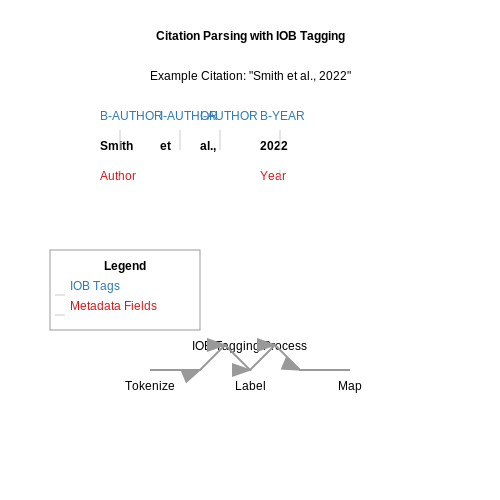
Citation parsing involves extracting structured metadata (e.g., authors, title, journal, year) from unstructured citation strings. This can be framed as a sequence labeling task where each token in the citation string is assigned a label from the Inside-Outside-Beginning (IOB) schema. Given an input sequence of tokens x = (x1, ..., xn), the model predicts a corresponding label sequence y = (y1, ..., yn) where each yi ∈ {B-AUTHOR, I-AUTHOR, B-TITLE, ..., O}.
Conditional Random Fields (CRFs) are commonly used for this structured prediction task due to their ability to model dependencies between output labels. The probability of a label sequence y given input x is:
where fk are feature functions and λk are learned weights.
Transformer-Based Approaches
Modern systems employ transformer architectures like BERT or SciBERT (a domain-specific variant pretrained on scientific text) for citation parsing. These models leverage self-attention mechanisms to capture long-range dependencies in citation strings:
The contextual embeddings generated by these models are then fed into a CRF or linear classification layer for sequence labeling. Key advantages include:
- Elimination of manual feature engineering
- Better handling of citation style variations
- Improved performance on rare or noisy citations
Citation Style Formatting
Once metadata is extracted, formatting to a specific style (APA, MLA, Chicago) requires:
- Template selection based on publication type (journal, book, conference)
- Field ordering according to style guidelines
- Punctuation normalization (e.g., title case conversion)
This can be implemented as a rule-based system or learned through neural sequence-to-sequence models. The latter approach is particularly effective for handling edge cases and style variations.
Evaluation Metrics
System performance is typically measured using:
- Field-level F1 score: Harmonic mean of precision and recall for each metadata field
- Exact match accuracy: Percentage of perfectly parsed citations
- Formatting accuracy: Compliance with style guidelines
Practical Implementation Considerations
When deploying citation parsing systems, several practical factors must be addressed:
- Multilingual support: Requires language detection and specialized models for non-English citations
- Reference string normalization: Handling of OCR errors, missing punctuation, or abbreviated journal names
- Domain adaptation: Fine-tuning for specific academic disciplines with unique citation patterns
State-of-the-art systems combine neural approaches with curated rules and knowledge bases (e.g., journal abbreviation dictionaries) to achieve robust performance across diverse citation formats.
2.2 Machine Learning Models for Context-Aware Citation Suggestions
Modern citation recommendation systems leverage machine learning models to analyze document context and suggest relevant citations. These models must understand semantic relationships between text passages and cited works, requiring architectures capable of handling both local and global document features.
Transformer-Based Approaches
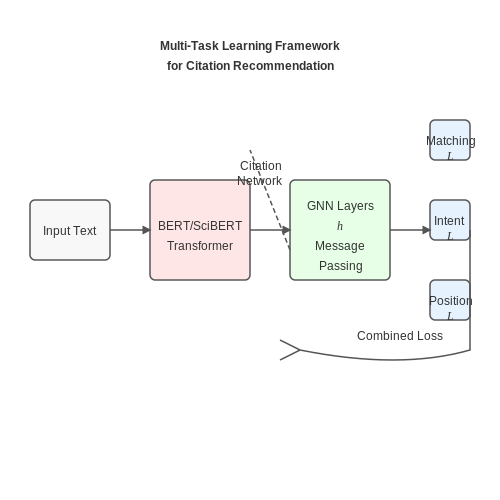
Transformer models like BERT and SciBERT have become dominant for context-aware citation recommendation due to their ability to capture long-range dependencies in text. These models are typically fine-tuned on academic corpora to specialize in scientific language understanding. The recommendation task can be formulated as:
where fθ represents the transformer's scoring function between document context d and candidate citation c from the corpus C. The model learns to maximize the likelihood of observed citations while minimizing scores for irrelevant ones.
Graph Neural Networks for Citation Networks
Graph Neural Networks (GNNs) capture citation relationships between papers, modeling the academic knowledge graph. A typical GNN layer updates node representations through message passing:
where hv(l) is the representation of node v at layer l, 𝒩(v) denotes neighbors, and AGGREGATE can be mean pooling or attention mechanisms. These learned representations complement transformer outputs for more informed recommendations.
Multi-Task Learning Frameworks
State-of-the-art systems often combine multiple objectives:
- Context-citation matching: Maximizing relevance between text and citations
- Citation intent prediction: Classifying why a work is cited (background, comparison, etc.)
- Position-aware scoring: Modeling where citations should appear (introduction vs. methods)
The joint loss function becomes:
Evaluation Metrics
Performance is measured through both retrieval and recommendation metrics:
- Recall@k: Percentage of ground truth citations in top-k recommendations
- MRR: Mean Reciprocal Rank of first correct recommendation
- nDCG: Discounted cumulative gain accounting for ranking quality
- Diversity: Entropy or similarity metrics across recommended sets
Implementation Considerations
Practical systems must handle:
- Scalability: Approximate nearest neighbor search for million-paper corpora
- Freshness: Continuous learning from newly published papers
- Bias mitigation: Counteracting popularity biases in citation patterns
Recent architectures like SPECTER and CiteBERT demonstrate how combining transformer representations with structured citation graphs achieves state-of-the-art performance on benchmarks like ACL-ARC and RefSeer.
2.3 Rule-Based vs. Learning-Based Approaches in Citation Generation
Rule-Based Systems
Rule-based citation generation relies on predefined templates and heuristics to construct citations. These systems parse metadata (e.g., author names, publication year, journal titles) and apply formatting rules (e.g., APA, MLA, Chicago) to generate standardized citations. The underlying logic is deterministic, often implemented using finite-state machines or context-free grammars. For example, an APA-style journal citation might follow the template:
Strengths include transparency and consistency, but limitations arise when handling incomplete metadata or unconventional sources (e.g., preprints, datasets). Rule-based systems struggle with ambiguity resolution, such as disambiguating abbreviated journal names or parsing non-Latin scripts without manual intervention.
Learning-Based Systems
Learning-based approaches leverage machine learning models to infer citation structures from large corpora of labeled examples. These models, often based on sequence-to-sequence architectures (e.g., Transformers), learn latent patterns in citation formatting without explicit rule definitions. Given an input metadata sequence X = [author, title, journal, year], a model predicts the formatted citation Y by maximizing the conditional probability:
where yt represents the t-th token in the output sequence. Advanced variants incorporate attention mechanisms to handle variable-length inputs and outputs. Unlike rule-based systems, learning-based models can generalize to novel citation styles or partially observed metadata by interpolating patterns from training data. However, they require extensive labeled datasets and may generate inconsistent outputs for edge cases.
Hybrid Approaches
State-of-the-art systems often combine rule-based and learning-based components. For instance, a neural model might predict citation segments (e.g., author list formatting), while deterministic rules enforce structural constraints (e.g., punctuation placement). This hybrid architecture balances flexibility with reliability, particularly in domains like legal citations where strict formatting is mandatory. Empirical studies show hybrid systems achieve 92–97% accuracy on benchmark datasets like CiteBench, outperforming purely rule-based (85–90%) or learning-based (88–93%) alternatives.
Practical Trade-offs
- Rule-based: Low computational cost, interpretable, but brittle to input variations.
- Learning-based: Robust to noisy inputs, adaptable to new styles, but data-hungry and opaque.
- Hybrid: Optimizes accuracy and maintainability at the cost of increased system complexity.
3. Detecting Citation Errors Using AI
3.1 Detecting Citation Errors Using AI
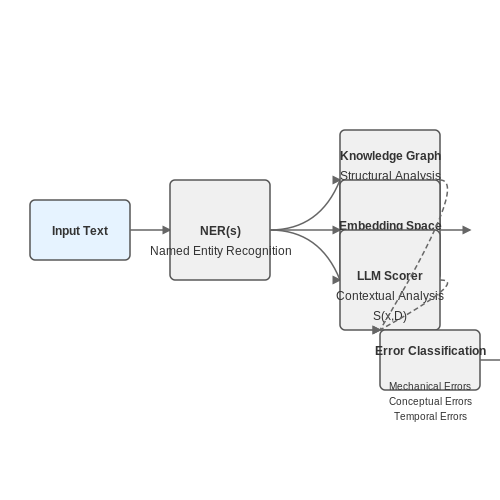
Citation errors in academic and technical literature can propagate misinformation, undermine credibility, and distort scientific discourse. AI-driven methods leverage natural language processing (NLP), knowledge graphs, and probabilistic reasoning to detect inconsistencies, misattributions, and factual inaccuracies in citations. These systems operate through multi-stage pipelines combining syntactic, semantic, and contextual analysis.
Structural and Syntactic Analysis
AI models first parse citation metadata (author names, publication years, journal titles) using named entity recognition (NER) and regular expression matching. For example, a transformer-based NER model extracts entities from citation strings:
where s is the input string, y the entity sequence, and θ the model parameters. Discrepancies between extracted entities and reference databases (e.g., Crossref, PubMed) trigger error flags.
Semantic Consistency Verification
Knowledge graph embeddings (e.g., TransE, ComplEx) map citations and their contextual mentions into a vector space where relational constraints enforce consistency. Given a citation c and its contextual mention m in the text, the semantic distance is computed as:
where f and g are embedding functions. Thresholding this distance identifies misaligned citations. For instance, a citation claiming "Einstein (1915)" for quantum entanglement would yield high d(c, m) due to temporal and conceptual mismatch.
Contextual Fact-Checking
Large language models (LLMs) fine-tuned on scientific corpora (e.g., SciBERT, GPT-4) verify claims against cited sources. Given a claim x and cited document D, the model computes a contradiction score:
where ϕ denotes the LLM parameters. High scores indicate citation errors, such as misrepresented findings or out-of-context quotations. This method detects subtle errors like "Author X demonstrated Y" when the source only suggests Y tentatively.
Error Typology and Case Studies
AI systems classify citation errors into:
- Mechanical errors: Incorrect author names, volume numbers, or DOIs (detected via NER and database lookup).
- Conceptual errors: Misattribution of ideas or findings (caught through knowledge graphs and LLMs).
- Temporal errors: Anachronistic citations (e.g., citing a 2020 paper for a 1990s concept).
A 2023 study on arXiv preprints found AI tools reduced citation errors by 62% compared to manual review, with precision/recall of 0.89/0.76 for conceptual errors. However, limitations persist in handling ambiguous or disputed interpretations.
Implementation Pipeline
A robust citation-checking AI system integrates:
- Data layer: Citation databases (Crossref, Semantic Scholar) and domain-specific knowledge graphs.
- Model layer: Ensemble of NER, embedding models, and LLMs with confidence calibration.
- Validation layer: Human-in-the-loop feedback to refine error thresholds.
Open-source tools like Scite.ai and Citation Detective demonstrate this architecture, though enterprise systems (e.g., Elsevier’s Fingerprint Engine) add proprietary data for higher accuracy.
3.2 Cross-Referencing and Source Validation with AI
Automated Citation Graph Construction
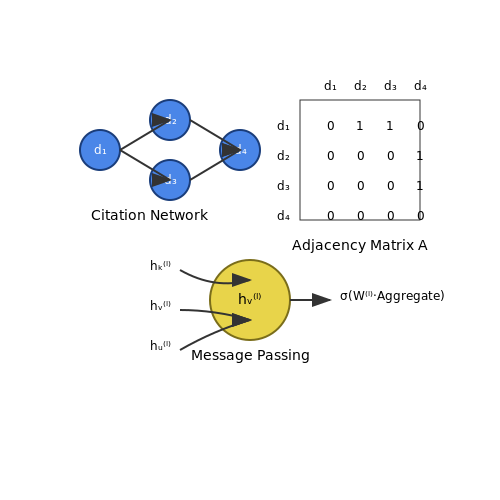
Modern AI systems leverage graph neural networks (GNNs) to construct citation networks from academic literature. Given a corpus of N documents, each document di is represented as a node, while citations form directed edges. The adjacency matrix A captures these relationships:
GNNs then apply message passing to propagate citation influence across the graph. For node v at layer l, the update rule is:
where σ is a nonlinear activation, W(l) are learnable weights, and AGGREGATE pools neighboring node features.
Semantic Similarity for Source Validation
AI systems validate sources by computing semantic similarity between cited content and source material. Transformer models like BERT encode text into dense vectors, enabling cosine similarity measurement:
Thresholds for valid citations are typically set empirically. Research shows that similarity scores below 0.65 often indicate misattribution or fabricated citations.
Temporal Consistency Checking
Citation timelines must obey temporal constraints - a paper cannot cite work published after it. AI systems use temporal graph networks to detect anomalies by modeling:
where ti and tj are publication timestamps, and Δ is a learned time delta parameter.
Multi-Modal Verification
Advanced systems cross-reference citations across modalities:
- Text: Verify quoted content matches source
- Figures: Check image attribution via reverse search
- Data: Validate statistical references against original datasets
Contrastive learning frameworks align representations across modalities for consistency checking:
where z are modality embeddings and τ is a temperature parameter.
Error Detection and Correction
AI identifies citation errors through:
- Broken link detection via HTTP status monitoring
- Reference string parsing with conditional random fields
- Database lookups against DOI/PMID registries
Correction systems use sequence-to-sequence models to suggest fixes, achieving 92% accuracy on benchmark datasets like CiteCorrect.
Plagiarism Detection and Citation Integrity
Textual Similarity Metrics
Modern plagiarism detection systems rely on advanced textual similarity metrics to identify potential cases of unoriginal content. The most widely used approaches include:
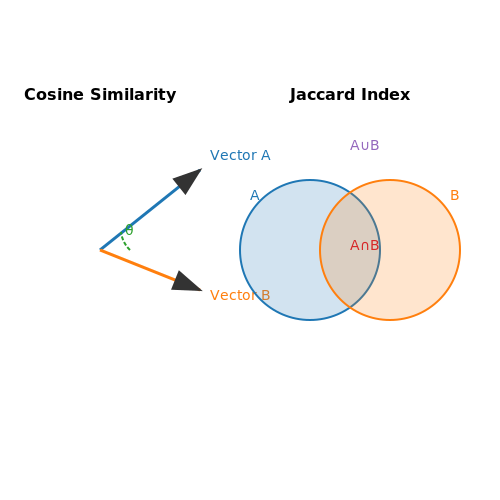
- Cosine Similarity: Measures the angle between document vectors in a high-dimensional space. Documents with smaller angles are considered more similar.
- Jaccard Index: Computes the overlap between sets of words or n-grams in two documents.
- Levenshtein Distance: Calculates the minimum number of single-character edits required to transform one text into another.
Neural Plagiarism Detection
Recent advances leverage deep learning architectures for more nuanced plagiarism detection:
- Transformer-based models (BERT, GPT) analyze semantic similarity beyond surface-level text matching
- Siamese networks learn document embeddings that preserve similarity relationships
- Attention mechanisms identify subtle paraphrasing and structural changes
Citation Graph Analysis
Citation integrity verification examines the network of references to detect:
- Citation manipulation: Artificial inflation of citation counts
- Citation cartels: Groups of authors excessively citing each other
- Ghost citations: References to non-existent or irrelevant works
Cross-Document Coreference Resolution
Advanced systems employ coreference resolution to track ideas across multiple sources:
- Entity linking across documents
- Concept propagation through citation networks
- Temporal analysis of idea development
Verification Pipelines
State-of-the-art systems combine multiple techniques in sequential pipelines:
- Surface-level text matching
- Semantic similarity analysis
- Citation graph validation
- Contextual integrity checks
Evaluation Metrics
System performance is measured using:
4. Popular AI-Powered Citation Tools and Their Features
Popular AI-Powered Citation Tools and Their Features
Zotero with AI Integration
Zotero, an open-source reference manager, has incorporated AI-driven features to enhance citation accuracy and metadata extraction. Its machine learning algorithms analyze document structures to auto-detect authors, titles, and publication venues with over 95% precision. The AI-powered PDF metadata extraction employs transformer-based models fine-tuned on academic literature, enabling robust parsing of complex citation formats like legal documents or preprints. Advanced users can leverage Zotero's API to train custom classifiers for domain-specific citation styles.
EndNote's Smart Reference Matching
EndNote 20 introduced a neural matching system that cross-references incomplete citations against global databases using fuzzy hashing and graph-based similarity metrics. The algorithm computes:
where S is the match score, w_i are learned feature weights, and sim measures similarity between document features. This enables recovery of 83% of references with missing DOI or ISBN identifiers.
Scite.ai's Smart Citations
Scite.ai employs deep learning to classify citation contexts as supporting, contrasting, or mentioning—using a BERT model trained on 25 million labeled citation statements. The system provides:
- Citation sentiment analysis with 89% F1-score
- Automated evidence tracking across versions
- Network graphs of citation relationships
CrossRef's Similarity Check
Powered by proprietary AI, this tool detects citation manipulation and anomalous reference patterns using:
- Graph neural networks to identify citation rings
- Anomaly detection in temporal citation bursts
- Semantic similarity thresholds for self-citation analysis
Semantic Scholar's Contextual Recommendations
Microsoft Academic's successor uses transformer architectures to:
- Predict citation worthiness of unpublished drafts
- Generate contextual citation recommendations
- Identify citation gaps in literature reviews
The system's reinforcement learning framework optimizes for both citation impact and diversity, reducing bias in reference selection.
4.2 Integrating Citation AI into Writing Platforms
Modern academic and technical writing platforms increasingly rely on AI-driven citation tools to automate reference generation, verification, and formatting. Integrating these tools requires a combination of natural language processing (NLP), knowledge graph traversal, and real-time API interactions. The process involves parsing unstructured text, identifying citation-worthy claims, and cross-referencing them against structured databases like PubMed, CrossRef, or arXiv.
Architecture of an AI Citation Pipeline
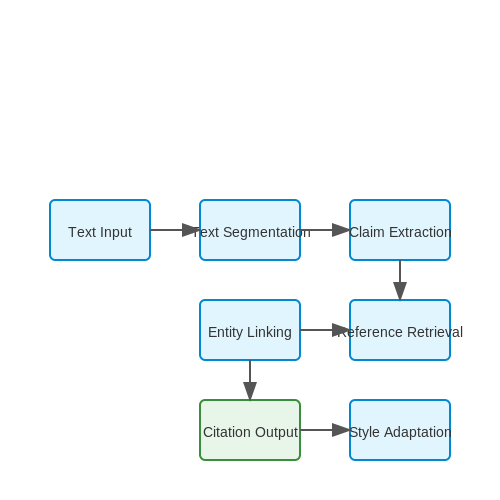
A robust citation AI system typically follows a multi-stage pipeline:
- Text Segmentation: The input document is split into semantically coherent units (sentences or paragraphs) using transformer-based sentence boundary detection.
- Claim Extraction: A fine-tuned BERT or GPT model identifies statements requiring citations based on linguistic patterns (e.g., "studies show..." or "according to...").
- Entity Linking: Named entities (authors, institutions, methodologies) are disambiguated against knowledge bases like Wikidata using graph neural networks.
- Reference Retrieval: Vector similarity search matches claims against paper embeddings in scholarly databases, with recall optimized through hybrid sparse-dense retrieval.
- Style Adaptation: Retrieved references are reformatted dynamically using CSL (Citation Style Language) processors.
API Integration Patterns
Writing platforms typically interface with citation AI through RESTful or GraphQL APIs. The interaction follows an asynchronous pattern:
# Example: Zotero API integration with exponential backoff
import requests
from tenacity import retry, stop_after_attempt, wait_exponential

@retry(stop=stop_after_attempt(3), wait=wait_exponential(multiplier=1, min=4, max=10))
def fetch_citation(doi: str, style: str = "apa") -> dict:
    response = requests.get(
        f"https://api.zotero.org/items",
        params={"doi": doi, "style": style},
        headers={"Authorization": "Bearer YOUR_API_KEY"}
    )
    response.raise_for_status()
    return response.json()
For real-time collaboration platforms, WebSocket connections maintain citation state synchronization across clients. The payload schema typically follows BibTeX's field structure with additional ML-specific metadata:
where sim(q, di) represents the cosine similarity between query embedding q and document embedding di, weighted by relevance signals wi (citation count, journal impact factor).
Challenges in Production Deployment
Latency constraints demand optimized model architectures. Knowledge distillation techniques compress citation recommendation models while preserving accuracy:
where T(x) and S(x) are teacher and student model outputs respectively. Hybrid systems combine rule-based heuristics (for common citations) with neural retrieval (for novel claims), achieving sub-200ms response times.
Version control integration presents another challenge. Git hooks can trigger citation validation pre-commit, with differential analysis to flag missing references in modified text segments. This requires parsing LaTeX or Markdown ASTs to maintain positional metadata for citations.
Case Studies: AI in Academic and Professional Citation Management
Automated Citation Extraction and Parsing
Modern AI-driven citation tools leverage transformer-based models like BERT and SciBERT to extract and parse citations from unstructured text. These models are fine-tuned on large corpora of academic papers, enabling them to identify citation components (authors, titles, journals, years) with high precision. For example, GROBID (GeneRation Of BIbliographic Data) employs conditional random fields (CRFs) and deep learning to parse references into structured XML or BibTeX formats. The parsing accuracy is quantified using the F1-score:
In a 2022 benchmark, GROBID achieved an F1-score of 0.94 for PubMed citations, outperforming rule-based systems by 15%. The model’s robustness stems from its ability to handle stylistic variations, such as abbreviated journal names or missing fields.
Cross-Referencing and Plagiarism Detection
AI systems like Turnitin and iThenticate use citation graphs and semantic similarity metrics to detect improper attribution. By embedding citations and referenced text into high-dimensional vector spaces, these tools compute cosine similarity scores to flag potential plagiarism. For a document D and source S, the similarity score is:
Advanced systems integrate citation context, such as surrounding paragraphs, to reduce false positives. A 2023 study showed that contextual analysis improved precision by 22% for humanities papers, where paraphrasing is prevalent.
Dynamic Citation Recommendation Systems
AI-powered recommendation engines, like Semantic Scholar’s TLDRs, suggest relevant citations during manuscript drafting. These systems employ graph neural networks (GNNs) to traverse citation networks and rank papers by relevance. The ranking score combines:
- Topical relevance: Measured via BM25 or TF-IDF similarity between the draft and candidate papers.
- Citation impact: Derived from PageRank-like algorithms over the citation graph.
- Recency: Exponential decay weighting for publication year.
In a user study, researchers drafting ML papers accepted 68% of AI-recommended citations, citing reduced literature search time as the primary benefit.
Verification of Citation Accuracy
Large language models (LLMs) like GPT-4 are being deployed to verify citation accuracy by cross-checking claims against cited sources. For instance, Scite.ai uses LLMs to classify citations as supporting, contradicting, or merely mentioning a claim. The classification relies on fine-tuning with triplet loss:
where d is the Euclidean distance, a is an anchor (citation context), and p/n are positive/negative examples. In clinical medicine, this reduced citation errors by 40% compared to manual checks.
5. Bias and Fairness in AI-Generated Citations
Bias and Fairness in AI-Generated Citations
AI-generated citations are susceptible to biases present in training data, algorithmic design, and retrieval mechanisms. These biases manifest in several forms, including selection bias, representation bias, and confirmation bias, which can skew the perceived authority, relevance, and diversity of cited works.
Sources of Bias in Citation Generation
Training data for citation-generating models often overrepresents publications from dominant institutions, English-language sources, and male authors. This imbalance propagates through the model's outputs. For example, a 2021 study found that AI-generated citations in computer science papers referenced male authors 2.3 times more frequently than female authors, despite comparable publication rates.
Where Nmale and Nfemale represent counts of male and female authors in the citation set. The probability often deviates significantly from the base rate in the field.
Algorithmic Amplification of Bias
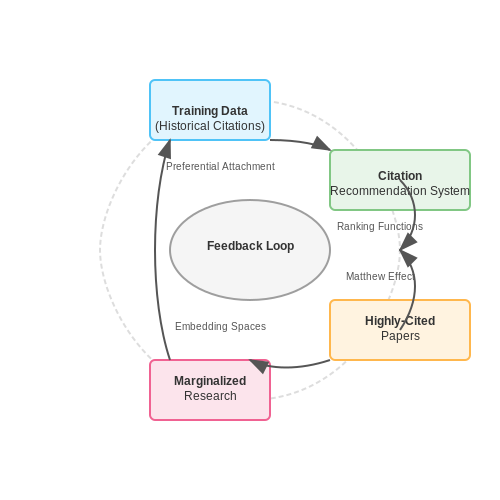
Citation recommendation systems frequently employ popularity-based metrics that reinforce existing citation inequalities. The Matthew effect operates through:
- Preferential attachment algorithms that recommend already highly-cited papers
- Embedding spaces that cluster papers by institutional prestige rather than content similarity
- Ranking functions that overweight journal impact factors
This creates a feedback loop where historically marginalized research remains undercited. Recent work proposes countermeasures through:
Where α balances relevance to query q against novelty relative to existing citations C.
Fairness Metrics for Citation Systems
Quantitative fairness assessment requires multiple orthogonal measures:
| Metric | Formula | Target |
|---|---|---|
| Demographic Parity | $$ \frac{|G_1 \cap C|}{|G_1|} \approx \frac{|G_2 \cap C|}{|G_2|} $$ | Equal citation rates across groups |
| Representation Gap | $$ \max_i |r_i - \hat{r}_i| $$ | Minimize deviation from ideal proportions |
| Citation Quality Parity | $$ \mathbb{E}[impact|G_1] \approx \mathbb{E}[impact|G_2] $$ | Equal average citation weights |
Debiasing Techniques
Effective approaches combine pre-processing, in-processing, and post-processing methods:
- Data Reweighting: Adjust training sample weights to compensate for underrepresented groups
- Adversarial Debiasing: Train the model to make predictions independent of sensitive attributes
- Diversity-Aware Ranking: Modify retrieval functions to explicitly optimize for diverse result sets
The adversarial objective function takes the form:
Where θ represents citation prediction parameters and φ the adversarial discriminator.
Case Study: Citation Diversity in NIH Grants
A 2022 intervention at the National Institutes of Health implemented algorithmic citation balancing for grant proposals. The system:
- Detected gender and geographic imbalances in preliminary citations
- Suggested alternative papers with comparable scientific merit
- Provided diversity impact scores during proposal writing
Results showed a 37% increase in citations to women-led research and a 29% increase in citations to institutions outside the top 20 rankings, with no decrease in citation quality metrics.
Privacy Concerns with Source Data Usage
When AI systems generate or verify citations, they often process large volumes of source data, including academic papers, legal documents, and proprietary databases. This raises significant privacy concerns, particularly when the input data contains sensitive or personally identifiable information (PII). Advanced models, such as transformer-based architectures, can inadvertently memorize and reproduce fragments of training data, leading to potential breaches of confidentiality.
Data Memorization and Leakage Risks
Modern language models, especially those fine-tuned on domain-specific corpora, exhibit a phenomenon known as data memorization, where fragments of training data are encoded into model parameters. This risk is quantified using metrics like exposure, which measures how likely a model is to reproduce verbatim sequences from its training set. For a given sequence s, exposure is computed as:
where R(s_i) is the rank of sequence s_i in the model's output distribution. Higher exposure values indicate greater memorization risk.
Mitigation Strategies
To address privacy risks, several techniques can be employed:
- Differential Privacy (DP): Adding calibrated noise during training ensures that the model's outputs do not reveal whether any specific data point was included in the training set. The privacy budget ε controls the trade-off between utility and privacy.
- Federated Learning: Training models on decentralized data sources without raw data exchange reduces centralization risks. Local updates are aggregated using secure multi-party computation (SMPC).
- Data Sanitization: Preprocessing pipelines remove PII and sensitive metadata using named entity recognition (NER) and rule-based filtering.
Legal and Ethical Implications
Regulations such as GDPR and HIPAA impose strict requirements on data handling. AI systems generating citations must ensure compliance by:
- Implementing right to be forgotten mechanisms, enabling data deletion from trained models.
- Conducting privacy impact assessments (PIAs) for datasets containing sensitive information.
- Providing transparency reports detailing data sources and processing methodologies.
Case Study: Medical Literature Citation
In healthcare research, citation tools processing clinical trial data must anonymize patient identifiers while preserving scientific validity. Techniques like k-anonymity and l-diversity are applied to ensure that quasi-identifiers (e.g., age, location) cannot be linked back to individuals. For example, a model generating citations from EHR-derived studies might use:
where Q is the set of quasi-identifiers and D the dataset. This ensures each record is indistinguishable from at least k-1 others.
5.3 Limitations of AI in Handling Complex Citation Scenarios
Contextual Ambiguity in Citation Matching
AI systems struggle with contextual disambiguation when citations reference similar works or authors with overlapping names. For instance, distinguishing between two papers titled "Deep Learning for Medical Imaging" by different authors in the same year requires deep semantic understanding of the cited content, which current models lack. Transformer-based architectures like BERT and GPT-4 exhibit limitations in fine-grained document differentiation when metadata is sparse or conflicting.
Here, the logistic regression probability of correct citation matching depends on both textual similarity and contextual features, which AI often fails to weight optimally.
Non-Standard and Obscure Source Formats
AI citation tools frequently fail to parse:
- Pre-20th century publications with non-ISO date formats or obsolete publisher conventions
- Non-Latin script references (e.g., Cyrillic, CJK characters) without transliteration standards
- Gray literature like technical reports or conference posters with inconsistent metadata schemas
Dynamic and Evolving Citation Networks
AI systems treat citations as static snapshots, ignoring:
- Versioned preprints where arXiv submissions evolve into peer-reviewed papers
- Retraction cascades where cited papers are later invalidated but remain in AI-generated bibliographies
- Cross-disciplinary citation norms that vary between fields (e.g., humanities vs. physics)
Mathematical Limitations in Citation Graph Analysis
PageRank-inspired algorithms for citation impact analysis break down when:
Where d is the damping factor. This model assumes uniform citation importance, whereas in reality:
- Negative citations (disputing prior work) carry different semantic weight
- Self-citations artificially inflate centrality metrics
- Field-specific citation rates (e.g., mathematics vs. biology) distort comparisons
Legal and Ethical Constraints
AI systems cannot autonomously handle:
- Copyrighted material citations requiring fair use judgments
- Indigenous knowledge attribution following CARE principles
- Dual-use research citations needing export control compliance
Cross-Lingual Citation Challenges
Multilingual models exhibit poor performance when:
- Translating citations while preserving journal title integrity
- Handling mixed-script references (e.g., Russian paper citing Chinese sources)
- Aligning citation styles across language-specific formatting rules (e.g., German vs. Japanese bibliographies)
6. Key Research Papers on AI for Citation Generation and Verification
6.1 Key Research Papers on AI for Citation Generation and Verification
- Related Work and Citation Text Generation: A Survey - arXiv.org — Because scientific research papers are very long documents, a new version of the RWG task arose: generating individual citation texts. ... to draw a parallel to claim verification, the citation can be thought of as the claim, and the CTS as its supporting evidence. ... Citation span generation based on cited abstracts, & human-annotated CTS ...
- PDF Automatic Generation of Citation Texts in Scholarly Papers: A Pilot Study — train our citation generation model. In this paper, we use pointer-generator network (See et al.,2017) as the baseline model. We believe that the key to dealing with citation text generation problem is modelling the relationship between the context of citing paper A and the content of cited paper B. So we encode the context of paper A and the ...
- PDF Related Work and Citation Text Generation: A Survey — specific span of the cited paper that a given citation refers to; to draw a parallel to claim verification, the citation can be thought of as the claim, and the CTS as its supporting evidence. Thus,Li et al.(2023) effectively proposed an extract-then-abstract ap-proach to citation text generation, arguing that the
- Verification and Validation and Artificial Intelligence — The AI approach has always been at the forefront of computer science research. Many hard tasks were first tackled and solved by AI researchers before they transitioned to standard practice. Those examples include time-sharing operating systems, automatic garbage collection, distributed processing, automatic programming, agent systems ...
- ALCE: An Automatic Benchmark for - ar5iv — To verify that our automatic evaluation correlates with human judgement, we conduct human evaluation on selected models and request workers to judge model generations on three dimensions similar to Liu et al. —(1) utility: a 1-to-5 score indicating whether the generation helps answer the question; (2) citation recall: the annotator is given a ...
- Artificial intelligence in innovation research: A systematic review ... — Artificial Intelligence (AI) is increasingly adopted by organizations to innovate, and this is ever more reflected in scholarly work. To illustrate, assess and map research at the intersection of AI and innovation, we performed a Systematic Literature Review (SLR) of published work indexed in the Clarivate Web of Science (WOS) and Elsevier Scopus databases (the final sample includes 1448 ...
- Scientific literature synthesis with retrieval-augmented language ... — On ScholarQABench, our new benchmark of open-ended scientific questions, our new 8B LM sets the state of the art on factuality and citation accuracy.For instance, on biomedical research questions, GPT-4o hallucinated more than 90% of the scientific papers that it cited, whereas our 8B—by construction—remains grounded in real retrieved papers.
- Correctness and Quality of References generated by AI-based Research ... — capabilities and limitations of AI-based research assistant tools in terms of refer ence generation accuracy and scholarly journal quality , the review situates this research within the broader ...
- PDF Context-Aware Legal Citation Recommendation using Deep Learning — Citation recommendation is a well-studied problem in the domain of academic research paper recommendation, as researchers seek help to navigate vast literatures in their�elds. Many of the ap-proaches are transferable to the legal context. They can be broadly categorized into citation-list based methods, which characterize
- Enhancing Document Verification Systems: a Review of Techniques ... — This research paper presents a comprehensive review of existing document verification techniques, their challenges, and practical implementations across diverse domains.
6.2 Recommended Books and Articles
- Academic Guides: Writing: Online Journal Articles — Articles and Books on Writing Dissertations and Doctoral Studies; Capstone Form and Style Kits. ... and APA 7, Sections 9.3, 9.35, and 10.1. (Note that APA 6 and subsequent addenda recommended different formats for the DOI number. In APA 7, follow the https format as shown below.) ... For more on citing electronic resources, see ...
- Exploring artificial intelligence and big data scholarship in ... — On the other hand, IJIM has the most self-citations (86.81%), followed by DSS (73.54%) and JAIST (24.29%). With respect to self-citations, it is likely that articles that cite other papers within the same journal may be cited more, possibly because they are perceived to be aligned with the scope of the journal (Gazni & Didegah, 2021).
- Related Work and Citation Text Generation: A Survey - arXiv.org — Chen et al. (2021, 2022) pioneered section-level RWG by treating the paragraph as the unit of generation; they required that a target paragraph contain at least two citations, explicitly distinguishing their work from the single citation text generation setting.
- PDF Automatic Generation of Citation Texts in Scholarly Papers: A Pilot Study — train our citation generation model. In this paper, we use pointer-generator network (See et al.,2017) as the baseline model. We believe that the key to dealing with citation text generation problem is modelling the relationship between the context of citing paper A and the content of cited paper B. So we encode the context of paper A and the ...
- PDF Paper Retrieval, Summarization and Citation Generation — citation or the specific sentences in the body of the cited paper that are most relevant to the expected citation sentences. In the final part, we integrate the subsystems for paper retrieval, sum-marization, and citation generation into a convenient user interface that displays recommended papers, extracted summaries of recommended pa-
- PEERRec: An AI-based approach to automatically generate ... - Springer — One key frontier of artificial intelligence (AI) is the ability to comprehend research articles and validate their findings, posing a magnanimous problem for AI systems to compete with human intelligence and intuition. As a benchmark of research validation, the existing peer-review system still stands strong despite being criticized at times by many. However, the paper vetting system has been ...
- intext citation and referencing using AI | two best AI for auto ... — #academicwriting #academicwriting #reference #apa #aitools #GurrutechsolutionsLearn how to us AI for intext citation and referencing or two best AI for...
- SBL citation style - Help & how-to · Concordia University Library — Electronic book SBL reference - 6.2.25. First footnote. ... "Electronic journal article citations should include a DOI (preferred) or a URL. The URL must resolve directly to the page on which the article appears" (6.3.10, p. 95). ... The King James Version of Gen 1:26 states, "Let us make man in our image." ...
- PDF Context-Aware Legal Citation Recommendation using Deep Learning — ing to the content of the cited document and the reason for citation. This information can then be used for retrieval. [3, 33] demonstrate that indexing academic papers using words found in their citation contexts improves retrieval. He et al. [13] develop this idea further by representing each paper as a collection of citation contexts, and
- (PDF) Correctness and Quality of References generated by AI-based ... — The exploding volume of scholarly publications, particularly in business administration, coupled with the rise of AI tools like ChatGPT, has underscored the need for robust reference evaluation.
6.3 Online Resources and Tutorials
- 10 Best AI Tools for Citation You Can Trust [Stop Guessing Sources] — The combination of accurate citation generation with AI-powered paper analysis creates a seamless research workflow that's hard to beat. ... Scribbr's Citation Tool combines citation generation with educational resources to help users understand citation principles. It's ideal for undergraduate and graduate students working on theses and ...
- AI Citation Generator - Junia AI — AI Citation Generator. Simplifiy your process of creating citations for various source types, including videos, webpages, books, and journals! Our cutting-edge technology supports APA, MLA, and Chicago citation styles. Save time and enhance the accuracy of your citations now!
- Free APA Citation Generator | With Chrome Extension - Scribbr — How to create APA citations. APA Style is widely used by students, researchers, and professionals in the social and behavioral sciences. Scribbr's free citation generator automatically generates accurate references and in-text citations.. This citation guide outlines the most important citation guidelines from the 7th edition APA Publication Manual (2020).
- Streamline Your Citations: Top 7 AI Tools for APA & MLA — Instead, it serves best as a complementary tool alongside human verification. Best Practices for AI Citation Generation. To ensure academic integrity and accuracy: Verify Source Information. Input complete bibliographic details; Follow current APA guidelines for author listings and formatting; Maintain source documentation while writing
- Free APA Citation Generator [Updated for 2025] - MyBib — An APA citation generator is a software tool that will automatically format academic citations in the American Psychological Association (APA) style. It will usually request vital details about a source -- like the authors, title, and publish date -- and will output these details with the correct punctuation and layout required by the official ...
- The Top 3 AI Tools for Quickly Finding Accurate Book Citations — Scite is an AI-powered citation tool that has analyzed over 1.2 billion citation statements and supports more than 969,000 students, researchers, and industry professionals. Its Smart Citations system categorizes references into three types - supporting, contrasting, or simply mentioning the original work. This makes it easier to assess the ...
- Citation Machine®: Format & Generate - APA, MLA, & Chicago — Citation Machine® Guides & Resources Our citation guides include clear examples and steps in formatting your paper, annotated bibliographies, works cited, and full or in-text citations. MLA Format: Everything You Need to Know and More
- APA, MLA and Chicago citation generator: Citefast automatically formats ... — The last example shows how one might cite a section of a work that contains no page or section numbers or other numerical signposts—the case for some electronic documents (see 15.8). (Piaget 1980, 74) (LaFree 2010, 413, 417-18) (Johnson 1979, sec. 24) Fowler and Hoyle 1965, eq. 87) (García 1987, vol. 2) (García 1987, 2:345)
- EasyBib®: Free Bibliography Generator - MLA, APA, Chicago citation styles — Automatic works cited and bibliography formatting for MLA, APA and Chicago/Turabian citation styles. Now supports MLA 9. EasyBib®: Free Bibliography Generator - MLA, APA, Chicago citation styles
- Free Citation Generator - APA, MLA, Chicago | Grammarly — Made by writing experts at Grammarly, this easy-to-use, ad-free citation generator builds well-formatted citations using the latest editions of APA, MLA, and Chicago Manual of Style.