
Predicting Music Preferences from User Texts
1. Defining the Problem: From Text to Music Preferences
1.1 Defining the Problem: From Text to Music Preferences
Problem Formulation
The task of predicting music preferences from user-generated text is a structured prediction problem in natural language processing (NLP). Given a corpus of text documents D = {d1, d2, ..., dn} and a set of music tracks M = {m1, m2, ..., mk}, the goal is to learn a mapping function f: D → M that minimizes the prediction error on unseen data. This can be framed as a multi-class classification problem where each music track represents a class label.
Feature Extraction from Text
Textual data must be transformed into numerical representations suitable for machine learning. Common approaches include:
- Bag-of-Words (BoW): Represents documents as term frequency vectors, ignoring word order but capturing lexical content.
- Word Embeddings (e.g., Word2Vec, GloVe): Maps words to dense vector spaces where semantic similarity corresponds to geometric proximity.
- Contextual Embeddings (e.g., BERT, RoBERTa): Generates dynamic word representations based on surrounding context, capturing polysemy and syntactic relationships.
Music Representation
Music tracks can be characterized by:
- Acoustic Features: Extracted from audio signals (e.g., MFCCs, spectral contrast, chroma features).
- Metadata: Genre, artist, release year, and other categorical attributes.
- Behavioral Data: User listening history, skip rates, and playlist co-occurrence statistics.
Modeling Approaches
Several architectures are suitable for this task:
- Logistic Regression: A baseline model that learns a linear mapping from text features to music preferences.
- Neural Networks: Feedforward or recurrent networks that capture non-linear relationships between text and music.
- Attention Mechanisms: Transformers or hierarchical attention networks that weight relevant words or phrases more heavily.
Evaluation Metrics
Model performance is assessed using:
- Precision@k: The fraction of recommended tracks in the top-k predictions that are relevant.
- Mean Reciprocal Rank (MRR): The average reciprocal rank of the first relevant recommendation.
- Normalized Discounted Cumulative Gain (NDCG): Measures ranking quality by accounting for the position of relevant items.
Challenges and Considerations
Key challenges include:
- Data Sparsity: Users may have limited text-music pairs, requiring techniques like transfer learning or data augmentation.
- Cold Start: New users or tracks with no historical data necessitate content-based or hybrid approaches.
- Bias and Fairness: Models may inherit biases from training data, leading to skewed recommendations.
Applications and Use Cases
Personalized Music Recommendation Systems
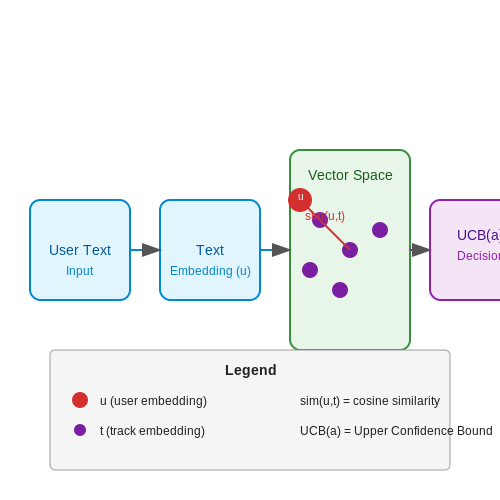
Modern streaming platforms leverage text-based music preference prediction to enhance recommendation engines. By analyzing user-generated content—such as reviews, social media posts, or playlist descriptions—models like BERT or GPT-4 extract latent preferences. For instance, a user describing a preference for "melancholic acoustic guitar with introspective lyrics" can be mapped to a vector space where similar tracks are clustered using cosine similarity:
Here, u represents the user's text embedding, and t denotes track metadata embeddings. Platforms like Spotify and Apple Music use hybrid models combining collaborative filtering with text-derived signals to reduce cold-start problems.
Dynamic Advertising and A/B Testing
Advertisers exploit text-to-music affinity models to optimize targeted campaigns. A neural network trained on Reddit comments paired with Last.fm listening histories can predict which users are likely to engage with ads for specific genres. For example, a user discussing "high-energy workout playlists" might receive promotions for EDM festivals. The ad-placement strategy often involves multi-armed bandit algorithms:
where a is the ad variant, T total trials, and na the number of times a was shown. This balances exploration of new genres with exploitation of known preferences.
Mood-Based Playlist Generation
Clinical applications use text-to-music models for therapeutic interventions. A transformer fine-tuned on r/Anxiety posts paired with EEG-validated calming music selections can generate playlists for mental health apps. The model might decompose text into Valence-Arousal-Dominance (VAD) scores:
where the MLP projects BERT embeddings into a 3D VAD space. Startups like Moodify deploy such models with real-time EEG feedback loops.
Ethical Considerations and Bias Mitigation
Text-based music recommendation systems risk amplifying cultural biases. For example, a model trained on predominantly English-language reviews may underrepresent non-Western genres. Debiasing techniques involve:
- Adversarial training to minimize demographic leakage in embeddings
- Counterfactual augmentation of training data with synthetic minority-class examples
- Fairness constraints in the loss function:
$$ \mathcal{L} = \mathcal{L}_{\text{task}} + \lambda \|\nabla_{\mathbf{z}} \mathbb{E}[y|\mathbf{z}, d]\|^2 $$
Here d represents sensitive attributes, and z denotes latent representations. The gradient penalty term minimizes demographic predictability.
1.3 Challenges in Predicting Music Preferences from Text
Semantic Gap Between Text and Musical Features
The fundamental challenge lies in mapping linguistic features to acoustic or musical attributes. While natural language processing (NLP) models excel at extracting semantic meaning from text, musical preferences are influenced by low-level audio features like timbre, rhythm, and harmony that lack direct linguistic analogs. This creates a discontinuous embedding space where similar textual descriptions may correspond to dissimilar musical preferences, and vice versa.
where φt and φm represent text and music embedding functions respectively, and d is a distance metric. The inequality shows how textual similarity fails to guarantee musical similarity.
Data Sparsity and Cold Start Problem
User-generated text about music preferences exhibits extreme sparsity - most users provide minimal explicit feedback. The long-tail distribution of musical items means most songs have few or no textual associations. This creates a cold-start problem for both new users and new musical items. Matrix factorization approaches struggle when the user-item matrix R ∈ ℝm×n has density below 0.1%, which is typical in music recommendation scenarios.
Multimodal Alignment Challenges
Effective prediction requires aligning three distinct modalities: textual semantics, acoustic features, and user behavior patterns. Each modality operates on different timescales and abstraction levels:
- Text: High-level semantic concepts (e.g., "energetic", "melancholic")
- Audio: Mid-level features (MFCCs, chroma, spectral contrast)
- Behavior: Implicit feedback (play counts, skips, dwell time)
Current multimodal architectures often fail to capture the nonlinear interactions between these modalities. The alignment problem becomes particularly acute when dealing with figurative language (e.g., "this song is fire") that doesn't literally describe acoustic properties.
Temporal Dynamics of Musical Taste
Musical preferences evolve non-stationarily over time due to cultural trends, personal life events, and mere exposure effects. This temporal variation creates concept drift in prediction models. A user's textual description from six months ago may no longer reflect current preferences, yet most static embedding models don't account for this dynamics. The challenge compounds when considering seasonal patterns (e.g., holiday music) and short-term mood fluctuations.
where yt represents musical preference at time t, and x1:t is the historical text sequence.
Ethical and Privacy Considerations
Predictive models trained on user-generated text risk amplifying biases present in the training data. Musical preferences correlate with sensitive attributes like age, ethnicity, and socioeconomic status. There's also the privacy challenge of inferring potentially sensitive information (e.g., mental state, political views) from casual music-related text. Differential privacy techniques often degrade recommendation quality substantially when applied to text-based models.
Evaluation Metric Challenges
Standard recommendation metrics like precision@k or NDCG may not capture the nuanced relationship between text and music. A track predicted as relevant based on textual analysis might be acoustically dissimilar to the user's actual preference. This necessitates novel evaluation protocols that measure:
- Cross-modal consistency between text embeddings and audio embeddings
- Temporal stability of predictions
- Diversity of recommendations relative to text input
The metric problem is exacerbated by the lack of standardized datasets containing aligned text, audio, and preference data at scale.

2. Sources of User Text Data
2.1 Sources of User Text Data
User-generated text data serves as a rich, high-dimensional input for training models to predict music preferences. The primary sources of such data can be categorized into explicit and implicit textual interactions, each offering unique linguistic and behavioral signals.
Explicit Textual Feedback
Direct user input, such as reviews, ratings, and comments, provides explicit signals about musical preferences. Platforms like RateYourMusic and Last.fm host structured reviews where users articulate their opinions on albums, tracks, or artists. These texts often contain sentiment-laden adjectives (e.g., "ethereal," "repetitive," "energetic") that correlate strongly with acoustic features like tempo, valence, and complexity. For instance, a review stating "The dense layering of synths creates a hypnotic atmosphere" suggests a preference for high-texture electronic music.
Mathematically, the sentiment S of a review can be modeled as a function of lexical features L and contextual embeddings E:
where σ is the logistic function, wi are learned weights, and v is a context vector.
Implicit Textual Traces
Indirect text sources, such as social media posts, search queries, and forum discussions, reveal latent preferences through behavioral patterns. Twitter posts with artist mentions or hashtags (e.g., #BlackMetal) can be mined to infer genre affinities. Reddit discussions in communities like r/LetsTalkMusic often contain comparative analyses (e.g., "Artist X’s lyrics resonate more than Y’s"), which can be parsed using graph-based attention networks to model relational preferences.
Search queries logged by music platforms (e.g., "songs similar to [track]") are particularly valuable for collaborative filtering. The semantic similarity between query terms and track metadata can be quantified using cosine distance in a BERT embedding space:
Structured vs. Unstructured Data
Structured text (e.g., playlist titles like "Chill Vibes 2024") provides weak supervision for genre classification, while unstructured data (e.g., blog posts) requires deeper NLP pipelines. Hybrid approaches often combine:
- Named Entity Recognition (NER): To extract artist, album, and genre references.
- Topic Modeling: Latent Dirichlet Allocation (LDA) over music-related subreddits to identify latent themes.
- Temporal Analysis: Tracking shifts in vocabulary (e.g., increased use of "lo-fi" over time) to adapt preference models dynamically.
Ethical and Privacy Considerations
User text data often contains personally identifiable information (PII) or sensitive context (e.g., mental health discussions in lyrics forums). Differential privacy techniques, such as adding Laplace noise to word frequencies, can mitigate re-identification risks:
where Δf is the global sensitivity and ε the privacy budget.
2.2 Techniques for Cleaning and Normalizing Text Data
Text data preprocessing is a critical step in natural language processing (NLP) pipelines, particularly for tasks like predicting music preferences from user-generated text. Raw text often contains noise, inconsistencies, and artifacts that can degrade model performance. Advanced techniques for cleaning and normalization ensure the input data is both consistent and semantically meaningful.
Noise Removal and Text Sanitization
User-generated text frequently includes non-linguistic elements such as HTML tags, URLs, emojis, and special characters. A systematic approach to noise removal involves:
- HTML/XML Tag Stripping: Regular expressions or dedicated parsers like BeautifulSoup remove markup while preserving textual content.
- URL and Social Media Handle Removal: Pattern matching eliminates web addresses and @mentions that lack semantic value for preference modeling.
- Emoji and Emoticon Processing: Conversion to textual descriptions (e.g., ":smile:") or complete removal based on task requirements.
- Non-Alphanumeric Character Filtering: Selective retention of punctuation with syntactic significance (e.g., apostrophes in contractions) while discarding decorative symbols.
where \(\Phi\) represents sequential transformation operations applied to text \(t\).
Text Normalization Techniques
Normalization creates lexical consistency across documents through:
- Case Folding: Uniform lowercase conversion preserves meaning while reducing dimensionality, though with potential loss of named entity information.
- Contraction Expansion: Converting "don't" to "do not" using predefined mapping dictionaries.
- Number Normalization: Replacing numerals with textual equivalents (e.g., "3" → "three") or standardized placeholders.
- Slang and Spelling Correction: Context-aware correction using probabilistic language models or pretrained tools like SymSpell.
Advanced Lemmatization and Stemming
Morphological reduction techniques condense words to their base forms:
- Porter Stemmer: Rule-based suffix stripping that may produce non-dictionary stems (e.g., "running" → "run").
- Lemmatization: Dictionary-based morphological analysis requiring part-of-speech tagging for accurate reduction (e.g., "better" → "good" when adjective).
where \(B\) is the set of base forms and \(P\) is the morphological transformation probability.
Handling Music-Specific Lexical Variations
Music preference prediction introduces domain-specific normalization challenges:
- Artist and Track Name Standardization: Alias resolution using knowledge bases like MusicBrainz.
- Genre Term Disambiguation: Mapping colloquial genre references (e.g., "indie") to standardized taxonomies.
- Lyric-Specific Tokenization: Special handling of repeated phrases, onomatopoeia, and non-standard vocalizations common in song texts.
Encoding and Vectorization Considerations
Post-normalization text requires careful encoding for machine learning:
- Subword Tokenization: Byte Pair Encoding (BPE) or WordPiece handles rare musical terms and neologisms.
- Vocabulary Pruning: Frequency-based filtering retains semantically rich tokens while discarding hapax legomena.
- Dimensionality Analysis: Singular Value Decomposition (SVD) on term-document matrices identifies optimal feature spaces.
where \(\mathbf{X}\) is the term-document matrix and \(\mathbf{\Sigma}\) contains singular values indicating term importance.
2.3 Extracting Relevant Features from Text
Textual data contains rich semantic information that can be leveraged to predict music preferences. The process involves transforming unstructured text into structured numerical representations that machine learning models can process. Key techniques include lexical analysis, syntactic parsing, and semantic embedding.
Lexical Features
Lexical features capture surface-level text properties. Term Frequency-Inverse Document Frequency (TF-IDF) is a widely used method that weights word importance based on their frequency in a document relative to their frequency across a corpus. For a term t in document d, TF-IDF is computed as:
where TF(t, d) is the term frequency in document d, and IDF(t) is the inverse document frequency:
Here, N is the total number of documents, and DF(t) is the number of documents containing term t. This approach emphasizes rare but meaningful terms while downweighting common stopwords.
Syntactic Features
Syntactic features capture grammatical structure. Part-of-speech (POS) tagging and dependency parsing reveal how words relate within sentences. For instance, a user describing music as "energetic and fast-paced" may prefer high-tempo genres. POS tags can be encoded as one-hot vectors or aggregated into statistical features (e.g., ratio of adjectives to nouns).
Semantic Embeddings
Pre-trained language models like BERT and GPT generate dense vector representations that encode contextual meaning. Given an input text T with tokens {w₁, w₂, ..., wₙ}, BERT produces contextual embeddings hᵢ for each token:
These embeddings can be pooled (e.g., mean or CLS token) to form a fixed-length document vector. Fine-tuning BERT on music-related text improves feature relevance for preference prediction tasks.
Domain-Specific Feature Engineering
Music-related lexicons (e.g., emotion or genre vocabularies) enhance feature discriminability. For example, the VADER sentiment analyzer detects affective language linked to musical taste. Similarly, named entity recognition can identify artists, albums, or genres mentioned in user reviews.
Feature selection techniques like mutual information or L1 regularization identify the most predictive features. For high-dimensional embeddings, dimensionality reduction via PCA or UMAP improves computational efficiency without significant information loss.
3. Sentiment Analysis for Emotion Detection
Sentiment Analysis for Emotion Detection
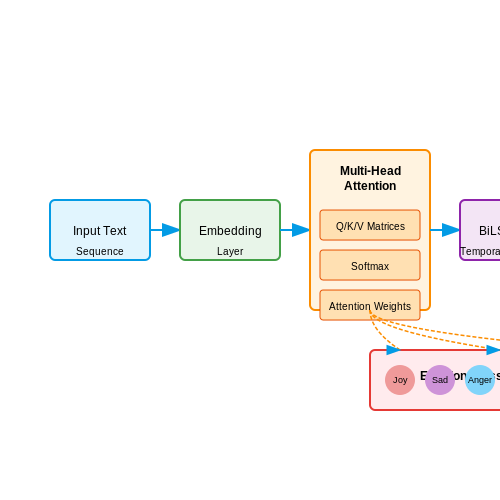
Sentiment analysis in the context of predicting music preferences from user texts involves extracting emotional valence and intensity from textual data. Advanced techniques leverage deep learning architectures, such as transformer-based models, to capture nuanced emotional states that correlate with musical taste. The process typically involves fine-tuning pre-trained language models on emotion-annotated corpora, enabling the detection of subtle affective cues beyond simple polarity (positive/negative).
Mathematical Foundations
The core problem can be formulated as a sequence classification task where for an input text sequence X = (x1, ..., xn), we predict an emotion distribution y ∈ ℝk over k emotion categories. Transformer models compute this through stacked self-attention layers:
where Q, K, and V are learned query, key, and value matrices respectively, and dk is the dimension of key vectors. The multi-head attention mechanism allows the model to jointly attend to information from different representation subspaces:
Emotion-Specific Fine-Tuning
For music preference prediction, we typically fine-tune models on emotion-labeled datasets like GoEmotions or EmoBank, using a hierarchical loss function that captures both discrete emotion categories and continuous valence-arousal dimensions:
where α and β are weighting hyperparameters, LCE is categorical cross-entropy, and LMSE is mean squared error for valence-arousal prediction.
Contextual Emotion Dynamics
Music preferences often correlate with temporal emotion patterns rather than static snapshots. We can model this using attention-based temporal pooling:
where ht are bidirectional LSTM hidden states and s is the context-aware emotion representation.
Practical Implementation
For implementation, we typically use HuggingFace's Transformers library with custom emotion heads. The following architecture modifications are particularly effective:
- Adding a secondary attention layer focused on emotion-bearing phrases
- Incorporating musical domain knowledge through emotion-word embeddings
- Using label distribution learning for ambiguous emotional expressions
from transformers import AutoModel, AutoTokenizer
import torch.nn as nn

class EmotionAwareTransformer(nn.Module):
    def __init__(self, model_name="bert-base-uncased", num_emotions=8):
        super().__init__()
        self.bert = AutoModel.from_pretrained(model_name)
        self.emotion_head = nn.Linear(self.bert.config.hidden_size, num_emotions)
        self.attention = nn.Linear(self.bert.config.hidden_size, 1)

    def forward(self, input_ids, attention_mask):
        outputs = self.bert(input_ids, attention_mask=attention_mask)
        sequence_output = outputs.last_hidden_state
        weights = torch.softmax(self.attention(sequence_output), dim=1)
        context = torch.sum(weights * sequence_output, dim=1)
        return self.emotion_head(context)
Evaluation Metrics
For rigorous evaluation, we recommend:
- Emotion-wise F1 scores: To detect model biases toward dominant emotions
- Valence-Arousal Concordance Correlation (CCC):
$$ \rho_c = \frac{2\rho\sigma_x\sigma_y}{\sigma_x^2 + \sigma_y^2 + (\mu_x - \mu_y)^2} $$
- Top-k Accuracy: Given the multi-label nature of emotions
3.2 Topic Modeling to Identify Musical Themes
Latent Dirichlet Allocation (LDA) serves as the foundational probabilistic model for uncovering latent thematic structures in text corpora. Given a collection of user-generated texts discussing music, LDA assumes each document is a mixture of topics, where each topic is a probability distribution over words. The generative process follows:
where w represents a word, d a document, and z a latent topic. The Dirichlet priors α and β govern document-topic and topic-word distributions respectively, ensuring sparse and interpretable topic assignments.
Model Inference and Parameter Estimation
Collapsed Gibbs sampling provides an efficient Markov Chain Monte Carlo (MCMC) approach for posterior inference. The conditional probability for assigning word wi to topic zj given all other assignments is:
where n-i,j(wi) counts word wi assigned to topic j excluding current position, and W is vocabulary size. Variational inference offers an alternative deterministic approximation, optimizing the evidence lower bound (ELBO):
Music-Specific Topic Modeling Enhancements
Standard LDA requires adaptation for musical context. A hierarchical extension incorporates artist metadata through:
where a denotes artist information. Dynamic topic models capture temporal evolution of musical themes by chaining topic distributions across epochs:
Neural topic models employing variational autoencoders (VAEs) learn continuous topic representations through:
Evaluation Metrics for Musical Topic Quality
Topic coherence measures quantify interpretability through pointwise mutual information (PMI):
where V(t) contains top M words for topic t. For music applications, we augment this with genre-specific divergence metrics:
Implementation leverages Gensim or custom TensorFlow/PyTorch frameworks with GPU acceleration for large-scale user text processing. Hyperparameter optimization employs Bayesian methods to tune topic count (K), Dirichlet priors, and batch sizes.
3.3 Word Embeddings and Semantic Similarity
Word embeddings transform discrete linguistic symbols into continuous vector spaces where semantic relationships are preserved through geometric properties. The fundamental assumption is that words appearing in similar contexts share meaning, formalized by the distributional hypothesis. Modern embedding techniques optimize this through neural networks, capturing higher-order co-occurrence statistics than traditional count-based methods like Latent Semantic Analysis.
From One-Hot to Distributed Representations
Traditional one-hot encoding represents words as sparse vectors in V-dimensional space, where V is vocabulary size. This fails to capture semantic relationships, as all vectors are orthogonal. Distributed representations project words into a dense d-dimensional space (d ≪ V), where similarity can be measured via vector operations.
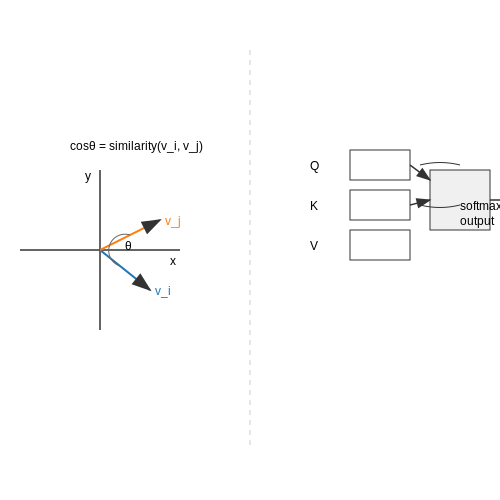
where vi and vj are embedding vectors for words wi and wj. The cosine similarity ranges from -1 (antonyms) to 1 (synonyms), with near-zero values indicating semantic independence.
Neural Embedding Architectures
Two dominant paradigms exist for learning embeddings:
- Skip-gram with Negative Sampling (SGNS): Predicts context words given a target word, with negative samples drawn from noise distribution. Optimizes:
- Continuous Bag-of-Words (CBOW): Predicts target word from surrounding context. More efficient but less precise for rare words.
Contextualized Embeddings
Transformer-based models like BERT generate dynamic embeddings where word representations depend on entire input sequences. The attention mechanism computes:
enabling position-aware semantic modeling. This captures polysemy - the same word having different meanings in distinct contexts.
Semantic Similarity for Music Preference Prediction
In music recommendation systems, embeddings map user-generated text (reviews, playlists) and song metadata to a joint space. Key techniques include:
- Cross-modal alignment: Minimizing distance between text and audio embeddings via triplet loss:
where t is text, a+ is matching audio, and a- is non-matching sample.
- Hierarchical attention: Combining word-level and sentence-level embeddings to model compositional semantics in user reviews.
Evaluation metrics include Spearman correlation between predicted and human-rated similarity scores, or precision@k for retrieval tasks. State-of-the-art systems achieve >0.85 correlation on music-related semantic benchmarks.
4. Supervised Learning Approaches
4.1 Supervised Learning Approaches
Feature Extraction from Textual Data
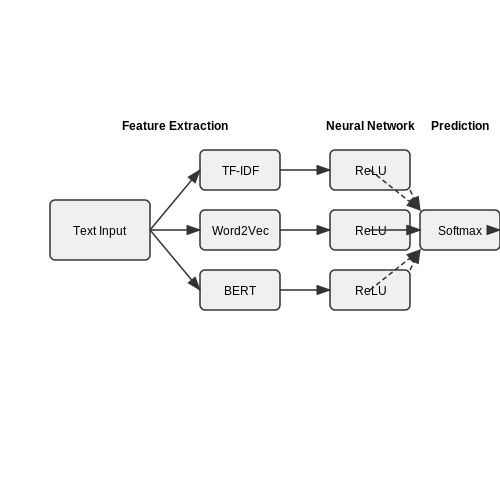
The first critical step in predicting music preferences from user texts involves transforming unstructured text into meaningful numerical features. For this task, we consider both traditional NLP techniques and modern deep learning approaches:
where ti represents the raw text input and ϕ is the feature extraction function. Common approaches include:
- Bag-of-Words (BoW) with TF-IDF weighting:
$$ \text{TF-IDF}(t,d) = \text{tf}(t,d) \times \log\left(\frac{N}{\text{df}(t)}\right) $$
- Word Embeddings (Word2Vec, GloVe) that map words to dense vectors preserving semantic relationships
- Contextual Embeddings from transformer models like BERT, which generate dynamic representations based on surrounding text
Model Architectures for Preference Prediction
Given the extracted features X and corresponding music preference labels Y, we frame this as a supervised learning problem. For multi-class classification (predicting music genres), the objective function typically takes the form:
where pi,c is the predicted probability of class c for instance i, and λ controls L2 regularization.
Linear Models with Text Features
Logistic regression with TF-IDF features provides a strong baseline. The decision function for a single instance is:
where w represents the learned weights for each feature.
Neural Network Approaches
For more complex relationships, we can employ deep learning architectures:
- Feedforward Networks with embedding layers:
$$ \mathbf{h}_1 = \text{ReLU}(\mathbf{W}_1\mathbf{x} + \mathbf{b}_1) $$ $$ \mathbf{h}_2 = \text{ReLU}(\mathbf{W}_2\mathbf{h}_1 + \mathbf{b}_2) $$ $$ \mathbf{\hat{y}} = \text{softmax}(\mathbf{W}_3\mathbf{h}_2 + \mathbf{b}_3) $$
- Attention-based Models that learn to focus on relevant text segments when making predictions
- Hybrid Architectures combining CNN layers for local pattern detection with LSTM layers for sequential modeling
Handling Implicit Feedback
When working with real-world music preference data, we often encounter implicit feedback (play counts, skips) rather than explicit ratings. This requires specialized loss functions like:
where S contains observed positive pairs (user i, item j+), j- are sampled negative items, and L is a weighting function based on the item's rank.
Evaluation Metrics
For assessing model performance, we consider both accuracy-oriented and ranking metrics:
| Metric | Formula | Use Case |
|---|---|---|
| Precision@k | $$\frac{\text{TP@k}}{\text{TP@k} + \text{FP@k}}$$ | Top-k recommendation quality |
| NDCG | $$\frac{\text{DCG}}{\text{IDCG}}$$ | Ranking quality considering position |
| Mean Reciprocal Rank | $$\frac{1}{|Q|} \sum_{i=1}^{|Q|} \frac{1}{\text{rank}_i}$$ | Early occurrence of relevant items |
Practical Considerations
When deploying these models in production systems, several challenges emerge:
- Cold Start Problem: New users or songs with limited interaction history require specialized handling through content-based approaches or hybrid models
- Concept Drift: Music preferences evolve over time, necessitating continuous model updates or online learning approaches
- Multimodal Fusion: Combining text features with audio signal analysis often yields superior performance
# Example PyTorch model for music preference prediction
class MusicPreferencePredictor(nn.Module):
    def __init__(self, vocab_size, embed_dim, num_classes):
        super().__init__()
        self.embedding = nn.EmbeddingBag(vocab_size, embed_dim)
        self.fc1 = nn.Linear(embed_dim, 256)
        self.fc2 = nn.Linear(256, 128)
        self.classifier = nn.Linear(128, num_classes)

    def forward(self, text, offsets):
        embedded = self.embedding(text, offsets)
        x = F.relu(self.fc1(embedded))
        x = F.relu(self.fc2(x))
        return self.classifier(x)
4.2 Unsupervised and Semi-Supervised Methods
Unsupervised and semi-supervised learning techniques are particularly valuable when labeled data is scarce or expensive to obtain. In the context of predicting music preferences from user-generated texts, these methods leverage latent patterns in the data without requiring extensive annotations.
Topic Modeling for Text Representation
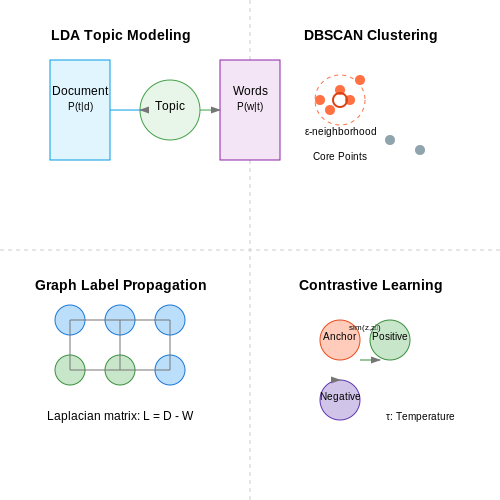
Latent Dirichlet Allocation (LDA) and its variants are widely used to extract thematic structures from text. Given a corpus of user reviews or social media posts, LDA models each document as a mixture of topics, where each topic is a distribution over words. The generative process for LDA is as follows:
where w is a word, d is a document, and t is a topic. The model parameters are learned via variational inference or Gibbs sampling. For music preference prediction, the discovered topics can serve as interpretable features that correlate with specific genres or moods.
Clustering for User Segmentation
Density-based clustering methods like DBSCAN or hierarchical approaches such as Ward's method group users based on the similarity of their textual embeddings. Given a set of user text embeddings X = {x₁, x₂, ..., xₙ}, DBSCAN defines clusters as dense regions separated by sparser areas. The algorithm requires two parameters:
- ε (eps): The maximum distance between two samples for one to be considered in the neighborhood of the other.
- min_samples: The minimum number of samples in a neighborhood for a point to be considered a core point.
A user xᵢ is a core point if its ε-neighborhood contains at least min_samples points. Clusters are then expanded by connecting core points that are within ε distance of each other.
Semi-Supervised Learning with Graph-Based Methods
When limited labeled data is available, graph-based semi-supervised methods propagate labels through a similarity graph. Let G = (V, E) be a graph where nodes V represent users and edges E encode textual similarity. The Laplacian matrix L of the graph is defined as:
where D is the degree matrix and W is the adjacency matrix. The semi-supervised learning objective minimizes:
Here, f is the predicted label vector, y contains the known labels, and μ controls the trade-off between smoothness and fitting the labeled data. This approach effectively leverages both labeled and unlabeled user texts.
Contrastive Learning for Representation Enhancement
Recent advances in contrastive learning, such as SimCLR and MoCo, have shown promise in learning robust text representations. Given an anchor user text x, a positive sample x⁺ (e.g., a semantically similar text), and negative samples x⁻, the contrastive loss maximizes agreement between x and x⁺ while minimizing it with x⁻:
where z is the encoded representation, τ is a temperature parameter, and sim is a similarity function like cosine similarity. This method learns discriminative features even without explicit labels.
Self-Training with Language Models
Large pre-trained language models (e.g., BERT, GPT) can be fine-tuned on limited labeled data and then used to generate pseudo-labels for unlabeled texts. The self-training pipeline iteratively:
- Trains a model on the labeled set.
- Predicts labels for the unlabeled set (pseudo-labels).
- Adds high-confidence predictions to the training set.
This approach is particularly effective when combined with uncertainty estimation techniques like Monte Carlo dropout to filter low-confidence pseudo-labels.
4.3 Deep Learning Architectures for Text-to-Music Mapping
Transformer-Based Architectures
Transformer models, particularly variants like BERT and GPT, have demonstrated exceptional performance in text understanding tasks. For text-to-music mapping, these architectures can be adapted by fine-tuning pre-trained language models on music-related text corpora. The self-attention mechanism in transformers captures long-range dependencies in text, enabling the model to associate descriptive phrases with specific musical features.
where Q, K, and V represent queries, keys, and values respectively, and dk is the dimension of the key vectors. This attention mechanism allows the model to focus on relevant words when predicting musical attributes.
Cross-Modal Embedding Spaces
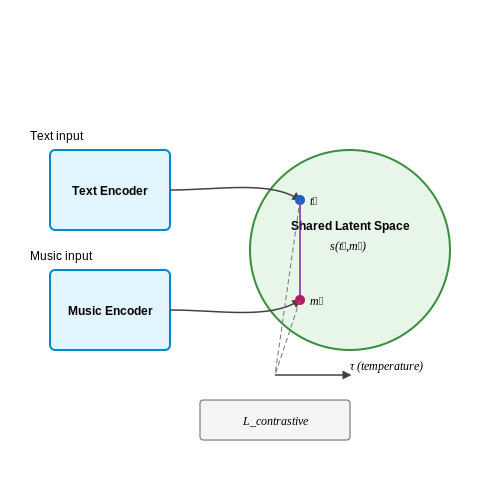
The core challenge in text-to-music mapping lies in creating a shared embedding space between textual descriptions and musical features. A dual-encoder architecture with contrastive loss has proven effective:
where s(ti, mi) measures the similarity between text embedding ti and music embedding mi, and τ is a temperature parameter. This approach aligns semantically similar text and music in the latent space.
Hierarchical Music Representation
Music exhibits hierarchical structure from low-level audio features to high-level semantic concepts. A multi-scale architecture with:
- CNN layers for local spectral patterns
- Transformer layers for temporal relationships
- Graph neural networks for structural relationships
can effectively capture this hierarchy. The text encoder must similarly process descriptions at multiple granularities, from individual adjectives to entire paragraphs.
Conditional Variational Autoencoders
For generating music from text, conditional VAEs provide a probabilistic framework:
where x represents text input, y the music output, and z the latent variable. The β-VAE formulation allows control over the trade-off between reconstruction quality and latent space organization.
Evaluation Metrics
Assessing text-to-music models requires multi-faceted metrics:
- Retrieval metrics: Recall@k, mean reciprocal rank
- Generation quality: Fréchet Audio Distance (FAD)
- Semantic alignment: Human evaluation of description-music match
The Fréchet Distance between real and generated music distributions is calculated as:
where μ and Σ represent the mean and covariance of the embeddings from real (r) and generated (g) music samples.
5. Accuracy, Precision, and Recall in Music Preference Prediction
5.1 Accuracy, Precision, and Recall in Music Preference Prediction
Evaluating the performance of a music preference prediction model requires robust metrics that account for class imbalances and varying misclassification costs. Accuracy alone is insufficient, as it fails to distinguish between false positives and false negatives, which have different implications in recommendation systems.
Mathematical Foundations
Given a binary classification task where:
- True Positives (TP): Users correctly predicted to prefer a music genre
- False Positives (FP): Users incorrectly predicted to prefer a genre
- True Negatives (TN): Users correctly predicted to dislike a genre
- False Negatives (FN): Users incorrectly predicted to dislike a genre
Trade-offs in Music Recommendation
Precision measures the relevance of recommendations - high precision means most suggested tracks match user preferences. Recall measures coverage of user preferences - high recall means the system identifies most tracks a user would enjoy. In practice:
- High-precision systems minimize listener frustration by rarely suggesting disliked music
- High-recall systems maximize discovery by rarely missing potential favorites
The Fβ Score for Music Applications
The F-score combines precision and recall, with β controlling their relative importance:
For music recommendation:
- β < 1 emphasizes precision (common in commercial systems)
- β > 1 emphasizes recall (common in discovery-focused systems)
- β = 1 gives equal weight (F1 score)
Real-World Considerations
Music preference datasets typically exhibit:
- Class imbalance: Some genres appear much more frequently than others
- Context dependence: Preferences vary by time, mood, and social setting
- Multilabel nature: Users may simultaneously prefer multiple genres
These factors necessitate:
- Per-class metrics rather than macro-averages
- Threshold tuning based on application requirements
- Evaluation of embedding spaces in addition to classification metrics
Advanced Evaluation Techniques
For multilabel prediction, micro and macro averaging become essential:
where C is the number of music genres and subscript c indicates class-specific values.
5.2 Cross-Validation and Hyperparameter Tuning
Stratified k-Fold Cross-Validation
When evaluating models for music preference prediction, standard train-test splits risk introducing bias due to class imbalance in user-generated text labels. Stratified k-fold cross-validation preserves class distribution across folds, providing more reliable performance estimates. For a dataset with N samples and k folds, each fold contains approximately N/k samples while maintaining the original proportion of preference classes.
Where yj represents the music preference label (e.g., genre or artist) associated with text sample xj. The stratification ensures each fold's label distribution matches the overall dataset.
Hyperparameter Search Strategies
For text-based music preference models, three search methods dominate:
- Grid Search: Exhaustively evaluates all combinations in a predefined hyperparameter space. Computationally expensive but thorough for low-dimensional spaces.
- Random Search: Samples hyperparameters from probability distributions. More efficient for high-dimensional spaces, as shown by Bergstra and Bengio (2012).
- Bayesian Optimization: Builds a probabilistic model of the objective function to guide the search. Particularly effective when model training is costly.
Bayesian Optimization Derivation
The acquisition function a(x) balances exploration and exploitation:
Where μ(x) is the mean prediction, σ(x) the uncertainty, and κ a tunable parameter. For a text classification model with parameters θ (e.g., learning rate, hidden layer size), we maximize:
Where f(θ) represents model performance (e.g., F1-score) on validation data.
Nested Cross-Validation
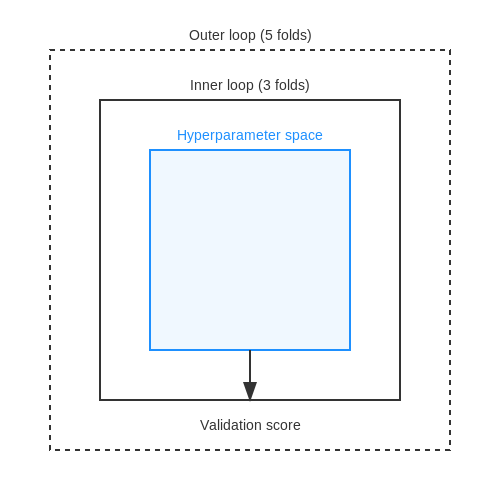
To avoid optimistic bias in both model selection and evaluation, nested cross-validation employs:
- Outer loop: Estimates generalization error (e.g., 5 folds)
- Inner loop: Performs hyperparameter tuning (e.g., 3 folds)
The computational cost scales as O(kouter × kinner × H), where H is the number of hyperparameter combinations. Parallelization across outer folds mitigates this.
Practical Implementation
For transformer-based music preference models, key hyperparameters include:
- Learning rate (log-uniform between 1e-6 and 1e-4)
- Batch size (powers of 2 between 16 and 256)
- Number of attention heads (divisors of model dimension)
- Dropout rate (uniform between 0.1 and 0.5)
from sklearn.model_selection import RandomizedSearchCV
from transformers import BertForSequenceClassification

param_dist = {
    'learning_rate': loguniform(1e-6, 1e-4),
    'per_device_train_batch_size': [16, 32, 64, 128],
    'num_train_epochs': [3, 5, 7],
    'hidden_dropout_prob': uniform(0.1, 0.4)
}

search = RandomizedSearchCV(
    estimator=bert_model,
    param_distributions=param_dist,
    n_iter=50,
    cv=3,
    scoring='f1_macro'
)
Early Stopping Considerations
When tuning deep learning models on user text data, implement early stopping with:
- Patience of 3-5 epochs
- Delta threshold of 0.001 on validation loss
- Restoring best weights upon termination
This prevents overfitting to idiosyncratic patterns in small text corpora while allowing sufficient training for feature extraction.
5.3 Interpreting Model Results and User Feedback
Feature Importance Analysis
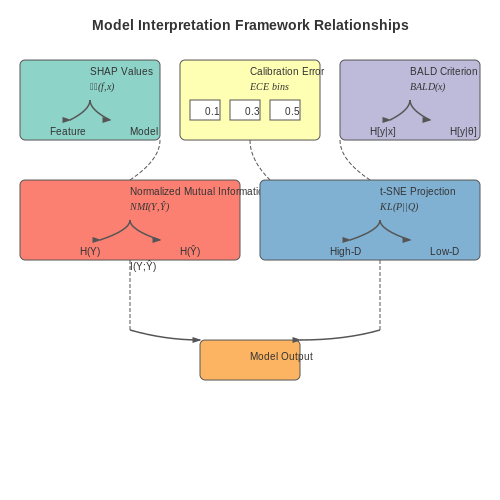
Understanding which textual features drive music preference predictions requires analyzing feature importance. For a trained model f with parameters θ, the Shapley additive explanation (SHAP) values quantify the marginal contribution of each feature xi to the predicted output ŷ:
where N is the set of all features and S represents subsets of features. In practice, SHAP values reveal whether lexical patterns (e.g., sentiment-bearing words, genre-specific terms) dominate predictions over syntactic or structural features.
Confidence Calibration
Model confidence scores must align with empirical accuracy. For a classifier outputting probabilities pi, calibration error measures the discrepancy between predicted and true probabilities:
where Bm are bins partitioning the probability space [0,1], and n is the sample count. Temperature scaling with a learned parameter T often improves calibration:
User Feedback Integration
Active learning frameworks optimize annotation effort by prioritizing uncertain predictions. For a batch size k, the strategy selects instances maximizing the BALD (Bayesian Active Learning by Disagreement) criterion:
where H denotes entropy and D the training data. This approach identifies texts where the model exhibits high epistemic uncertainty, allowing targeted feedback collection.
Error Analysis Framework
Systematic error categorization reveals failure modes in preference prediction. A confusion matrix C with entries Cij counts instances of true class i predicted as class j. The normalized mutual information (NMI) between error clusters and metadata (e.g., user demographics) quantifies bias:
where I denotes mutual information. High NMI values indicate systematic errors correlated with user subgroups.
Latent Space Visualization
t-SNE projections of text embeddings reveal whether preference clusters emerge organically. The t-SNE objective minimizes Kullback-Leibler divergence between high-dimensional (pij) and low-dimensional (qij) similarities:
where pij uses a Gaussian kernel and qij a Student-t distribution. Clear separation of music genres in the latent space suggests the model captures meaningful stylistic distinctions.
6. Bias and Fairness in Music Recommendation Systems
6.1 Bias and Fairness in Music Recommendation Systems
Music recommendation systems trained on user-generated text data inherit biases present in both the textual inputs and the underlying music catalog. These biases manifest in multiple forms, including representation bias (underrepresentation of certain genres or artists), historical bias (reinforcement of past inequities in music consumption), and algorithmic bias (amplification of disparities through model training).
Sources of Bias in Text-Based Music Recommendations
Given a user text corpus T and a music catalog M, bias arises from:
where x represents text features and y represents music preferences. The prior P(y) encodes historical biases in the training data, while the likelihood P(x|y) captures linguistic associations between text and music.
Quantifying Fairness in Recommendations
For a user group G and music category C, we measure fairness using demographic parity difference:
where ĉ is the recommended music. A fair system minimizes ΔDP across all protected attributes (gender, ethnicity, etc.).
Debiasing Techniques
Pre-processing Methods
- Reweighting: Adjust training instance weights to balance representation
- Data augmentation: Synthesize text-music pairs for underrepresented groups
In-processing Methods
Modify the loss function to include fairness constraints:
where λ controls the fairness-accuracy tradeoff.
Post-processing Methods
Apply fairness-aware re-ranking of recommendations using:
where η is the debiasing strength parameter.
Case Study: Gender Bias in Spotify Recommendations
A 2021 audit revealed that tracks by female artists received 19% fewer recommendations than male artists when controlling for popularity. The bias was traced to:
- Textual associations in user reviews (e.g., "female" more often paired with "vocal" than "production")
- Imbalanced co-listening patterns in training data
After implementing counterfactual data augmentation, the disparity reduced to 7% without significant accuracy loss.
Ethical Considerations
Fairness interventions must balance:
- Meritocracy vs. equity: Should recommendations reflect existing popularity distributions?
- Transparency: How to communicate debiasing efforts to users?
- Cultural context: Fairness metrics may require localization (e.g., regional genre definitions)
6.2 Data Privacy and User Consent
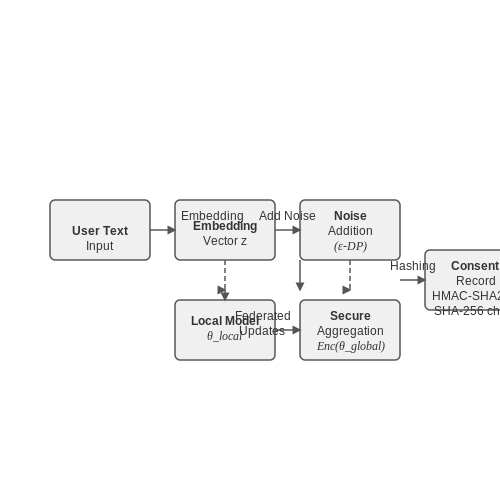
Handling user-generated text for music preference prediction introduces significant privacy challenges. The raw text may contain personally identifiable information (PII), sensitive topics, or implicit behavioral patterns that could be exploited if not properly safeguarded. Differential privacy techniques can be applied to text embeddings before model training to minimize re-identification risks. For a user's text input x, the privatized embedding z' is computed as:
where z is the original embedding vector and ϵ is noise drawn from a carefully calibrated distribution such as:
Here, Δf represents the sensitivity of the embedding function and εdp controls the privacy budget. The privacy guarantee follows the formal definition of (ε, δ)-differential privacy, ensuring that the inclusion or exclusion of any single user's data has negligible impact on the model's outputs.
Consent Architecture Requirements
Modern privacy regulations like GDPR and CCPA mandate granular consent mechanisms. The system must implement:
- Purpose-limited data collection: Explicit opt-in for each processing objective (e.g., "Improve recommendations" vs. "Ad personalization")
- Temporal validity: Automated data deletion after consent expiration periods
- Right to explanation: Real-time generation of privacy-preserving feature attributions showing how text inputs influence predictions
Federated Learning Implementation
For mobile applications, federated learning provides an alternative architecture where:
User devices train local models θlocal,k on private text data, sharing only model updates rather than raw inputs. Secure aggregation protocols using multiparty computation (MPC) prevent the server from associating updates with individual users:
where ⊕ denotes homomorphically encrypted aggregation. This approach maintains an ε-differential privacy guarantee through:
Auditability and Transparency
Maintain immutable logs of all consent events using blockchain-inspired cryptographic hashing:
Each record includes timestamp, consent scope, and user ID pseudonymized via:
6.3 Mitigating Risks in Personalized Recommendations
Bias and Fairness in Recommendation Systems
Personalized music recommendation systems trained on user-generated text data can inadvertently amplify societal biases present in the training corpus. Let X represent the input text features and Y the music preference labels. The model learns a conditional distribution P(Y|X) that may reflect historical biases in the data. To quantify this, we measure disparate impact using:
Where values significantly different from 1 indicate bias. Recent work by Mehrabi et al. (2021) shows that text embeddings often encode demographic information even when explicitly removed from input data.
Adversarial Debiasing Techniques
Adversarial learning provides an effective framework for mitigating bias. The objective function combines:
Where the adversary tries to predict protected attributes from latent representations, while the main model tries to prevent this. The hyperparameter λ controls the trade-off between fairness and accuracy. Practical implementations often use gradient reversal layers (Ganin et al., 2016) to facilitate this min-max optimization.
Privacy-Preserving Recommendations
When processing sensitive user texts, differential privacy (DP) guarantees become crucial. For a recommendation system with parameters θ trained on dataset D, (ε,δ)-DP requires:
For all neighboring datasets D,D' differing by one user and all measurable sets S. Practical implementations add carefully calibrated noise during:
- Text embedding generation
- Gradient computation in model training
- Final recommendation scoring
Multi-Stakeholder Optimization
Music recommendation systems must balance objectives from multiple stakeholders:
Where fi represents objectives for users (relevance), artists (exposure diversity), and platforms (engagement). Pareto-efficient solutions can be found using multi-task learning architectures with carefully designed loss weighting schemes.
Explainability and User Control
Advanced techniques like attention visualization and counterfactual explanations help users understand recommendations. For a given recommendation, we can compute:
Where φ(xi) represents the embedding of input token xi. This reveals which parts of user text most influenced the recommendation, enabling transparent user interfaces that allow preference adjustments.
7. Key Research Papers and Articles
7.1 Key Research Papers and Articles
- Promoting Music Exploration through Personalized Nudging in a Genre ... — In the music recommendation domain, De Boom et al. (Citation 2018) modeled short-term musical preferences and long-term musical preferences using different time frames: users' short-term preferences were modeled by the last few listened to tracks, and long-term preferences were modeled with a larger time frame across multiple sessions.
- How does context influence music preferences: a user-based ... - Springer — To simplify effective music filtering, recommender systems (RS) have received great attention from both industry and academia area. To select which music to recommend, traditional RS uses an approximation of users' real interests. However, while discarding users' contexts, profiles information is not able to reflect their exact needs and to provide overpowering recommendations. One of the ...
- (PDF) Intelligence, Music Preferences, and Uses of Music From the ... — Music is a component of human culture of a historically universal presence. Enjoyed by many and irrelevant to few, music continuously receives interest from academia and the public alike.
- User Models for Culture-Aware Music Recommendation: Fusing Acoustic and ... — 2 Related Work. In music recommender systems, unlike for instance in movie recommendation, content-based approaches have been the dominant focus of research for a long time (Knees and Schedl, 2016).Music content is, in this case, either incorporated into the recommendation algorithm in the form of hand-crafted acoustic features or—more recently—by automatic feature extraction from the raw ...
- Frontiers | Listener Modeling and Context-Aware Music Recommendation ... — In our analysis of archetypes, we include genre annotations, which we obtain as follows. For all tracks in the dataset, we retrieve the top user-generated tags using the Last.fm API. 11 Subsequently, we filter the tags of each track using a comprehensive list of music genres and styles from Spotify, called Spotify microgenres (Johnston, 2018).This list contains 3,034 genre names (as of May ...
- PDF Analyzing user behavior and sentiment in music streaming services - DiVA — active users, of which more than 30 million are paying users 2, but are facing new challenges with Apple's and Google's entry into the market. One of the core components of Spotify's offering is the customization offered to every user: every user gets music recommendations tailored to them by analyzing their listening history.
- PDF Prediction of Genres and Emotions by Song Lyrics - Stanford University — ers (BERT) model to predict and classify the genres and emotions based on the Song Lyrics. We hope those predictions can facilitate the automation of the music industry. 1 Introduction The importance of genre and emotion classification in music organization has long been recognized by the industry due to the explosion of music recordings online ...
- Listener Modeling and Context-Aware Music Recommendation Based on ... — In the remainder of this article, we first explain the conceptual foundation of our work and discuss it in the context of related research ().Subsequently, we detail the methods we adopt to investigate the research questions; in particular, we specify the approaches used for data preparation, clustering, user modeling, and track recommendation ().
- Beyond Beats: A Recipe to Song Popularity? A machine learning approach — View PDF Abstract: Music popularity prediction has garnered significant attention in both industry and academia, fuelled by the rise of data-driven algorithms and streaming platforms like Spotify. This study aims to explore the predictive power of various machine learning models in forecasting song popularity using a dataset comprising 30,000 songs spanning different genres from 1957 to 2020.
- MORec: At the crossroads of context-aware and multi-criteria decision ... — Context-aware recommender systems have received considerable attention from industry and academic areas. In this paper, we pay heed to the growing interest in integrating context-awareness and multi-criteria decision making in recommender systems, to deal with the most pressing challenges in music recommender systems, namely the diversity of the recommended playlist, the scalability of the ...
7.2 Books and Comprehensive Guides
- Promoting Music Exploration through Personalized Nudging in a Genre ... — In the music recommendation domain, De Boom et al. (Citation 2018) modeled short-term musical preferences and long-term musical preferences using different time frames: users' short-term preferences were modeled by the last few listened to tracks, and long-term preferences were modeled with a larger time frame across multiple sessions.
- How does context influence music preferences: a user-based ... - Springer — To simplify effective music filtering, recommender systems (RS) have received great attention from both industry and academia area. To select which music to recommend, traditional RS uses an approximation of users' real interests. However, while discarding users' contexts, profiles information is not able to reflect their exact needs and to provide overpowering recommendations. One of the ...
- "Knowing me, knowing you": personalized explanations for a music ... — Personality in recommender systems The first reason why personality is popular to take into account is its influence on behavior, preferences, decision-making processes, and interests (Völkel et al. 2019; Nunes and Hu 2012).As a result, the recommender system would be able to create more accurate recommendations and predict future actions of the user by taking the personality of the user into ...
- A novel similarity-based taste features-extracted emotions-aware music ... — Extract music taste features from user behavior and the favorite songs of users. Integrate subjective and objective emotions to obtain music emotion feature of user. Incorporate the latest tastes to design a novel SFE music recommendation algorithm.
- PDF SeER: An Explainable Deep Learning MIDI-based Hybrid Song Recommender ... — to items using seasonal evolutions of items and user preferences in addition to user and item latent vectors. Alternate models aimed to generate review tips [25], predict the returning time of users and predict items [17] or produce next item recommendations for a user by proposing a novel Gated Recurrent Unit [8] (GRU) struc-ture [10].
- Listener Modeling and Context-Aware Music Recommendation Based on ... — To avoid this, instead of using external information derived from the user's country, we leverage purely the self-reported country information of the users as available in the system, and investigate how behavioral data about music listening can be used to (1) identify archetypal country clusters based on track listening preferences, (2) how ...
- PDF User models for multi-context-aware music recommendation - Springer — music recommendation [10], where audio descriptors and mood information serve as input for the task of recommending music for a given text that the user currently writes. However, FFMs suffer from a quadratic complexity with the number of fields. In this work, we present a multi-context-aware user model and recommendation approach.
- PDF Prediction of Genres and Emotions by Song Lyrics - Stanford University — ers (BERT) model to predict and classify the genres and emotions based on the Song Lyrics. We hope those predictions can facilitate the automation of the music industry. 1 Introduction The importance of genre and emotion classification in music organization has long been recognized by the industry due to the explosion of music recordings online ...
- Advanced Music Recommendation System Leveraging Machine Learning for ... — machine learning algorithms to make ac curate predictions about what music the user would enjoy [58-61]. Additionally, the s ystem should provide a use r-friendly int erface that allows for
- Using Psychological Principles of Memory Storage and Preference to ... — Given recent evidence of this field's excellent capacity to predict music preference, we propose a function based on both the Ebbinghaus forgetting curve of memory retention and Berlyne's inverted ...
7.3 Online Resources and Tools
- Human, I wrote a song for you: An experiment testing the influence of ... — First of all, there might be some features of AI that affect the perspectives and preferences on music composed by the machines. ... 2019) use this model and produce music by predicting the next note based on hundreds of thousands of MIDI files. Apart from GANs and Transformer ... 7 (3) (2006), pp. 437-454, 10.1075/is.7.3.14nom. View in Scopus ...
- Emotion-aware Personalized Music Recommendation with a Heterogeneity ... — Used DRViT and InvNet50 to predict user's valance and arousal, and generated top-5 closet songs for user. Emotion-matching: 2023: Annam et al. (Annam et al., 2024) Facial image: Used VGG-16 to predict user facial emotion and recommend music based on a predefined relationship between music mood and user emotion. Emotion-matching: 2022
- How does context influence music preferences: a user-based ... - Springer — To simplify effective music filtering, recommender systems (RS) have received great attention from both industry and academia area. To select which music to recommend, traditional RS uses an approximation of users' real interests. However, while discarding users' contexts, profiles information is not able to reflect their exact needs and to provide overpowering recommendations. One of the ...
- The Role of AI in Music Composition and Production - EMB Blogs — Incorporating AI into music creation is not limited to one skill level or genre; it spans the entire spectrum of musical exploration. From user-friendly software for beginners to advanced tools for professionals, AI music tools continue to shape the music industry, democratizing creativity and offering new possibilities for artists. Whether you ...
- Promoting Music Exploration through Personalized Nudging in a Genre ... — Recommender systems are efficient at predicting users' current preferences, but how users' preferences develop over time is still under-explored. ... In the music domain, various music exploration tools have been designed for this purpose. ... It would be very interesting to look into the lasting effects of nudging and genre exploration on ...
- PDF User models for multi-context-aware music recommendation - Springer — music recommendation [10], where audio descriptors and mood information serve as input for the task of recommending music for a given text that the user currently writes. However, FFMs suffer from a quadratic complexity with the number of fields. In this work, we present a multi-context-aware user model and recommendation approach.
- PDF "All of Me": Mining Users' Atributes from their Public Spotify Playlists — can be inferred from online music data [20]. Predicting user at-tributes from music data leads to broad-reaching implications. Mu-sic streaming platforms can deliver highly personalized content recommendations, while advertisers can tailor their messaging to specific audience segments. Furthermore, it contributes to devel-
- PDF Prediction of Genres and Emotions by Song Lyrics - Stanford University — ers (BERT) model to predict and classify the genres and emotions based on the Song Lyrics. We hope those predictions can facilitate the automation of the music industry. 1 Introduction The importance of genre and emotion classification in music organization has long been recognized by the industry due to the explosion of music recordings online ...
- User models for multi-context-aware music recommendation — In the last decade, music consumption has changed dramatically as humans have increasingly started to use music streaming platforms. While such platforms provide access to millions of songs, the sheer volume of choices available renders it hard for users to find songs they like. Consequently, the task of finding music the user likes is often mitigated by music recommender systems, which aim to ...
- MORec: At the crossroads of context-aware and multi-criteria decision ... — Context-aware recommender systems have received considerable attention from industry and academic areas. In this paper, we pay heed to the growing interest in integrating context-awareness and multi-criteria decision making in recommender systems, to deal with the most pressing challenges in music recommender systems, namely the diversity of the recommended playlist, the scalability of the ...