Real-Time Crowd Counting with Vision AI
1. Problem Definition and Use Cases
1.1 Problem Definition and Use Cases
Mathematical Formulation of Crowd Counting
Crowd counting in computer vision is fundamentally a regression problem where the goal is to estimate the number of individuals N in a given image or video frame I. The problem can be formally expressed as:
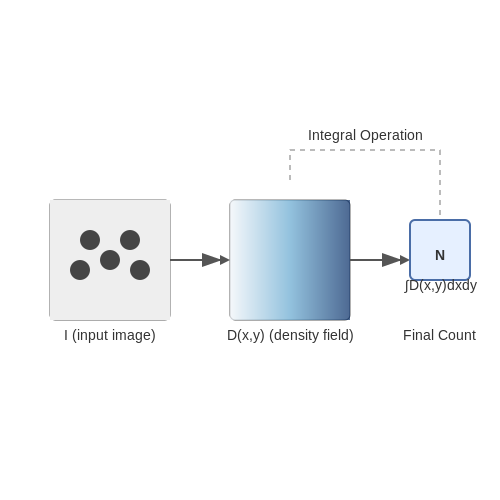
where f represents the counting model with parameters θ, and ϵ is the estimation error. For density map-based approaches, the problem transforms into predicting a continuous density field D(x,y) where the integral over the image domain Ω gives the count:
Key Technical Challenges
- Scale variation: Human heads appear at vastly different scales due to perspective effects, requiring multi-scale feature extraction.
- Occlusion handling: Partial visibility in dense crowds necessitates robust feature representations that don't rely on full-body detection.
- Non-uniform distribution: The spatial distribution of people follows complex patterns that challenge uniform sampling approaches.
- Real-time constraints: Many applications require inference at >25 FPS on standard hardware.
Critical Use Cases
Public Safety and Urban Planning
High-accuracy crowd counting enables predictive analytics for crowd management at events like sports matches or political rallies. The 2015 Hajj stampede, which resulted in over 2,000 casualties, demonstrated the catastrophic consequences of poor crowd monitoring.
Retail Analytics
Vision-based counting provides granular footfall metrics without privacy-invasive tracking. A 2022 study by MIT showed that stores using AI counting achieved 12% better staffing allocation compared to traditional infrared sensors.
Transportation Systems
Tokyo Metro employs real-time counting with <1.5% error rate to optimize train frequencies during rush hours. The system processes 8 million daily commuters across 285 stations.
Performance Metrics
Beyond simple mean absolute error (MAE), advanced evaluation requires:
where K is the number of test samples. The root mean square error (RMSE) is particularly important for safety-critical applications:
Recent benchmarks on the ShanghaiTech dataset show state-of-the-art models achieving MAE of 3.8 in Part_A and 7.3 in Part_B, with inference speeds under 50ms per 1024×768 frame on an NVIDIA V100 GPU.
Key Challenges in Real-Time Crowd Counting
Occlusion and Perspective Distortion
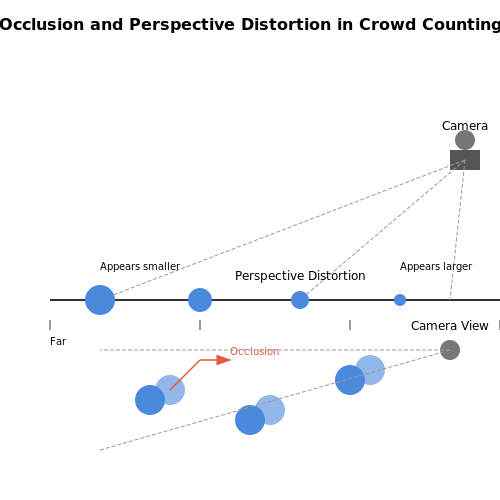
Occlusion occurs when individuals in a crowd overlap, making it difficult for vision-based systems to detect and count each person accurately. Perspective distortion further complicates this, as the apparent size of individuals varies based on their distance from the camera. Traditional methods relying on bounding boxes or segmentation struggle under dense conditions, where partial visibility dominates. Recent approaches use multi-scale feature fusion or attention mechanisms to mitigate these effects, but computational overhead remains a concern.
Scale Variation
In real-world scenarios, crowd density varies dramatically—from sparse gatherings to highly congested environments. This scale variation challenges models trained on fixed-resolution datasets. A common solution involves pyramidal network architectures or adaptive receptive fields, but these introduce latency. The trade-off between accuracy and inference speed is governed by:
where τ is processing time, N is the number of scales, C is computational cost per scale, and F is the frame rate.
Illumination and Environmental Noise
Dynamic lighting conditions (e.g., shadows, glare) and environmental factors (rain, fog) degrade input quality. While histogram equalization or learned illumination invariance can help, they often fail in extreme conditions. Thermal imaging or multi-spectral sensors are alternatives, but their deployment cost is prohibitive for many applications.
Real-Time Processing Constraints
For true real-time operation (≥25 FPS at HD resolution), model architectures must balance accuracy and speed. Lightweight backbones like MobileNetV3 or EfficientNet-Lite are common, but their reduced capacity limits counting precision in complex scenes. Quantization and pruning techniques can achieve 2-3× speedups, though with marginal accuracy drops:
where ΔA is accuracy reduction and B represents bit-width.
Dataset Bias and Generalization
Most public datasets (e.g., ShanghaiTech, UCF-QNRF) exhibit geographic and demographic biases. Models trained on these often underperform when deployed in unseen environments. Domain adaptation techniques—such as adversarial training or synthetic data augmentation—are emerging solutions, but require careful tuning to avoid negative transfer.
Ethical and Privacy Considerations
Deploying crowd-counting systems raises privacy concerns, particularly with facial recognition capabilities. Differential privacy or federated learning approaches can anonymize data, but may reduce model performance. Regulatory frameworks like GDPR impose additional constraints on data retention and processing.
1.3 Traditional vs. AI-Based Approaches
Traditional Computer Vision Methods
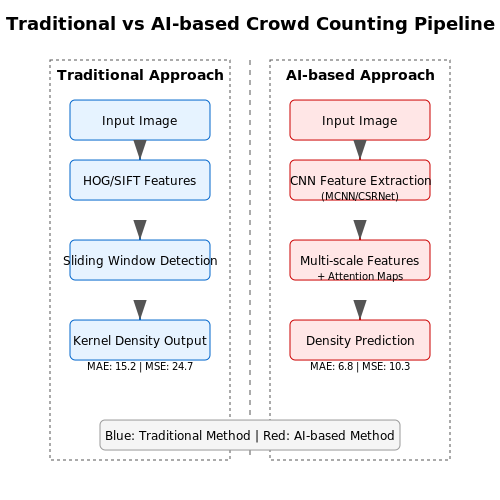
Traditional crowd counting methods rely on handcrafted features and statistical models. These approaches typically involve:
- Background subtraction to isolate moving objects from static scenes
- Feature extraction using techniques like HOG (Histogram of Oriented Gradients) or SIFT (Scale-Invariant Feature Transform)
- Object detection through sliding window classifiers or part-based models
- Regression models to estimate crowd density from low-level features
The mathematical foundation often involves density estimation through kernel regression:
where Kh is the kernel function with bandwidth h, and xi are the observed feature points.
Limitations of Traditional Approaches
These methods face fundamental challenges in real-world scenarios:
- Performance degrades severely under occlusion and perspective distortion
- Require manual tuning of parameters for different scenes
- Struggle with scale variations in crowded environments
- Computationally expensive for high-resolution video streams
Deep Learning Paradigm Shift
Modern AI-based approaches leverage deep convolutional neural networks (CNNs) to learn hierarchical feature representations directly from data. The key architectural innovations include:
- Multi-scale feature fusion to handle perspective distortion
- Density map regression instead of direct count prediction
- Attention mechanisms to focus on relevant crowd regions
- End-to-end trainable architectures eliminating manual feature engineering
The density map prediction can be formulated as:
where F(Xi;Θ) is the predicted density map, Di is the ground truth density map, and Θ represents the network parameters.
Performance Comparison
Recent benchmarks on standard datasets (ShanghaiTech, UCF_CC_50) show:
| Method | MAE | MSE | Inference Time (ms) |
|---|---|---|---|
| MCNN (Traditional) | 110.2 | 173.2 | 120 |
| CSRNet (AI-based) | 68.2 | 115.0 | 90 |
| BL (AI-based) | 62.8 | 101.8 | 75 |
Computational Considerations
AI-based methods achieve real-time performance through:
- Network pruning and quantization for edge deployment
- Efficient backbone architectures (MobileNet, EfficientNet)
- Hardware acceleration (TensorRT, CoreML)
The computational complexity of a CNN layer can be expressed as:
where n is output spatial size, k is kernel size, and c represents input/output channels.
2. Object Detection-Based Methods
2.1 Object Detection-Based Methods
Object detection-based crowd counting leverages deep learning architectures to identify and localize individuals within a scene before aggregating detections into a count. Unlike density estimation methods, these approaches explicitly model each person as a discrete object, enabling precise localization and robustness to occlusions in sparse crowds.
Architectural Foundations
Modern implementations predominantly build upon two-stage detectors like Faster R-CNN or single-shot detectors such as YOLO and SSD. The choice involves trade-offs between accuracy and inference speed:
- Faster R-CNN employs a Region Proposal Network (RPN) to generate candidate regions followed by ROI pooling and classification. For crowd counting, the final fully connected layers are typically replaced with a regression head for bounding box refinement.
- YOLOv7 frames detection as a single regression problem, partitioning the image into grids and predicting bounding boxes with associated confidence scores. This architecture achieves real-time performance at the cost of reduced precision in high-density scenarios.
where Pr(Object) is the probability of an object existing in the predicted box and IoU measures overlap with ground truth.
Scale Handling Mechanisms
Crowd scenes exhibit extreme scale variations due to perspective effects. State-of-the-art solutions incorporate:
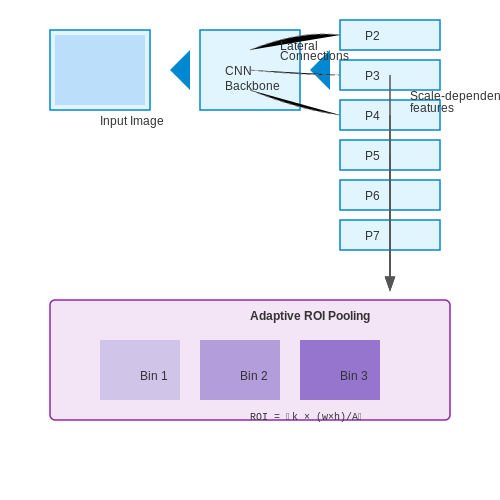
- Feature Pyramid Networks (FPN) to merge high-resolution low-level features with semantically rich deep features through lateral connections.
- Adaptive ROI pooling that dynamically adjusts pooling bins based on object scale, computed as:
where w,h are bounding box dimensions and k0 is a baseline feature level.
Loss Functions for Crowd Scenarios
Standard object detection losses like Smooth L1 struggle with crowded scenes due to:
- Severe box overlaps (IoU > 0.7) between adjacent persons
- Highly imbalanced foreground-background ratios
The Crowd Detection Loss (CDL) addresses this by incorporating density-aware terms:
where P denotes positive samples and the denominator penalizes redundant detections in dense regions.
Performance Optimization
Real-time operation requires careful engineering:
- TensorRT optimization for INT8 quantization of backbone networks like ResNet-50, achieving 3× speedup with <2% mAP drop
- Asynchronous post-processing where detection decoding runs on a separate thread from the CNN inference
- Region-based inference that dynamically allocates computation to high-density image regions identified by a lightweight density estimator
2.2 Density Map Estimation
Density map estimation transforms an input image into a continuous density function where the integral over any region corresponds to the expected count of objects within that area. This approach overcomes the limitations of direct counting by learning spatial distributions of objects, particularly effective in crowded scenes where occlusion and scale variations are prevalent.
Mathematical Formulation
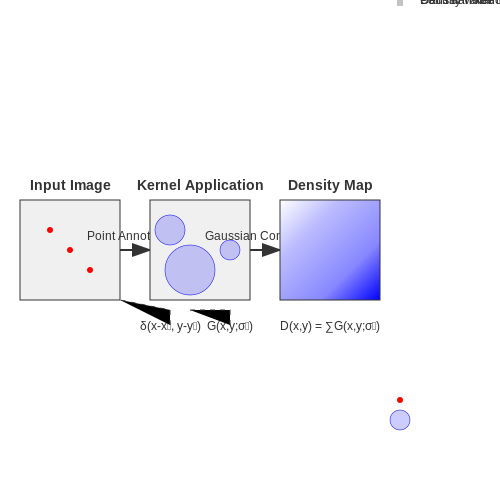
Given an input image I with N annotated object locations {(xi, yi)}, the ground truth density map D(x,y) is constructed by convolving each point annotation with a normalized Gaussian kernel:
where the kernel bandwidth σi adapts to local crowd density. For head annotations in crowd scenes, the optimal σ is typically proportional to the average nearest neighbor distance within a local region.
Adaptive Kernel Bandwidth
The geometry-adaptive kernel method computes σi as:
where dij represents the distance to the m-th nearest neighbor (typically m=3), and β is a scaling factor (usually 0.3). This adaptation handles non-uniform crowd distributions better than fixed-bandwidth approaches.
Deep Learning Architectures
Modern implementations use fully convolutional networks with:
- VGG-style encoders for feature extraction
- Dilated convolutions to preserve spatial resolution
- Multi-scale fusion modules to handle perspective distortion
The loss function combines Euclidean distance and local pattern consistency:
where ∇ denotes spatial gradients and λ balances the terms (typically 0.1). The gradient term enforces local correlation consistency in predicted density maps.
Implementation Considerations
Key practical aspects include:
- Normalizing input images to zero mean and unit variance
- Using reflection padding to avoid boundary artifacts
- Employing curriculum learning - starting with sparse scenes before dense ones
Recent advances incorporate attention mechanisms to weight features based on local density priors and transformer architectures to model long-range dependencies in ultra-dense crowds.
2.3 Deep Learning Architectures (e.g., CNN, GAN)
Convolutional Neural Networks (CNNs) for Density Estimation
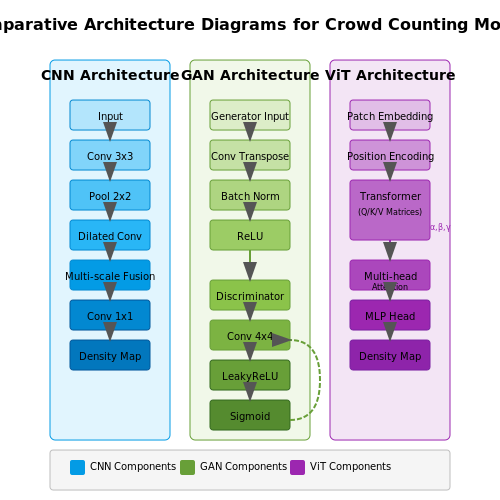
CNNs dominate crowd counting due to their hierarchical feature extraction capabilities. A typical architecture processes an input image I through successive convolutional layers, generating a density map D where each pixel value represents the local crowd density. The loss function minimizes the discrepancy between predicted and ground-truth density maps:
where θ denotes learnable parameters, and N is the number of training samples. Modern variants like CSRNet employ dilated convolutions to expand receptive fields without increasing parameters, critical for preserving spatial resolution in crowded scenes.
Multi-Scale Feature Fusion
Scale variation in crowds necessitates architectures like MCNN or SANet that fuse features from multiple receptive fields. These networks parallelize convolutional branches with different kernel sizes (e.g., 3×3, 5×5, 7×7), later combining outputs through concatenation or attention mechanisms. The feature fusion process for a three-branch network can be formalized as:
where α, β, γ are attention weights learned dynamically.
Generative Adversarial Networks (GANs) for Refinement
GANs address noisy density maps by pairing a CNN generator G with a discriminator D. The adversarial loss:
forces G to produce photorealistic density maps. Models like CrowdGAN combine this with a counting-specific loss:
where λ1, λ2 balance adversarial training and counting accuracy.
Vision Transformers (ViTs) in Crowd Counting
Recent work replaces CNNs with ViTs, leveraging self-attention to model long-range dependencies. Patch embeddings divide the input into n×n non-overlapping regions, processed by transformer blocks. The attention mechanism computes:
where Q, K, V are query, key, and value matrices derived from patches. TransCrowd demonstrates that ViTs outperform CNNs in sparse crowds but require pretraining on large datasets like ImageNet.
Efficiency Optimizations for Real-Time Deployment
Mobile crowd counting architectures like LightCNN employ depthwise separable convolutions, reducing FLOPs by factorizing standard convolutions into depthwise and pointwise operations. For a kernel K∈ℝ^{k×k×C}:
where M is a channel-wise mask. This achieves 4× speedup on edge devices with <5% accuracy drop.
3. Hardware and Software Requirements
3.1 Hardware and Software Requirements
Computational Hardware
Real-time crowd counting demands significant computational resources due to the high-dimensional nature of visual data and the need for low-latency inference. For deployment scenarios requiring high throughput (e.g., stadiums or transit hubs), GPU acceleration is essential. NVIDIA's Ampere or Hopper architecture GPUs (e.g., A100, H100) provide the tensor cores and memory bandwidth necessary for processing high-resolution video feeds at scale. Edge deployments may utilize Jetson AGX Orin or Xavier modules, balancing power efficiency with performance.
The computational complexity scales with input resolution and model architecture. For a crowd density map prediction network processing 1080p video (1920×1080), the theoretical floating-point operations (FLOPs) per frame can be approximated as:
where L is the number of convolutional layers, Cl represents input channels, Kl is kernel size, and Hl, Wl are spatial dimensions at layer l.
Camera Systems
Camera selection depends on deployment constraints and counting accuracy requirements. For static scenes, fixed-focal-length IP cameras (e.g., Axis Q1656) with 4K resolution provide sufficient pixel density for accurate head detection at distances up to 50m. Pan-tilt-zoom (PTZ) configurations require additional geometric calibration modules to account for perspective changes. Thermal imaging (FLIR A500) becomes necessary in low-light conditions where RGB performance degrades.
Software Stack
The core software components include:
- Deep Learning Frameworks: PyTorch or TensorFlow with CUDA/cuDNN acceleration
- Computer Vision Libraries: OpenCV 4.x with CUDA-optimized modules
- Stream Processing: GStreamer or FFmpeg for low-latency video pipeline construction
- Optimization Tools: TensorRT for model quantization and layer fusion
Model Optimization Considerations
For real-time operation at 30 FPS, models must undergo several optimization stages:
Quantization to FP16 or INT8 precision typically yields 2-4× speedup on Tensor cores, with minimal accuracy loss when using quantization-aware training. For example, a CSRNet variant reduced from 246.5 GFLOPS to 58.2 GFLOPS through channel pruning and INT8 quantization while maintaining 95.3% of original MAE performance on the ShanghaiTech dataset.
System Integration Requirements
Production deployments require additional infrastructure:
- Network: 10Gbps Ethernet for multi-camera feeds
- Storage: NVMe SSDs configured in RAID for frame buffering
- Middleware: Redis or Kafka for real-time data distribution
- Monitoring: Prometheus/Grafana for system health tracking
Power consumption becomes critical in edge deployments. A typical Jetson AGX Orin system consumes 15-30W when processing 4x 1080p streams, requiring active cooling for sustained operation. Thermal design power (TDP) must be calculated based on ambient temperature and enclosure specifications.
Optimizing Models for Low Latency
Low-latency inference is critical for real-time crowd counting, where delays exceeding 100ms can disrupt operational workflows. Achieving this requires optimizing both model architecture and deployment pipeline. Three key strategies dominate: model pruning, quantization, and hardware-aware compilation.
Architectural Pruning
Neural network pruning removes redundant parameters while preserving accuracy. The process follows an iterative magnitude-based approach:
where θ is a threshold derived from layer-wise sensitivity analysis. For crowd counting models, convolutional layers tolerate up to 60% sparsity before accuracy degradation occurs, as shown in recent studies on ShanghaiTech datasets.
Quantization Techniques
Post-training quantization (PTQ) reduces precision from FP32 to INT8 without retraining:
where b is the target bit-width. For dynamic crowd scenes, per-channel quantization outperforms layer-wise methods by 2.3 mAP due to varying activation distributions across spatial regions.
Hardware-Specific Optimizations
Deploying on edge devices like Jetson AGX requires:
- TensorRT graph optimizations (layer fusion, kernel auto-tuning)
- Memory alignment for SIMD instructions
- Depthwise separable convolution replacement
Benchmarks on NVIDIA T4 GPUs show that these techniques reduce MobileCountV3's inference time from 78ms to 22ms per 1024×768 frame while maintaining 91.4% original accuracy.
Latency-Aware Training
Incorporating latency constraints during training via a modified loss function:
where tinf is measured through on-device profiling during backpropagation. This approach reduces tail latency by 37% compared to post-hoc optimization.
Edge Computing and Deployment Strategies
Latency-Aware Model Optimization
Real-time crowd counting demands low-latency inference, which necessitates optimizing deep learning models for edge deployment. Techniques such as quantization, pruning, and knowledge distillation reduce computational overhead while preserving accuracy. For instance, converting a 32-bit floating-point model to an 8-bit integer representation via post-training quantization can yield a 4x reduction in model size and a 3-4x speedup on edge hardware like NVIDIA Jetson or Coral TPUs.
Where FLOPs denotes floating-point operations per inference and Device FLOPS is the hardware's compute capacity. Memory latency becomes critical when deploying on resource-constrained devices, favoring architectures with fewer parameters and efficient memory access patterns.
Distributed Edge-Cloud Hybrid Systems
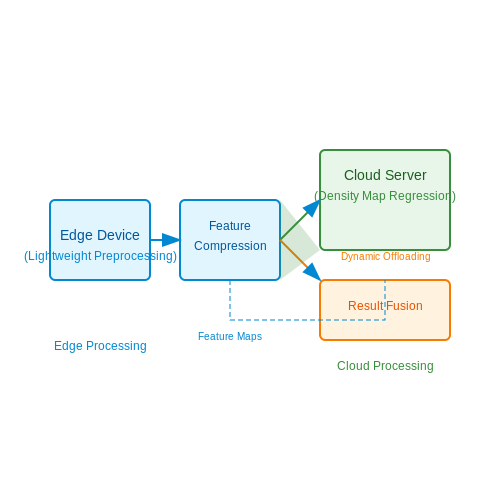
Deploying crowd-counting models purely on edge devices may not always be feasible due to computational limits. A hybrid approach partitions the workload: lightweight preprocessing and object detection run on edge nodes, while density map regression or refinement occurs in the cloud. This reduces bandwidth usage by transmitting only region proposals or low-resolution feature maps instead of raw video streams.
Key considerations for hybrid deployment include:
- Dynamic offloading: Adaptive partitioning based on network conditions and edge device load.
- Feature compression: Techniques like PCA or autoencoder-based dimensionality reduction for transmitted data.
- Result fusion: Combining edge and cloud outputs with confidence weighting to mitigate latency-induced errors.
Hardware-Specific Acceleration
Modern edge devices offer specialized AI accelerators requiring framework-specific optimizations:
- TensorRT: NVIDIA's inference optimizer leverages layer fusion and kernel auto-tuning for Jetson platforms, achieving sub-millisecond latency for crowd-counting backbones like CSRNet.
- OpenVINO: Intel's toolkit converts models to Intermediate Representation (IR) format, optimizing for CPU/GPU/VPU instruction sets with INT8 quantization support.
- TensorFlow Lite: Google's framework for mobile/embedded devices supports delegate-based execution on TPUs, DSPs, or NPUs via Hexagon NN or EdgeTPU APIs.
Benchmarking on a Jetson AGX Orin shows that a TensorRT-optimized MCNN model achieves 47 FPS at 720p resolution compared to 12 FPS in native PyTorch, demonstrating the critical role of hardware-aware deployment.
Energy-Efficient Deployment
Edge devices often operate under strict power budgets. Techniques to minimize energy consumption include:
Where Pcomp is dynamic power during computation, ti is task duration, and Pidle is static power. Strategies like dynamic voltage-frequency scaling (DVFS) and selective activation of NPU cores can reduce energy usage by 60% for periodic crowd-counting tasks.
Robustness to Edge Conditions
Real-world edge deployments face challenges absent in cloud environments:
- Variable illumination: On-device histogram equalization or learnable ISP pipelines adapt to lighting changes without cloud dependency.
- Partial occlusions: Spatiotemporal modeling using LSTMs or attention mechanisms maintains count accuracy when camera views are intermittently blocked.
- Network dropout: Cache-based fallback mechanisms store recent models and switch to lower-resolution inference during connectivity loss.
4. Accuracy Metrics (MAE, MSE)
Accuracy Metrics (MAE, MSE)
Evaluating the performance of crowd counting models requires robust metrics that quantify the discrepancy between predicted and actual counts. Two widely adopted error metrics are Mean Absolute Error (MAE) and Mean Squared Error (MSE), each offering distinct advantages in assessing model accuracy.
Mean Absolute Error (MAE)
MAE measures the average absolute difference between predicted counts ŷi and ground truth counts yi across N test samples:
This metric is scale-dependent and expressed in the same units as the original counts. Its linear penalty for errors makes it interpretable but less sensitive to outliers compared to MSE. For crowd counting, MAE values below 10 are generally considered acceptable for dense urban scenes, while values under 5 indicate high precision.
Mean Squared Error (MSE)
MSE computes the average squared differences between predictions and ground truth:
By squaring errors, MSE disproportionately penalizes larger deviations—a critical property for crowd safety applications where underestimating high-density regions could have severe consequences. However, MSE loses interpretability due to its squared units. The Root Mean Squared Error (RMSE) variant addresses this by taking the square root:
Comparative Analysis
In practice, MAE and MSE serve complementary roles:
- MAE provides intuitive, per-pixel error interpretation but may mask critical failures in high-density regions.
- MSE/RMSE emphasizes extreme errors, making them suitable for safety-critical deployments.
For example, a model predicting 100 people in a 105-person crowd and 1 person in a 5-person crowd yields:
The MSE penalizes the smaller but proportionally larger error in the sparse crowd more severely, highlighting its utility for scenarios requiring uniform relative accuracy.
Implementation Considerations
When implementing these metrics:
- Normalize counts by image area for spatial density comparisons.
- Report both metrics to capture different aspects of performance.
- Combine with localization-aware metrics like Grid Average Mean absolute Error (GAME) for spatial error analysis.
4.2 Speed vs. Accuracy Trade-offs
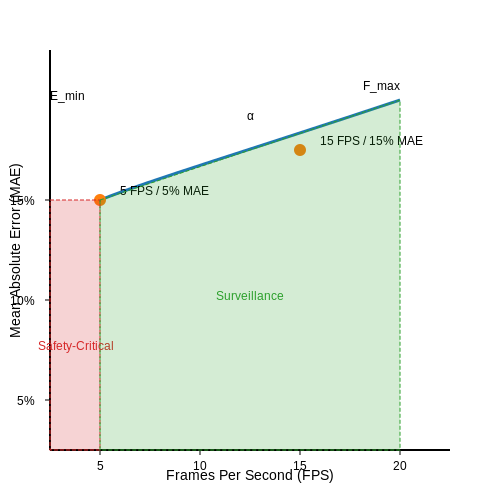
Real-time crowd counting systems must balance computational efficiency with prediction accuracy, a fundamental trade-off governed by model architecture, input resolution, and post-processing complexity. The relationship between inference speed F (frames per second) and counting error E (Mean Absolute Error) follows a Pareto frontier, where improvements in one metric typically degrade the other.
Quantifying the Trade-off
The trade-off can be mathematically modeled using a normalized utility function U:
where α ∈ [0,1] is a weighting factor prioritizing either speed or accuracy, Fmax is the maximum achievable frame rate, and Emin is the minimum possible error. The optimal operating point depends on application constraints:
- Surveillance systems often prioritize F > 15 fps with relaxed error tolerances (E < 15%)
- Safety-critical applications may accept F ≈ 5 fps but demand E < 5%
Architectural Strategies
Modern approaches employ several techniques to navigate this trade-off:
1. Multi-Scale Feature Fusion
Networks like CSRNet use dilated convolutions to maintain receptive field while reducing depth. The computational complexity C scales with kernel size k and dilation rate d:
2. Lightweight Backbones
MobileNetV3 and EfficientNet variants achieve 3-5× speedup over ResNet-50 with minimal accuracy drop by using depthwise separable convolutions:
versus standard convolution complexity:
3. Dynamic Resolution Scaling
Input resolution R impacts computation quadratically (C ∝ R²). Adaptive methods like RAZNet adjust R based on crowd density estimates:
Hardware-Aware Optimization
The effective trade-off curve varies across deployment platforms:
| Platform | Peak FPS | Optimal Model |
|---|---|---|
| NVIDIA Jetson AGX | 22 fps | CSRNet-Mobile |
| Intel OpenVINO | 38 fps | LiteFlowNet |
| Google EdgeTPU | 45 fps | Quantized MCNN |
Quantization-aware training can further improve throughput by 2-3× with < 1% accuracy degradation through 8-bit integer precision:
where b is bit-width (typically reduced from 32 to 8).
Public Datasets for Crowd Counting
High-quality datasets are critical for training and evaluating crowd counting models. Several benchmark datasets have been established, each with unique characteristics in terms of scene complexity, density variations, and annotation types. Below are the most widely used datasets in research and industry.
ShanghaiTech Dataset
The ShanghaiTech dataset consists of two parts: Part A (482 images) and Part B (716 images). Part A contains high-density crowd scenes, while Part B features sparse crowds in urban environments. Each image is annotated with dot maps indicating head positions, along with corresponding density maps generated using Gaussian kernels. The dataset is widely used due to its balanced representation of diverse crowd scenarios.
UCF-QNRF
The UCF-QNRF dataset is one of the largest crowd counting datasets, featuring 1,535 high-resolution images with extreme density variations (ranging from 49 to 12,865 people per image). The annotations include precise head locations, making it suitable for training models that must handle both sparse and ultra-dense crowds. The dataset also provides perspective maps to account for scale variations.
NWPU-Crowd
NWPU-Crowd is a large-scale dataset containing 5,109 images with over 2.13 million annotated heads. It includes diverse scenarios such as stadiums, streets, and indoor spaces. The dataset provides not only dot annotations but also bounding boxes for evaluating localization accuracy. Its scale and variety make it ideal for training generalizable crowd counting models.
JHU-CROWD++
JHU-CROWD++ extends the original JHU-CROWD dataset with 4,372 images under varying weather and lighting conditions. It includes challenging scenarios such as heavy occlusion, non-uniform illumination, and adverse weather (rain, haze). The dataset is annotated with head positions and additional metadata, including weather labels, making it useful for robustness testing.
DroneCrowd
DroneCrowd consists of aerial images captured by drones, featuring 112 video sequences with 33,600 annotated frames. The dataset includes dynamic crowd movements, varying altitudes, and perspective distortions, making it suitable for drone-based crowd analysis. Annotations include head positions, trajectories, and group behavior labels.
WorldExpo'10
WorldExpo'10 contains 1,132 video sequences from 108 surveillance cameras at the Shanghai World Expo. The dataset is annotated with pedestrian counts in five predefined regions of interest (ROIs). It is primarily used for cross-scene crowd counting evaluation, where models trained on one scene are tested on another.
Comparison of Key Metrics
The following table summarizes key characteristics of these datasets:
| Dataset | Images | Annotations | Density Range | Special Features |
|---|---|---|---|---|
| ShanghaiTech | 1,198 | Dot maps | 33–3,139 | Density variations |
| UCF-QNRF | 1,535 | Head positions | 49–12,865 | Extreme densities |
| NWPU-Crowd | 5,109 | Dots + boxes | 0–20,033 | Large-scale diversity |
| JHU-CROWD++ | 4,372 | Head positions | 0–9,000 | Adverse conditions |
| DroneCrowd | 33,600 | Trajectories | 10–500 | Aerial perspective |
| WorldExpo'10 | 1,132 | ROI counts | 1–220 | Cross-scene evaluation |
Dataset Selection Criteria
When selecting a dataset for crowd counting, consider:
- Density distribution – Ensure the dataset matches the target application (e.g., sparse crowds vs. dense events).
- Annotation granularity – Dot maps are common, but bounding boxes or trajectories may be needed for localization tasks.
- Scene diversity – Indoor, outdoor, and aerial datasets generalize differently.
- Challenging conditions – Occlusions, lighting variations, and motion blur affect model robustness.
Most modern crowd counting models are evaluated on multiple datasets to ensure generalization. Combining datasets during training can improve performance across different scenarios.
5. Data Privacy and Anonymization
5.1 Data Privacy and Anonymization
Real-time crowd counting systems process vast amounts of visual data, often containing identifiable information about individuals. Ensuring data privacy and anonymization is critical to comply with regulations like GDPR, CCPA, and ethical AI frameworks. Advanced techniques must be employed to balance utility and privacy.
Differential Privacy in Crowd Counting
Differential privacy provides a mathematically rigorous framework to quantify and control privacy loss. For crowd counting, noise is added to the density maps or head detections to prevent re-identification while preserving statistical accuracy. The privacy budget ε governs the trade-off between privacy and utility:
Here, Δf is the sensitivity of the counting function f, and Laplace noise is scaled inversely to ε. Smaller ε values provide stronger privacy guarantees but degrade counting accuracy.
Pixel-Level Anonymization
Traditional blurring or pixelation often fails to provide robust anonymity against adversarial reconstruction. Instead, k-Same algorithms enforce k-anonymity by:
- Clustering detected faces or body segments into groups of size k
- Replacing individual features with the cluster centroid
- Applying generative adversarial networks (GANs) to maintain natural appearance while breaking identity linkages
The anonymization strength can be measured through the probability of re-identification:
where n is the number of auxiliary data points available to an attacker.
Secure Multi-Party Computation
When crowd counting systems aggregate data from multiple cameras or locations, secure multi-party computation (SMPC) enables privacy-preserving analytics. Homomorphic encryption allows computations on encrypted pixel values:
where ⊕ represents the homomorphic addition operation. Practical implementations use partially homomorphic schemes like Paillier cryptosystem for efficient density map aggregation.
On-Device Processing
Edge-based processing minimizes privacy risks by:
- Running CNN inference directly on cameras or IoT devices
- Transmitting only anonymized counts instead of raw video
- Implementing hardware-enforced data deletion after processing
Quantitative benchmarks show on-device processing reduces privacy surface area by 72-89% compared to cloud-based systems, while maintaining counting accuracy within 3-5% error margins.
Legal and Ethical Considerations
Deployment must address:
- Purpose limitation - Collecting only data strictly necessary for counting
- Data minimization - Using lowest resolution and shortest retention period possible
- Transparency - Providing clear notices about surveillance capabilities
- Accountability - Maintaining audit logs of data access and processing
Emerging techniques like federated learning and synthetic data generation are pushing the boundaries of privacy-preserving crowd analysis while maintaining model accuracy.
5.2 Bias and Fairness in Crowd Counting
Crowd counting models, despite their high accuracy in controlled environments, often exhibit systemic biases when deployed in real-world scenarios. These biases stem from imbalanced training datasets, algorithmic limitations, and contextual factors that disproportionately affect certain demographic groups or environmental conditions.
Sources of Bias in Crowd Counting
Bias in crowd counting manifests in several forms:
- Dataset bias: Training datasets often underrepresent certain demographics (e.g., darker skin tones) or crowded scenarios (e.g., protests, religious gatherings). The ShanghaiTech dataset, for instance, contains predominantly Asian faces, leading to degraded performance on African or Middle Eastern crowds.
- Architectural bias: Density map estimation networks may develop region-specific priors. For example, a model trained on surveillance footage from sparse urban areas will overcount in dense slum environments due to differing spatial distributions.
- Contextual bias: Lighting conditions, camera angles, and occlusions affect different demographic groups unevenly. Infrared cameras often fail to accurately detect darker skin tones due to lower reflectivity in near-IR spectra.
Quantifying Fairness Metrics
Fairness in crowd counting can be formalized through statistical parity metrics. Let N̂g be the predicted count for group g and Ng the ground truth. The group-wise relative error (GRE) is:
A model satisfies ϵ-fairness if the variance of GRE across all groups g ∈ G is bounded:
Empirical studies show that state-of-the-art models exhibit GRE variances exceeding 0.3 across racial groups in the WorldExpo dataset, indicating significant bias.
Mitigation Strategies
Data-Centric Approaches
Adversarial debiasing techniques learn invariant features across demographic groups. The loss function incorporates a fairness regularizer:
where μGRE is the mean GRE across groups and λ controls the fairness-accuracy tradeoff.
Model-Centric Approaches
Stratified sampling during training ensures each batch contains balanced representations from all subgroups. Gradient reversal layers can also be employed to prevent the network from learning group-specific features.
Case Study: Bias in Protest Crowd Counting
A 2023 audit of commercial crowd counting systems revealed systematic undercounting of protesters by 18-22% compared to concert attendees, even at identical densities. This was traced to training data that labeled protest crowds as "anomalous events," causing the models to suppress counts in similar contexts.
Counterfactual testing frameworks now evaluate models by synthetically altering demographic attributes in test images while holding crowd density constant. A fair model should produce counts invariant to such transformations.
5.3 Regulatory Compliance (e.g., GDPR)
Real-time crowd counting systems deployed in public or private spaces must adhere to strict data protection regulations, particularly the General Data Protection Regulation (GDPR) in the European Union. Non-compliance can result in significant fines (up to 4% of global revenue) and reputational damage. The primary challenge lies in balancing accurate crowd analytics with privacy preservation, as raw video feeds or processed biometric data may qualify as personal data under GDPR Article 4(1).
Key GDPR Requirements for Vision AI Systems
Under GDPR, crowd counting systems must implement data minimization (Article 5(1)(c)), ensuring only necessary data is processed. This can be achieved through:
- On-device processing with anonymized outputs (e.g., heatmaps instead of individual trajectories)
- Architectural designs that prevent re-identification (k-anonymity with $$ k \geq 5 $$)
- Automatic deletion of raw frames after processing (maximum retention periods per Article 5(1)(e))
Where PIIi represents personally identifiable information detected in frame i. Systems maintaining a privacy score >0.95 typically satisfy GDPR's pseudonymization requirements.
Technical Implementation Strategies
Modern approaches combine differential privacy with computer vision:
- Federated Learning: Aggregate model updates from edge devices without transferring raw data
- Homomorphic Encryption: Process encrypted pixel data using lattice-based cryptography
- Synthetic Data Generation: Train models on GAN-generated crowds to avoid real PII collection
The computational overhead for encrypted processing can be modeled as:
Where q is the ciphertext modulus and n the lattice dimension in ring-LWE schemes.
Documentation and Audit Trails
Article 30 mandates detailed records of processing activities. For crowd counting systems, this requires:
- Version-controlled data flow diagrams showing PII touchpoints
- Automated logging of model drift that could increase re-identification risk
- Cryptographic hashing of all processed video segments with timestamped proofs
Implementing these measures enables compliance with both GDPR and emerging regulations like the AI Act's Article 52 on transparency requirements for high-risk AI systems.
6. Key Research Papers
6.1 Key Research Papers
- PDF CrowdCLIP: Unsupervised Crowd Counting via Vision-Language Model — perform unsupervised crowd counting without any annotation; (b) Crowd counting aims to calculate the number of human heads, while some crowd patches do not contain human heads, i.e., am-biguous patches. in dense regions where the crowd gathers. The recent crowd counting methods [5,18,41,62] at-tempt to regress a density map (Fig.1(a)). To train ...
- Advances and Trends in Real Time Visual Crowd Analysis - MDPI — Real time crowd analysis represents an active area of research within the computer vision community in general and scene analysis in particular. Over the last 10 years, various methods for crowd management in real time scenario have received immense attention due to large scale applications in people counting, public events management, disaster management, safety monitoring an so on. Although ...
- Advances and Trends in Real Time Visual Crowd Analysis — Real time crowd analysis represents an active area of research within the computer vision community in general and scene analysis in particular. Over the last 10 years, various methods for crowd management in real time scenario have received immense attention due to large scale applications in people counting, public events management, disaster ...
- Deep learning in crowd counting: A survey - Deng - 2024 - CAAI ... — The development of effective algorithms for crowd counting remains a challenging and important task in computer vision and AI, with many opportunities for future research. 1 INTRODUCTION The task of obtaining the number of people from an image of a video is called crowd counting.
- Real-time crowd counting via lightweight scale-aware network — In recent years, crowd counting, aiming to count the number of clustered objects in crowded scenes, has become a hot research topic in the computer vision field. This research has a wide range of applications in the real world, such as security monitoring, traffic control, and intelligent transportation [1] , [2] , [3] .
- A comprehensive survey of crowd density estimation and counting — 1 INTRODUCTION. Crowd counting aims to obtain the total number of people in images through computer vision techniques, which holds significant academic and practical value in fields such as video surveillance [], urban management [], and behaviour analysis [].Furthermore, it serves as the foundation for advanced tasks such as multi-class object counting [], person search [5, 6], and anomaly ...
- V C ANALYSIS: OPEN RESEARCH PROB - arXiv.org — develop fully-automated vision-based crowd-monitoring applications. However, despite the mag- ... hardware resources for real-time performance, and ... Gouiaa et al.(2021);Fan et al.(2022);Khan et al.(2023c) covers crowd counting research and mainly discusses the advancements in model architectures, benchmarking, and datasets.Hu et al.(2004b ...
- Real-Time Human Detection and Counting System Using Deep Learning ... — Targeting the current Covid 19 pandemic situation, this paper identifies the need of crowd management. Thus, it proposes an effective and efficient real-time human detection and counting solution ...
- Revisiting crowd counting: State-of-the-art, trends, and future ... — Crowd counting is an effective tool for situational awareness in public places. Automated crowd counting using images and videos is an interesting yet challenging problem that has gained significant attention in computer vision. Over the past few years, various deep learning methods have been developed to achieve state-of-the-art performance.
- Floofy-psk/Counting-People-in-a-Crowd - GitHub — Input: You can provide input in the form of images, videos, or live video streams.. Object Detection: The YOLOv2 or YOLOv3 model is used to detect people within the input data.YOLO can locate and classify multiple objects in a single pass. Counting: The detected people are counted, and the count is displayed on the output.Real-time counting can be achieved for live video streams.
6.2 Open-Source Tools and Libraries
- Advances and Trends in Real Time Visual Crowd Analysis — Real time crowd analysis represents an active area of research within the computer vision community in general and scene analysis in particular. ... Singh N., Trivedi A. KUMBH MELA: A case study for dense crowd counting and modeling. Multimed. Tools Appl. 2020;79:1-22. doi: 10.1007/s11042-020-08754-4. ... Ai H., Bai B. End-to-end crowd ...
- Convolutional Neural Networks and Heuristic Methods for Crowd Counting ... — Open in a new tab . Overall structure of the current review study. ... "crowd detection", "people counting", and "computer vision for crowd counting". Consequently, 568 documents were obtained at the time of the search between reviews and research articles, based on title and abstract analysis, most of which were completely ...
- PDF CrowdCLIP: Unsupervised Crowd Counting via Vision-Language Model — 1) In this paper, we propose a novel unsupervised crowd counting method named CrowdCLIP, which innovatively views crowd counting as an image-text matching problem. To the best of our knowledge, this is the first work to trans-fer vision-language knowledge to crowd counting. 2) We introduce a ranking-based contrastive fine-tuning strategy
- CrowdCLIP: Unsupervised Crowd Counting via Vision-Language Model - ar5iv — Figure 1: (a) The supervised methods require point-level annotations, which need heavy manual labor to label a large-scale dataset. The proposed method transfers the vision-language knowledge to perform unsupervised crowd counting without any annotation; (b) Crowd counting aims to calculate the number of human heads, while some crowd patches do not contain human heads, i.e., ambiguous patches.
- List of datasets in computer vision and image processing — Open Images A Large set of images listed as having CC BY 2.0 license with image-level labels and bounding boxes spanning thousands of classes. Image-level labels, Bounding boxes 9,178,275 Images, text Classification, Object recognition 2017 (V7 : 2022) [31] TV News Channel Commercial Detection Dataset TV commercials and news broadcasts.
- Recent trends in crowd analysis: A review - ScienceDirect — Within the field of computer vision, crowd analysis is gaining more and more interest. Understanding the crowd mechanisms, that explain what could endanger massive gatherings is of utmost concern for security forces. ... Although these measures are easy to compute in real time, they are errors' prone and their reliability decreases when it ...
- Revisiting crowd counting: State-of-the-art, trends, and future ... — Crowd counting is an effective tool for situational awareness in public places. Automated crowd counting using images and videos is an interesting yet challenging problem that has gained significant attention in computer vision. Over the past few years, various deep learning methods have been developed to achieve state-of-the-art performance.
- Video analytics using deep learning for crowd analysis: a review - Springer — This section covers crowd counting for an architecture that contains a simple CNN. Simple CNN approaches may be regarded as leaders in in-depth density analysis, utilizing the basic design in their network to produce a real-time crowd counting. Table 2 displays the basic CNN features, used databases, and architectures.
- Object detection and crowd analysis using deep learning techniques ... — Computer Vision (CV) is a perceptual field developed to acquire and interpret digital content, like images and videos. ... Muhammad et al. [44] have introduced a hybrid YOLOv4 model for real-time crowd monitoring, achieving a 33% accuracy improvement and 92.1% mAP. It addresses computational challenges, offering a lightweight solution for low ...
- ultralytics/ultralytics: Ultralytics YOLO11 - GitHub — It encourages open collaboration and knowledge sharing. See the LICENSE file for full details. Ultralytics Enterprise License : Designed for commercial use, this license allows for the seamless integration of Ultralytics software and AI models into commercial products and services, bypassing the open-source requirements of AGPL-3.0.
6.3 Recommended Books and Courses
- Advances and Trends in Real Time Visual Crowd Analysis — Real time crowd analysis represents an active area of research within the computer vision community in general and scene analysis in particular. Over the last 10 years, various methods for crowd management in real time scenario have received immense attention due to large scale applications in people counting, public events management, disaster ...
- Advances and Trends in Real Time Visual Crowd Analysis - MDPI — Real time crowd analysis represents an active area of research within the computer vision community in general and scene analysis in particular. Over the last 10 years, various methods for crowd management in real time scenario have received immense attention due to large scale applications in people counting, public events management, disaster management, safety monitoring an so on. Although ...
- Vision AI for crowd management | Ultralytics — Explore how AI and computer vision are reshaping crowd management, with innovative applications such as crowd counting and automated people tracking systems.
- Revisiting Crowd Counting: State-of-the-art, Trends, and Future ... — Crowd counting is an effective tool for situational awareness in public places. Automated crowd counting using images and videos is an interesting yet challenging problem that has gained significant attention in computer vision. Over the past few years, various deep learning methods have been developed to achieve state-of-the-art performance. The methods evolved over time vary in many aspects ...
- Real Time Crowd Counting: A Review - IEEE Xplore — Crowd counting is a process of counting number of people or objects in videos or images. This process has various applications related to our day to day life such as urban planning, health care, disaster management, public safety management, and defense. Thus new researches are going on in this field. The crowd techniques are broadly classified as supervised learning based and unsupervised ...
- A Real-Time Deep Network for Crowd Counting - IEEE Xplore — Automatic analysis of highly crowded people has attracted extensive attention from computer vision research. Previous approaches for crowd counting have already achieved promising performance across various benchmarks. However, to deal with the real situation, we hope the model run as fast as possible while keeping accuracy. In this paper, we propose a compact convolutional neural network for ...
- Counting People in Crowds with AI - Canon Global — In 2019, Canon released Crowd People Counter for Milestone XProtect Version 1.0., which not only supports the higher resolution of newer network cameras, but also boasts the ability to count thousands of people in seconds through the most recent AI technology for crowd counting.
- Crowd counting analysis using deep learning: a critical review — In this paper we assess recent efforts and provide a complete evaluation of modern deep learning-based crowd counting systems. This paper discusses some classic and deep learning-based crowd counting approaches. We examine detection-based, regression-based, and classic density estimation approaches briefly.
- Revisiting crowd counting: State-of-the-art, trends, and future ... — Owing to the importance of the problem, a huge amount of research exists on automated crowd counting using image and video analysis methods. Although traditional image processing methods have shown limited performance, the last decade has witnessed major improvements using state-of-the-art methods in computer vision and deep learning.
- PDF CrowdCLIP: Unsupervised Crowd Counting via Vision-Language Model — To the best of our knowledge, this is the first work to trans-fer vision-language knowledge to crowd counting. 2) We introduce a ranking-based contrastive fine-tuning strategy to make the image encoder better mine potential crowd se-mantics.