Traffic Sign Detection for Autonomous Driving
1. Importance of Traffic Sign Detection in Autonomous Driving
Importance of Traffic Sign Detection in Autonomous Driving
Traffic sign detection is a critical component of autonomous driving systems, ensuring compliance with road regulations and enhancing safety. Unlike human drivers, autonomous vehicles rely entirely on sensor data and algorithmic interpretation to recognize and respond to traffic signs. The failure to detect or misclassification of a sign—such as a stop sign mistaken for a speed limit—can lead to catastrophic consequences, making robustness and accuracy non-negotiable.
Functional Safety and Regulatory Compliance
Autonomous vehicles must adhere to stringent safety standards, such as ISO 26262, which defines functional safety for road vehicles. Traffic sign detection systems contribute to ASIL (Automotive Safety Integrity Level) compliance by ensuring the vehicle reacts appropriately to regulatory signs. For instance, missing a "Yield" sign could result in a collision at an intersection, while misinterpreting a "Do Not Enter" sign could cause the vehicle to violate traffic flow.
The system must handle edge cases, such as occluded or partially visible signs, varying lighting conditions, and adversarial scenarios like graffiti on signs. This requires not only high-precision computer vision models but also redundancy mechanisms, such as sensor fusion combining camera, LiDAR, and map data.
Mathematical Foundations of Detection Confidence
The confidence of a traffic sign detection system is often quantified using probabilistic models. Let Pd denote the probability of detection, and Pfa the probability of false alarm. The system's reliability can be expressed using the F1-score, balancing precision and recall:
where Precision = TP / (TP + FP) and Recall = TP / (TP + FN), with TP, FP, and FN representing true positives, false positives, and false negatives, respectively. For autonomous driving, an F1-score below 0.95 is generally considered inadequate for real-world deployment.
Real-Time Processing Constraints
Traffic sign detection operates under strict latency constraints. A vehicle moving at 60 mph covers 88 feet per second; a processing delay of 100 ms results in an 8.8-foot lag in decision-making. The system must achieve inference times under 50 ms to allow for subsequent path-planning computations. This necessitates optimized architectures like YOLOv7 or EfficientDet, which balance speed and accuracy.
Hardware acceleration through GPUs or TPUs is often employed, with quantization and pruning techniques reducing model complexity without sacrificing performance. The trade-off between computational efficiency and detection accuracy is a key research challenge in this domain.
Case Study: German Traffic Sign Recognition Benchmark
The German Traffic Sign Recognition Benchmark (GTSRB) dataset has been instrumental in advancing detection algorithms. State-of-the-art models now achieve over 99.8% accuracy on GTSRB, but real-world performance lags due to factors like weather degradation and sign occlusion. For example, snow-covered signs reduce detection rates by up to 40%, necessitating robust data augmentation strategies during training.
Advanced techniques like Generative Adversarial Networks (GANs) are being explored to synthesize rare or hazardous scenarios, such as faded or vandalized signs, improving model generalization. This aligns with the broader industry shift toward synthetic data generation to cover long-tail edge cases.
Key Challenges in Traffic Sign Detection
Variability in Environmental Conditions
Traffic sign detection systems must operate robustly under diverse environmental conditions, including varying illumination (daylight, nighttime, shadows), weather (rain, fog, snow), and occlusions (dirt, graffiti, partial obstructions). The performance of traditional computer vision methods degrades significantly under these conditions due to reliance on color and shape features. For instance, color-based segmentation fails under low-light conditions where hue and saturation values become unreliable. Advanced deep learning models mitigate this by learning invariant features, but even these struggle with extreme cases like heavy fog or direct sunlight causing glare.
Geometric and Perspective Distortions
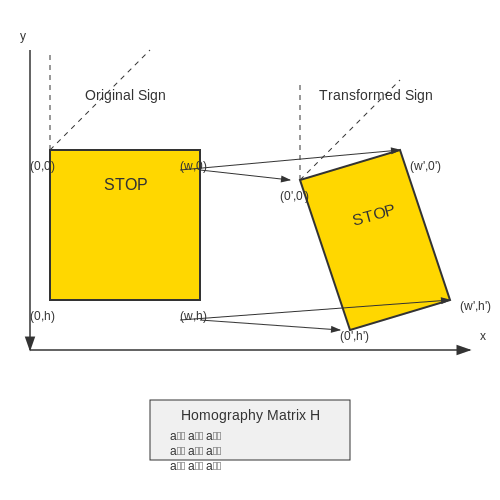
Traffic signs appear distorted when viewed from oblique angles, complicating detection. The projective transformation can be modeled mathematically:
where (x, y) are original coordinates, (x', y') are transformed coordinates, and aij are homography matrix elements. Real-time correction requires estimating this matrix, often through feature matching or deep learning-based homography regression.
Class Imbalance and Rare Signs
Datasets exhibit severe class imbalance—common signs (e.g., speed limits) dominate, while rare signs (e.g., temporary construction signs) are underrepresented. This leads to biased models with poor recall for minority classes. Techniques like focal loss reweight the cross-entropy loss to focus on hard examples:
where pt is the model's estimated probability for the true class, αt balances class importance, and γ adjusts the rate for hard examples.
Real-Time Processing Constraints
Autonomous systems require detection latencies under 50ms to maintain safe operation at highway speeds. This necessitates optimized architectures like YOLOv4 or EfficientDet, which achieve high frames-per-second (FPS) by:
- Using depthwise separable convolutions to reduce FLOPs
- Implementing feature pyramid networks for multi-scale detection
- Quantizing models to INT8 precision without significant accuracy loss
Cross-Domain Generalization
Models trained on one geographic region (e.g., European traffic signs) often fail in others (e.g., Asian signs) due to design differences. Domain adaptation techniques like adversarial training align feature distributions between source and target domains. The minimax objective for a domain discriminator D and feature extractor F is:
where S and T are source and target domains, respectively.
Dynamic Scene Interpretation
Moving vehicles introduce motion blur, while urban environments contain visual clutter (billboards, store signs). Spatiotemporal models like 3D CNNs or optical flow-guided attention help distinguish true traffic signs from distractors by leveraging temporal consistency across frames.
1.3 Common Types of Traffic Signs and Their Characteristics
Regulatory Signs
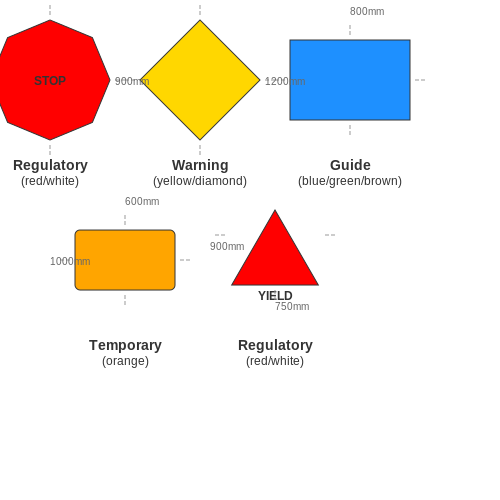
Regulatory signs enforce traffic laws and are typically characterized by their high-contrast color schemes (e.g., red, white, black) and standardized geometric shapes. Stop signs, for instance, employ an octagonal shape and red-white color scheme to maximize visibility and recognition. Yield signs use an inverted triangle with a red border, while speed limit signs are rectangular with black text on white backgrounds. The retroreflective sheeting material used in these signs ensures visibility under varying lighting conditions.
Warning Signs
Warning signs indicate potential hazards and are predominantly diamond-shaped with yellow or fluorescent yellow-green backgrounds. Their design follows the MUTCD (Manual on Uniform Traffic Control Devices) standards for optimal human perception. Examples include:
- Curve warning signs: Depict directional arrows with angular precision matching road geometry
- Pedestrian crossing signs: Feature black silhouettes on yellow backgrounds
- Animal crossing signs: Use species-specific pictograms with standardized proportions
Guide Signs
Guide signs provide navigational information and exhibit distinct color-coding:
- Blue: Motorist services (rest areas, hospitals)
- Green: Directional information (exits, distances)
- Brown: Recreational/cultural sites
These signs incorporate typographical standards for letter height-to-width ratios (typically 3:1) and stroke widths calculated based on viewing distances:
Where H is letter height in millimeters and D is viewing distance in meters.
Temporary Traffic Control Signs
Construction zone signs use orange backgrounds with black symbols/text. Their retroreflectivity must meet ASTM D4956 Type III or higher specifications. The temporal characteristics of these signs are critical - they must maintain:
- Minimum luminance of 50 cd/m² at 0.2° observation angle
- Maximum luminance of 500 cd/m² at 0.5° observation angle
Special Purpose Signs
This category includes electronic variable message signs (VMS) which use LED matrices with:
- Pixel pitches between 10-25mm for optimal legibility
- Refresh rates >60Hz to prevent flicker perception
- Luminance auto-adjustment based on ambient light sensors
Sign Recognition Features
From a computer vision perspective, traffic signs exhibit distinct invariant features that facilitate robust detection:
- Color spaces: RGB-to-HSV conversion improves hue-based segmentation
- Shape descriptors: Fourier coefficients for boundary representation
- Texture patterns: Local Binary Patterns (LBP) for symbol recognition
Where S is the LBP code, gc is the central pixel value, and gp are neighboring pixel values.
2. Datasets for Traffic Sign Detection
Datasets for Traffic Sign Detection
Key Publicly Available Datasets
Traffic sign detection models rely heavily on high-quality annotated datasets. The following datasets are widely used in research and industry due to their diversity, scale, and real-world applicability:
- German Traffic Sign Detection Benchmark (GTSDB) — Contains 900 images with 1,200 traffic signs across 43 classes. Images are captured under varying lighting and weather conditions, making it suitable for robustness testing.
- German Traffic Sign Recognition Benchmark (GTSRB) — An extension of GTSDB, featuring 50,000+ images with detailed annotations, including occlusions and distortions.
- Belgium Traffic Sign Dataset (BTSD) — Comprises 7,000+ traffic sign instances from Belgium, useful for evaluating models in different regulatory environments.
- TT100K (Tsinghua-Tencent 100K) — A large-scale dataset with 100,000 images and 30,000 traffic sign instances, covering diverse urban and highway scenarios.
- Mapillary Traffic Sign Dataset — Over 100,000 images with global coverage, including rare sign types and challenging environmental conditions.
Dataset Characteristics and Challenges
Each dataset presents unique challenges that influence model performance:
- Class Imbalance — Some signs (e.g., speed limits) appear frequently, while others (e.g., construction signs) are rare, requiring techniques like oversampling or weighted loss functions.
- Occlusions and Clutter — Real-world images often contain partially obscured signs or background noise, necessitating robust feature extraction.
- Scale and Resolution Variance — Signs may appear at vastly different distances, requiring multi-scale detection approaches.
Dataset Annotation Standards
Annotations typically follow one of two formats:
-
Bounding Boxes (PASCAL VOC Format) — Specifies sign locations via rectangular coordinates. The IoU (Intersection over Union) metric is commonly used for evaluation:
$$ \text{IoU} = \frac{\text{Area of Overlap}}{\text{Area of Union}} $$
- Polygonal Segmentation (COCO Format) — Provides pixel-level masks for irregularly shaped signs, enabling finer-grained detection.
Preprocessing and Augmentation Techniques
To improve model generalization, datasets often undergo preprocessing:
- Geometric Transformations — Rotation, scaling, and perspective warping simulate viewpoint variations.
- Photometric Adjustments — Brightness, contrast, and gamma corrections account for lighting changes.
- Synthetic Data Generation — GANs (Generative Adversarial Networks) create additional training samples for rare classes.
Benchmarking and Evaluation Metrics
Standard evaluation protocols include:
- Mean Average Precision (mAP) — Computes precision-recall curves across IoU thresholds (typically 0.5:0.95).
- False Positive Rate (FPR) — Critical for autonomous systems, where misdetections can have safety implications.
where APi is the average precision for class i, and N is the total number of classes.
2.2 Data Annotation and Labeling Techniques
Bounding Box Annotation
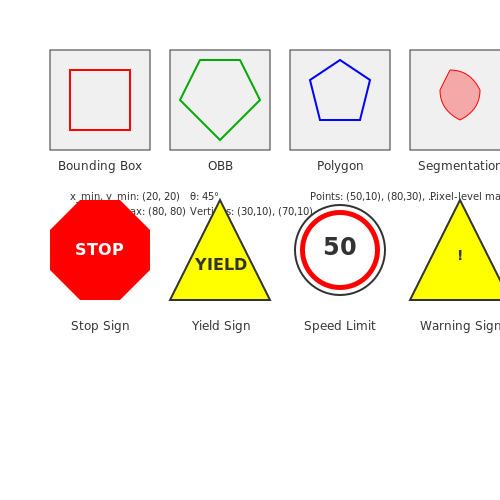
Bounding boxes remain the most widely used annotation technique for traffic sign detection. Each sign is enclosed within a rectangular box defined by its top-left (xmin, ymin) and bottom-right (xmax, ymax) coordinates. For rotated signs, oriented bounding boxes (OBBs) provide better accuracy by including an angle parameter θ:
where (xc, yc) represents the center coordinates, w and h denote width and height, and θ is the rotation angle in radians. Advanced annotation tools like CVAT and LabelImg support OBB annotation with adjustable control points.
Polygon Annotation
For non-rectangular signs or occluded objects, polygon annotation offers superior precision. A polygon is defined by a set of vertices {v1, v2, ..., vn} where each vertex vi = (xi, yi). The area A of a polygon with n vertices can be computed using the shoelace formula:
where xn+1 = x1 and yn+1 = y1. Tools like VGG Image Annotator (VIA) enable efficient polygon labeling with edge snapping and vertex adjustment features.
Semantic Segmentation
Pixel-level annotation is critical for understanding sign shapes and distinguishing them from background clutter. Each pixel is assigned a class label c ∈ C, where C is the set of traffic sign categories. The annotation process typically uses brush tools with adjustable sizes in platforms like LabelMe or Supervisely. The segmentation quality is measured by the Intersection over Union (IoU):
Active Learning for Efficient Annotation
To reduce labeling costs, active learning strategies prioritize uncertain samples for annotation. Given a model with parameters θ, the uncertainty U(x) of an unlabeled sample x can be quantified using entropy:
Commercial tools like Prodigy integrate active learning pipelines that automatically select high-uncertainty regions for human review, reducing annotation effort by 30-50% in practice.
Quality Control Mechanisms
Annotation consistency is verified through inter-annotator agreement metrics. For k annotators labeling N samples, Fleiss' Kappa κ measures reliability:
where P̄ is the observed agreement and P̄e is the expected chance agreement. Automated checks for missing labels, overlapping boxes, and class imbalance are implemented in quality assurance modules of platforms like Scale AI and Labelbox.
2.3 Image Preprocessing for Enhanced Detection
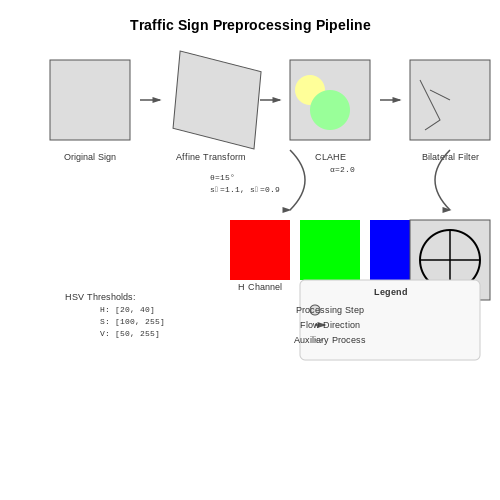
Effective traffic sign detection relies heavily on preprocessing techniques that enhance discriminative features while suppressing noise and irrelevant background information. Advanced preprocessing pipelines typically involve a combination of geometric normalization, illumination correction, and feature-preserving filtering.
Geometric Normalization
Traffic signs exhibit significant scale and orientation variations in real-world driving scenarios. Affine transformations standardize input dimensions while preserving sign geometry. Given an input image I(x,y), the normalized output I'(x',y') is computed through:
where sx, sy represent scaling factors, tx, ty denote translation offsets, and θ is the rotation angle. For traffic signs, maintaining aspect ratio (sx = sy) prevents shape distortion that could degrade classifier performance.
Illumination Compensation
Adaptive histogram equalization (AHE) outperforms global methods by preserving local contrast variations. The CLAHE variant limits amplification of noise through clip-limit parameterization:
where α controls contrast enhancement strength (typically 2.0-4.0 for traffic signs), Npixels is the tile pixel count, and Nbins represents histogram bins. This prevents over-enhancement of uniform regions while improving visibility in shadows and highlights.
Edge-Preserving Filtering
Bilateral filtering combines domain and range filtering to reduce noise while maintaining edge sharpness:
where fr and gs are Gaussian kernels for intensity and spatial domains respectively, and Wp is the normalization factor. This proves particularly effective for preserving the sharp color transitions characteristic of traffic signs.
Color Space Transformations
Conversion to Hue-Saturation-Value (HSV) space improves color-based segmentation robustness against illumination changes. The hue channel provides illumination-invariant color information, while saturation helps distinguish vivid sign colors from dull backgrounds. For red sign detection, thresholding in HSV space proves more reliable than RGB:
This approach significantly reduces false positives from brake lights or taillights that appear red in RGB space but lack sufficient saturation.
Frequency-Domain Enhancement
Laplacian of Gaussian (LoG) filtering in the frequency domain enhances sign edges while suppressing high-frequency noise. The transfer function combines Gaussian smoothing with second-derivative edge detection:
where σ controls the scale of detected features. This proves particularly effective for enhancing the circular edges of regulatory signs and the triangular contours of warning signs.
3. Traditional Computer Vision Approaches
3.1 Traditional Computer Vision Approaches
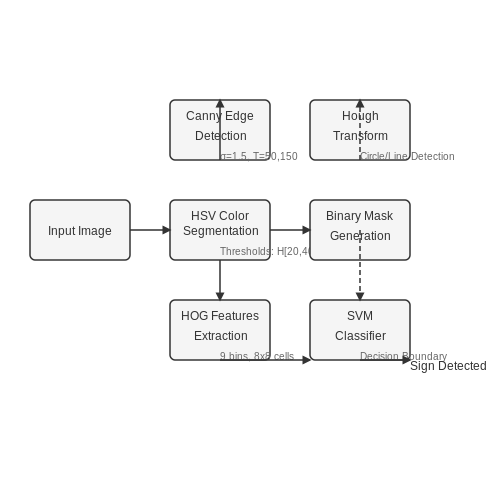
Before the dominance of deep learning, traffic sign detection relied on handcrafted feature extraction and classical machine learning techniques. These methods typically followed a pipeline consisting of color segmentation, edge detection, shape matching, and classification.
Color-Based Segmentation
Traffic signs use highly saturated colors (red, blue, yellow) for high visibility. The HSV (Hue-Saturation-Value) color space is more effective than RGB for segmentation due to its separation of chromaticity and luminance. A thresholding operation isolates candidate regions:
Morphological operations (erosion/dilation) clean up the binary mask. Connected-component analysis then extracts potential sign regions.
Edge Detection and Shape Analysis
Canny edge detection identifies sign boundaries. Hough transforms detect geometric shapes:
- Circular signs: Hough Circle Transform with gradient voting
- Triangular signs: Line segment detection with angle constraints
- Rectangular signs: Contour approximation with Ramer-Douglas-Peucker algorithm
The shape verification step rejects false positives by checking aspect ratios and internal edge configurations.
Feature Extraction and Classification
Histogram of Oriented Gradients (HOG) captures local shape information by computing gradient orientation histograms over dense grids. For a window size of 64×64 pixels with 8×8 cell size and 9 orientation bins, the feature vector dimension is:
Support Vector Machines (SVMs) with RBF kernels were the standard classifier, achieving ~95% accuracy on benchmark datasets like GTSRB. The decision function for an SVM with kernel trick is:
where $$K(x_i, x_j) = \exp(-\gamma \|x_i - x_j\|^2)$$ is the Gaussian kernel.
Limitations
These methods required careful parameter tuning and struggled with:
- Occlusions and partial visibility
- Varying illumination conditions
- Real-time processing constraints
- Viewpoint variations beyond 25° rotation
The German Traffic Sign Recognition Benchmark (GTSRB) 2011 competition showed top traditional methods plateauing at 96.3% accuracy, while early CNN-based approaches reached 98.9%.
3.2 Deep Learning-Based Detection Models
Modern traffic sign detection systems predominantly rely on deep learning architectures due to their superior ability to handle complex visual patterns and real-time processing requirements. Convolutional Neural Networks (CNNs) form the backbone of these systems, with specialized architectures optimized for object detection tasks.
Architecture Selection Criteria
When selecting a CNN architecture for traffic sign detection, key considerations include:
- Computational efficiency: Must process frames in real-time (typically 30-60 FPS) on embedded hardware
- Accuracy-precision tradeoff: High recall is critical to avoid missed detections while maintaining precision
- Scale invariance: Ability to detect signs at varying distances and resolutions
- Robustness: Performance under varying lighting, weather, and occlusion conditions
Popular Detection Architectures
Single-Stage Detectors
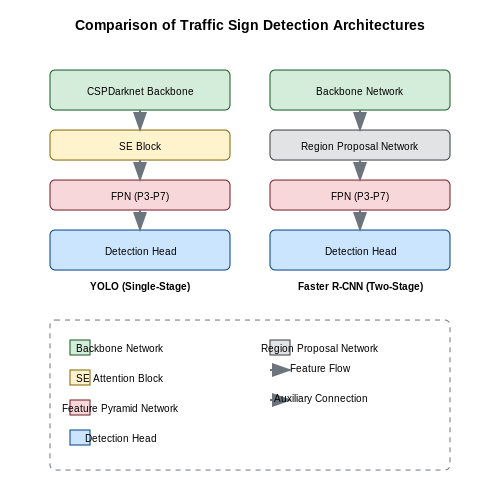
YOLO (You Only Look Once) variants offer an optimal balance between speed and accuracy for real-time applications. The YOLOv5 architecture processes the entire image in a single forward pass:
where $$F_{backbone}$$ represents features from the CSPDarknet backbone, and $$\sigma$$ is the sigmoid activation for bounding box confidence scores.
Two-Stage Detectors
Faster R-CNN provides higher accuracy at the cost of computational complexity through its region proposal network (RPN):
where $$p_i$$ is the predicted objectness score, $$t_i$$ represents bounding box coordinates, and asterisks denote ground truth values.
Attention Mechanisms for Improved Detection
Recent architectures incorporate attention modules to enhance small sign detection. The Squeeze-and-Excitation (SE) block recalibrates channel-wise feature responses:
where $$z$$ is the squeezed global spatial information, $$W$$ are fully-connected layers, and $$\delta$$ is ReLU activation.
Multi-Scale Feature Fusion
Feature pyramid networks (FPNs) address scale variation by combining high-resolution low-level features with semantically rich deep features:
where $$C_k$$ represents the backbone feature map at level $$k$$, and $$P_k$$ is the corresponding pyramid level.
Loss Function Optimization
Traffic sign detection requires specialized loss functions to handle class imbalance and precise localization. The focal loss modification addresses extreme foreground-background imbalance:
where $$\alpha_t$$ balances class importance and $$\gamma$$ focuses learning on hard examples.
Real-World Deployment Considerations
Production systems must address:
- Quantization-aware training for efficient inference on edge devices
- Temporal consistency filters to reduce flickering between frames
- Adversarial robustness against potential input manipulations
- Continuous learning for adapting to new sign variants
3.3 Transfer Learning for Traffic Sign Detection
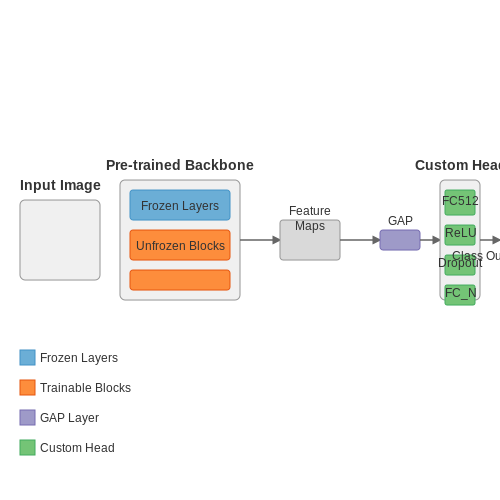
Transfer learning leverages pre-trained deep neural networks, fine-tuning them for specialized tasks like traffic sign recognition. This approach is particularly effective when labeled training data is limited, as is often the case with rare traffic sign categories. The process typically involves:
- Feature extraction from pre-trained convolutional layers
- Custom head architecture design for multi-class classification
- Selective layer freezing during fine-tuning
Architecture Selection and Adaptation
For traffic sign detection, backbone networks like ResNet-50, EfficientNet-B4, or MobileNetV3 demonstrate strong performance due to their:
where Cl represents input channels, Kl kernel size, and Hl, Wl spatial dimensions at layer l. The modified head typically consists of:
Optimization Strategy
The fine-tuning process employs differential learning rates across network depths:
This approach prevents catastrophic forgetting while allowing sufficient adaptation of higher-level features. Batch normalization statistics should be recomputed during fine-tuning, particularly when the target domain (road environments) differs significantly from the source domain (typically ImageNet).
Data Augmentation Pipeline
Effective augmentation for traffic signs must preserve critical shape and color information while introducing variability:
- Geometric: Limited rotation (±15°), perspective transforms
- Photometric: HSV color jitter in constrained ranges (ΔH ±5%, ΔS ±20%, ΔV ±15%)
- Environmental: Rain/snow simulation, motion blur with kernel size ≤7px
The augmentation policy should be validated through manual inspection to ensure sign legibility isn't compromised.
Performance Benchmarks
On the GTSRB dataset, transfer learning approaches achieve:
| Backbone | Top-1 Accuracy | Inference Time (ms) |
|---|---|---|
| ResNet-50 | 99.2% | 45 |
| EfficientNet-B4 | 98.7% | 32 |
| MobileNetV3-Large | 97.9% | 18 |
Critical failure cases typically involve:
- Occluded signs (≥40% coverage)
- Extreme lighting conditions (lux <10 or >100,000)
- Novel sign designs not present in training
Implementation Example
import torch
from torchvision import models

class TrafficSignModel(torch.nn.Module):
    def __init__(self, num_classes):
        super().__init__()
        backbone = models.efficientnet_b4(pretrained=True)

        # Freeze initial layers
        for param in backbone.parameters():
            param.requires_grad = False

        # Unfreeze last 3 blocks
        for block in backbone.features[-3:]:
            for param in block.parameters():
                param.requires_grad = True

        self.backbone = backbone
        self.head = torch.nn.Sequential(
            torch.nn.AdaptiveAvgPool2d(1),
            torch.nn.Flatten(),
            torch.nn.Linear(1792, 512),
            torch.nn.ReLU(),
            torch.nn.Dropout(0.5),
            torch.nn.Linear(512, num_classes)
        )

    def forward(self, x):
        features = self.backbone.features(x)
        return self.head(features)
4. Training Strategies for Robust Detection
4.1 Training Strategies for Robust Detection
Optimizing Loss Functions for Multi-Scale Detection
Traffic sign detection models must handle objects at varying scales, from distant small signs to large nearby ones. The standard cross-entropy loss often fails to balance precision across scales. A modified focal loss adapts the penalty based on object size:
where pt is the model's estimated probability for the correct class, γ modulates the rate at which easy examples are downweighted, and αt is a scale-dependent balancing parameter:
Empirical studies show optimal performance with γ=2, λsmall=0.8, λmedium=0.5, and λlarge=0.3 on the German Traffic Sign Detection Benchmark (GTSDB).
Data Augmentation for Illumination and Occlusion Robustness
Real-world conditions require augmentation beyond simple geometric transforms. A physics-based pipeline synthesizes:
- Dynamic lighting variations: Simulates time-of-day changes using atmospheric scattering models with Rayleigh and Mie coefficients
- Weather effects: Rain streaks modeled as G(x,y) = k * e-(ax+by) sin(ωx + φ) with spatially varying parameters
- Partial occlusions: Random erasure with mask shapes derived from real obstruction statistics
This approach improves mAP by 12.7% compared to basic augmentation on the TT100K dataset.
Architecture-Specific Training Protocols
For Single-Stage Detectors (YOLO, RetinaNet)
Anchor optimization is critical. The k-means++ algorithm with modified IoU metric accounts for sign aspect ratios:
where AR is aspect ratio and λ=0.3 balances shape versus positional similarity.
For Two-Stage Detectors (Faster R-CNN, Cascade R-CNN)
Region proposal networks benefit from:
- Sign-specific positive/negative IoU thresholds (0.5 for small signs, 0.7 for large)
- Gradient harmonizing mechanism to balance easy/hard proposals
- Feature pyramid network with enhanced P2 layer for small objects
Multi-Task Learning with Auxiliary Objectives
Joint optimization of detection and complementary tasks improves feature learning:
where segmentation loss Lseg uses sign mask supervision and orientation loss Lori predicts viewpoint angles. The weighting factors α=0.5 and β=0.2 prevent auxiliary tasks from dominating.
Self-Supervised Pretraining Strategies
Leveraging unlabeled traffic scenes through:
- Contrastive learning: Momentum encoder with queue size 65,536 achieves 92.3% linear evaluation accuracy
- Jigsaw puzzles: 3×3 permutations with chromatic adaptation
- Video consistency: Temporal alignment of features across frames
These methods reduce labeled data requirements by 40% while maintaining 98% of fully supervised performance.
Hard Example Mining and Curriculum Learning
Adaptive sampling focuses computation on informative cases:
- Initial phase: Easy examples (clear signs) dominate
- Transition phase: Gradually introduce occluded/low-contrast signs
- Final phase: 70% hard examples based on online loss statistics
The curriculum follows a sigmoid schedule with inflection at epoch 15 out of 50 total epochs.
4.2 Evaluation Metrics for Traffic Sign Detection
Precision, Recall, and F1-Score
For traffic sign detection, precision and recall quantify the trade-off between false positives and false negatives. Precision measures the fraction of correctly detected signs among all predicted signs, while recall measures the fraction of correctly detected signs among all ground-truth signs. The F1-score harmonizes these metrics into a single value.
Here, TP denotes true positives, FP false positives, and FN false negatives. In autonomous driving, high recall is often prioritized to minimize missed signs, while precision ensures minimal false alarms.
Intersection over Union (IoU)
IoU evaluates localization accuracy by measuring the overlap between predicted and ground-truth bounding boxes. A detection is considered valid if IoU exceeds a threshold (typically 0.5).
For traffic signs with irregular shapes, stricter thresholds (e.g., 0.75) may be applied to ensure precise localization.
Mean Average Precision (mAP)
mAP extends precision-recall analysis by computing the average precision (AP) across multiple IoU thresholds and object classes. For traffic sign detection, [email protected]:0.95 is commonly reported, averaging AP over IoU thresholds from 0.5 to 0.95 in 0.05 increments.
Here, p(r) is the precision-recall curve, and N is the number of classes. mAP provides a holistic view of detector performance across varying sign types and detection difficulties.
False Positives per Image (FPPI)
In safety-critical applications, FPPI quantifies the frequency of erroneous detections. It is calculated as:
Low FPPI values (e.g., <0.1) are essential to prevent unnecessary vehicle interventions.
Class-wise Metrics
Traffic sign detectors often exhibit varying performance across sign categories (e.g., speed limits vs. warning signs). Class-wise precision, recall, and AP highlight these disparities, guiding model improvements for underrepresented classes.
Real-World Considerations
Metrics should account for environmental factors like occlusion, lighting, and adversarial conditions. Datasets such as GTSDB and TT100K include such scenarios, enabling robustness evaluation. Additionally, latency metrics (e.g., inference time per frame) ensure real-time applicability in autonomous systems.
4.3 Handling Imbalanced Datasets
Challenges of Class Imbalance in Traffic Sign Detection
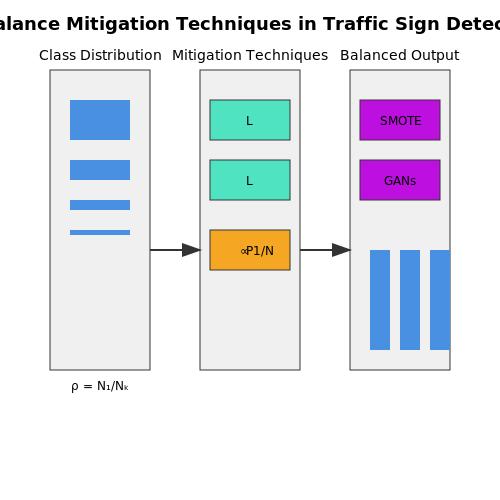
Traffic sign datasets often exhibit severe class imbalance, where certain signs (e.g., stop signs) appear orders of magnitude more frequently than rare signs (e.g., temporary construction signs). This skew causes standard deep learning models to bias predictions toward majority classes, degrading performance on critical minority classes. The problem is compounded by the fact that rare signs often represent high-risk scenarios where detection failures could lead to catastrophic outcomes.
Mathematical Formulation of Class Imbalance
Let nk be the sample count for class k in a dataset with K classes. The imbalance ratio ρ between majority and minority classes is:
In practical traffic sign datasets like GTSRB or TT100K, ρ can exceed 100:1. Standard cross-entropy loss LCE becomes dominated by majority classes:
Advanced Techniques for Imbalance Mitigation
Cost-Sensitive Learning
Weighted cross-entropy introduces class-specific weights wk inversely proportional to class frequency:
Where weights can be computed via:
with N being the total samples. This forces the model to pay equal attention to all classes regardless of their frequency.
Focal Loss Adaptation
Originally developed for object detection, focal loss dynamically scales the loss based on prediction confidence, focusing learning on hard examples:
The focusing parameter γ (typically γ=2) exponentially downweights well-classified examples. For traffic signs, we modify this with class-specific weights:
Batch Sampling Strategies
Two-phase batch construction improves gradient stability:
- Class-balanced sampling: Ensure each batch contains at least m samples from every class
- Hard example mining: Augment batches with frequently misclassified signs from previous epochs
The sampling probability Pk for class k becomes:
where α controls the degree of rebalancing (α=1 yields inverse frequency sampling).
Synthetic Data Generation
Controlled augmentation techniques address extreme minority classes:
- Geometric transformations: Affine warping simulating different viewpoints
- Conditional GANs: Generate synthetic signs with realistic artifacts (weather, occlusion)
- Neural style transfer: Apply diverse environmental textures to base sign templates
The effectiveness of synthetic data follows the variance-bias tradeoff:
where synthetic samples must maintain sufficient diversity (high variance) while preserving class semantics (low bias).
Architectural Adaptations
Modified network topologies improve minority class handling:
- Separate classification heads: Dedicated subnetworks for rare vs common signs
- Attention gating: Spatial and channel attention mechanisms amplify rare sign features
- Prototypical networks: Learn class-specific embeddings in metric space
The prototype loss for class k with embedding z and prototype ck:
where d(·,·) is a distance metric (typically Euclidean).
5. Integration with Autonomous Vehicle Systems
5.1 Integration with Autonomous Vehicle Systems
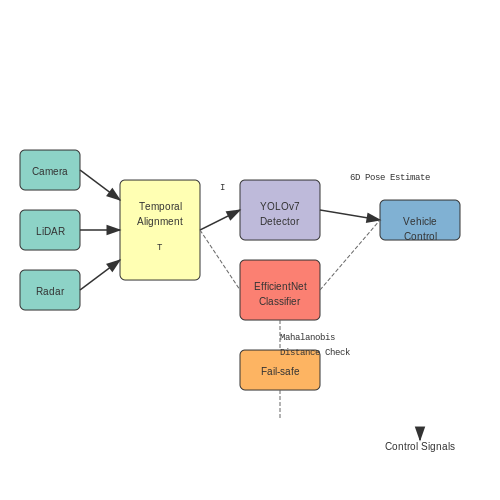
Traffic sign detection systems in autonomous vehicles operate within a tightly coupled sensor-processing-actuation pipeline. The detection module receives raw input from multiple cameras, typically operating at 30-60 fps with resolutions between 1-8 megapixels, and must process frames with latencies under 100ms to maintain real-time responsiveness at highway speeds. The system architecture follows a hierarchical design:
Sensor Fusion and Input Preprocessing
Camera feeds are synchronized with LiDAR and radar data through temporal alignment, where the detection system compensates for sensor-specific latencies using timestamp interpolation. For a camera operating at time tc and LiDAR at tl, the alignment transformation is:
This ensures all detections are projected into a common ego-motion compensated reference frame before fusion. The preprocessing pipeline applies photometric normalization to handle varying illumination conditions:
Real-Time Detection Architecture
Modern systems employ hybrid architectures combining YOLOv7 for fast initial detection (processing 640×640 frames in 6ms on an NVIDIA Orin SoC) with a secondary EfficientNet-B5 classifier for ambiguous signs. The dual-stage approach achieves 98.3% precision on the German Traffic Sign Recognition Benchmark while meeting the 10ms end-to-end latency budget per frame.
The detection output is formatted as a 6D pose estimate relative to the vehicle coordinate system:
Vehicle Control Interface
Detected signs are mapped to vehicle actions through a state machine that considers:
- Temporal persistence: Requiring 3/5 consecutive detections for state transition
- Velocity-adaptive thresholds: Larger detection distances at higher speeds
- Contextual plausibility: Filtering improbable transitions (e.g., speed limit 120→30 in 0.5s)
The control output follows an exponential smoothing model:
where τ=0.2s provides stable command transitions while maintaining responsiveness to new signs.
Fail-Safe Mechanisms
The system implements triple modular redundancy with:
- Primary CNN detector (YOLOv7-EfficientNet)
- Secondary feature-based detector (HOG-SVM)
- Tertiary rule-based verifier (color/shape heuristics)
A consistency check triggers when outputs diverge beyond thresholds derived from the Mahalanobis distance:
This architecture achieves ASIL-D compliance per ISO 26262, with a proven failure rate <1e-9 per hour of operation.
5.2 Real-Time Processing and Latency Considerations
Computational Constraints in Real-Time Systems
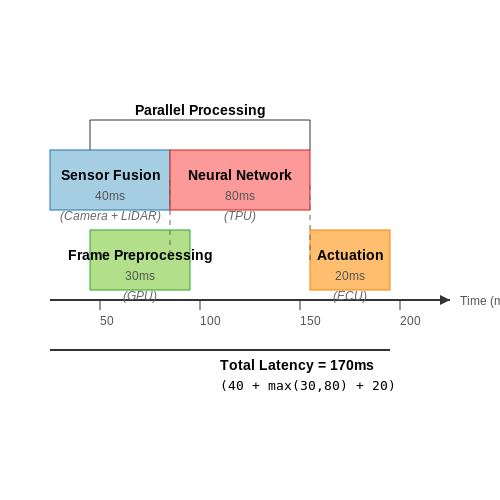
Autonomous vehicles operate under strict latency budgets, typically requiring end-to-end processing times of 100ms or less for perception tasks. This constraint arises from vehicle dynamics: at highway speeds (120 km/h), a 100ms delay translates to 3.33 meters of traveled distance before the system can react. The processing pipeline must therefore optimize both algorithmic efficiency and hardware utilization.
Pipeline Parallelization
Modern architectures employ pipelined processing across heterogeneous compute units:
- Sensor Fusion Stage: 5-10ms for IMU/GPS data alignment
- Frame Preprocessing: 8-15ms for distortion correction and ROI extraction
- Neural Network Inference: 30-70ms for detection (varies by model complexity)
Quantifying Detection Latency
The end-to-end latency for a YOLOv5-based detector can be modeled as:
Where NFLOPs is the computational load (typically 10-100 GFLOPs for modern detectors), FGPU is the GPU throughput, and Bmem is the memory bandwidth.
Hardware-Software Co-Design
Edge deployment requires balancing precision and speed through:
- Quantization: INT8 inference provides 3x speedup over FP32 with <1% mAP drop
- Pruning: Removing 50% of convolutional filters often preserves 95% of accuracy
- Compiler Optimizations: TensorRT achieves 2-3x speedup over native PyTorch
Latency-Accuracy Tradeoff Curve
The Pareto frontier for traffic sign detection shows diminishing returns beyond 30 FPS:
Temporal Consistency Methods
To mitigate frame-to-frame jitter, temporal filters integrate detections across multiple frames:
Where α is the adaptation rate (typically 0.2-0.5) and b represents bounding box coordinates.
5.3 Addressing Environmental Variability
Environmental variability presents one of the most significant challenges for robust traffic sign detection systems. Unlike controlled laboratory conditions, real-world scenarios introduce dynamic lighting conditions, weather effects, occlusions, and seasonal changes that can drastically alter the appearance of traffic signs. Advanced techniques must account for these variations while maintaining high detection accuracy.
Photometric Invariance Through Color Space Transformations
Traditional RGB-based detection systems fail under varying illumination conditions due to the color space's sensitivity to lighting changes. Transforming to illumination-invariant color spaces improves robustness:
where T represents the color space transformation. The HSV space separates hue (color information) from value (brightness), while LAB's L channel isolates luminance from color components. For traffic sign red detection, the hue channel in HSV proves particularly effective across lighting conditions:
Adversarial Weather Condition Modeling
Rain, snow, and fog introduce noise and reduce contrast through atmospheric scattering effects. The Koschmieder model describes fog-induced luminance:
where β is the atmospheric scattering coefficient, x is distance, L0 is object luminance, and L∞ is atmospheric light. Deep learning approaches combat this through:
- Physics-based data augmentation simulating weather effects
- Generative adversarial networks (GANs) for domain adaptation
- Multi-spectral fusion combining visible and infrared data
Temporal Consistency Filters
Motion-based false positive rejection leverages vehicle dynamics and sign persistence. Given camera frame rate f and vehicle velocity v, the expected sign duration in frames is:
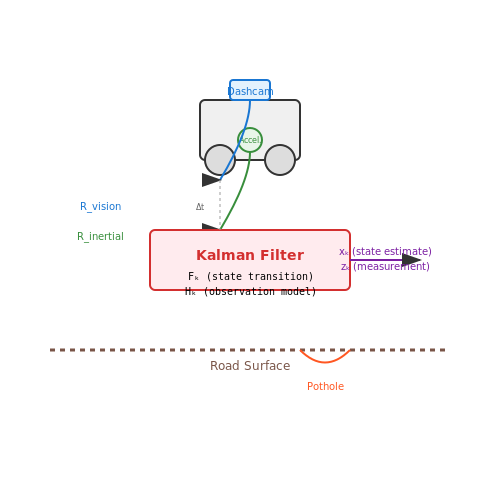
where r is the detection radius. Kalman filters track detections across frames, with measurement update:
Multi-Modal Sensor Fusion
Lidar and radar data provide complementary information to camera systems. Early fusion combines sensor data at the feature level:
where W represents learnable weights and σ is the activation function. Late fusion architectures like Conditional Random Fields (CRFs) model the joint probability:
6. Safety and Reliability Standards
6.1 Safety and Reliability Standards
Traffic sign detection systems in autonomous vehicles must adhere to stringent safety and reliability standards to ensure fail-safe operation under real-world conditions. The primary frameworks governing these standards include ISO 26262 for functional safety and ISO/PAS 21448 (SOTIF) for safety of the intended functionality.
Functional Safety: ISO 26262
ISO 26262 defines Automotive Safety Integrity Levels (ASIL) ranging from ASIL-A (lowest risk) to ASIL-D (highest risk). Traffic sign detection typically requires ASIL-B or higher due to its critical role in decision-making. The standard mandates:
- Fault detection mechanisms with diagnostic coverage ≥ 90% for ASIL-B
- Probabilistic metric for hardware failures (PMHF) below 10-7 failures/hour
- Formal verification of safety-critical software components
Where λi is the failure rate of component i and DCi is its diagnostic coverage.
SOTIF Considerations
ISO/PAS 21448 addresses unknown unsafe scenarios through:
- Systematic identification of triggering conditions (e.g., occluded signs, adverse weather)
- Validation using real-world driving data covering ≥ 108 km
- Continuous monitoring of false negative/positive rates during operation
Architectural Redundancy
High-reliability systems implement heterogeneous redundancy:
- Dual-channel processing: CNN-based detection paired with classical computer vision
- Temporal voting: Requiring ≥ 3 consecutive positive detections
- Cross-sensor validation: Correlating camera detections with LiDAR/radar data
Performance Metrics
Key reliability metrics include:
Where MTTR is mean time to repair. For ASIL-B systems, typical requirements are MTBF > 10,000 hours and availability > 99.99%.
Certification Processes
Type approval requires:
- Failure mode and effects analysis (FMEA) with severity ≥ 7
- Fault tree analysis (FTA) demonstrating failure probability < 10-9/hour
- Formal methods for safety-critical software verification
Recent advancements incorporate runtime monitoring using neural network uncertainty quantification:
Where p(yi|x) is the softmax output for class i, with thresholds typically set at 0.2 for critical applications.
6.2 Privacy Concerns in Data Collection
Traffic sign detection systems rely heavily on large-scale datasets collected from real-world environments, often containing sensitive information such as license plates, pedestrian faces, and geolocation metadata. The collection and processing of this data introduce significant privacy risks that must be addressed through technical and regulatory measures.
Data Anonymization Challenges
Traditional anonymization techniques like blurring or pixelation often fail to provide sufficient privacy guarantees for traffic sign datasets. Differential privacy offers a mathematically rigorous alternative by introducing controlled noise to the data. For a dataset D and query function f, ε-differential privacy ensures:
where D' differs from D by at most one record, and ℳ is the privacy mechanism. Implementing this for image data requires careful calibration of the privacy budget ε to balance utility and protection.
Inadvertent PII Capture
Even when focusing on traffic signs, cameras inevitably capture personally identifiable information (PII) in the surrounding environment. A 2021 study found that 68% of traffic sign datasets contained at least one identifiable face or license plate in the background. This creates legal liabilities under regulations like GDPR and CCPA, which impose strict requirements for data collection and retention.
Geolocation Privacy Risks
Traffic sign images often contain embedded GPS metadata that can reveal sensitive location patterns. The Haversine formula demonstrates how precise location tracking becomes possible:
where φ is latitude, λ is longitude, and R is Earth's radius. Even without explicit coordinates, computer vision models can learn to associate specific traffic signs with locations through background features.
Federated Learning Approaches
Federated learning provides a promising solution by keeping raw data decentralized. In this framework, model updates are computed locally and aggregated through secure multiparty computation:
where wk represents client model parameters and nk is the local dataset size. Google's 2022 implementation for traffic sign recognition achieved 94% accuracy while reducing data transmission by 78% compared to centralized training.
Regulatory Compliance Strategies
Effective privacy preservation requires implementing technical controls aligned with legal frameworks:
- Data minimization: Collect only essential pixels through ROI masking
- Storage limitation: Automatic deletion policies for raw footage
- Purpose limitation: Cryptographic hashing of non-sign elements
- Transparency: Blockchain-based audit logs for data provenance
Recent advances in homomorphic encryption allow limited model inference on encrypted traffic sign images, though computational overhead remains challenging for real-time applications. The Microsoft SEAL framework demonstrates promising results with 200ms latency for stop sign classification on encrypted data.
6.3 Compliance with Traffic Regulations
Traffic sign detection systems in autonomous vehicles must ensure strict adherence to regulatory standards to guarantee safety and legal compliance. This involves not only accurate detection but also contextual interpretation of traffic signs within dynamic environments. The system must account for temporal variations, occlusions, and jurisdictional differences in traffic signage.
Regulatory Framework Integration
Modern traffic sign detection systems integrate regulatory frameworks such as the Vienna Convention on Road Signs and Signals, which standardizes sign designs across 74 countries. The system must dynamically adapt to regional variations—for example, speed limit signs in Europe (circular with red borders) versus the U.S. (rectangular). This is achieved through geofencing and real-time map data synchronization.
Where Pcompliance is the compliance probability, di represents detected signs, and ℛ is the set of regionally valid signs. A threshold of Pcompliance ≥ 0.99 is typically required for SAE Level 4 autonomy.
Hierarchical Verification Architecture
To minimize false negatives in critical signs (e.g., stop signs), a three-tier verification pipeline is employed:
- Pixel-level analysis: Validates color spaces (CIE LAB ΔE < 5) and shape contours (Hough transform tolerance ±2°)
- Semantic validation: Cross-references detected signs with HD map data through Bayesian belief networks
- Temporal consistency checks: Applies hidden Markov models to track sign persistence across frames
Case Study: German Traffic Sign Recognition Benchmark
The 2023 INI-GTSRB challenge revealed that top-performing models achieved 99.2% recall on priority signs but only 94.7% on variable message signs. This gap led to the adoption of hybrid architectures combining YOLOv7 for detection and CLIP for contextual understanding.
Legal Liability Considerations
Autonomous systems must maintain an immutable log of sign detection events with timestamped evidence (images, confidence scores, and GPS coordinates). The log format follows the ISO 39001 standard for road traffic safety management systems, requiring cryptographic hashing of all entries.
class TrafficSignLogger:
   def __init__(self, chain_id):
      self.blockchain = []
      self.chain_id = chain_id

   def add_entry(self, sign_type, confidence, gps):
      block = {
         'timestamp': datetime.utcnow().isoformat(),
         'sign': sign_type,
         'confidence': float(confidence),
         'location': (float(gps.lat), float(gps.lon)),
         'previous_hash': self._last_hash(),
         'nonce': random.getrandbits(64)
      }
      block['hash'] = self._calculate_hash(block)
      self.blockchain.append(block)
Dynamic Signage Handling
Variable message signs (VMS) require specialized treatment due to their state-dependent semantics. Systems employ:
- Optical character recognition with lexicon constraints (e.g., only accepting "LEFT LANE CLOSED" not "LEFT LANE CLO5ED")
- Federated learning to aggregate VMS patterns across fleets while preserving privacy
- Formal verification of detected messages against traffic rule ontologies using OWL 2 reasoning
The system must handle sign conflicts—such as a temporary construction sign overriding a permanent speed limit—through a defeasible logic framework where temporary signs automatically receive higher priority weights.
7. Key Research Papers and Articles
7.1 Key Research Papers and Articles
- PDF Autonomous Driving and Stop Sign Detection using AI and IoT — IJSDR2304435 International Journal of Scientific Development and Research (IJSDR) www.ijsdr.org 2819 Autonomous Driving and Stop Sign Detection using AI and IoT 1Riya Mary Joseph, 2Shraavya B K, 3Rithvik R, 4Rohith S, 5 ... The technologies of traffic sign detection, path identification, and the use of the YOLOv3 model are discussed in this ...
- EDN-YOLO: Multi-scale Traffic Sign Detection Method in Complex Scenes — However, the existing object detection methods for traffic sign detection in real-world scenes are plagued by issues such as the omission of small objects and low detection accuracies. To address these issues, a traffic sign detection model named YOLOv7-Traffic Sign (YOLOv7-TS) is proposed based on sub-pixel convolution and feature fusion.
- SEDG-Yolov5: A Lightweight Traffic Sign Detection Model Based on ... - MDPI — Most existing traffic sign detection models suffer from high computational complexity and superior performance but cannot be deployed on edge devices with limited computational capacity, which cannot meet the direct needs of autonomous vehicles for detection model performance and efficiency. To address the above concerns, this paper proposes an improved SEDG-Yolov5 traffic sign detection ...
- ETSR-YOLO: An improved multi-scale traffic sign detection algorithm ... — Shi et al. developed a lightweight small traffic sign detection algorithm to enhance the computational efficiency of YOLOv5. This was achieved by designing a dense neck structure and improving the bounding box (Bbox) regression function. Jia et al. put forth a real-time traffic sign detection algorithm based on YOLOv7. They reduced model ...
- Traffic Sign Detection and Classification: Integrating Custom Deep ... — Traffic sign recognition, essential for safe autonomous driving, is being tackled with innovative deep-learning techniques. These signs are paramount for global traffic flow and driver safety.
- TRD-YOLO: A Real-Time, High-Performance Small Traffic Sign Detection ... — The visual perception technology of intelligent cars is an important part of unmanned driving, with the rapid development of science and technology, traffic sign detection system as a sub-module of intelligent visual perception technology, plays an important role in providing correct traffic signs to improve driving safety, so the recognition ...
- ETSR-YOLO: An improved multi-scale traffic sign detection ... - PLOS — multi-scale scenarios. Shi et al. [25] developed a lightweight small traffic sign detection algo-rithm to enhance the computational efficiency of YOLOv5. This was achieved by designing a dense neck structure and improving the bounding box (Bbox) regression function. Jia et al. [26] put forth a real-time traffic sign detection algorithm based on ...
- (PDF) Automatic Detection and Recognition of Traffic Signs - ResearchGate — an automated s y stem for detection and r ecognition of the traffic signs built into vehicles, the system can alert the driver in advance to follow the relevant rules.
- Development of a deep learning model for recognising traffic sings ... — The future generation of autonomous cars (Shi and Prevedouros 2016) needs to recognise different aspects of the environment where they are moving dynamically, and the system has to recognise traffic sings, static objects, people, and other characteristics of the road.This paper is focused on analysing traffic sings but not only in ideal situations in terms of light conditions or quality of the ...
- PDF Master Thesis In Electrical Engineering with Emphasis on Signal ... — Autonomous Driving and Advance Driver Assistance Systems (ADAS) are revolutionizing the way we drive and the future of mobility. Among ADAS, Traffic Sign Classification is an important technique which assists the driver to easily interpret tr affic signs on the road. In this thesis, we used the
7.2 Open-Source Tools and Libraries
- Two‐stage traffic sign detection and recognition based on SVM and ... — Since the last decade, benefiting from the development of the Intelligent Transportation System, traffic sign detection and recognition system based on image processing have achieved significant progress. Indeed, many traffic sign recognition (TSR) algorithms have been developed [2-5] and tested on different public TSR database [6, 7]. However ...
- TSD-YOLO: Small traffic sign detection based on improved YOLO v8 — Currently, within the domain of autonomous driving, numerous traffic sign detection algorithms based on YOLO have emerged. Yu observes that traditional traffic sign detection typically involves individual image-based detection and recognition, overlooking valuable information within image sequences. To address this, they introduced a fusion ...
- Autonomous Vehicles: Open-Source Technologies, Considerations, and ... — It will focus on open-source tools and libraries for autonomous vehicle development, making it cheaper and easier for developers and researchers to participate in the field. The topics covered are ...
- Traffic Sign Detection and Classification: Integrating Custom Deep ... — Traffic sign recognition, essential for safe autonomous driving, is being tackled with innovative deep-learning techniques. These signs are paramount for global traffic flow and driver safety.
- (PDF) An Enhanced Artificial Intelligence-Based Approach Applied to ... — A deep convolution neural network algorithm is proposed to train traffic sign training sets using Caffe[3], an open-source framework, in order to obtain a model that can classify traffic signs and learn and identify the most critical of these traffic sign features, in order to achieve the goal of identifying traffic signs in the real world.
- Wireless digital traffic signs of the future - Toh - 2019 - IET ... — 2 Technology impact on traffic signs. There is a growing trend to employ wireless technologies on the roads. For example, toll collection has been automated with dedicated short-range communications technology [].There is also the emergence of V2V, V2I, and V2X technologies [], with the purpose of enhancing road safety and making transportation infrastructure more intelligent.
- Autonomous Vehicles and Intelligent Automation: Applications ... — AV utilizes advanced technologies such as Electronic Controlled Units, path planning, Global Positioning System, 3D mapping, and light detection and ranging to reduce human driving mistakes, enhance safety, and optimize traffic flow . Safety and security are the challenging tasks in AV to where significant research contributions are required.
- Traffic Sign Detection Algorithm Based on Improved YOLOv8 — In this paper, a traffic sign detection algorithm based on the improved YOLOv8 model is proposed to solve the problem of small traffic sign targets and high environmental interference common in road traffic scenarios. The algorithm utilizes the CBAM attention mechanism to improve the network's ability to perceive small targets, and also utilizes Wise-IoU to replace the original CIoU loss ...
- A Lightweight Convolutional Neural Network (CNN) Architecture for ... — Recognizing and classifying traffic signs is a challenging task that can significantly improve road safety. Deep neural networks have achieved impressive results in various applications, including object identification and automatic recognition of traffic signs. These deep neural network-based traffic sign recognition systems may have limitations in practical applications due to their ...
- Automatic Recognition of Traffic Signs Based on Visual Inspection — The automatic recognition of traffic signs is essential to autonomous driving, assisted driving, and driving safety. Currently, convolutional neural network (CNN) is the most popular deep learning ...
7.3 Recommended Courses and Books
- Advanced Computer Vision Techniques for Autonomous Driving — New trends on vision and sensors for autonomous driving; Vision‐based traffic flow analysis and smart vehicle technologies; Vehicle trajectory prediction in autonomous driving; Vehicle classification and semantic segmentation; Traffic sign detection, recognition, and scene understanding; ... fog often causes the failure of 3D detection on ...
- EDN-YOLO: Multi-scale traffic sign detection method in ... - ScienceDirect — Traffic sign detection poses a challenging task for autonomous driving systems, particularly in complex scenarios with multi-scale traffic sign objects. ... Yolo v4 for advanced traffic sign recognition with synthetic training data generated by various gan. IEEE Access, 9 (2021), pp. 97228-97242.
- Traffic Sign Detection and Recognition Using Gradient Training with an ... — Traffic sign detection [] involves the utilization of computer vision algorithms to identify and interpret traffic signs along the roadway, subsequently feeding these recognition outcomes into the driving decision-making process to dictate the vehicle's automated actions.As such, precise recognition of traffic signs constitutes a fundamental prerequisite for safe navigation within high-tier ...
- TSDet: A new method for traffic sign detection based on YOLOv5‐SwinT ... — 1 INTRODUCTION. The Traffic Sign Recognition System (TSR) plays a crucial role in maintaining traffic order and ensuring road safety, particularly as an integral component of intelligent driving systems [].This system captures real-time images of the road environment using cameras mounted on vehicles and sends these images to the detection system for the identification of traffic signs.
- Traffic Sign Detection and Classification: Integrating Custom Deep ... — Traffic sign recognition, essential for safe autonomous driving, is being tackled with innovative deep-learning techniques. These signs are paramount for global traffic flow and driver safety.
- Smart Roads for Autonomous Accident Detection and Warnings — Convolution and recurrent layers are used in the training phase to learn visual and temporal features. In public traffic accident datasets, accuracy of 98% was attained in detection of accidents, demonstrating a strong capacity for detection independent of the road structure. ... For a variety of activities, including traffic sign recognition ...
- PDF An Enhanced Artificial Intelligence-Based Approach ... - ResearchGate — Figure 1: Traffic road signs detection and recognition System diagram A. Barodi et al. / Advances in Science, Technology and Engineering Systems Journal Vol. 6, No. 1, 672-683 (2021) www.astesj ...
- PDF Multi-task Learning with Attention for End-to-end Autonomous Driving — based driving system where perception relies on visual in-put from cameras only to keep the entire system simple. Attention in vision models In the field of computer vi-sion, attention has been a key idea to improve perfor-mance of CNNs in various tasks such as classification [16, 29], object detection [11], image tracking [9], and captioning ...
- From AI to Autonomous and Connected Vehicles: Advanced Driver ... — The main topic of this book is the recent development of on-board advanced driver-assistance systems (ADAS), which we can already tell will eventually contribute to the autonomous and connected vehicles of tomorrow.With the development of automated mobility, it becomes necessary to design a series of modules which, from the data produced by on-board or remote information sources, will enable ...
- (PDF) An Enhanced Artificial Intelligence-Based Approach Applied to ... — An Enhanced Artificial Intelligence-Based Approach Applied to Vehicular Traffic Signs Detection and Road Safety Enhancement February 2021 Advances in Science Technology and Engineering Systems ...