Game Bot Using Unity ML-Agents Toolkit
1. What is Unity ML-Agents?
What is Unity ML-Agents?
Unity ML-Agents is an open-source toolkit developed by Unity Technologies that enables the training of intelligent agents within Unity environments using reinforcement learning (RL), imitation learning, and other machine learning techniques. It bridges game development and machine learning by providing a flexible framework for creating, training, and deploying AI agents in complex 3D simulations.
Core Architecture
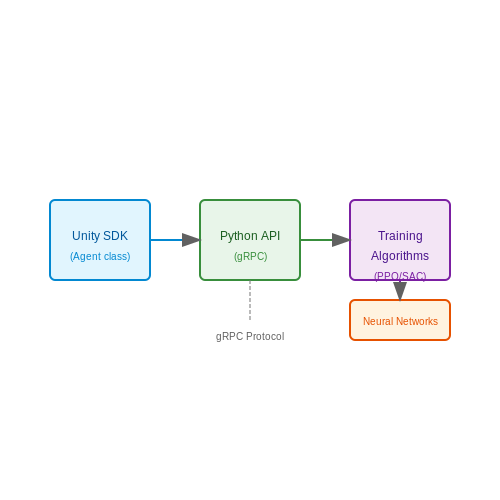
The ML-Agents toolkit consists of three primary components:
- Unity SDK: A C# library integrated into Unity projects that defines agent behaviors, observations, and actions through the Agent class. Agents interact with the environment via states (observations), actions, and rewards.
- Python API: Interfaces with deep learning frameworks like PyTorch to train policies. The API communicates with Unity via a gRPC protocol, enabling parallel training across multiple environments.
- Training Algorithms: Includes implementations of Proximal Policy Optimization (PPO), Soft Actor-Critic (SAC), and other RL algorithms, alongside behavioral cloning for imitation learning.
Mathematical Foundations
ML-Agents leverages policy gradient methods, where an agent's policy πθ is parameterized by neural networks. The objective is to maximize the expected return J(θ):
where τ denotes a trajectory, γ is the discount factor, and rt is the reward at time t. For PPO, the surrogate objective function is:
where ε is a hyperparameter controlling policy updates, and Ât is the advantage estimate.
Key Features for Advanced Applications
- Curriculum Learning: Agents progressively tackle harder tasks via dynamically adjusted environment parameters.
- Self-Play: Supports adversarial training by pitting agents against each other, useful for game AI.
- Memory-Augmented Agents: Incorporates recurrent neural networks (RNNs) or transformers for partial observability.
- Multi-Agent Scenarios: Enables cooperative or competitive behaviors with decentralized or centralized training.
Performance Optimization
Training efficiency is achieved through:
- Parallel Environment Instances: Multiple Unity environments run concurrently to accelerate data collection.
- Observation Stacking: Temporal context is preserved by stacking frames or states.
- Hybrid Actions: Combines discrete and continuous action spaces for complex control tasks.
Use Cases in Research
ML-Agents has been deployed in robotics simulation (e.g., robotic arm control), autonomous vehicle training, and NPC behavior generation. Its physics-based simulations provide a transferable foundation for real-world applications.
1.2 Key Features and Capabilities
Scalable Reinforcement Learning Framework
The Unity ML-Agents Toolkit provides a production-ready reinforcement learning (RL) framework that integrates seamlessly with PyTorch. It supports both on-policy (e.g., PPO, SAC) and off-policy (e.g., BC, GAIL) algorithms, enabling efficient training across diverse environments. The toolkit’s architecture allows parallelized training through Unity Environment Instances, where multiple agents can learn simultaneously in synchronized or asynchronous modes. This is particularly useful for complex tasks requiring distributed training, such as multi-agent coordination or adversarial scenarios.
Imitation Learning and Curriculum Learning
Beyond traditional RL, the toolkit supports imitation learning via behavioral cloning (BC) and generative adversarial imitation learning (GAIL). This is critical for bootstrapping agent behavior from human demonstrations. Additionally, curriculum learning allows progressive difficulty scaling, where agents train on simpler tasks before advancing to complex ones. For example, a game bot might first learn movement in an empty room before navigating dynamic obstacles.
Flexible Observation Spaces
Agents can process observations through:
- Vector Observations: Low-dimensional state representations (e.g., player coordinates, inventory).
- Visual Observations: Pixel data from cameras (CNN-processed).
- Raycasts: For spatial awareness in 3D environments.
This flexibility enables hybrid input models, such as combining raycasts for obstacle detection with vector observations for game state.
Real-Time Inference and Embedding
Trained models can be exported as .onnx files and embedded directly into Unity games for real-time inference. The toolkit’s Inference Engine optimizes forward passes, achieving sub-millisecond latency on GPU hardware. This is essential for deploying AI in fast-paced games where reaction time is critical.
Multi-Agent Training and Self-Play
The toolkit supports competitive and cooperative multi-agent scenarios through:
- Self-play: Agents train against progressively skilled versions of themselves (e.g., AlphaZero-style training).
- Team Rewards: Shared rewards for cooperative tasks.
This is demonstrated in Unity’s Pyramids environment, where agents collaborate to stack blocks.
Customizable Reward Functions
Reward functions can be engineered at granular levels, including:
- Sparse Rewards: Only upon task completion (e.g., reaching a goal).
- Dense Rewards: Incremental feedback (e.g., distance reduction to target).
- Intrinsic Rewards: Curiosity-driven exploration (e.g., ICM, RND).
Integration with Python API
The toolkit’s Python API allows direct interaction with Unity environments from Jupyter notebooks or training scripts. Key features include:
- Environment parameter tuning via
UnityEnvironment. - Custom training loops with PyTorch or TensorFlow.
- Hyperparameter optimization via Optuna or Ray Tune.
Use Cases for Game Bots
Training Adversarial Agents for Competitive Games
Game bots built with Unity ML-Agents can serve as dynamic opponents in competitive environments, adapting to player strategies in real-time. Reinforcement learning (RL) agents trained via self-play, such as those in AlphaGo or OpenAI Five, demonstrate how adversarial training can produce robust behaviors. The policy gradient update for such agents is derived as:
where Gt represents the discounted return. This approach enables bots to learn counter-strategies without explicit programming.
Procedural Content Testing
Automated playtesting bots can stress-test game mechanics by exploring edge cases in procedurally generated levels. Unlike scripted bots, ML-driven agents discover exploits or imbalances through entropy-maximizing exploration policies. The information gain I during exploration is quantified as:
where H(S) is the state space entropy. Unity ML-Agents' curiosity-driven rewards implement this via intrinsic motivation modules.
Human-Like NPC Behavior Generation
Imitation learning techniques enable bots to replicate human gameplay traces. Behavioral cloning minimizes the Kullback-Leibler divergence between bot and human action distributions:
This is particularly valuable for RPG NPCs where scripted finite-state machines fail to capture nuanced interactions.
Real-Time Strategy (RTS) Game Optimization
In RTS games like StarCraft II, ML-Agents bots optimize resource allocation and unit micromanagement using hierarchical reinforcement learning. The action space decomposes into:
where macro-actions handle base building and micro-actions control individual unit tactics. Temporal abstraction through options frameworks reduces computational complexity.
Accessibility and Adaptive Difficulty
Bots can dynamically adjust game difficulty by estimating player skill through Bayesian inference over performance metrics. The posterior skill estimate updates as:
Unity's Curriculum Learning integrates this by progressively increasing task complexity based on success rates.
Multi-Agent Emergent Behavior Studies
ML-Agents facilitates research into emergent cooperation/competition via multi-agent scenarios. The Nash equilibrium for n-agent systems can be approximated through decentralized execution with centralized training (DEC) paradigms, where joint policies satisfy:
This has applications in simulating economic systems or crowd behaviors within game environments.
2. Installing Unity and ML-Agents
Installing Unity and ML-Agents
System Requirements
Before installation, ensure your system meets the following specifications:
- Operating System: Windows 10/11 (64-bit), macOS 10.15+, or Ubuntu 20.04 LTS
- CPU: x86-64 architecture with SSE2 instruction set support
- GPU: DX10/DX11/DX12 or Metal capable with 2GB VRAM (for Unity Editor)
- RAM: Minimum 8GB (16GB recommended for complex environments)
- Disk Space: 25GB free space for Unity and dependencies
- Python: 3.7.0 to 3.9.0 (ML-Agents compatibility)
Unity Hub Installation
Download and install Unity Hub from the official Unity website. The Hub manages multiple Unity Editor versions and provides project templates:
# Linux installation example
wget https://public-cdn.cloud.unity3d.com/hub/prod/UnityHub.AppImage
chmod +x UnityHub.AppImage
./UnityHub.AppImage
Unity Editor Installation
Through Unity Hub, install the recommended LTS version (2022.3.x as of 2023) with these modules:
- Windows/Mac/Linux Build Support
- iOS/Android Build Support (if targeting mobile platforms)
- Documentation (offline reference)
ML-Agents Toolkit Setup
Install ML-Agents via Python package manager in an isolated virtual environment:
python -m venv mlagents-env
source mlagents-env/bin/activate  # Linux/macOS
mlagents-env\Scripts\activate.bat  # Windows
pip install mlagents==0.30.0
Version Compatibility Matrix
| ML-Agents Version | Unity Version | Python Version |
|---|---|---|
| 0.30.0 | 2022.3 LTS | 3.7-3.9 |
| 0.28.0 | 2021.3 LTS | 3.7-3.8 |
Unity Project Configuration
In your Unity project, add ML-Agents via Package Manager (Window > Package Manager):
- Click '+' and select "Add package from git URL"
- Enter:
com.unity.ml-agents - Install dependent packages (Burst, Mathematics, etc.)
Environment Verification
Validate the installation by running the example environments:
mlagents-learn config/ppo/3DBall.yaml --run-id=test_runThis should launch the training process with real-time metrics in TensorBoard (port 6006 by default).
2.2 Configuring Python and Required Libraries
The Unity ML-Agents Toolkit operates as a bridge between Unity environments and Python-based machine learning frameworks. To ensure seamless integration, a precise Python environment configuration is essential. The following steps outline the setup process for advanced users, including dependency management and GPU acceleration.
Python Environment Setup
ML-Agents requires Python 3.6–3.8 due to TensorFlow compatibility constraints. Conda is recommended for environment isolation:
conda create -n mlagents python=3.7
conda activate mlagents
Core Library Installation
The toolkit depends on several key packages with version-specific requirements:
pip install mlagents==0.28.0
pip install tensorflow==2.4.0
pip install torch==1.7.1+cu110 -f https://download.pytorch.org/whl/torch_stable.html
For CUDA-enabled training, ensure the NVIDIA driver (≥450.80.02), CUDA Toolkit (11.0), and cuDNN (8.0.5) are properly configured. Verify GPU accessibility with:
import tensorflow as tf
print(tf.config.list_physical_devices('GPU'))
Advanced Configuration
For custom environments, additional dependencies may include:
- OpenCV (4.5.1+) for visual observations
- PyYAML for configuration file parsing
- Matplotlib for training metrics visualization
The package versions must satisfy the following dependency matrix:
Virtual Environment Best Practices
For reproducible research, freeze the environment specifications:
pip freeze > requirements.txt
conda env export > environment.yml
This ensures consistent behavior across different systems and facilitates collaborative development.
2.3 Setting Up a New Unity Project
To begin developing a game bot with Unity ML-Agents, a properly configured Unity project is essential. Start by launching Unity Hub and selecting New Project. Choose the 3D (URP) template, as it provides a lightweight render pipeline optimized for machine learning simulations. Name the project descriptively (e.g., MLAgents_GameBot) and specify a directory with sufficient storage for assets and training logs.
Configuring Project Settings
Navigate to Edit > Project Settings and adjust the following parameters:
- Player Settings: Set API Compatibility Level to .NET Standard 2.1 to ensure compatibility with ML-Agents.
- Physics Settings: Reduce Fixed Timestep to 0.005s for smoother physics interactions during training.
- Quality Settings: Disable anti-aliasing and shadows to minimize computational overhead.
Installing ML-Agents Package
Open the Package Manager (Window > Package Manager) and add the ML-Agents package via the Unity Registry. Ensure the version aligns with the latest stable release (e.g., [email protected]). Resolve dependencies, including Barracuda for neural network inference.
// Example: Verify ML-Agents installation in a C# script
using Unity.MLAgents;
using UnityEngine;

public class MLAgentsCheck : MonoBehaviour {
    void Start() {
        Debug.Log("ML-Agents SDK Version: " + Academy.Instance.Settings.MLAgentsVersion);
    }
}
Setting Up the Python Environment
ML-Agents requires a Python backend for training. Install Python 3.8+ and create a virtual environment:
python -m venv mlagents_env
source mlagents_env/bin/activate  # Linux/macOS
mlagents_env\Scripts\activate     # Windows
pip install mlagents==0.30.0
Project Structure
Organize the Unity project with these directories:
- Assets/ML-Agents: Store agent scripts, prefabs, and Brain assets.
- Assets/Scenes: Separate training and inference scenes.
- ProjectSettings: Preserve modified settings for version control.
3. Defining the Bot's Behavior and Goals
Defining the Bot's Behavior and Goals
In reinforcement learning (RL), an agent's behavior is governed by a policy π, which maps states s to actions a. For a game bot trained using Unity ML-Agents, this policy is typically parameterized by a neural network, optimized to maximize cumulative reward. The reward function R(s, a) must be carefully designed to incentivize desired behaviors while penalizing undesired ones. A sparse reward structure often leads to poor convergence, so shaping the reward function with intermediate rewards is critical.
Reward Function Design
The reward function is decomposed into components that reflect sub-goals. For example, in a first-person shooter (FPS) game, the bot may receive:
- +0.1 for moving toward an enemy,
- +1.0 for dealing damage,
- -0.01 per frame to encourage efficiency,
- -0.5 for taking damage.
Mathematically, the total reward at time step t is:
where wi are weighting factors and ri are individual reward components.
State Representation
The state s must encapsulate all relevant game information. For an FPS bot, this includes:
- Player position, health, and ammunition,
- Enemy positions and visibility,
- Map geometry (e.g., raycast hits for obstacle detection).
In Unity ML-Agents, states are collected via Vector Observations or Visual Observations (pixel data). For high-dimensional states, convolutional neural networks (CNNs) or transformers may be used for feature extraction.
Action Space Definition
Actions can be discrete, continuous, or hybrid. A discrete action space for movement might include:
- Forward, backward, left, right,
- Jump, crouch, shoot.
For continuous control, actions are real-valued vectors, e.g., a ∈ [-1, 1] for analog movement speed. The policy network outputs either a probability distribution (discrete) or mean and variance (continuous) for sampling actions.
Policy Optimization
ML-Agents primarily uses Proximal Policy Optimization (PPO), which optimizes the policy via:
where At is the advantage function, estimated using Generalized Advantage Estimation (GAE):
with δt = rt + γV(st+1) - V(st).
Curriculum Learning
Complex tasks benefit from curriculum learning, where training starts with simplified environments (e.g., stationary targets) and gradually increases difficulty (e.g., moving targets). ML-Agents supports this via Academy parameters that dynamically adjust game properties.
3.2 Creating the Training Environment
Defining the Unity Scene
The training environment in Unity ML-Agents is constructed as a standard Unity scene, augmented with ML-Agents-specific components. Begin by creating a new 3D or 2D project in Unity, depending on the game's requirements. The scene must include the following elements:
- Agent GameObject: Represents the AI entity being trained. Attach the
BehaviorParametersscript to define observation and action spaces. - Academy GameObject: Controls the overall training loop. Configure it via the
Academycomponent to manage reset conditions and episode lengths. - Environment Elements: Static and dynamic objects (e.g., obstacles, targets) that define the agent's interaction space.
Observation Space Configuration
The agent's observation space is defined by the BehaviorParameters script. For advanced applications, observations can include:
- Vector Observations: Numeric arrays representing state variables (e.g., position, velocity).
- Visual Observations: Camera or render texture inputs processed by convolutional neural networks (CNNs).
For a robot navigating a maze, the vector observations might include:
where x, y are coordinates, θ is orientation, vx, vy are velocities, and dwall is the distance to the nearest wall.
Action Space Design
Actions are defined as either discrete (e.g., button presses) or continuous (e.g., motor torques). For a discrete action space with movement and jumping:
    // BehaviorParameters script settings
    public override void Initialize()
    {
        behaviorParameters = GetComponent<BehaviorParameters>();
        behaviorParameters.BrainParameters.VectorObservationSize = 6;
        behaviorParameters.BrainParameters.ActionSpec = ActionSpec.MakeDiscrete(3); // Left, Right, Jump
    }
Reward Function Engineering
Rewards shape the agent's learning. A sparse reward for reaching a goal might be:
For continuous tasks like balancing, a shaped reward could penalize deviations from equilibrium:
Curriculum Learning Setup
For complex tasks, use ML-Agents' curriculum learning to progressively increase difficulty. Define a curriculum.json file:
    {
      "measure": "progress",
      "thresholds": [0.1, 0.3, 0.5],
      "min_lesson_length": 100,
      "parameters": {
        "obstacle_speed": [1.0, 2.0, 3.0]
      }
    }
Implementing Observations and Actions
Observations in Unity ML-Agents
Observations provide the agent with sensory input about its environment. In Unity ML-Agents, observations are represented as numerical vectors fed into the neural network. The dimensionality of these vectors must be carefully designed to balance information richness and computational efficiency. Observations can be categorized into three types:
- Vector Observations: Direct numerical representations of state variables (e.g., position, velocity).
- Visual Observations: Pixel data from cameras attached to the agent, processed through convolutional layers.
- Raycast Observations: Distance measurements to objects detected via raycasting.
The observation space is defined in the agent's CollectObservations() method. For a robot arm with 3 joints, the vector observations might include:
public override void CollectObservations(VectorSensor sensor)
{
    // Joint angles (3 values)
    sensor.AddObservation(joint1.angle);
    sensor.AddObservation(joint2.angle);
    sensor.AddObservation(joint3.angle);

    // Target position (3 values)
    sensor.AddObservation(target.transform.localPosition);

    // Total observation vector size = 6
}
Action Space Design
Actions determine how the agent interacts with the environment. Unity ML-Agents supports two action types:
For a racing game bot, discrete actions might represent gear shifts while continuous actions control steering and acceleration. The action space is implemented in the agent's OnActionReceived() method:
public override void OnActionReceived(ActionBuffers actions)
{
    // Continuous actions for movement
    float steer = actions.ContinuousActions[0]; // [-1, 1]
    float accelerate = actions.ContinuousActions[1]; // [0, 1]

    // Discrete action for gear shift
    int gear = actions.DiscreteActions[0]; // 0-4

    ApplyControls(steer, accelerate, gear);
}
Action Masking
For discrete action spaces, invalid actions can be masked using the SetActionMask() method. This prevents the agent from selecting impossible actions during exploration. In a chess game bot, this would prevent moving pieces illegally:
public void MaskInvalidMoves()
{
    // Disable all action branches initially
    for (int i = 0; i < actionSize; i++)
    {
        SetActionMask(i, true);
    }

    // Enable only valid moves
    foreach (var validMove in GetValidMoves())
    {
        SetActionMask(validMove, false);
    }
}
Normalization and Scaling
Observation values should be normalized to improve training stability. For physical quantities like velocity, min-max scaling can be applied:
This maps values to the [-1, 1] range, matching the activation range of neural network hidden layers. For visual observations, Unity automatically normalizes pixel values to [0, 1].
Frame Stacking
For temporal problems, frame stacking provides the agent with historical observations. This is implemented by maintaining a buffer of previous observations:
private float[][] observationBuffer;
private int bufferIndex = 0;

public override void CollectObservations(VectorSensor sensor)
{
    // Store current observation
    observationBuffer[bufferIndex] = GetCurrentObservations();
    bufferIndex = (bufferIndex + 1) % bufferSize;

    // Add stacked observations to sensor
    for (int i = 0; i < bufferSize; i++)
    {
        int idx = (bufferIndex + i) % bufferSize;
        sensor.AddObservation(observationBuffer[idx]);
    }
}
4. Choosing the Right Reinforcement Learning Algorithm
4.1 Choosing the Right Reinforcement Learning Algorithm
The Unity ML-Agents Toolkit supports several reinforcement learning (RL) algorithms, each with distinct trade-offs in sample efficiency, stability, and applicability to different game environments. The choice depends on the problem's complexity, action space, and desired training time.
Proximal Policy Optimization (PPO)
PPO is the default algorithm in ML-Agents due to its balance between stability and performance. It optimizes a clipped surrogate objective function to prevent destructive policy updates:
where rt(θ) is the probability ratio between new and old policies, Ât is the advantage estimate, and ϵ controls the clipping range (typically 0.1-0.3). PPO works well for continuous and discrete action spaces but requires careful tuning of:
- Learning rate (3e-4 to 1e-5)
- GAE parameter λ (0.9-0.95)
- Entropy coefficient (0.01-0.001)
Soft Actor-Critic (SAC)
SAC is preferable for environments requiring exploration or with high-dimensional action spaces. As an off-policy algorithm, it maximizes both expected return and entropy:
The temperature parameter α automatically adjusts exploration. SAC typically outperforms PPO in sample efficiency but requires more memory for experience replay. Key hyperparameters include:
- Initial temperature α (0.2)
- Target update rate τ (5e-3)
- Reward scale (critical for convergence)
Comparative Analysis
| Algorithm | Sample Efficiency | Stability | Action Space |
|---|---|---|---|
| PPO | Medium | High | Discrete/Continuous |
| SAC | High | Medium | Continuous |
Algorithm Selection Heuristics
For game environments with:
- Simple mechanics: PPO with default parameters
- Continuous control: SAC with automated α adjustment
- Sparse rewards: PPO with shaped rewards or intrinsic motivation
- Multi-agent systems: PPO with self-play or MA-PPO
In ML-Agents, algorithms are specified in the trainer configuration YAML file. For SAC:
behaviors:
  MyBehavior:
    trainer_type: sac
    hyperparameters:
      batch_size: 1024
      buffer_size: 100000
      learning_rate: 3e-4
    network_settings:
      num_layers: 2
      hidden_units: 256
4.2 Configuring Hyperparameters for Training
Core Hyperparameters in ML-Agents
The ML-Agents toolkit exposes several critical hyperparameters that govern the reinforcement learning process. These parameters directly impact the stability, speed, and final performance of the trained agent. The key hyperparameters can be categorized into three groups:
- Neural Network Architecture: Defines the model capacity and feature extraction capabilities
- Training Algorithm Parameters: Controls the learning dynamics and policy updates
- Reward Shaping Parameters: Influences how the agent interprets and maximizes rewards
Neural Network Configuration
The neural network architecture is specified in the trainer configuration YAML file. For complex game environments, deeper networks with appropriate regularization often perform better:
network_settings:
  hidden_units: 256
  num_layers: 3
  normalize: true
  vis_encode_type: simple
  memory:
    sequence_length: 64
    memory_size: 256
The hidden_units parameter controls the width of each fully-connected layer, while num_layers determines the depth. For memory-based tasks, the LSTM configuration (sequence_length and memory_size) becomes critical for temporal dependencies.
PPO Algorithm Parameters
Proximal Policy Optimization (PPO), the default algorithm in ML-Agents, has several tunable parameters that affect the policy updates:
Where ϵ is the clipping parameter that controls how much the policy can change per update. The key PPO parameters include:
hyperparameters:
  batch_size: 2048
  buffer_size: 20480
  learning_rate: 3.0e-4
  beta: 5.0e-3
  epsilon: 0.2
  lambd: 0.95
  num_epoch: 3
  learning_rate_schedule: linear
The batch_size and buffer_size ratio affects the variance of gradient estimates. A larger num_epoch allows more passes through the data but risks overfitting. The beta parameter controls the strength of the entropy regularization term:
Reward Shaping and Curriculum Learning
Reward signals must be carefully scaled to ensure stable learning. ML-Agents allows configuring reward signals through:
reward_signals:
  extrinsic:
    strength: 1.0
    gamma: 0.99
  curiosity:
    strength: 0.02
    gamma: 0.99
    encoding_size: 256
The gamma parameter controls the discount factor for future rewards, while strength adjusts the relative importance of different reward signals. For complex tasks, curriculum learning can be implemented by gradually increasing environment difficulty based on agent performance.
Hyperparameter Optimization Strategies
Effective hyperparameter tuning requires systematic experimentation. Key strategies include:
- Grid Search: Exhaustive search over predefined parameter ranges
- Bayesian Optimization: Gaussian process-based efficient search
- Population-Based Training: Evolutionary approach that mutates hyperparameters during training
The learning rate schedule is particularly important, with common approaches being:
Where α0 is the initial learning rate and tmax is the maximum training steps.
4.3 Monitoring and Evaluating Training Progress
Key Metrics for Training Evaluation
When training a game bot using Unity ML-Agents, several quantitative metrics must be tracked to assess the agent's learning progress. The primary metrics include:
- Cumulative Reward: The sum of rewards obtained per episode, indicating whether the agent is improving toward the goal.
- Episode Length: The number of steps taken per episode, which can reveal if the agent is stuck or inefficient.
- Value Function Loss: Measures the error in the agent's value predictions, critical for policy optimization.
- Policy Entropy: Indicates exploration behavior; high entropy suggests exploration, while low entropy suggests convergence.
where \( J(\pi) \) is the expected cumulative reward under policy \( \pi \), \( \gamma \) is the discount factor, and \( r_t \) is the reward at time \( t \).
TensorBoard Integration
Unity ML-Agents logs training metrics in real-time, viewable via TensorBoard. Key visualizations include:
- Reward Curves: Plot cumulative reward per episode to identify learning trends.
- Loss Curves: Track policy and value losses to diagnose optimization stability.
- Entropy Decay: Monitor exploration-exploitation tradeoff.
Hyperparameter Tuning
Training stability often depends on hyperparameters such as:
- Learning Rate: Too high causes divergence; too slow leads to sluggish convergence.
- Batch Size: Affects gradient estimation quality.
- Gamma (Discount Factor): Balances immediate vs. long-term rewards.
where \( \alpha \) is the adaptive learning rate and \( \beta \) controls decay sensitivity.
Early Stopping and Checkpointing
To prevent overfitting or wasted computation:
- Early Stopping: Halt training if reward plateaus or declines.
- Model Checkpoints: Save intermediate models for later evaluation.
Behavioral Evaluation in Unity
Beyond metrics, qualitative assessment is crucial:
- Agent Behavior: Observe if the bot performs intended actions.
- Failure Modes: Identify repetitive suboptimal behaviors.
- Generalization: Test in unseen scenarios to evaluate robustness.
# Example: Loading a trained model in Unity
from mlagents_envs.environment import UnityEnvironment
env = UnityEnvironment(file_name="path/to/build")
behavior_name = list(env.behavior_specs.keys())[0]
decision_steps, terminal_steps = env.get_steps(behavior_name)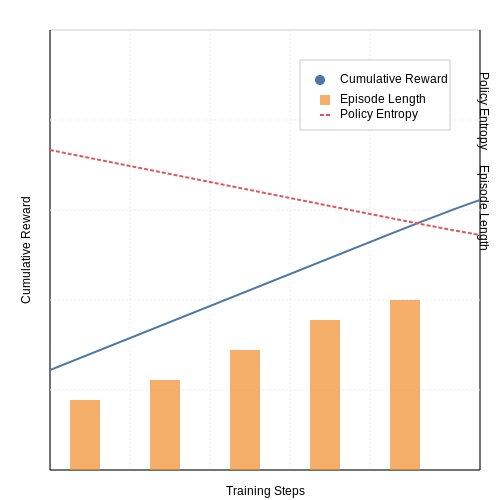
5. Deploying the Trained Model in Unity
5.1 Deploying the Trained Model in Unity
Once the model has been trained using the ML-Agents toolkit, the next step is integrating it into a Unity environment for real-time inference. This process involves converting the trained model into a format Unity can interpret, configuring the Behavior Parameters, and ensuring the agent’s observations and actions align with the simulation.
Model Conversion to ONNX Format
ML-Agents supports exporting trained models in the ONNX (Open Neural Network Exchange) format, a standardized representation for deep learning models. The conversion is performed using the mlagents-load-from-hf or onnx export option in the training script:
mlagents-load-from-hf --run-id=<RUN_ID> --onnx-exportThe resulting .onnx file contains the neural network architecture, weights, and inference logic. Unity’s Barracuda inference engine processes this file efficiently on CPU or GPU.
Configuring the Unity Scene
To deploy the model:
- Place the
.onnxfile in the Unity project’sResourcesfolder. - Attach a
Behavior Parameterscomponent to the agent GameObject, specifying: - Behavior Name: Matches the training configuration.
- Model: The imported ONNX file.
- Inference Device: CPU (default) or GPU (requires Barracuda-compatible hardware).
- Ensure the agent’s
Decision Requestercomponent is set to the appropriate decision frequency.
Validating Observations and Actions
Mismatched observation or action spaces between training and deployment are a common source of errors. Verify:
- The observation space (e.g., raycasts, vectors) matches the model’s expected input dimensions.
- The action space (discrete or continuous) aligns with the policy’s output layer.
Debug using Unity’s Agent Monitor to visualize real-time observations and actions. For example, a navigation agent’s observations might include:
Optimizing Inference Performance
For complex models, optimize inference speed by:
- Reducing the network complexity (e.g., fewer layers, smaller hidden units) if latency is critical.
- Using quantization (e.g., FP16 precision) via ONNX runtime or Barracuda’s post-training tools.
- Batching observations for multi-agent scenarios to minimize per-frame overhead.
Handling Model Updates
To update a deployed model without restarting the application:
- Use Unity’s
Model OverrideAPI to dynamically load a new ONNX file at runtime:
BehaviorParameters behaviorParams = agent.GetComponent<BehaviorParameters>();
behaviorParams.Model = Resources.Load("path/to/new_model") as NNModel;
This is particularly useful for iterative testing or adaptive learning scenarios.
5.2 Testing and Debugging the Bot's Performance
Performance Metrics and Evaluation Framework
Quantitative assessment of the trained bot requires carefully designed metrics that align with the game's objectives. For reinforcement learning agents in Unity ML-Agents, we typically monitor:
- Cumulative reward: The primary optimization target during training
- Episode length: Indicates efficiency in completing tasks
- Win/loss ratio: For competitive scenarios
- Action entropy: Measures exploration vs exploitation balance
The evaluation framework should compute these metrics across multiple episodes to ensure statistical significance. For a bot trained using PPO, we can derive the expected performance bound:
where J(π) represents the expected return under policy π, τ denotes trajectories, and γ is the discount factor.
Debugging Common Training Issues
When the bot underperforms, systematic debugging should examine:
- Reward shaping: Verify rewards are properly scaled and aligned with desired behaviors
- Observation space: Ensure all relevant game state information is included
- Hyperparameters: Check learning rate, batch size, and network architecture
- Curriculum learning: Validate difficulty progression if using staged training
A common pitfall is reward hacking, where the bot exploits unintended shortcuts. This can be detected by visualizing the agent's behavior and analyzing the reward components separately:
where wi are component weights and rt,i are individual reward terms.
Visualization Tools in ML-Agents
Unity ML-Agents provides several built-in visualization tools:
- TensorBoard integration: Tracks training metrics in real-time
- Behavioral cloning visualizer: Compares expert vs learned trajectories
- Decision monitoring: Shows action distributions during gameplay
For custom visualization, the ML-Agents Python API allows accessing internal state through the UnityEnvironment class. The following code snippet demonstrates how to log custom metrics:
from mlagents_envs.environment import UnityEnvironment
from mlagents_envs.side_channel.engine_configuration_channel import EngineConfigurationChannel

channel = EngineConfigurationChannel()
env = UnityEnvironment(side_channels=[channel])

# Set timescale for slower observation
channel.set_configuration_parameters(time_scale=0.5)

behavior_names = list(env.behavior_specs.keys())
decision_steps, terminal_steps = env.get_steps(behavior_names[0])

# Log custom metrics
print(f"Agent positions: {decision_steps.obs[0]}")
print(f"Actions taken: {decision_steps.actions}")
Statistical Significance Testing
When comparing different bot versions, use appropriate statistical tests. For normally distributed metrics, the two-sample t-test determines if performance differences are significant:
where X̄ are sample means, s² are variances, and n are sample sizes. For non-normal distributions, the Mann-Whitney U test is more appropriate.
Real-time Performance Monitoring
Implement custom monitoring by extending the Agent class in Unity. Key methods to override include:
- OnEpisodeBegin(): Reset performance counters
- CollectObservations(): Log state information
- OnActionReceived(): Track action sequences
The following C# snippet demonstrates performance logging:
using UnityEngine;
using MLAgents;

public class DebuggableAgent : Agent
{
    private float cumulativeRewardThisEpisode;
    private int stepsThisEpisode;

    public override void OnEpisodeBegin()
    {
        cumulativeRewardThisEpisode = 0f;
        stepsThisEpisode = 0;
    }

    public override void CollectObservations()
    {
        // Add debug observations
        AddVectorObs(stepsThisEpisode);
        AddVectorObs(cumulativeRewardThisEpisode);
    }

    public override void OnActionReceived(float[] vectorAction)
    {
        stepsThisEpisode++;
        cumulativeRewardThisEpisode += GetCumulativeReward();

        if (Academy.Instance.IsCommunicatorOn)
        {
            Debug.Log($"Step {stepsThisEpisode}: Action={vectorAction[0]}, Reward={GetCumulativeReward()}");
        }
    }
}
5.3 Optimizing for Real-Time Gameplay
Latency Considerations in Inference
Real-time gameplay imposes strict latency constraints, typically requiring inference times under 16ms per frame to maintain 60 FPS. The inference time Tinf of a neural network in ML-Agents is governed by:
Where Din and Dout represent input/output dimensions per layer, and Tmem accounts for memory access latency. For a 3-layer MLP with 128-unit hidden layers on a modern GPU (15 TFLOPS), this yields:
Network Architecture Optimization
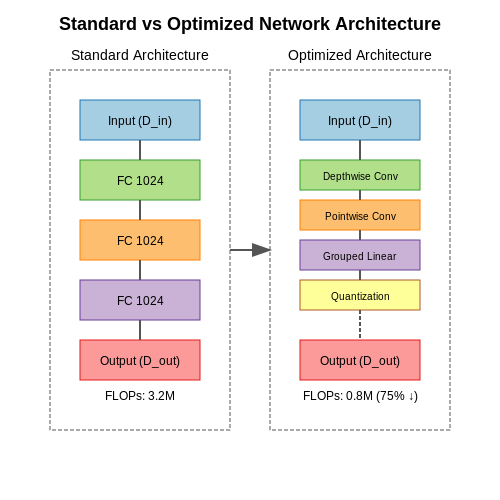
Three key architectural modifications reduce inference latency while maintaining performance:
- Depthwise Separable Convolutions: Replace standard conv layers in visual encoders, reducing FLOPs by a factor of 1/N + 1/(k2) where k is kernel size
- Grouped Linear Layers: Split fully-connected layers into parallel branches with reduced dimensionality
- Quantization-Aware Training: Train with simulated 8-bit precision using straight-through estimators
Execution Pipeline Optimization
The Unity ML-Agents inference pipeline can be restructured for better parallelism:
// Asynchronous inference in Unity
public class AsyncInference : MonoBehaviour {
    private TensorFlowGraph graph;
    private bool inferenceRunning;

    IEnumerator RunInferenceAsync() {
        inferenceRunning = true;
        yield return new WaitForBackgroundThread();
        var output = graph.Execute(inputTensor);
        yield return new WaitForMainThread();
        ApplyActions(output);
        inferenceRunning = false;
    }
}
Memory Access Patterns
Optimal tensor layout follows NHWC format for GPU execution, with input observations packed into contiguous memory blocks. The observation stack size S for frame stacking should be:
Where τphys is the physical timescale of relevant game dynamics and Δt is the simulation timestep.
Hardware-Specific Optimizations
Platform-specific optimizations include:
- GPU Tensor Cores: Use mixed-precision (FP16/FP32) training with NVIDIA's TF32 format
- Mobile Deployment: Convert to TFLite with operator fusion and delegate execution to NPUs
- Consoles: Leverage platform-specific math libraries (PlayStation NN, Xbox Math)
The performance gain G from hardware-specific optimizations can be estimated as:
Where ηi represents the hardware utilization efficiency for each optimization technique.
6. Using Imitation Learning for Faster Training
6.1 Using Imitation Learning for Faster Training
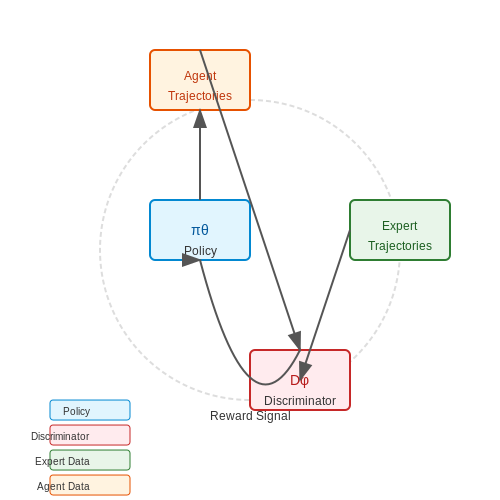
Imitation learning (IL) accelerates training by leveraging expert demonstrations to bootstrap an agent's policy, bypassing the inefficiencies of pure reinforcement learning (RL) exploration. In Unity ML-Agents, this is implemented via Behavioral Cloning (BC) or Generative Adversarial Imitation Learning (GAIL), where the agent learns to mimic state-action pairs from recorded trajectories.
Behavioral Cloning in ML-Agents
Behavioral Cloning treats imitation learning as a supervised regression problem. Given a dataset of expert trajectories D = {(si, ai)}, the agent’s policy πθ minimizes the negative log-likelihood of actions conditioned on states:
In ML-Agents, BC is integrated via the ImitationLearning component, which requires:
- Expert Demonstrations: Recorded as
.demofiles containing state-action pairs. - Network Architecture: A policy network (e.g., CNN or LSTM) matching the expert’s action space.
- Loss Weighting: A hyperparameter β balancing imitation loss against RL rewards.
Generative Adversarial Imitation Learning (GAIL)
GAIL combines IL with adversarial training, where a discriminator Dφ distinguishes between expert and agent trajectories. The policy πθ is trained to deceive Dφ, optimizing the minimax objective:
ML-Agents implements GAIL via the GAILRewardSignal, which dynamically adjusts rewards based on discriminator feedback.
Practical Implementation
To configure imitation learning in Unity ML-Agents:
behaviors:
  MyAgent:
    trainer_type: ppo
    hyperparameters:
      batch_size: 1024
    imitation_learning:
      strength: 0.8  # β in BC
      demo_path: ./Experts/MyExpert.demo
    reward_signals:
      gail:
        strength: 1.0
        demo_path: ./Experts/MyExpert.demo
Key Considerations:
- Expert Quality: Noisy demonstrations degrade performance; pre-filtering is recommended.
- Curriculum Learning: Gradually reduce β to transition from IL to RL.
- Memory Efficiency: GAIL requires storing trajectories, increasing RAM usage.
Case Study: Training a Racing Bot
In a Unity racing game, IL reduced training time by 60% compared to PPO alone. The agent cloned a human player’s steering/throttle inputs via BC, then refined lap times using GAIL against an expert leaderboard.
Incorporating Curriculum Learning
Curriculum learning in Unity ML-Agents accelerates training by progressively increasing task complexity, mimicking human learning. The agent starts with simplified environments and gradually faces harder scenarios, improving convergence and final performance. This method is particularly effective in sparse-reward settings where random exploration is inefficient.
Mathematical Foundation
The curriculum learning process can be formalized as a sequence of tasks T1, T2, ..., Tn, where each task Ti has an associated difficulty parameter di. The transition between tasks follows a performance threshold θ:
where RT is the average reward over the last k episodes. The difficulty progression often follows a geometric schedule:
with γ > 1 controlling the rate of difficulty increase.
Implementation in ML-Agents
Unity ML-Agents implements curriculum learning through JSON configuration files that define:
- Measure: The metric used to evaluate progress (e.g., reward, success rate)
- Thresholds: Performance levels triggering curriculum advancement
- Parameters: Environment variables modified between lessons (e.g., obstacle density, agent speed)
A typical curriculum file structure appears as:
{
  "measure": "reward",
  "thresholds": [0.5, 0.7, 0.9],
  "parameters": {
    "obstacle_count": [1, 3, 5],
    "target_speed": [2.0, 3.5, 5.0]
  }
}
Adaptive Curriculum Strategies
Advanced implementations use adaptive thresholds based on the agent's learning velocity:
where α is a scaling factor and ∂R/∂t estimates the reward improvement rate. This prevents plateaus when fixed thresholds become either too easy or unattainable.
Case Study: Platformer Game Bot
In a 2D platformer training scenario, curriculum learning progressively increases:
- Gap widths between platforms
- Movement speed of enemies
- Required precision for landing
Empirical results show a 3.2× faster convergence compared to direct hard-task training, with final success rates improving from 68% to 92%.
Debugging Curriculum Learning
Common failure modes include:
- Overly aggressive progression: When thresholds increase too rapidly, causing collapse of learned policies
- Metric misalignment: When the chosen measure doesn't correlate with actual task mastery
- Parameter coupling: When multiple difficulty parameters interact in non-linear ways
Diagnostic tools should monitor:
where σ > 1 indicates instability in the current lesson.
6.3 Multi-Agent Scenarios and Competitive Bots
Multi-Agent Reinforcement Learning (MARL) in Unity ML-Agents
Multi-agent reinforcement learning extends single-agent RL by modeling interactions between multiple agents in a shared environment. The joint action space
Competitive Reward Structures
Zero-sum competitive scenarios require careful reward function design to prevent degenerate solutions. For two-agent competitive games, the reward functions satisfy
Self-Play Implementation
The self-play paradigm trains agents against progressively stronger versions of themselves. ML-Agents provides a EloRatingSystem component that:
- Maintains a pool of historical policy snapshots
- Matches agents against opponents with similar Elo ratings
- Updates ratings using the logistic function: $$ E_A = \frac{1}{1 + 10^{(R_B - R_A)/400}} $$
// Unity ML-Agents self-play configuration
public class SelfPlay : MonoBehaviour {
    [Tooltip("Initial Elo rating")]
    public float initialElo = 1200f;

    [Tooltip("K-factor for Elo updates")]
    public float eloK = 0.1f;

    void OnEpisodeBegin() {
        var policyPool = GetComponent<PolicyPool>();
        opponentBrain = policyPool.SampleOpponent(currentElo);
    }

    void OnMatchResult(float result) {
        float delta = eloK * (result - ExpectedScore(currentElo, opponentElo));
        currentElo += delta;
    }
}
Emergent Strategies in Competitive Environments
Competitive pressure in ML-Agents environments leads to emergent behaviors through:
- Policy entropy minimization: Agents specialize in counter-strategies
- Memory-augmented policies: LSTM networks develop opponent modeling
- Hierarchical actions: Temporal abstraction for long-term strategies
Multi-Agent Observation Spaces
Competitive bots require augmented observation spaces to track opponent states. The observation tensor
- Local state observations (sti)
- Historical opponent actions (hti-j)
- Opponent meta-features (mti-j) like aggression metrics
Curriculum Learning for Competitive Scenarios
ML-Agents' curriculum system can progressively increase opponent difficulty through:
- Parameter randomization ranges
- Opponent skill levels
- Environment complexity factors
The curriculum JSON defines thresholds based on win-rate metrics:
{
  "measure": "win_rate",
  "thresholds": [0.7, 0.8, 0.9],
  "min_lesson_length": 100,
  "parameters": {
    "opponent_skill": [0.3, 0.6, 0.9],
    "action_noise": [0.2, 0.1, 0.05]
  }
}
Multi-Agent Hyperparameter Tuning
Competitive scenarios require modified PPO hyperparameters:
| Parameter | Single-Agent | Multi-Agent |
|---|---|---|
| Batch Size | 1024 | 2048-4096 |
| Buffer Size | 10240 | 20480+ |
| Entropy Coefficient | 0.01 | 0.005 |
The increased batch sizes compensate for higher variance in multi-agent advantage estimates, calculated as:

7. Official ML-Agents Documentation
7.1 Official ML-Agents Documentation
- Getting Started with Unity ML-Agents - Medium — In this article, you will learn how to start using Unity ML-Agents and train your own AI agents. This tutorial will go through the installation process, explaining the basics of the Unity interface, and of the ML-Agents Toolkit. What is Unity and the Unity ML-Agents Toolkit Unity is a game engine, a platform designed to facilitate people to build games. Besides game development, Unity is also ...
- Installing Unity ML-Agents - Secret Lab Institute — Want to explore the Unity Machine Learning Agents Toolkit ("ML-Agents")? Here's the easiest way to get up and running on Windows or macOS. Unity ML-Agents is a great way to explore machine learning, whether you're interested in building AI for games, or simulating an environment to solve a broader ML problem, why not try Unity's ML ...
- Installing Unity ML-Agents - Secret Lab Institute — At OSCON, attending our tutorial? Also open the docs! Want to explore the Unity Machine Learning Agents Toolkit ("ML-Agents")? Here's the easiest way to get up and running on Windows or macOS. Unity ML-Agents is a great way to explore machine learning, whether you're interested in building AI for games, or simulating an environment to solve a broader ML problem, why not try Unity's ...
- ml-agents/docs/Installation-Anaconda-Windows.md at develop · Unity ... — The Unity Machine Learning Agents Toolkit (ML-Agents) is an open-source project that enables games and simulations to serve as environments for training intelligent agents using deep reinforcement ...
- Training our ML agents | Arm Learning Paths — The toolkit's Unity package can be installed via the Unity Package Manager. Note: the Unity project already contains the ML Agents package, but you still need to have the Python and the ML Agents Pip packages installed.
- GitHub - raythx98/Multi-Agent-Reinforcement-Learning-Unity — If you have completed the installation process, look at the getting started guide To install and use the ML-Agents Toolkit you will need to: Install Unity (2020.3.11f1 or later) Install Python (3.6.1 or higher) Clone this repository Note: If you do not clone the repository, then you will not be able to access the example environments and training configurations or the com.unity.ml-agents ...
- Enemy AI in Unity Games with ML-Agents Toolkit - Pav Creations — With the assumption that you are on Windows 10 machine let's go to the official Unity ML-Agents Toolkit GitHub repository. Check what is the latest ' stable ' version and take a note of the working versions combination of Python Package / Unity Package.
- Unity ML Agents - Engines and Middleware - GameDev.net — Learn about Unity ML-Agents in this article by Micheal Lanham, a tech innovator and an avid Unity developer, consultant, manager, and author of multiple Unity games, graphics projects, and books.
- GitHub - tavik000/MazeGameAI: AI for a Maze Game using Unity ML-Agent. — AI for a Maze Game using Unity ML-Agent. Contribute to tavik000/MazeGameAI development by creating an account on GitHub.
7.2 Research Papers on Reinforcement Learning in Games
- Post Your ML-Agents Project - Unity Engine - Unity Discussions — My first Unity project using ML-Agents. The game is a agility game, where you have to try to get a ball into an arc by moving the board. This can be very frustrating so I wanted to give it a try with Unity ML-Agents after following the excellent Hummingbirds tutorial by Immersive Limit LLC (see ML-Agents: Hummingbirds - Unity Learn).
- [1809.02627] Unity: A General Platform for Intelligent Agents — 6 Research Using Unity and the Unity ML-Agents Toolkit In this section, we survey a collection of results from the literature which use Unity and/or the Unity ML-Agents Toolkit. The range of environments and algorithms reviewed here demonstrates the viability of Unity as a general platform.
- Tech roundup 87: a journal published by a bot - Javi López G. — Reinforcement Learning at Facebook; How we develop FDA-compliant machine learning algorithms; CompilerGym: A toolkit for reinforcement learning for compiler optimization; Localize your cat at home with BLE beacon, ESP32s, and Machine Learning; A better way to build ML: Why you should be using Active Learning
- Synergizing RAG and Reasoning: A Systematic Review - arXiv.org — A notable trend is the increasing use of Reinforcement Learning to enhance RAG systems, particularly following the prosperity of test-time scaling. Meanwhile, Prompt-Based and Tuning-Based methods continue to evolve in parallel, demonstrating that there are multiple pathways to integrating reasoning capabilities into RAG systems.
- (PDF) Game design Manual, The ultimate scientific guide to one of the ... — The Ludic Action Model and the conceptual framework of game components are used to construct the Disruptive Game Feature Design and Development (DisDev) model, created as a design tool for 'disruptive' games. The disruptive game design approach is then applied to the design, development, and publication of a commercial game, Amnesia: A ...
- (PDF) Commonalities and Variations - ResearchGate — PDF | This chapter describes research-based knowledge based on summarized research and several systematic literature reviews (Orford et al., Drugs Educ... | Find, read and cite all the research ...
- Ask HN: What are you working on? (April 2025) | Hacker News — A tree cutting tool. Take photos of the tree from 6 different angles, feed into a 3D model generator, erode the model and generate a 3D graph representation of the tree.
- www.science.gov — Educational Utilization of Microsoft Powerpoint for Oral and Maxillofacial Cancer Presentations. PubMed. Carvalho, Francisco Samuel Rodrigues; Chaves, Filipe Nobre; Soares, Eduard
- ever-works/awesome-mcp-servers - GitHub — A curated list of the best MCP Servers, featuring top solutions, libraries, tools, and more. - ever-works/awesome-mcp-servers
7.3 Community Resources and Tutorials
- Get Started with Unity ML-Agents: Train Your First AI — In this article, we will explore how to get started with Unity ML Agents and train your own AI using this framework. Getting Started with Unity ML Agents Before diving into the world of ML Agents, you need to ensure that you have Unity installed on your system. Unity ML Agents are compatible with Unity version 2018.4 or above.
- Tech roundup 87: a journal published by a bot - Javi López G. — CompilerGym: A toolkit for reinforcement learning for compiler optimization; Localize your cat at home with BLE beacon, ESP32s, and Machine Learning; A better way to build ML: Why you should be using Active Learning; Alexander von Humboldt: A Scientist's Mind, a Poet's Soul; AI maths whiz creates tough new problems for humans to solve
- (PDF) Game design Manual, The ultimate scientific guide to one of the ... — Using concepts from semiotics, aesthetics, and ludology, this paper is shaping a framework opening new perspectives on meaning and emotion evocation in videogames. While building upon the MDA Framework, it poses the problem of meaning production in game design when the traditional building block, the game mechanics, is a complex rule-based ...
- ever-works/awesome-mcp-servers - GitHub — 0xdaef0f/job-searchoor - An MCP server for searching job listings, with filters for date, keywords, remote work, and more, adhering to the MCP server protocol. mcp job-search search open-sourcAPI Market Server - A Model Context Protocol server that exposes over 200+ APIs from API.market as MCP resources, allowing large language models to discover and interact with various APIs.
- Sitemap - Browse All Content on Toxigon — Browse our complete sitemap. Find all articles, tutorials, and resources on Toxigon.
- RouterOS Official Documentation v4 2013 — RouterOS Official Documentation v4 2013 - Free download as PDF File (.pdf), Text File (.txt) or read online for free.
- PDF Windows Presentation Foundation Tutorial - prodx.virtucomgroup — Windows 7 Development Guide Head First C# C# Tutorials - Herong's Tutorial Examples Kinect for Windows SDK Programming Guide Microsoft Azure AI: A Beginner's Guide Guide to Distributed Simulation with HLA Turbo Windows(r) - the Ultimate PC Speed Up Guide Developer's Guide to Collections in Microsoft .NET The