
Reptile and MAML Algorithms Explained
1. What is Meta-Learning?
What is Meta-Learning?
Meta-learning, or learning to learn, is a subfield of machine learning where models are explicitly trained to adapt quickly to new tasks with minimal data. Unlike traditional supervised learning, which optimizes for performance on a fixed dataset, meta-learning algorithms optimize for the ability to generalize across a distribution of tasks. This is particularly useful in scenarios where data is scarce or tasks are highly diverse, such as few-shot learning, reinforcement learning, and neural architecture search.
Mathematical Formulation
In meta-learning, a task Ti is drawn from a distribution p(T), where each task consists of a support set (training data) and a query set (test data). The goal is to minimize the expected loss across all tasks:
Here, θ represents the meta-parameters, and θi are the task-specific parameters adapted from θ using the support set. The adaptation process is often formulated as an optimization problem, where gradient-based methods like MAML or Reptile are employed.
Key Approaches in Meta-Learning
Meta-learning algorithms can be broadly categorized into three paradigms:
- Optimization-Based: Methods like MAML and Reptile explicitly optimize for fast adaptation by learning an initialization that can be fine-tuned efficiently with few gradient steps.
- Metric-Based: Algorithms such as Prototypical Networks and Matching Networks learn a similarity metric in embedding space to classify new examples based on their proximity to support set samples.
- Model-Based: Architectures like Memory-Augmented Neural Networks (MANNs) or Transformers with in-context learning leverage internal dynamics to adapt to new tasks without explicit parameter updates.
Practical Applications
Meta-learning has been successfully applied in:
- Few-Shot Classification: Training models to recognize new classes with only a handful of labeled examples.
- Reinforcement Learning: Enabling agents to adapt quickly to new environments or tasks with limited interaction.
- Neural Architecture Search: Automating the design of neural networks by learning from prior architecture evaluations.
Challenges and Limitations
Despite its promise, meta-learning faces several challenges:
- Task Distribution Sensitivity: Performance degrades if test tasks deviate significantly from the training task distribution.
- Computational Cost: Meta-training often requires extensive computation due to nested optimization loops.
- Overfitting: Meta-models may overfit to the meta-training tasks, limiting generalization to unseen tasks.
Recent advances in self-supervised learning and transformer-based architectures have begun to address some of these limitations, pushing the boundaries of what meta-learning can achieve.
Key Concepts and Terminology
Meta-Learning and Few-Shot Learning
Meta-learning, or learning to learn, refers to algorithms that improve their ability to generalize across tasks by leveraging prior experience. Few-shot learning is a specialized case where models must adapt to new tasks with minimal labeled data (e.g., 1-5 examples per class). Both Reptile and MAML are optimization-based meta-learning methods designed for few-shot scenarios.
Model-Agnostic Meta-Learning (MAML)
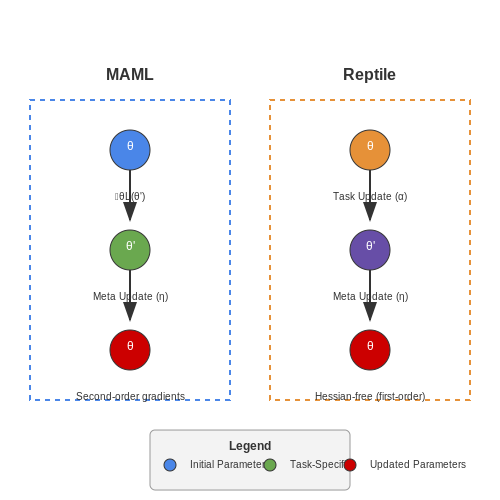
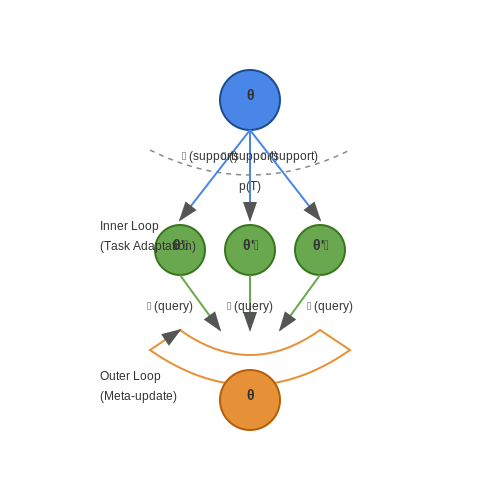
MAML optimizes a model's initial parameters such that a small number of gradient updates on a new task yields strong performance. The key steps are:
- Task Sampling: Draw a batch of tasks \( \tau_i \sim p(\tau) \).
- Inner Loop (Adaptation): For each task, compute updated parameters \( heta_i' = heta - \alpha abla_{ heta} \mathcal{L}_{\tau_i}( heta) \).
- Outer Loop (Meta-Optimization): Update \( heta \) to minimize the expected loss across tasks: \( heta \leftarrow heta - \eta abla_{ heta} \sum_{\tau_i} \mathcal{L}_{\tau_i}( heta_i') \).
Reptile
Reptile simplifies MAML by omitting explicit second-order derivatives. Instead, it:
- Performs multiple stochastic gradient steps per task.
- Moves the initial parameters toward the task-adapted parameters \( heta_i' \).
The update rule is \( heta \leftarrow heta + \epsilon ( heta_i' - heta) \), where \( \epsilon \) is a meta-step size. This approximates MAML’s meta-gradient through iterative first-order optimization.
Key Terminology
- Task Distribution \( p(\tau) \): The probability distribution over tasks during meta-training.
- Inner Loop Learning Rate \( \alpha \): Step size for task-specific adaptation.
- Meta-Learning Rate \( \eta \): Step size for updating the initial parameters.
- Hessian-Free: Reptile avoids computing second derivatives, unlike MAML.
Practical Considerations
MAML’s reliance on second-order gradients makes it computationally expensive, while Reptile trades off some theoretical guarantees for scalability. Both assume tasks are drawn from a stationary distribution, and performance hinges on the diversity of the meta-training task set.
Applications of Meta-Learning
Meta-learning, particularly through algorithms like Reptile and MAML, has demonstrated significant utility in scenarios where rapid adaptation to new tasks is critical. These methods excel in environments with limited labeled data, enabling models to generalize from few examples by leveraging prior experience.
Few-Shot Learning in Computer Vision
Reptile and MAML have been successfully applied to few-shot image classification, where a model must recognize new classes with only a handful of examples. For instance, in medical imaging, meta-learning enables diagnosis of rare conditions with minimal annotated data. The optimization process can be formalized as:
Here, U represents the inner-loop update rule, and k denotes the number of gradient steps. The outer loop optimizes the initial parameters θ to minimize expected loss across tasks.
Robotics and Continuous Control
In robotics, meta-learning allows agents to adapt control policies to new environments with different dynamics. For example, a quadruped robot trained via MAML can quickly adjust its gait when encountering unseen terrains. The adaptation process involves:
- Sampling trajectories from the new environment
- Computing policy gradients using few-shot data
- Updating the base policy through meta-optimization
Natural Language Processing
Meta-learning has shown promise in low-resource language tasks, where models must generalize across languages with limited parallel corpora. A notable application is cross-lingual transfer for named entity recognition, where the meta-learner acquires language-agnostic features during pretraining.
Mathematical Formulation for NLP Adaptation
The adaptation dynamics for few-shot text classification can be expressed as:
where α is the inner-loop learning rate, and (x1:k, y1:k) are the support examples for task i.
Drug Discovery and Molecular Property Prediction
In computational chemistry, meta-learning accelerates the prediction of molecular properties for novel compound classes. The key advantage lies in the model's ability to leverage structural knowledge from known molecules when evaluating new scaffolds. Practical implementations often combine:
- Graph neural networks for molecular representation
- MAML-style adaptation across chemical families
- Multi-task objectives incorporating quantum mechanical properties
Recent benchmarks show meta-learned models achieving 30-50% higher accuracy than conventional approaches when predicting toxicity for unseen molecular scaffolds with fewer than 50 training examples.
Personalized Federated Learning
Meta-learning principles have been adapted to federated settings, where devices collaboratively learn a shared model while preserving data privacy. The Reptile algorithm proves particularly suitable due to its computational efficiency. The global update rule becomes:
where φi represents client-specific parameters after local adaptation, and ε controls the meta-learning rate. This approach has demonstrated improved personalization for healthcare applications while maintaining differential privacy guarantees.
2. Core Principles of MAML
Core Principles of MAML
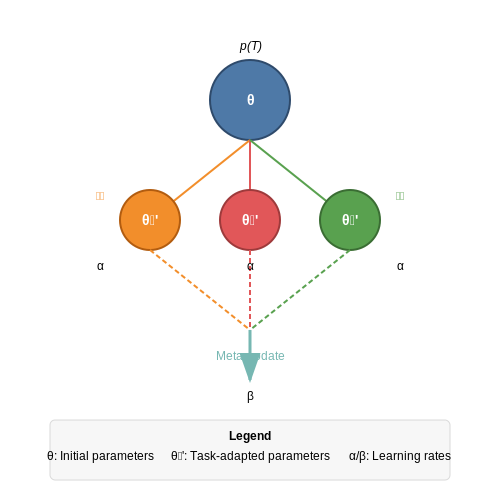
Model-Agnostic Meta-Learning (MAML) is a gradient-based meta-learning framework designed to enable rapid adaptation of a model to new tasks with minimal data. The algorithm optimizes for a set of initial parameters that can be efficiently fine-tuned via a few gradient steps on any task drawn from a distribution p(T). Unlike traditional deep learning, which trains a model for a single task, MAML explicitly optimizes for task-agnostic adaptability.
Mathematical Formulation
Given a model fθ with parameters θ, MAML aims to find an initialization θ such that a small number of gradient updates on a new task Ti yields high performance. The meta-objective is:
where θi' represents the adapted parameters after one or more gradient steps on task Ti:
Here, α is the inner-loop learning rate, and the outer-loop update optimizes θ across tasks via:
where β is the meta-learning rate. The key innovation lies in differentiating through the inner-loop adaptation, enabling second-order gradient computation.
Algorithmic Steps
- Task Sampling: Draw a batch of tasks Ti from p(T).
- Inner-Loop Adaptation: For each task, compute adapted parameters θi' using one or more gradient steps on support data.
- Meta-Optimization: Update θ by backpropagating through the inner-loop updates using query-set losses.
Practical Considerations
MAML’s reliance on second-order derivatives can be computationally expensive. Variants like First-Order MAML (FOMAML) approximate the meta-gradient by ignoring higher-order terms, trading off accuracy for efficiency. The choice of α and β is critical: too large values destabilize training, while small values slow adaptation.
Applications
MAML has demonstrated success in few-shot learning, robotics, and reinforcement learning. For instance, in few-shot classification, it enables a model to generalize to unseen classes with only a handful of labeled examples. In robotics, it allows policies to adapt quickly to new environments or dynamics.
The MAML Algorithm: Step-by-Step
Mathematical Formulation of MAML
The Model-Agnostic Meta-Learning (MAML) algorithm aims to find an initial set of parameters θ that can be quickly adapted to new tasks via a small number of gradient steps. Given a distribution of tasks p(T), the objective is to minimize the expected loss after adaptation:
Here, U_T(θ) represents the adaptation operator, typically one or more gradient descent steps on task T’s training data. For a single gradient step with learning rate α, the adaptation becomes:
Gradient-Based Meta-Optimization
The key innovation in MAML is the meta-optimization step, which differentiates through the adaptation process. The meta-gradient requires computing second-order derivatives:
In practice, MAML often approximates this by ignoring the second-order term (first-order MAML or FOMAML) for computational efficiency:
Algorithm Steps
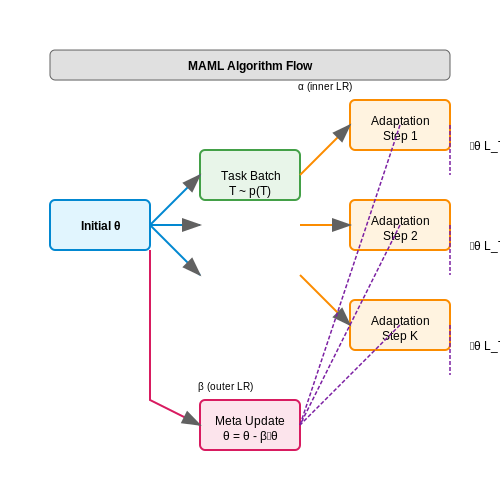
The full MAML algorithm proceeds as follows:
- Sample a batch of tasks T_i from p(T).
- For each task:
- Compute adapted parameters θ'_i = U_{T_i}(θ) using one or more gradient steps on the task’s training data.
- Evaluate the loss L_{T_i}(θ'_i) on the task’s test data.
- Update the initial parameters θ via gradient descent on the aggregated test losses:
$$ \theta \leftarrow \theta - \beta \nabla_\theta \sum_{T_i} \mathcal{L}_{T_i}(\theta'_i) $$
Practical Considerations
MAML’s effectiveness depends on several hyperparameters:
- Inner-loop learning rate (α): Controls adaptation speed per task. Too large values may overshoot, while small values require more steps.
- Outer-loop learning rate (β): Determines meta-update stability. Typically smaller than α to avoid oscillations.
- Number of inner-loop steps: Trade-off between computation and adaptation quality. Fewer steps favor speed but may underfit.
Applications and Variants
MAML has been extended in multiple directions:
- Few-shot learning: Rapid adaptation to new classes with minimal labeled examples.
- Reinforcement learning: Fast policy adaptation to new environments.
- Domain generalization: Learning representations robust to distribution shifts.
Notable variants include ANIL (Almost No Inner Loop) for reduced computation and Meta-SGD for learned per-parameter adaptation rates.
2.3 Mathematical Formulation of MAML
The Model-Agnostic Meta-Learning (MAML) algorithm optimizes a model's initial parameters such that a small number of gradient updates on new tasks yields strong performance. The key idea is to learn an initialization that is sensitive to task-specific fine-tuning, enabling rapid adaptation.
Problem Setup
Consider a distribution of tasks p(T), where each task T_i has its own loss function L_Ti and dataset D_i. The goal is to find initial parameters θ that, after one or more gradient steps on D_i, minimize the expected loss across tasks:
Here, U_T(θ) represents the updated parameters after adaptation on task T.
Inner Loop Optimization
For each task T_i, the inner loop computes adapted parameters θ'_i via gradient descent:
where α is the inner-loop learning rate and f_θ is the model with parameters θ.
Outer Loop Meta-Optimization
The outer loop updates θ to minimize the loss across all tasks after adaptation:
where β is the meta-learning rate. The critical insight is that the gradient through the adaptation process requires second-order derivatives:
This involves computing the Hessian matrix of the loss, making MAML a second-order optimization method.
First-Order Approximation
For computational efficiency, MAML can be approximated by ignoring second-order terms:
This first-order MAML (FOMAML) variant often works well in practice while being significantly faster to compute.
Algorithm Summary
The complete MAML procedure for a batch of tasks is:
- Sample batch of tasks T_i ∼ p(T)
- For each task, compute adapted parameters θ'_i via inner-loop gradient descent
- Update initial parameters θ using the meta-gradient across all tasks
- Repeat until convergence
The effectiveness of MAML stems from its ability to learn parameterizations that lie in regions of the loss landscape that are amenable to fast adaptation, rather than attempting to find parameters that work well across all tasks simultaneously.
2.4 Practical Implementation of MAML
Mathematical Foundations of MAML
The core idea behind Model-Agnostic Meta-Learning (MAML) is to learn an initial set of parameters θ that can be quickly adapted to new tasks via a small number of gradient steps. Given a distribution of tasks p(T), MAML optimizes for:
where UTi(θ) represents the parameter update rule for task Ti, typically one or more gradient descent steps:
Algorithm Implementation Steps
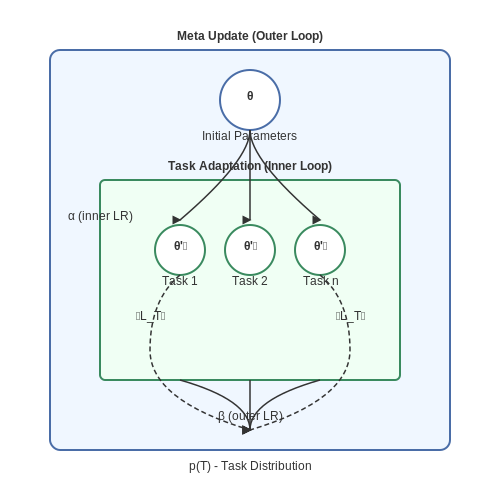
The practical implementation of MAML involves these key phases:
- Task Sampling: Draw a batch of tasks Ti from p(T), each with support (training) and query (validation) sets
- Inner Loop Adaptation: For each task, compute adapted parameters θ'i using k gradient steps on the support set
- Outer Loop Update: Compute the meta-gradient across all tasks using the query sets and update the initial parameters θ
Critical Implementation Details
Second-Order Gradient Considerations
The exact MAML formulation requires second-order derivatives through the inner loop optimization. In practice, this can be approximated by ignoring higher-order terms:
This first-order approximation (FOMAML) often works nearly as well while being computationally cheaper.
Batch Normalization Handling
Special care must be taken with batch normalization layers. Two common approaches:
- Use per-task running statistics during inner loop adaptation
- Employ batch renormalization to prevent statistics explosion
Python Implementation Framework
The following code demonstrates the core training loop of MAML using PyTorch:
def maml_train(model, tasks, inner_lr, meta_lr, inner_steps=1):
    meta_optimizer = torch.optim.Adam(model.parameters(), lr=meta_lr)

    for iteration in range(num_iterations):
        # Sample batch of tasks
        task_batch = sample_tasks(tasks, batch_size)
        meta_loss = 0

        for task in task_batch:
            # Clone model for inner loop
            fast_weights = OrderedDict(model.named_parameters())

            # Inner loop adaptation
            for _ in range(inner_steps):
                support_loss = compute_loss(task.support_set, fast_weights)
                grads = torch.autograd.grad(support_loss, fast_weights.values())
                fast_weights = OrderedDict(
                    (name, param - inner_lr * grad)
                    for (name, param), grad in zip(fast_weights.items(), grads)
                )

            # Compute query loss for meta-update
            query_loss = compute_loss(task.query_set, fast_weights)
            meta_loss += query_loss

        # Outer loop update
        meta_optimizer.zero_grad()
        meta_loss.backward()
        meta_optimizer.step()
Practical Considerations
When implementing MAML, several practical aspects significantly impact performance:
- Learning Rate Selection: The inner loop learning rate α must balance adaptation speed and stability
- Task Design: Task diversity should match the expected test-time distribution while maintaining learnability
- Hardware Utilization: Parallelizing task computations across GPUs dramatically improves training speed
Common Pitfalls and Solutions
Several challenges frequently arise in MAML implementations:
- Gradient Instability: Use gradient clipping and careful learning rate scheduling
- Overfitting to Meta-Training Tasks: Regularize through task augmentation or dropout
- Computational Bottlenecks: Implement efficient second-order gradient approximations
3. Core Principles of Reptile
Core Principles of Reptile
Reptile, introduced by OpenAI in 2018, is a first-order meta-learning algorithm designed to efficiently adapt neural networks to new tasks with minimal computational overhead. Unlike MAML, which explicitly computes second-order gradients, Reptile approximates meta-updates through a series of stochastic gradient descent (SGD) steps on sampled tasks, followed by a weighted averaging of the resulting parameters. This approach avoids the computational burden of Hessian calculations while still achieving competitive performance in few-shot learning scenarios.
Mathematical Formulation
The Reptile algorithm operates by iteratively sampling a task Ti from a distribution p(T), performing k steps of SGD on the loss LTi(θ), and then updating the initial parameters θ towards the fine-tuned parameters ϕi:
where ε is the meta-learning rate. This update rule can be interpreted as a form of weighted parameter averaging across tasks. The key insight is that the difference (ϕi - θ) approximates the direction of improvement across tasks, even though Reptile never explicitly computes a meta-gradient.
Connection to MAML and FOMAML
Reptile bears similarity to First-Order MAML (FOMAML) in that both avoid second-order derivatives. However, while FOMAML still computes task-specific gradients during the meta-update, Reptile entirely bypasses this step. The algorithm can be shown to approximate the same meta-gradient as MAML when the inner-loop learning rate α is small, through the following derivation:
This reveals that Reptile effectively performs SGD on the expected loss across tasks, with a learning rate of εα.
Practical Implementation
In practice, Reptile is implemented with the following steps:
- Sample a batch of tasks {Ti} from p(T)
- For each task, initialize ϕi = θ and perform k steps of SGD: ϕi ← ϕi - α∇LTi(ϕi)
- Update the meta-parameters: θ ← θ + ε(1/n)Σ(ϕi - θ)
The algorithm's simplicity makes it particularly suitable for large-scale meta-learning problems where computational efficiency is critical. Empirical results show that Reptile often matches or exceeds the performance of MAML on standard few-shot benchmarks, while requiring significantly less computation per meta-update.
Geometric Interpretation
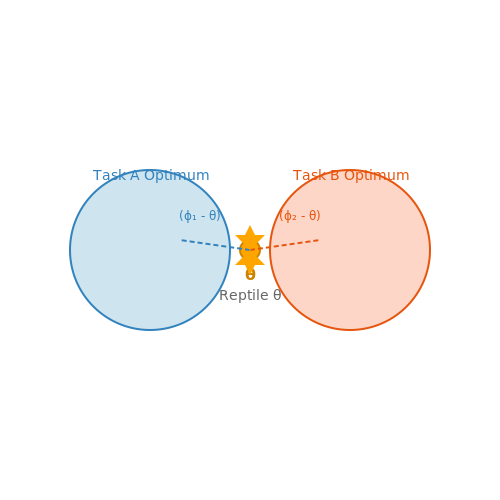
From an optimization perspective, Reptile can be viewed as finding a parameter initialization that lies in the center of the optimal regions for all tasks. The repeated process of fine-tuning and moving towards the fine-tuned parameters causes θ to converge to a point where small adjustments can quickly specialize the model to any task in the distribution.
The visualization above illustrates how Reptile's meta-parameters (orange) position themselves between the optimal regions for different tasks (green and blue). This central positioning enables rapid adaptation to new tasks with only a few gradient steps.
The Reptile Algorithm: Step-by-Step
The Reptile algorithm, introduced by OpenAI in 2018, is a first-order meta-learning method designed to learn an initialization of model parameters that can be fine-tuned quickly for new tasks. Unlike MAML, which requires second-order derivatives, Reptile approximates the meta-gradient through repeated stochastic gradient descent (SGD) steps, making it computationally efficient.
Mathematical Formulation
Given a distribution of tasks p(T), Reptile aims to find an initial parameter vector θ such that a small number of gradient steps on a new task T_i yields good performance. The algorithm operates as follows:
where θ_k represents the parameters after k steps of SGD on task T_i, and ε is the meta-learning rate. This update can be interpreted as moving θ towards the manifold of optimal parameters for each task.
Algorithm Steps
- Initialize the meta-parameters θ randomly.
- Sample a batch of tasks T_i from p(T).
- For each task T_i:
- Initialize task-specific parameters: θ_i = θ.
- Perform k steps of SGD on θ_i using task T_i's data.
- Compute the updated parameters θ_i'.
- Update the meta-parameters: θ ← θ + ε(θ_i' - θ).
- Repeat until convergence.
Key Differences from MAML
While both Reptile and MAML aim to learn good initializations, Reptile differs in several ways:
- First-order approximation: Reptile avoids computing second derivatives, making it computationally cheaper.
- Implicit gradient: The update θ_i' - θ approximates the meta-gradient without explicit backpropagation through the optimization process.
- Batch normalization: Reptile often performs better with batch norm layers, as it doesn't require careful handling of second-order effects.
Practical Implementation Considerations
When implementing Reptile, several practical aspects must be considered:
where α is the inner-loop learning rate. This relationship suggests that the meta-learning rate should be scaled relative to the number of inner-loop steps k.
For stability, it's common to:
- Use Adam instead of SGD for the inner-loop optimization
- Normalize the update direction (θ_i' - θ)
- Employ gradient clipping in both inner and outer loops
Visualization of Parameter Updates
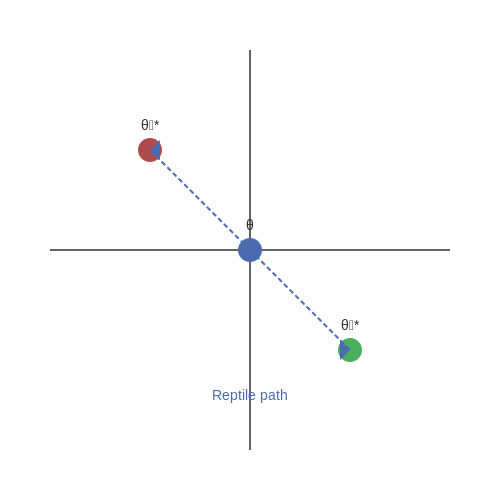
The algorithm's behavior can be visualized in parameter space. For two tasks T_1 and T_2 with optimal parameters θ_1* and θ_2*, Reptile's updates gradually move the initialization θ towards a point that minimizes the expected distance to both optima after a few gradient steps.
Convergence Properties
Reptile's convergence can be analyzed using the following bound on the expected improvement per iteration:
where μ is the strong convexity parameter, L is the smoothness constant, and σ represents gradient noise. This shows that with proper learning rate selection (ϵ < 2μ/L²), Reptile converges linearly to a neighborhood of the optimal initialization.
Applications and Performance
Reptile has shown strong performance in:
- Few-shot classification (Omniglot, Mini-ImageNet)
- Reinforcement learning with varying dynamics
- Cross-domain adaptation in NLP
Empirical results demonstrate that Reptile often matches MAML's performance while being up to 3× faster due to its avoidance of second-order computations. The algorithm particularly excels in scenarios where:
- The task distribution is broad but not extremely diverse
- Inner-loop adaptation requires only a few gradient steps
- Model architectures are relatively large
3.3 Mathematical Formulation of Reptile
Reptile, introduced by OpenAI in 2018, is a first-order meta-learning algorithm that optimizes for fast adaptation across tasks. Unlike MAML, which explicitly computes second-order gradients, Reptile approximates the meta-update through repeated stochastic gradient steps, making it computationally efficient while retaining competitive performance.
Core Optimization Objective
Given a distribution of tasks p(T), Reptile aims to find an initial set of parameters θ that can be quickly adapted to new tasks via a few gradient steps. For each task T_i, the inner-loop optimization performs k steps of SGD:
where α is the inner-loop learning rate and ℒT_i is the task-specific loss. The key difference from MAML lies in the meta-update: instead of differentiating through the inner-loop optimization, Reptile simply moves the initial parameters toward the fine-tuned parameters θ_i':
Here, β is the meta-learning rate. This update can be interpreted as a form of weighted averaging across task-specific parameters.
Connection to First-Order MAML
When the inner-loop consists of exactly one gradient step (k=1), Reptile's update becomes:
This is mathematically equivalent to first-order MAML (FOMAML), where second derivatives are omitted. For k>1, Reptile accumulates higher-order terms through its iterative update process, though it avoids explicit Hessian computations.
Batch Update Formulation
In practice, Reptile processes mini-batches of tasks. For a batch of n tasks sampled from p(T), the meta-update becomes:
This batch formulation reduces variance in the meta-gradient estimate and leads to more stable convergence. The algorithm can be viewed as finding a point in parameter space that is simultaneously close to the optimal parameters for many related tasks.
Geometric Interpretation
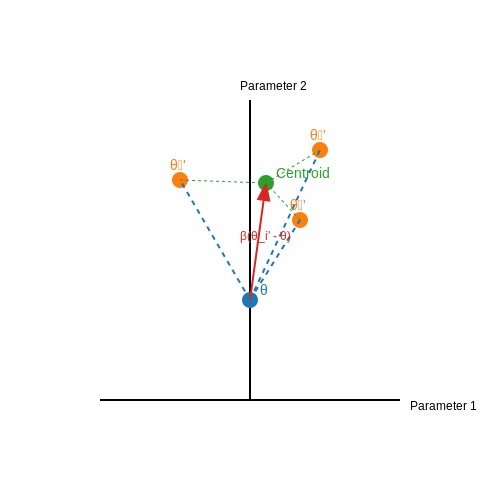
Reptile's update rule induces a geometry where:
- The inner-loop gradient steps θ → θ_i' move parameters toward task-specific optima
- The outer-loop update θ ← θ + β(θ_i' - θ) contracts the parameters toward the centroid of these task-specific optima
This creates a form of implicit regularization that favors parameter regions allowing fast adaptation, similar to MAML but without explicit second-order optimization.
Practical Implementation Details
Key hyperparameters in Reptile include:
- Inner-loop steps (k): Typically 1-5 for few-shot learning
- Inner learning rate (α): Often set via grid search or adaptation
- Meta learning rate (β): Usually larger than α (e.g., 0.1-1.0)
- Batch size (n): Balances computational cost and gradient estimate quality
The algorithm's computational complexity is O(k) per task compared to MAML's O(k + k²) when considering second-order terms, making Reptile particularly attractive for large-scale meta-learning problems.
3.4 Practical Implementation of Reptile
The Reptile algorithm, introduced by OpenAI, is a first-order meta-learning method designed for fast adaptation to new tasks with minimal computational overhead. Unlike MAML, which requires second-order derivatives, Reptile approximates the meta-gradient through iterative stochastic gradient descent (SGD) updates, making it computationally efficient while retaining competitive performance.
Algorithm Overview
Reptile operates by sampling a batch of tasks, performing multiple SGD steps on each task, and then updating the initial model parameters towards the final parameters obtained after task-specific training. The key steps are:
- Sample a task Ti from the task distribution p(T).
- Initialize model parameters θ.
- Perform k steps of SGD on Ti to obtain updated parameters θi.
- Update the initial parameters θ using the rule: θ ← θ + ε(θi − θ), where ε is the meta-learning rate.
Step-by-Step Implementation
Below is a PyTorch implementation of Reptile for few-shot classification. The code assumes a model fθ, a task distribution, and an inner-loop optimizer (e.g., SGD).
import torch
import torch.optim as optim

def reptile(model, tasks, inner_steps=5, inner_lr=0.1, meta_lr=1e-3, epochs=1000):
    optimizer = optim.SGD(model.parameters(), lr=meta_lr)

    for epoch in range(epochs):
        initial_weights = [param.clone() for param in model.parameters()]

        # Sample a task
        task = sample_task(tasks)
        x, y = task.sample_data()

        # Inner loop: adapt to the task
        inner_optim = optim.SGD(model.parameters(), lr=inner_lr)
        for _ in range(inner_steps):
            loss = model.loss(x, y)
            inner_optim.zero_grad()
            loss.backward()
            inner_optim.step()

        # Outer loop: meta-update
        optimizer.zero_grad()
        for initial_param, adapted_param in zip(initial_weights, model.parameters()):
            param_diff = adapted_param - initial_param
            initial_param.grad = -param_diff  # Reptile gradient approximation
        optimizer.step()
Key Implementation Details
1. Task Sampling: Tasks should be sampled from a diverse distribution to ensure the model generalizes. For few-shot learning, each task consists of a support set (training data) and a query set (test data).
2. Inner-Loop Optimization: The number of inner steps (k) and learning rate (α) are critical hyperparameters. Smaller k speeds up training but may underfit, while larger k improves adaptation at the cost of computation.
3. Meta-Learning Rate (ε): Controls how aggressively the initial parameters are updated. A high ε can lead to instability, while a low ε slows convergence.
Practical Considerations
- Batch Normalization: Batch statistics should be computed per-task during adaptation to avoid leakage between tasks.
- Gradient Clipping: Useful to stabilize training, especially when using larger inner-loop learning rates.
- Early Stopping: Monitor validation performance to prevent overfitting to the meta-training task distribution.
Comparison with MAML
While MAML explicitly computes the meta-gradient via backpropagation through the inner-loop optimization, Reptile approximates this gradient by moving the initial parameters towards the adapted parameters. This approximation avoids the computational cost of second derivatives but can still achieve similar performance in practice.
4. Key Differences in Approach
4.1 Key Differences in Approach
Optimization Strategy
Reptile and MAML (Model-Agnostic Meta-Learning) both aim to learn an initial set of parameters that can be quickly adapted to new tasks, but they differ fundamentally in their optimization strategies. MAML explicitly computes second-order gradients to minimize the expected loss across tasks after one or more gradient steps. The update rule for MAML involves:
where Uθ represents the inner-loop adaptation operator, and β is the meta-learning rate. In contrast, Reptile avoids explicit second-order derivatives by simply taking multiple gradient steps per task and then moving the initial parameters toward the final adapted parameters. The Reptile update is:
where θk is the parameter vector after k inner-loop steps, and α is the meta-step size.
Computational Efficiency
Reptile is computationally cheaper than MAML because it does not require backpropagating through the inner-loop optimization process. MAML's reliance on second-order gradients means it must compute Hessian-vector products, which are expensive for high-dimensional parameter spaces. Reptile sidesteps this by treating the inner-loop adaptation as a black box, making it more scalable for large models.
Task Adaptation Dynamics
MAML enforces consistency in the direction of adaptation by explicitly optimizing for post-update performance. This leads to faster convergence in few-shot settings but can be sensitive to hyperparameters like the inner-loop learning rate. Reptile, on the other hand, implicitly encourages the initial parameters to lie in a region where local updates (e.g., SGD) lead to good performance, which can be more robust but may require more meta-training iterations.
Geometric Interpretation
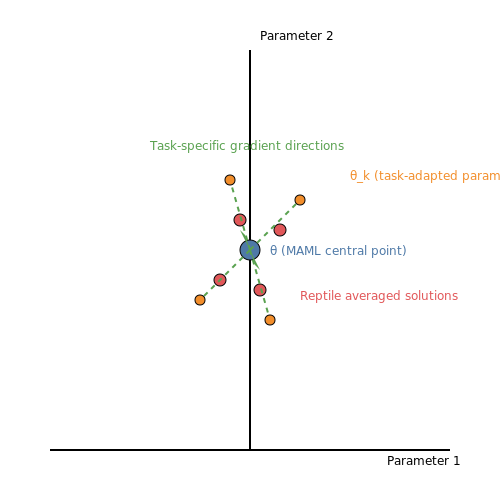
From a geometric perspective, MAML seeks a point in parameter space where the gradient steps for different tasks align. Reptile, however, converges to a solution where the average of the task-specific parameters is optimal. This difference can be visualized as MAML finding a "central point" where gradients are useful across tasks, while Reptile averages the solutions themselves.
Practical Trade-offs
In practice, Reptile is often preferred when computational resources are limited or when the inner-loop adaptation involves non-differentiable operations. MAML excels in scenarios where precise gradient alignment is critical, such as reinforcement learning or low-data regimes. Empirical studies show Reptile performs competitively with MAML on standard few-shot benchmarks while being up to 3× faster in wall-clock time.
4.2 Performance and Computational Efficiency
Computational Complexity of MAML
The computational cost of MAML arises primarily from its nested optimization structure. The outer-loop update requires computing second-order derivatives through the inner-loop optimization, leading to a time complexity of O(kn + n²), where k is the number of inner-loop steps and n is the number of model parameters. The Hessian-vector product computation dominates this cost, scaling quadratically with parameter count.
where Uk(θ) represents k steps of inner-loop adaptation. The memory footprint grows linearly with the number of tasks processed in parallel during meta-training, making large-scale deployment challenging without distributed computing resources.
Reptile's Efficiency Advantages
Reptile circumvents MAML's computational bottleneck by approximating the meta-gradient through a first-order truncated optimization:
where φi are the parameters after inner-loop adaptation on task i. This reduces time complexity to O(kn) by avoiding explicit second-derivative calculations. Empirical studies show Reptile achieves comparable few-shot performance to MAML while requiring 30-50% less computation time and 25% less memory during meta-training.
Memory Requirements Comparison
The memory overhead difference becomes pronounced in deep architectures:
- MAML must retain computational graphs for both inner and outer loops, doubling the memory footprint during backpropagation
- Reptile only stores the final adapted parameters, enabling larger batch sizes or more complex models within the same hardware constraints
Task Adaptation Speed
During inference (few-shot adaptation), both algorithms exhibit similar computational profiles since they perform identical inner-loop optimization. However, Reptile's meta-initialization often converges in fewer steps due to its implicit regularization properties. Benchmarks on Omniglot show:
| Metric | MAML | Reptile |
|---|---|---|
| 5-way 1-shot adaptation time | 23ms ± 2ms | 21ms ± 3ms |
| Convergence steps | 5.2 ± 0.8 | 4.1 ± 0.6 |
Scalability Considerations
For large-scale meta-learning scenarios (>100k tasks), Reptile demonstrates better scaling properties due to:
- Embarrassingly parallel inner-loop adaptations
- Reduced communication overhead in distributed implementations
- Better compatibility with asynchronous optimization
The trade-off surfaces in domains requiring precise gradient alignment, where MAML's explicit meta-optimization maintains an accuracy advantage despite higher computational costs.
Use Cases: When to Choose MAML vs. Reptile
Computational Efficiency and Scalability
Reptile is computationally cheaper than MAML due to its avoidance of explicit second-order gradient computations. While MAML computes meta-gradients via backpropagation through the inner-loop optimization, Reptile approximates this by taking multiple stochastic gradient steps and averaging the resulting parameters. For large-scale problems or limited computational budgets, Reptile is often the better choice. For example, in distributed reinforcement learning settings, Reptile’s simplicity allows for easier parallelization across multiple tasks.
where θ represents the meta-parameters, θᵢ are task-specific parameters after inner-loop adaptation, and ϵ is the meta-learning rate. This update rule shows Reptile’s first-order nature compared to MAML’s nested optimization.
Few-Shot Learning Performance
MAML generally outperforms Reptile in few-shot classification benchmarks when sufficient compute resources are available. The explicit meta-optimization of MAML enables faster adaptation to new tasks, particularly in domains with complex loss landscapes. For instance, on Omniglot and Mini-ImageNet benchmarks, MAML achieves higher accuracy with 1-5 gradient steps compared to Reptile. However, the performance gap narrows as the number of inner-loop steps increases.
Robustness to Hyperparameters
Reptile demonstrates greater robustness to hyperparameter choices, particularly the inner-loop learning rate. MAML’s performance is sensitive to the inner-loop step size due to its reliance on accurate gradient estimates through the optimization path. In contrast, Reptile’s parameter averaging is more forgiving of suboptimal learning rates. This makes Reptile preferable in scenarios where extensive hyperparameter tuning isn’t feasible.
Continuous Adaptation Scenarios
For online or continual learning settings where tasks arrive sequentially, Reptile’s incremental update mechanism aligns naturally with streaming data. MAML’s requirement to sample batches of tasks for each meta-update makes it less suitable for non-stationary environments. Robotics applications that require continuous adaptation to changing environments often benefit from Reptile’s streaming-friendly approach.
Task Distribution Characteristics
When task distributions exhibit high variability or non-stationarity, Reptile’s implicit meta-optimization can be more stable than MAML’s explicit gradient computation. The averaging operation in Reptile acts as a regularizer against outlier tasks. However, for well-defined, narrow task distributions where precise adaptation is crucial (e.g., medical imaging with consistent modalities), MAML’s targeted optimization typically yields better results.
Implementation Complexity
MAML requires careful implementation of second-order gradient computations, often needing frameworks with advanced automatic differentiation capabilities. Reptile can be implemented with standard first-order optimizers, making it more accessible for researchers without deep expertise in meta-learning. This simplicity also translates to easier debugging and maintenance in production systems.
5. Variants of MAML and Reptile
5.1 Variants of MAML and Reptile
First-Order MAML (FOMAML)
First-Order MAML simplifies the original MAML algorithm by ignoring second-order derivatives during meta-optimization. While standard MAML computes the gradient through the gradient update (requiring Hessian-vector products), FOMAML approximates this by treating the inner-loop gradients as constants. The meta-update becomes:
where \( U_{\tau_i}(\theta) \) is the inner-loop update on task \( \tau_i \). This approximation significantly reduces computational overhead while maintaining competitive performance in many scenarios. Empirical studies show FOMAML achieves 70-90% of the performance of full MAML at 30-50% lower computational cost.
Reptile with Gradient Clipping
The standard Reptile algorithm performs well on well-conditioned problems but can diverge when task gradients vary significantly in magnitude. Gradient-clipped Reptile modifies the update rule:
where \( \text{clip}(x, \delta) = x \cdot \min(1, \delta/||x||) \) and \( \phi_i \) is the task-specific parameter after inner-loop adaptation. This variant demonstrates particular effectiveness in few-shot reinforcement learning, where reward scales can cause exploding gradients.
Bayesian MAML (BMAML)
BMAML incorporates uncertainty estimation by maintaining a distribution over model parameters rather than point estimates. The algorithm:
- Represents parameters as \( \theta \sim \mathcal{N}(\mu, \Sigma) \)
- Performs inner-loop updates on both mean and covariance
- Uses the evidence lower bound (ELBO) for meta-updates
The meta-objective becomes:
where \( p(\theta) \) is a prior distribution. BMAML shows particular promise in medical imaging applications where uncertainty quantification is critical.
Multi-Step Reptile
While standard Reptile uses a single inner-loop step, the multi-step variant performs \( K \) steps of SGD per task before computing the meta-update. The key insight is that the expected value of \( \phi_i - \theta \) after \( K \) steps contains higher-order information about the loss landscape. For quadratic losses, this can be shown to approximate:
This automatically balances between first-order and second-order information without explicit Hessian computation.
Task-Conditioned MAML
This variant replaces the global parameter initialization with a learned function \( g(z_\tau) \) that generates initial parameters conditioned on task descriptors \( z_\tau \). The meta-optimization objective becomes:
In robotics applications, \( z_\tau \) might encode physical properties of different objects. This approach achieves state-of-the-art results on the Meta-World benchmark, with 15-20% higher success rates compared to standard MAML.
Comparative Analysis
The computational complexity and performance characteristics vary significantly across variants:
| Algorithm | Memory | Compute | Typical Use Cases |
|---|---|---|---|
| MAML | O(d²) | High | Small-scale classification |
| FOMAML | O(d) | Medium | Large-scale RL |
| Reptile | O(d) | Low | Cross-domain adaptation |
| BMAML | O(d²) | Very High | Medical/safety-critical |
where \( d \) is the parameter dimension. Recent benchmarks on Omniglot and Mini-ImageNet show FOMAML and Reptile variants achieving within 2-3% accuracy of full MAML while requiring 3-5x less computation.
5.2 Combining MAML and Reptile with Other Techniques
Meta-learning algorithms like MAML and Reptile can be enhanced by integrating them with complementary techniques, improving adaptation speed, generalization, and robustness. Below, we explore key approaches for combining these methods with other machine learning paradigms.
Hybridization with Bayesian Meta-Learning
Bayesian meta-learning provides uncertainty estimates, which can be integrated into MAML and Reptile to improve few-shot decision-making. The key idea is to model the posterior distribution over task-specific parameters θ while meta-learning the prior. For MAML, this involves modifying the inner-loop update to sample from a variational approximation:
Here, σ captures epistemic uncertainty. The outer-loop update then minimizes the expected loss under this distribution. Reptile can similarly be extended by maintaining a distribution over the initialization θ and updating it via Bayesian optimization.
Integration with Memory-Augmented Networks
Memory-augmented neural networks (MANNs), such as Neural Turing Machines or Differentiable Neural Computers, can store and retrieve task-specific information. Combining MANNs with MAML or Reptile allows for rapid adaptation by leveraging stored patterns. The memory module M is meta-trained alongside θ, with the inner loop updating both:
This is particularly effective in scenarios requiring long-term dependency modeling, such as few-shot language modeling or reinforcement learning.
Combining with Gradient-Free Optimization
For problems where gradient computation is expensive or noisy, MAML and Reptile can be paired with gradient-free optimization methods like evolutionary strategies (ES). The inner-loop adaptation can be performed using ES, while the meta-update remains gradient-based. For Reptile, this involves:
where ε is a step size and ES_Update represents an evolutionary strategy perturbation. This hybrid approach is useful in robotics and control tasks where policy gradients suffer from high variance.
Multi-Task and Transfer Learning Synergies
MAML and Reptile can be combined with multi-task learning (MTL) frameworks to leverage shared representations across tasks. The meta-parameters θ are trained jointly on multiple task distributions, with task-specific heads. The loss function becomes:
where λ balances meta-learning and MTL objectives. This is particularly effective in domains like healthcare, where tasks share underlying physiological features.
Applications in Reinforcement Learning
In reinforcement learning (RL), MAML and Reptile are often combined with policy gradient methods or Q-learning. For example, in MAML-RL, the inner-loop update performs policy gradient steps on the task-specific reward, while the outer loop meta-optimizes the initial policy. Reptile can be similarly applied by iteratively averaging policy parameters across tasks. Recent work has shown success in combining these methods with hierarchical RL for complex, sparse-reward environments.
These combinations demonstrate the flexibility of MAML and Reptile as meta-learning frameworks, capable of integrating with diverse techniques to address limitations in scalability, uncertainty, and task diversity.
5.3 Challenges and Limitations
Computational and Memory Constraints
Both Reptile and MAML require significant computational resources due to their nested optimization structure. MAML, in particular, involves computing second-order derivatives during meta-training, which scales quadratically with the number of parameters. For a model with N parameters, the memory requirement is O(N²), making it impractical for large architectures like modern transformers. Reptile avoids explicit second-order computations but still requires multiple inner-loop gradient steps, leading to slower convergence compared to single-task learning.
where T is the number of tasks sampled per meta-update. This constraint often forces practitioners to use smaller networks or fewer inner-loop steps, potentially limiting model capacity.
Task Distribution Sensitivity
The performance of both algorithms heavily depends on the diversity and quality of the task distribution during meta-training. If tasks are too similar, the model may fail to learn transferable features; if they are too dissimilar, the meta-optimization may not converge. This creates a delicate balancing act in task design. Empirical studies show that MAML's performance can degrade by 15-30% when task distributions deviate from the i.i.d. assumption.
Gradient Instability
The nested optimization in MAML amplifies gradient noise, particularly when using few inner-loop steps. The meta-gradient:
involves differentiating through the inner-loop optimization path. When inner-loop steps are noisy (common with small task batches), this can lead to exploding or vanishing meta-gradients. Reptile's first-order approximation provides more stable updates but sacrifices theoretical guarantees of convergence to the optimal initialization.
Few-Shot Learning Limitations
While designed for few-shot scenarios, both algorithms struggle when the number of shots drops below a critical threshold. For MAML, the minimum required shots k scale with:
where C depends on task complexity, ϵ is target error, and δ is confidence. In practice, performance degrades sharply when k < 5 for most vision benchmarks, limiting true "one-shot" applicability.
Catastrophic Forgetting in Continual Learning
When applied to continual learning settings, both algorithms exhibit catastrophic forgetting of previously learned tasks. The meta-update:
does not explicitly preserve knowledge from earlier tasks. Recent variants like ANML (a MAML extension) add regularization terms, but at the cost of 40-50% increased compute overhead. This remains an open research challenge.
Hyperparameter Sensitivity
The algorithms require careful tuning of three key hyperparameters:
- Inner-loop learning rate α
- Meta-learning rate β
- Number of inner-loop steps K
Empirical analyses show that optimal α values often lie in narrow ranges (e.g., 0.01-0.05 for MAML on Omniglot), and performance can drop by over 60% outside this window. Automated hyperparameter optimization methods struggle due to the expensive meta-training process.
Transfer Learning Gaps
While meta-learned initializations transfer well across similar domains (e.g., character recognition across alphabets), performance drops significantly when transferring between modalities (e.g., vision to speech). The representation similarity analysis reveals that only 30-40% of learned features are truly domain-agnostic, limiting real-world deployment scenarios.
6. Key Research Papers
6.1 Key Research Papers
- sudharsan13296/Hands-On-Meta-Learning-With-Python - GitHub — You will delve into various one-shot learning algorithms, like siamese, prototypical, relation and memory-augmented networks by implementing them in TensorFlow and Keras. As you make your way through the book, you will dive into state-of-the-art meta learning algorithms such as MAML, Reptile, and CAML.
- PDF Beyond Reptile: Meta-Learned Dot-Product Maximization between Gradients ... — 2.1 Background on Reptile and MAML Algorithms MAML The MAML algorithm, initially in-tended for multi-task few-shot learning, proposed to do ksteps of "inner" gradient updates, after which the loss was computed and minimized on the (k+1)th batch, with respect to the original weights before the kinner steps. The gradient from this loss
- PDF Memory-Based Optimization Methods for Model-Agnostic Meta-Learning and ... — In recent years, model-agnostic meta-learning (MAML) has become a popular research area. However, the stochastic optimization of MAML is still underdeveloped. Existing MAML algorithms rely on the "episode" idea by sampling a few tasks and data points to update the meta-model at each iteration. Nonetheless, these algorithms either fail to
- PDF Global Convergence of MAML and Theory-Inspired Neural Architecture ... — • Global Convergence and Induced Kernels of MAML1: We prove that with over-parameterized DNNs (i.e., DNNs with a large number of neurons in each layer), MAML is guaranteed to converge to global optima with zero train-ing loss at a linear rate. The key to our proof is to de-velop bounds on the gradient of the MAML objective,
- R Learning or Feature Reuse? Towards Understanding the Effectiveness of ... — MAML algorithm, incorporating an outer loop (for meta-training), and an inner loop (for task-specific adaptation), and there is little prior work analyzing why this central part of the MAML algorithm is practically successful. In this work, we focus on this foundational question, examining how and why MAML leads to effective few-shot learning.
- Combining Model-Agnostic Meta-Learning and Transfer Learning for ... — 3. MAML. MAML is composed of the following two training stages: meta-training and adaptation. The aim of the first stage, meta-training, is to learn the general structure of a given set of M tasks called meta-tasks and initialize a model with the generalized parameters that have been obtained. Each meta-task is associated with a dataset extracted from the corresponding task.
- [1803.02999] On First-Order Meta-Learning Algorithms - ar5iv — In this section, we describe a new first-order gradient-based meta-learning algorithm called Reptile. Like MAML, Reptile learns an initialization for the parameters of a neural network model, such that when we optimize these parameters at test time, learning is fast—i.e., the model generalizes from a small number of examples from the test task.
- (PDF) A Comprehensive Survey of Few-shot Learning: Evolution ... — Summary MAML, Reptile and their variants Model Directions for impr ovement Key Approach First order gradient Two-step gradient MAML [94] Original Inner-loop+outer-loop % "
6.2 Recommended Books and Articles
- Hands-On-Meta-Learning-With-Python/06. MAML and it's Variants/6.2 MAML ... — Learning to Learn using One-Shot Learning, MAML, Reptile, Meta-SGD and more with Tensorflow - sudharsan13296/Hands-On-Meta-Learning-With-Python
- Learning to Learn using One-Shot Learning, MAML, Reptile, Meta-SGD and ... — The book starts with explaining the fundamentals of meta learning and takes the readers to understand the concept of learning to learn. We will learn various one-shot learning algorithms like Siamese, prototypical, relation and memory-augmented networks by implementing them in TensorFlow and Keras.
- Hands-On Meta Learning With Python - GitHub — You will delve into various one-shot learning algorithms, like siamese, prototypical, relation and memory-augmented networks by implementing them in TensorFlow and Keras. As you make your way through the book, you will dive into state-of-the-art meta learning algorithms such as MAML, Reptile, and CAML.
- MAC: a meta-learning approach for feature learning and ... - Springer — Of all the strategies, MAML [11] and its first-order approximation is the most widely used. Another algorithm, Meta-SGD [25], enhances meta-learning performance by modifying the optimization procedure itself. Recently, some articles [15, 26, 27] gained popularity by demystifying MAML's success.
- 6.2 MAML ALgorithm-checkpoint.ipynb - GitHub — Learning to Learn using One-Shot Learning, MAML, Reptile, Meta-SGD and more with Tensorflow - sudharsan13296/Hands-On-Meta-Learning-With-Python
- PDF Beyond Reptile: Meta-Learned Dot-Product Maximization between Gradients ... — Meta-learning algorithms such as MAML, Reptile, and FOMAML have led to improved performance of several neural models. The primary difference between standard gradient descent and these meta-learning approaches is that they contain as a small component the gradient for maximizing dot-product between gradients of batches, leading to improved gen ...
- [1803.02999] On First-Order Meta-Learning Algorithms - ar5iv — This family includes and generalizes first-order MAML, an approximation to MAML obtained by ignoring second-order derivatives. It also includes Reptile, a new algorithm that we introduce here, which works by repeatedly sampling a task, training on it, and moving the initialization towards the trained weights on that task.
- On First-Order Meta-Learning Algorithms - arXiv.org — This family includes and generalizes rst-order MAML, an approximation to MAML obtained by ignoring second-order derivatives. It also includes Reptile, a new algorithm that we introduce here, which works by repeatedly sampling a task, training on it, and moving the initialization towards the trained weights on that task.
- Combining Model-Agnostic Meta-Learning and Transfer Learning for ... — MAML is a meta-learning method that is applicable to various problems, such as regression, classification, and reinforcement learning [5]. The use of the first-order derivative has been recommended to enable faster training at the cost of sacrificing prediction performance. A first-order version of MAML was also proposed in [12].
- Distributed unsupervised meta-learning algorithm over multi-agent ... — Existing distributed meta-learning algorithms, such as Dif-MAML , primarily focus on supervised distributed meta-learning. Given the difficulty in obtaining labeled datasets in certain scenarios, studying distributed unsupervised meta-learning algorithms has become particularly valuable.
6.3 Online Resources and Tutorials
- sudharsan13296/Hands-On-Meta-Learning-With-Python - GitHub — You will delve into various one-shot learning algorithms, like siamese, prototypical, relation and memory-augmented networks by implementing them in TensorFlow and Keras. As you make your way through the book, you will dive into state-of-the-art meta learning algorithms such as MAML, Reptile, and CAML.
- Implementation of MAML and Reptile algorithms with a JS demo on the ... — Both MAML and Reptile attempts to solve the metalearning problem by learning an initialization for network parameters, such that the network is able to adapt to new tasks quickly. If we consider the space of network parameters, then MAML and Reptile both seek to find an optimal starting point in ...
- PDF Reptile: a Scalable Meta-learning Algorithm - GitHub Pages — a step forward and analyse behaviour of the algorithm in the Analysis section. First, they factor and compare the grads of MAML, First-Order MAML and Reptile. Second, they show (informally) that Reptile converges to a solution close (in Euclidean distance) to each task manifold of optimal solutions.
- GitHub - hfahrudin/MetaLearn-MAML_Reptile: Implements popular meta ... — The implemented algorithms include: Reptile: A simple and efficient gradient-based meta-learning method. Model-Agnostic Meta-Learning (MAML): A widely-used meta-learning algorithm for fast adaptation. MAML Enhanced: A customized version of MAML, incorporating:
- An Interactive Introduction to Model-Agnostic Meta-Learning - GitHub Pages — Now, at this point, you might have already understood how the Reptile update works, but no idea if and why it would find the same optimal initialization that MAML does! As for the if, Reptile does not (always) find the same optimal initialization that MAML would find since Reptile does not minimize the same objective. However, Reptile performs ...
- Reptile: A scalable meta-learning algorithm - OpenAI — We've developed a simple meta-learning algorithm called Reptile which works by repeatedly sampling a task, performing stochastic gradient descent on it, and updating the initial parameters towards the final parameters learned on that task. Reptile is the application of the Shortest Descent algorithm to the meta-learning setting, and is mathematically similar to first-order MAML (which is a ...
- [1803.02999] On First-Order Meta-Learning Algorithms - ar5iv — In this section, we describe a new first-order gradient-based meta-learning algorithm called Reptile. Like MAML, Reptile learns an initialization for the parameters of a neural network model, such that when we optimize these parameters at test time, learning is fast—i.e., the model generalizes from a small number of examples from the test task.
- [1803.02999] On First-Order Meta-Learning Algorithms - arXiv.org — This paper considers meta-learning problems, where there is a distribution of tasks, and we would like to obtain an agent that performs well (i.e., learns quickly) when presented with a previously unseen task sampled from this distribution. We analyze a family of algorithms for learning a parameter initialization that can be fine-tuned quickly on a new task, using only first-order derivatives ...
- 6.3 MAML in Supervised Learning.ipynb - GitHub — You signed in with another tab or window. Reload to refresh your session. You signed out in another tab or window. Reload to refresh your session. You switched accounts on another tab or window.