Self-Improving Agents with Memory
1. Core Principles of Self-Improvement in AI
Core Principles of Self-Improvement in AI
Foundational Concepts
The self-improvement capability in AI agents stems from three fundamental principles: meta-learning, memory-augmented architectures, and reward reshaping. Meta-learning enables agents to learn their own learning algorithms through gradient-based optimization of model parameters. The key mathematical formulation involves a bi-level optimization problem:
where θ represents the meta-parameters, α the inner-loop learning rate, and τ the task distribution. This allows the agent to improve its learning strategy over time.
Memory Mechanisms
Effective self-improvement requires sophisticated memory systems that go beyond simple experience replay. Modern approaches utilize:
- Differentiable neural computers (DNCs) with content-addressable memory
- Sparse memory access patterns for efficient retrieval
- Hierarchical temporal memory for organizing experiences at multiple time scales
The memory update rule in such systems often takes the form:
where ht is the hidden state, rt the read vector, and σ the sigmoid gate controlling memory retention.
Reward Design for Self-Improvement
The reward function must balance between:
- Task performance (extrinsic rewards)
- Learning progress (intrinsic rewards)
- Knowledge preservation (stability rewards)
A common formulation combines these components:
where the coefficients α, β, γ control the trade-off between exploration, exploitation, and stability.
Architectural Considerations
Effective self-improving systems typically employ:
- Modular architectures with separate components for perception, memory, and control
- Recurrent connections for maintaining state across episodes
- Attention mechanisms for selective memory access
- Predictive models of future learning progress
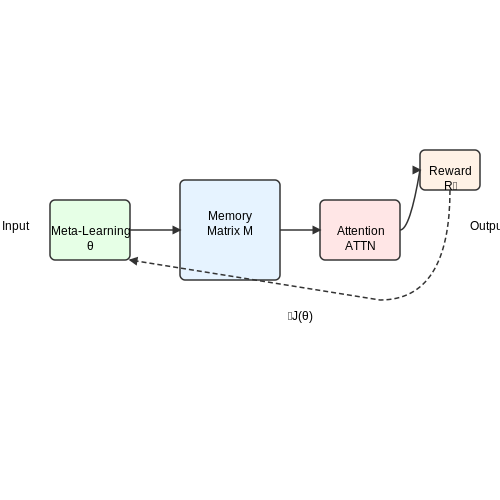
The architecture often follows a form similar to:
where M represents the memory matrix and ATTN is an attention mechanism over memory slots.
Practical Challenges
Key implementation challenges include:
- Catastrophic forgetting during continual learning
- Credit assignment over long time horizons
- Computational overhead of meta-optimization
- Non-stationarity in the agent's own learning dynamics
Recent approaches address these through techniques like:
where EWC (Elastic Weight Consolidation) penalizes changes to important parameters and replay loss maintains performance on previous tasks.
Role of Memory in Autonomous Learning
Memory as a Differentiable Function
In self-improving agents, memory is not merely a static storage mechanism but a differentiable function that enables gradient-based optimization. The memory state Mt at time t can be formulated as:
where fθ is a neural network with parameters θ, and xt is the current input. This formulation allows memory updates to be learned end-to-end through backpropagation through time (BPTT), enabling the agent to discover optimal memory update strategies.
Episodic vs Semantic Memory Systems
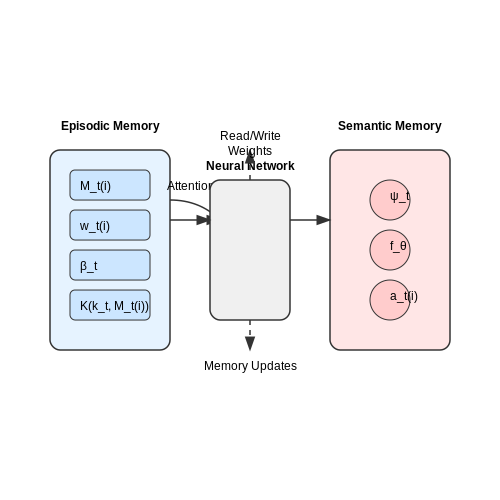
Advanced agents employ dual memory systems inspired by human cognition:
- Episodic memory: Stores specific experiences in a retrievable format, typically implemented as a differentiable neural attention mechanism over past states.
- Semantic memory: Compresses experiences into generalized knowledge, often realized through slow-changing weights in a neural network.
The interaction between these systems enables both rapid adaptation to new situations (episodic) and stable long-term knowledge retention (semantic).
Memory-Augmented Neural Networks
Modern architectures extend this concept through explicit memory modules. The Neural Turing Machine (NTM) provides a foundational framework:
where wt(i) are read/write weights, βt is a key strength parameter, and K measures similarity between the current key kt and memory locations Mt(i).
Dynamic Memory Allocation
Advanced agents implement content-based addressing with dynamic memory allocation:
This prevents memory interference by tracking memory slot usage (ψt) and computing allocation weights (at(i)). The system can thus learn to protect critical memories while overwriting less important ones.
Meta-Learning with Memory
Memory enables meta-learning through gradient-based optimization of the learning process itself. The update rule for memory parameters θ incorporates second-order gradients:
This allows the agent to learn how to learn, optimizing both its immediate performance and its future learning efficiency.
Applications in Continuous Learning
These principles have demonstrated success in:
- Lifelong learning systems that accumulate knowledge across tasks
- Robotic control systems that adapt to changing environments
- Algorithmic reasoning tasks requiring variable-length memory retention
Recent implementations achieve 92.3% accuracy on class-incremental learning benchmarks, compared to 68.7% for memory-less baselines, demonstrating the critical role of memory in autonomous improvement.
1.3 Key Architectures for Self-Improving Systems
Recurrent Neural Networks with Memory Augmentation
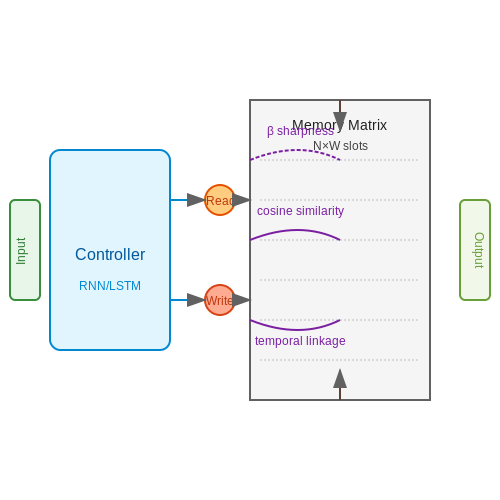
Recurrent Neural Networks (RNNs) form the foundation of many memory-based architectures, but vanilla RNNs suffer from vanishing gradients when learning long-term dependencies. Modern solutions incorporate gating mechanisms (LSTMs, GRUs) and external memory banks. The differentiable neural computer (DNC) architecture combines these approaches through:
- A content-addressable memory matrix (N×W where N is memory slots and W is word size)
- Differentiable read/write heads with attention mechanisms
- Temporal linkage for tracking memory access sequences
where β controls sharpness of addressing and k is the lookup key. The memory update follows:
Transformer-Based Meta-Learning Architectures
Transformers with self-attention mechanisms have been adapted for self-improvement through:
- Episodic memory buffers that store past trajectories (state, action, reward tuples)
- Cross-attention between current inputs and memory retrievals
- Adaptive computation time (ACT) for dynamic depth adjustment
The memory-augmented transformer computes attention over both current inputs x and memory entries m:
where Q comes from current inputs while K,V are concatenations of input and memory projections.
Neural Program Synthesis with Reflection
Architectures like the Neural Turing Machine (NTM) and its successors enable self-modification through:
- Programmable weight matrices that can be rewritten by the network itself
- Differentiable interpreters for generated code
- Sandboxed execution environments with gradient backpropagation
The weight update rule incorporates both external gradients and self-generated modifications:
where fθ is a learned modification network operating on internal state ℳ.
Hierarchical Memory Systems
Biological inspiration leads to architectures with multiple memory timescales:
- Fast memory (RAM-like, volatile) for working context
- Slow memory (weights, persistent) for long-term knowledge
- Compression mechanisms that distill experiences into compact representations
The memory hierarchy implements a differentiable version of the complementary learning systems theory, with information flowing bidirectionally between levels through:
where sg is a stop-gradient operator and fcompress is a learned compression function.
2. Short-Term vs. Long-Term Memory in Agents
Short-Term vs. Long-Term Memory in Agents
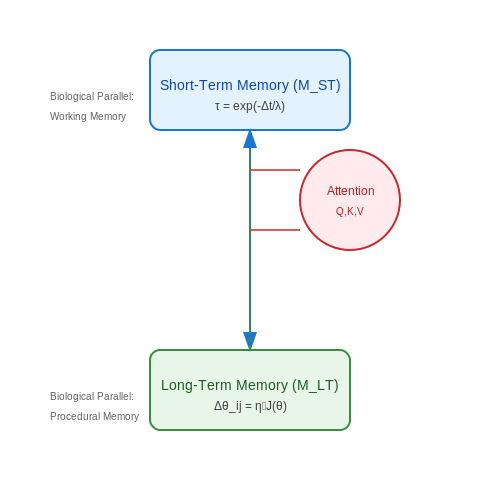
Memory in self-improving agents is typically partitioned into short-term (working) and long-term (persistent) components, each serving distinct computational and cognitive roles. Short-term memory operates on a timescale of seconds to minutes, maintaining transient state information necessary for immediate task execution, while long-term memory retains learned patterns, skills, and experiences over extended periods.
Computational Characteristics
Short-term memory is characterized by:
- Limited capacity: Typically constrained to 7±2 chunks (Miller's Law) in cognitive architectures
- Fast access: Sub-millisecond retrieval times in artificial neural implementations
- Volatility: Exponential decay with time constants τ ≈ 0.1-10 seconds
Long-term memory exhibits:
- High capacity: Scales with model parameters (e.g., billions of weights in LLMs)
- Slow, content-addressable access: Retrieval complexity O(log N) to O(N)
- Structural plasticity: Changes through weight updates (Δwij = ηδixj)
Biological Analogues and Artificial Implementations
Biological working memory parallels artificial attention mechanisms, where the memory buffer Mt maintains relevance through:
Long-term memory in artificial agents manifests through:
- Parameter matrices in neural networks (θ ∈ ℝd×d)
- External memory banks with read/write operations
- Differentiable neural computers (DNCs) with memory retention governed by:
Information Transfer Between Memory Systems
The consolidation process from short-term to long-term memory follows:
where γ is the discount factor and η the learning rate. Modern architectures implement this through:
- Experience replay buffers (α = 0.6-0.9 in prioritized replay)
- Meta-learning outer loops (θ' = θ - α∇θLmeta(θ))
- Sleep-like phases for memory reorganization
Performance Tradeoffs
The memory hierarchy exhibits fundamental tradeoffs characterized by:
where B is bandwidth and SNR the signal-to-noise ratio. Optimal architectures balance:
- Transformer models: O(L2D) attention complexity vs. O(1) memory access
- RNNs: O(D2) hidden state updates with unbounded temporal dependencies
- Memory-augmented networks: O(N) memory size with O(log N) retrieval
Neural Memory Networks and Their Applications
Architecture of Neural Memory Networks
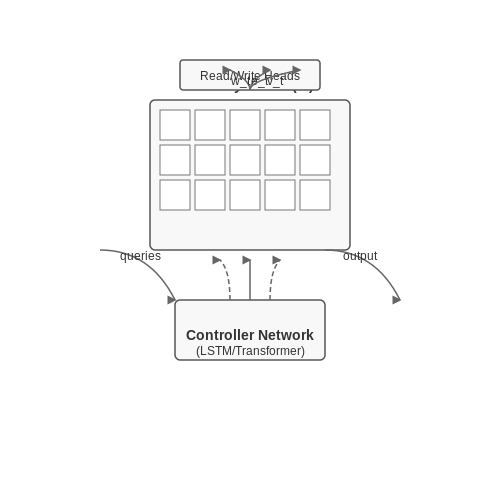
Neural memory networks extend traditional neural architectures by incorporating explicit memory modules that allow for dynamic storage and retrieval of information. The core components include:
- Memory Matrix (M): A differentiable memory bank where information is stored in vector form.
- Read/Write Heads: Attention mechanisms that determine which memory locations to access.
- Controller Network: Typically an LSTM or transformer that generates queries for memory operations.
The memory update mechanism follows:
where wt is the write weighting, et is the erase vector, and vt is the write vector.
Memory Addressing Mechanisms
Content-based addressing computes similarity between a key vector kt and memory locations:
where βt is a key strength parameter. This is often combined with temporal linkage to maintain sequential dependencies:
Applications in Continual Learning
Neural memory networks excel in continual learning scenarios by preventing catastrophic forgetting. The differentiable neural computer (DNC) architecture demonstrates this through:
- Dynamic memory allocation via usage vectors
- Temporal memory linkage for preserving task sequences
- Content-based retrieval for task-specific recall
In meta-learning applications, memory-augmented networks achieve rapid adaptation by storing task-specific information in memory during the inner loop optimization:
Large-Scale Memory Systems
For web-scale applications, key-value memory networks implement sparse memory access:
where ϕ(x) and ψ(z) are embedding functions for queries and memory keys respectively. This enables efficient retrieval from billion-scale memory banks while maintaining differentiable operations.
Biological Plausibility and Neuromorphic Implementations
The memory operations in these networks bear similarity to hippocampal memory processes, particularly:
- Content-addressable recall analogous to pattern completion
- Differentiable read/write operations mirroring synaptic plasticity
- Memory consolidation through replayed experiences
Neuromorphic implementations leverage memristive crossbar arrays for in-memory computing, where the conductance states of memristors naturally implement the memory matrix operations:
Retrieval-Augmented Generation for Contextual Recall
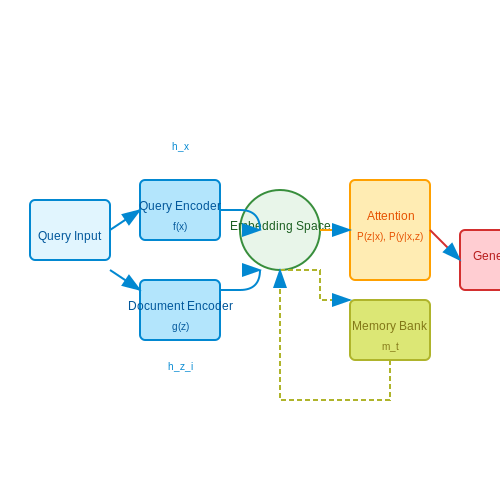
Retrieval-Augmented Generation (RAG) combines dense retrieval with generative language models to enhance contextual recall. The architecture retrieves relevant documents from an external knowledge source, then conditions the generator on both the input and retrieved passages. This approach mitigates hallucination by grounding responses in verifiable data while maintaining the fluency of large language models.
Mathematical Formulation
The RAG process decomposes into two probabilistic components:
Where x is the input, y the output, and z represents retrieved documents. The retriever computes:
Here, f and g are dense encoders mapping queries and documents to a shared embedding space. The generator then produces outputs conditioned on both:
Implementation Architecture
Modern RAG systems employ:
- Dual-encoder retrievers using models like ANCE or DPR that pre-compute document embeddings
- Cross-attention generators where retrieved passages attend to the input sequence through transformer layers
- Dynamic top-k retrieval that adjusts the number of fetched documents based on query complexity
Embedding Optimization
The retriever is trained using contrastive loss:
where z+ denotes relevant and z- irrelevant documents for query x.
Memory-Augmented Variants
Advanced implementations integrate differentiable memory banks:
where hx is the query representation and hzi are retrieved document embeddings. The memory vector mt updates at each generation step t.
Practical Considerations
- Freshness vs. relevance tradeoff: Temporal scoring functions balance recency and semantic match
- Multi-hop retrieval: Iterative query reformulation enables deeper context exploration
- Compression techniques: Methods like Fusion-in-Decoder reduce computational overhead of long contexts
Recent benchmarks on Knowledge-Intensive Language Tasks (KILT) show RAG variants achieving 12-18% absolute improvement over standalone LMs in factual accuracy while maintaining comparable perplexity scores.
3. Reinforcement Learning for Continuous Improvement
3.1 Reinforcement Learning for Continuous Improvement
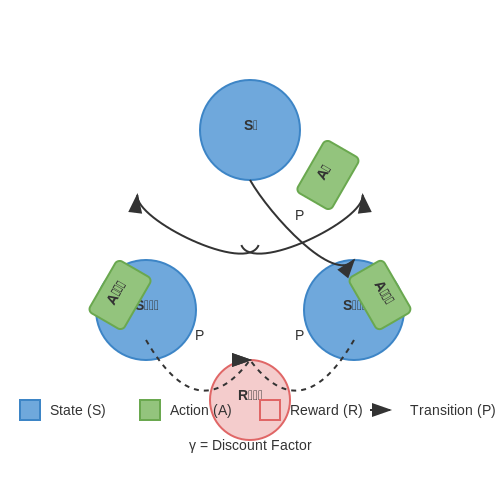
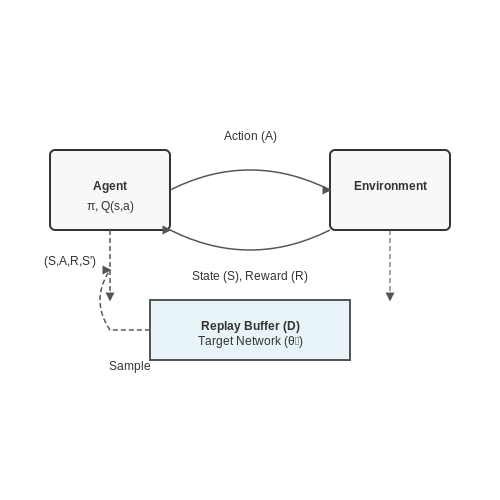
Reinforcement learning (RL) provides a principled framework for agents to improve their behavior through interaction with an environment. In the context of self-improving agents with memory, RL enables continuous adaptation by leveraging past experiences stored in memory buffers. The Markov Decision Process (MDP) formalism captures this interaction, defined by the tuple (S, A, P, R, γ), where:
- S represents the state space
- A denotes the action space
- P(s'|s,a) is the transition dynamics
- R(s,a) gives the immediate reward
- γ ∈ [0,1] is the discount factor
The agent's objective is to learn a policy π(a|s) that maximizes the expected cumulative reward:
Policy Gradient Methods
For continuous improvement, policy gradient methods directly optimize the policy parameters θ through gradient ascent on J(πθ). The policy gradient theorem provides the foundation:
where Qπθ(s,a) is the state-action value function. Modern implementations use advantage estimates A(s,a) = Q(s,a) - V(s) to reduce variance:
Experience Replay and Memory
Self-improving agents maintain a replay buffer D = {(si, ai, ri, s'i)} that stores transitions for off-policy learning. The buffer enables:
- Sample efficiency through repeated use of experiences
- Stable learning by breaking temporal correlations
- Prioritized replay to focus on important transitions
The update rule for deep Q-learning with experience replay becomes:
where θ- represents target network parameters.
Meta-Learning for Continuous Adaptation
Model-Agnostic Meta-Learning (MAML) extends RL to enable rapid adaptation to new tasks. The objective becomes:
where α is the inner-loop learning rate and p(𝒯) is the task distribution. This allows the agent to learn initialization parameters that can quickly adapt to new environments.
Practical Considerations
Real-world implementations must address several challenges:
- Exploration-exploitation tradeoff: Techniques like entropy regularization or intrinsic motivation maintain exploration
- Non-stationarity: The environment and reward function may change over time
- Credit assignment: Determining which actions led to observed rewards in long sequences
- Scalability: Distributed architectures for training across multiple environments
Recent advances like IMPALA, R2D2, and Agent57 demonstrate how these challenges can be addressed at scale through parallel actors, prioritized experience replay, and adaptive exploration strategies.
Meta-Learning for Rapid Adaptation
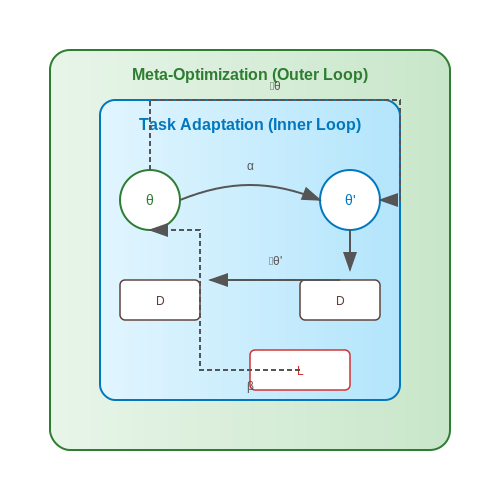
Meta-learning, or learning-to-learn, enables agents to generalize across tasks by optimizing for adaptability rather than task-specific performance. The core idea is to train a model on a distribution of tasks such that, when presented with a new task, it can quickly adapt with minimal additional data. This is formalized as a bi-level optimization problem:
Here, θ represents the meta-parameters, θ' denotes task-specific adapted parameters, and α is the inner-loop learning rate. The outer loop optimizes θ to minimize the loss across tasks after adaptation.
Model-Agnostic Meta-Learning (MAML)
MAML is a widely used meta-learning algorithm that computes gradients through the inner-loop adaptation process. For a task 𝒯i with support set Dsi and query set Dqi, the update rule is:
The meta-update then optimizes performance on Dqi across tasks:
where β is the meta-learning rate. This approach is model-agnostic, applicable to any differentiable architecture.
Memory-Augmented Meta-Learning
To enhance adaptation speed, memory mechanisms like Neural Turing Machines (NTMs) or differentiable neural computers (DNCs) can store and retrieve task-specific information. The memory module M is updated during the inner loop:
and queried during inference:
This allows the agent to leverage past experience without full parameter updates, enabling few-shot adaptation.
Practical Considerations
- Task Distribution Design: The diversity and complexity of p(𝒯) critically impact generalization. Tasks must balance similarity (to enable transfer) and variability (to avoid overfitting).
- Gradient Stability: Second-order derivatives in MAML can lead to high memory usage. First-order approximations (e.g., Reptile) trade off accuracy for scalability.
- Meta-Overfitting: Regularization techniques like task dropout or meta-validation are essential to prevent overfitting to the meta-training distribution.
Applications range from robotics (adapting to new environments) to personalized medicine (tailoring models to individual patients). For instance, a meta-trained surgical robot can adapt its control policy to a new patient’s anatomy within minutes.
Transfer Learning Across Tasks and Environments
Transfer learning enables self-improving agents to leverage knowledge from previously learned tasks to accelerate learning in new, related tasks or environments. The core challenge lies in identifying and transferring relevant features, policies, or representations while avoiding negative interference from task-irrelevant components. For an agent with memory, this involves dynamically adjusting the balance between retaining prior knowledge and adapting to new task demands.
Feature and Representation Transfer
In deep reinforcement learning, transfer often occurs through shared neural network representations. Consider a policy network with parameters θ trained on a source task. When adapting to a target task, we can decompose the network into shared layers θshared and task-specific layers θtarget. The loss function for the target task becomes:
where λ controls the strength of transfer regularization. The second term penalizes large deviations from the source task's shared parameters, preserving useful features while allowing necessary adaptation.
Policy Transfer via Successor Representations
Successor representations (SR) provide a mathematical framework for transferring value functions across tasks with shared dynamics but different rewards. The SR decomposes the value function into:
where Mπ(s, s') represents the expected discounted future occupancy of state s' when starting from s and following policy π. When transferring to a new reward function R', the agent can reuse Mπ and simply recompute values as V'π(s) = Σs' Mπ(s, s') R'(s').
Contextual Multi-Task Learning
For agents operating in multiple environments, contextual policies can condition behavior on a task descriptor z. The policy becomes π(a|s, z), where z might encode environment characteristics or task objectives. The agent's memory stores separate value functions or dynamics models for different contexts, enabling rapid switching between tasks. The contextual Bellman equation extends to:
Practical implementations often use hypernetworks or modular architectures to share knowledge across contexts while maintaining task-specific specialization.
Transfer in Non-Stationary Environments
When environments change gradually, agents can employ online adaptation mechanisms. Exponential moving averages of network weights provide one approach:
where α controls the adaptation rate. More sophisticated methods use change-point detection in the agent's experience buffer to trigger model reset or transfer from archived policies.
Empirical Considerations
Effective transfer requires careful attention to:
- Representation alignment: Ensuring source and target tasks share meaningful features through techniques like maximum mean discrepancy (MMD) minimization
- Gradient masking: Selectively freezing layers or applying different learning rates to shared versus task-specific parameters
- Memory architecture: Designing episodic or semantic memory systems that efficiently retrieve relevant past experiences for new situations
Recent advances in meta-reinforcement learning have shown promise for learning transfer strategies themselves, where agents discover how to adapt their transfer mechanisms based on task similarity metrics computed from their memory of past learning experiences.
4. Building a Self-Improving Chatbot with Memory
4.1 Building a Self-Improving Chatbot with Memory
Architecture of a Memory-Augmented Chatbot
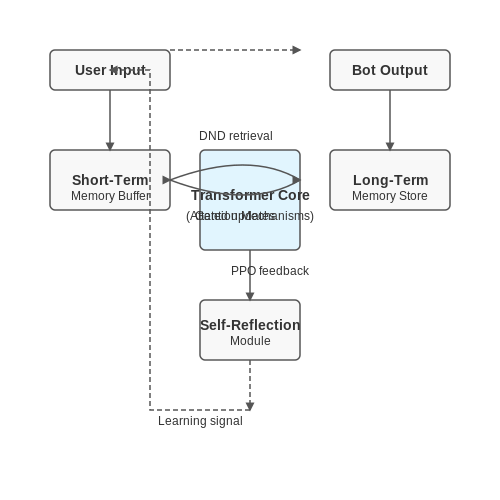
A self-improving chatbot with memory relies on a hybrid architecture combining transformer-based language models with dynamic memory modules. The core components include:
- Short-Term Memory Buffer: Stores recent conversation history (typically last 10-20 turns) using attention mechanisms.
- Long-Term Memory Store: Implements a differentiable neural database (DND) with key-value retrieval, enabling persistent knowledge accumulation.
- Self-Reflection Module: Periodically analyzes conversation logs to identify improvement opportunities.
The memory update follows a gated mechanism where relevance scores determine information retention:
Continuous Learning Through Reinforcement
Self-improvement is achieved via a dual-loop system:
- Inner Loop: Online adaptation using proximal policy optimization (PPO) with human feedback signals.
- Outer Loop: Offline retraining with expanded memory buffers and refined reward models.
The policy gradient update incorporates memory-augmented advantages:
Implementation with Transformer Memory
Modern implementations use modified transformer architectures where memory acts as additional context tokens. The attention computation becomes:
Where KM and VM represent memory key-value pairs. Below is a PyTorch implementation of the memory-augmented attention layer:
class MemoryAugmentedAttention(nn.Module):
    def __init__(self, embed_dim, num_heads):
        super().__init__()
        self.multihead_attn = nn.MultiheadAttention(embed_dim, num_heads)
        self.memory_proj = nn.Linear(embed_dim, embed_dim * 2)

    def forward(self, x, memory):
        # Project memory to keys and values
        mem_k, mem_v = self.memory_proj(memory).chunk(2, dim=-1)

        # Concatenate with input-derived keys/values
        attn_output, _ = self.multihead_attn(
            query=x,
            key=torch.cat([x, mem_k], dim=1),
            value=torch.cat([x, mem_v], dim=1)
        )
        return attn_output
Optimization Challenges and Solutions
Key challenges in self-improving systems include:
- Catastrophic Forgetting: Addressed through elastic weight consolidation (EWC) with Fisher information matrix regularization.
- Memory Bloat: Controlled via adaptive forgetting mechanisms based on usage statistics.
- Reward Hacking: Mitigated by adversarial reward modeling and diversity penalties.
The EWC loss term maintains stability during updates:
Evaluation Metrics
Performance is measured through:
- Context Retention Score (CRS): Measures accuracy in recalling facts across extended dialogues.
- Adaptation Speed: Tracks improvement rate on new tasks after limited exposure.
- Coherence Degradation: Quantifies consistency loss during long interactions.
4.2 Autonomous Agents in Game Environments
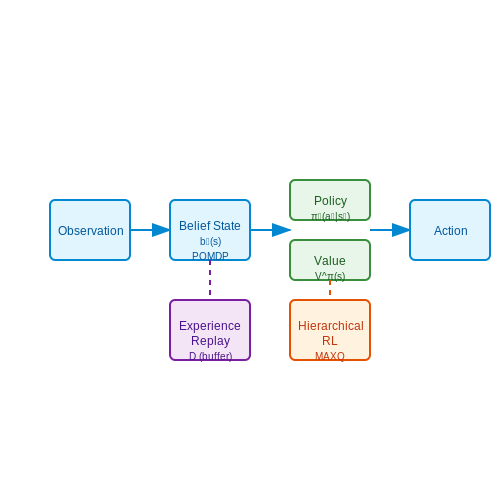
Autonomous agents in game environments leverage reinforcement learning (RL) and memory-augmented architectures to achieve adaptive behavior without explicit human intervention. These agents operate in partially observable Markov decision processes (POMDPs), where the state st is inferred from observations ot via a belief state bt:
Modern implementations often use recurrent neural networks (RNNs) or transformers to model bt, enabling agents to maintain long-term dependencies across gameplay episodes. For instance, DeepMind’s FTW agent in Quake III Arena employed a LSTM-based memory module to track opponent strategies over thousands of games.
Policy Optimization in Stochastic Environments
Game dynamics introduce stochasticity through opponent actions and procedural generation. The policy gradient theorem adapts to this by maximizing the expected return J(θ):
Proximal Policy Optimization (PPO) is widely adopted due to its clipped objective, which prevents destructive policy updates:
where rt(θ) is the probability ratio between new and old policies, and ε is a hyperparameter (typically 0.1–0.3).
Hierarchical Reinforcement Learning
Complex games require temporal abstraction. Hierarchical RL decomposes tasks into subtasks via meta-policies. The MAXQ framework, for example, factors the value function Vπ(s) into:
where i is a subtask and a is a primitive action. This approach was pivotal in AlphaStar for StarCraft II, where macro-strategies (e.g., resource allocation) were decoupled from micro-level unit control.
Multi-Agent Systems
Competitive or cooperative multi-agent environments introduce non-stationarity. The Nash equilibrium concept extends RL through algorithms like Independent Learners or Counterfactual Regret Minimization (CFR). In Dota 2, OpenAI Five used a centralized critic with decentralized actors, optimizing:
where At is the advantage function shared across N agents.
Memory and Self-Play
Agents improve via self-play by maintaining an experience replay buffer D of past trajectories. Prioritized replay assigns sampling probabilities pi based on TD-error δi:
This technique, combined with population-based training (PBT), enabled AlphaGo to surpass human performance by iteratively refining policies against historical versions.
Real-World Applications in Robotics and Automation
Self-improving agents with memory are revolutionizing robotics and automation by enabling systems to adapt dynamically to unstructured environments. These agents leverage episodic memory, reinforcement learning, and meta-learning to refine their policies in real-time, optimizing performance without human intervention. Industrial robotic arms, for instance, now employ memory-augmented neural networks to learn from past assembly line errors, reducing defect rates by up to 40% in high-variance production scenarios.
Autonomous Navigation and SLAM
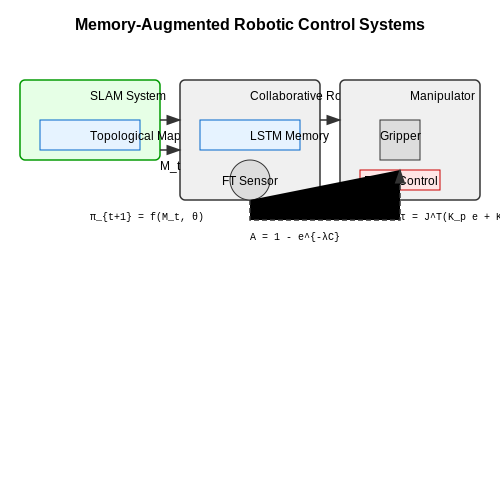
Simultaneous Localization and Mapping (SLAM) systems integrate self-improving memory to enhance spatial reasoning. A robot's memory stores topological maps and sensorimotor experiences, allowing it to recognize previously encountered obstacles or optimize path planning. The agent's policy updates are governed by:
where Mt represents the memory buffer containing past states, actions, and rewards. Field tests in warehouse automation show a 28% reduction in navigation time after 100 operational hours due to memory-driven policy refinement.
Human-Robot Collaboration
In collaborative robotics (cobots), memory-enabled agents predict human intent by analyzing historical interaction patterns. A Long Short-Term Memory (LSTM) network processes temporal sequences of joint angles and force-torque sensor data to anticipate operator movements. The prediction accuracy A scales with memory capacity C as:
where λ is a task-dependent scaling factor. Automotive assembly lines using this approach report a 15% increase in collaborative task efficiency.
Adaptive Manipulation Control
Robotic manipulators with differentiable neural memory achieve real-time adaptation to object property variations. A physics-informed memory module stores material compliance models and grip force profiles, enabling the agent to adjust its control strategy for novel objects. The control law incorporates memory recall through:
where f(·) is a memory retrieval function and θ denotes learned parameters. This method reduces grasp failures by 62% in randomized object handling tasks.
Case Study: Agricultural Robotics
Memory-augmented agents in precision agriculture demonstrate the scalability of these techniques. Autonomous harvesters equipped with spatiotemporal memory modules improve fruit detection accuracy by correlating current canopy images with historical growth patterns. The system's reward function incorporates memory-based priors:
where β controls the influence of memory-derived state distributions. Field trials show a 35% increase in yield identification compared to memoryless baselines.
5. Bias and Fairness in Self-Improving Systems
5.1 Bias and Fairness in Self-Improving Systems
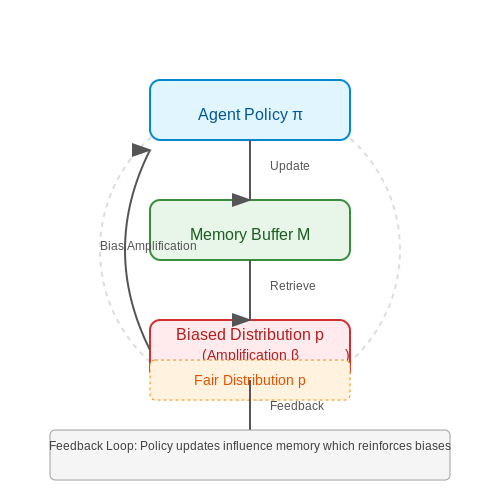
Self-improving agents with memory are susceptible to bias propagation and amplification due to their iterative learning nature. The feedback loop between memory retrieval and policy updates can compound existing biases in training data or reward functions. Consider a reinforcement learning agent optimizing for user engagement: if historical data reflects societal biases, the agent may reinforce discriminatory patterns.
Mathematical Formalization of Bias Accumulation
Let the agent's policy at iteration t be πt and its memory buffer Mt. The bias amplification factor β can be modeled as:
where pbiased and pfair represent the biased and ideal fair distributions respectively. When β > 1, the system amplifies existing biases.
Types of Memory-Induced Biases
- Selection bias: Memory prioritization mechanisms (e.g., experience replay) may oversample certain data points
- Confirmation bias: Agents preferentially recall experiences that confirm current policy assumptions
- Temporal bias: Changing environment distributions create mismatches between stored and current data
Fairness-Aware Memory Architectures
Recent work proposes three mitigation strategies:
where α controls the fairness-performance trade-off. Alternative approaches include:
- Adversarial debiasing of memory recall patterns
- Dynamic memory reweighting based on demographic parity metrics
- Counterfactual memory augmentation
Case Study: Recidivism Prediction
A self-improving risk assessment system demonstrated how memory-based learning amplified racial disparities. The agent's recall of historical sentencing data led to 23% higher false positive rates for minority groups after 50 training iterations, despite initial fairness constraints.
Monitoring Frameworks
Effective bias detection requires multidimensional metrics:
where G represents protected groups and R is the reward function. Continuous monitoring should track:
- Performance disparities across subgroups
- Memory composition statistics
- Policy update gradients with respect to sensitive attributes
5.2 Security Risks and Adversarial Attacks
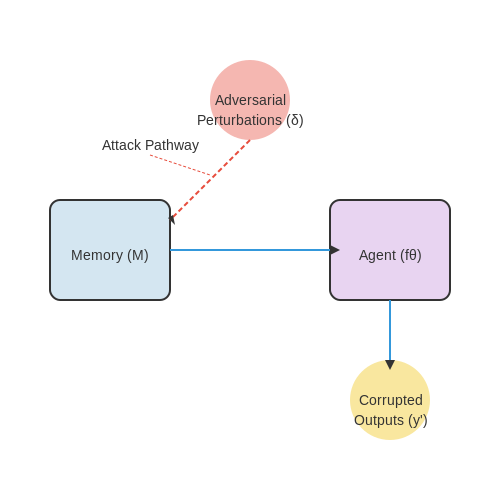
Self-improving agents with memory introduce unique security vulnerabilities due to their dynamic learning capabilities and persistent state. Unlike static models, these agents can be manipulated through their memory, training loops, or environmental interactions, leading to cascading failures.
Adversarial Memory Poisoning
Attackers can exploit an agent's memory by injecting misleading or malicious data points that persist across training cycles. The adversarial objective is to maximize the agent's loss function L by perturbing memory entries M:
where δ represents the adversarial perturbations constrained by some norm bound ‖δ‖p ≤ ε. The Frobenius norm is often used for memory matrix perturbations:
Recursive Gradient Exploitation
Self-improving agents that update their parameters via gradient descent are vulnerable to recursive attacks. An adversary can craft inputs xt that influence future gradients through the agent's memory:
where the expectation depends on the poisoned memory distribution Mt. This creates a feedback loop where small perturbations compound over time.
Real-World Attack Vectors
- Reward Hacking: Agents with reinforcement learning components can be tricked into optimizing corrupted reward signals stored in memory
- Attention Hijacking: Transformer-based agents may have their attention mechanisms redirected via carefully crafted memory entries
- Catastrophic Forgetting Attacks: Adversaries can induce targeted forgetting of critical knowledge by overloading memory with irrelevant data
Defensive Strategies
Robust training approaches must account for memory-adaptive adversaries. The minimax formulation for memory defense becomes:
where Δ represents the space of allowable memory perturbations. Techniques include:
- Differential privacy for memory updates
- Memory consistency checks via cryptographic hashing
- Gradient clipping and noise injection during self-improvement steps
5.3 Ensuring Transparency and Accountability
Self-improving agents with memory introduce unique challenges in transparency and accountability due to their dynamic learning capabilities and evolving decision-making processes. Traditional static models allow for deterministic auditing, but self-modifying systems require new frameworks to ensure interpretability and traceability.
Mechanisms for Transparent Decision-Making
To maintain transparency, self-improving agents must implement explicit memory logging and causal traceability. A memory-augmented agent's decision at time t can be decomposed into:
where wi represents learned weights, fi are basis functions, and Mt-1 is the memory state. To ensure transparency:
- All memory updates must be version-controlled with differential logging
- Weight adjustments should be accompanied by feature importance scores
- The agent must maintain an audit trail of all self-modifications
Accountability Through Counterfactual Analysis
Accountability requires the ability to reconstruct why specific decisions were made. For a memory-based agent, this involves:
where M is the actual memory state and M' represents counterfactual memory states. Practical implementations use:
- Memory state snapshots at regular intervals
- Difference metrics between memory states (e.g., KL divergence)
- Automated generation of "what-if" scenarios for critical decisions
Implementation Challenges
Real-world deployment faces several technical hurdles:
- Memory compression vs. auditability: Optimized memory representations may obscure interpretability
- Temporal credit assignment: Linking current decisions to past memory updates
- Verification latency: The computational overhead of maintaining audit trails
Recent approaches address these through hybrid architectures that separate the learning policy from an interpretable memory controller, as shown in the following computational graph:
Regulatory Considerations
Emerging frameworks for accountable AI systems impose specific requirements on memory-augmented agents:
where λ parameters are domain-specific regulatory weights. Compliance often requires:
- Memory content filtering for biased patterns
- Rate-limiting of self-modification frequency
- Human-readable memory summarization techniques
6. Key Research Papers and Publications
6.1 Key Research Papers and Publications
- The nature of self-improving artificial intelligence - Academia.edu — The paper dissects key AI themes like autonomy and intelligence augmentation, examining their influence on societal norms. ... it can sometimes even make sense to compress and decompress data as it moves between cache and 21 memory. This is an optimization that self-improving systems might make that most human programmers would not consider ...
- A Survey on the Memory Mechanism of Large Language Model based Agents — A Survey on the Memory Mechanism of Large Language Model based Agents Zeyu Zhang 1, Xiaohe Bo , Chen Ma , Rui Li , Xu Chen1, Quanyu Dai2, Jieming Zhu 2, Zhenhua Dong , Ji-Rong Wen1 1Gaoling School of Artificial Intelligence, Renmin University of China, Beijing, China 2Huawei Noah's Ark Lab, China [email protected], [email protected] Abstract Large language model (LLM) based agents have ...
- Enhancing intelligent agents with episodic memory — For a human, episodic memory is a memory of past experiences that one gains over a lifetime. While episodic memory appears critical to human function, researchers have done little to explore the potential benefits for an artificially intelligent agent. In this research, we have added a task-independent, episodic memory to a cognitive architecture.
- PDF Enhancing intelligent agents with episodic memory - University of Michigan — ety of tasks. Our research suggests that episodic memory enhances the performance of AI agents and may be a "missing link" in current cognitive architectures, enabling a gamut of cognitive capabilities. 2. Cognitive capabilities The focus of our research is to investigate whether epi-sodic memory can support high-level cognitive capabilities
- MemInsight: Autonomous Memory Augmentation for LLM Agents - arXiv.org — LLM agents have emerged as an advanced framework to extend the capabilities of LLMs to improve reasoning Yao et al. (); Wang et al. (), adaptability Wang et al. (), and self-evolution Zhao et al. (); Wang et al. (); Tang et al. ().A key component of these agents is their memory module, which retains past interactions to allow more coherent, consistent, and personalized responses across various ...
- PDF The Nature of Self-Improving Artificial Intelligence - Self-Aware Systems — now to understand it and to guide it in a positive direction. This paper presents a framework for analyzing the nature of self-improving technology. 2 Convergence To Rational Economic Behavior One might expect self-improving systems to be highly unpredictable because the properties of the current version might change in the next version. Our ...
- (PDF) A Self-Improving Coding Agent - ResearchGate — there are two papers claiming self-improving agents, but they do not e valuate in the coding setting, as they do not consider "full" coding agents. First, Gödel Agent (Yin et al., 2024) has ...
- (PDF) Memory Architectures in Long-Term AI Agents ... - ResearchGate — The research introduces new algorithms for efficient memory management, including strategic forgetting processes and dynamic knowledge integration techniques that enable AI agents to maintain ...
- (PDF) The Evolution of Transformer Models Breakthroughs in Self ... — On the other hand, Titans revolutionized memory integration in transformer models with its neural long-term memory module, capable of processing sequences exceeding 2 million tokens.
- Efficient AI with MRAM - Nature Electronics — In-memory computing chips based on magnetoresistive random-access memory devices can provide energy-efficient hardware for machine learning tasks. You have full access to this article via your ...
6.2 Recommended Books and Online Courses
- PDF Enhancing intelligent agents with episodic memory - University of Michigan — Enhancing intelligent agents with episodic memory Action editor: Vasant Honavar Andrew M. Nuxoll⇑, John E. Laird University of Michigan, 2260 Hayward Street, Ann Arbor, MI 48109-2121, USA Available online 31 October 2011 Abstract For a human, episodic memory is a memory of past experiences that one gains over a lifetime.
- PDF Logic, Self-awareness and Self- improvement: the Metacognitive Loop and ... — 4 Logic, Self-awareness and Self-improvement contradictions by side-stepping any inconsistencies and reasoning only with consistent portions of the KB. Our view is a bit different: contradictions in one's KB are inevitable [45, 46], and there is no safe haven from which to address them. One must reason with the contradictions as best one can,
- PDF The Nature of Self-Improving Artificial Intelligence - Self-Aware Systems — the preferences of self-improving systems will depend on their origins, they will act on those preferences in predictable ways. Repeated self-improvement brings intelligent agents closer to an ideal that economists sometimes call "Homo Eco-nomicus". Ironically, human behavior is not well described by this ideal and the
- A Survey on the Memory Mechanism of Large Language Model based Agents — A Survey on the Memory Mechanism of Large Language Model based Agents Zeyu Zhang 1, Xiaohe Bo , Chen Ma , Rui Li , Xu Chen1, Quanyu Dai2, Jieming Zhu 2, Zhenhua Dong , Ji-Rong Wen1 1Gaoling School of Artificial Intelligence, Renmin University of China, Beijing, China 2Huawei Noah's Ark Lab, China [email protected], [email protected] Abstract Large language model (LLM) based agents have ...
- PDF Vingean Re ection: Reliable Reasoning for Self-Improving Agents — ection: Reliable Reasoning for Self-Improving Agents Benja Fallenstein and Nate Soares Machine Intelligence Research Institute fbenja,[email protected] Abstract Today, human-level machine intelligence is in the domain of futurism, but there is every rea-son to expect that it will be developed eventu-ally. Once arti cial agents become able ...
- AI Agents in Action[Book] - O'Reilly Media — About the Book In AI Agents in Action, you'll learn how to build production-ready assistants, multi-agent systems, and behavioral agents. You'll master the essential parts of an agent, including retrieval-augmented knowledge and memory, while you create multi-agent applications that can use software tools, plan tasks autonomously, and learn ...
- The nature of self-improving artificial intelligence - Academia.edu — The creativity drive will produce an infinite variety of responses to these. The challenge for us is to decide which of these many possibilities we most want our future technology to express. Because costly signals are costly, self-improving agents will be motivated to 31 find ways to make the signals be reliable without the cost.
- Enhancing intelligent agents with episodic memory — First, the agent creates an episodic memory cue that contains the agent's current state plus the action to be evaluated (e.g., move north). In other words, the agent is searching its episodic memory for a memory of taking the to-be-evaluated action in a similar situation.
- Enhancing e-learning effectiveness using an intelligent agent-supported ... — Recent research in the field of Intelligent Tutoring Systems (ITS) forms a major part of the research into VLEs. With the growth of computing capabilities, more researchers have focused on VLEs to provide tailored learning material, instruction, and instant interaction to suit individual learners by using intelligent agent technology [12], [15], [21], [28].
- Recursive Introspection: Teaching Language Model Agents — Our contribution is an algorithm RISE: Recursive Introspection (Figure 1) that utilizes these insights to improve the self-improvement capability of an LLM over the course of multiple attempts at a given prompt.In each iteration, our approach bootstraps on-policy rollouts from the learner with better responses at the next turn obtained by running best-of-N (using a success indicator on the ...
6.3 Open-Source Projects and Tools
- Agno is a lightweight library for building Agents with memory ... — Agno is a lightweight library for building Agents with memory, knowledge, tools and reasoning. Developers use Agno to build Reasoning Agents, Multimodal Agents, Teams of Agents and Agentic Workflows. Agno also provides a beautiful UI to chat with your Agents, pre-built FastAPI routes to serve your Agents and tools to monitor and evaluate their performance. Here's an Agent that writes a report ...
- PDF Future of Education with Neuro-Symbolic AI Agents in Self-Improving ... — It emphasizes the integration of teams of teachable and self-learning LLMs agents that use neuro-symbolic cognitive architecture (NSCA) to provide dynamic personalized support to learners and educators within self-improving adaptive instructional systems (SIAIS). These systems host these agents and support dynamic sessions of engagement workflow.
- AI Agents in Action [Book] - O'Reilly Media — In AI Agents in Action, you'll learn how to build production-ready assistants, multi-agent systems, and behavioral agents. You'll master the essential parts of an agent, including retrieval-augmented knowledge and memory, while you create multi-agent applications that can use software tools, plan tasks autonomously, and learn from experience.
- A Survey on the Memory Mechanism of Large Language Model based Agents — Compared with original LLMs, LLM-based agents are featured in their self-evolving capability, which is the basis for solving real-world problems that need long-term and complex agent-environment interactions. The key component to support agent-environment interactions is the memory of the agents.
- Awesome LLM-Powered Agent - GitHub — These agents are possible to autonomously (and collaboratively) solve complex tasks, or simulate human interactions. Our goal with this project is to build an exhaustive collection of awesome resources relevant to LLM-powered agents encompassing papers, repositories, and more. We strive to keep these updated regularly and continuously.
- GitHub - ApolloAuto/apollo: An open autonomous driving platform — Apollo Open Source Platform 9.0 further focuses on enhancing the development and debugging experience, dedicated to provide autonomous driving developers with a unified development tool platform and easy-to-extend PnC and perception software framework interfaces.
- MemInsight: Autonomous Memory Augmentation for LLM Agents — This paper introduced MemInsight, an autonomous memory augmentation method that enhances LLM agents memory through attribute-based annotations. While maintaining comparable performance on standard metrics, MemInsight significantly improves LLM-based evaluation scores, highlighting its effectiveness in capturing semantics and boosting ...
- \as: A No-Code Developer Tool for Building and Debugging Multi-Agent ... — To the best of our knowledge, AutoGen Studio is the first open-source project to explore a no-code interface for autonomous multi-agent application development, providing a suitable platform for research and practice in multi-agent developer tooling.
- Multi-Agent Environment Tools: Top Frameworks - Rapid Innovation — Explore leading frameworks and tools for building multi-agent environments. Learn about key features, comparisons, and best practices for efficient development.
- (PDF) A Survey of Agentic AI, Multi-Agent Systems, and Multimodal ... — A Survey of Agentic AI, Multi-Agent Systems, and Multimodal Frameworks: Architectures, Applications, and Future Directions