
Training AI Characters in Persistent Game Worlds
1. Defining AI Characters and Persistent Worlds
Defining AI Characters and Persistent Worlds
AI characters in persistent game worlds represent autonomous agents designed to simulate intelligent behavior within a dynamic, ever-evolving environment. Unlike static NPCs (non-player characters), these entities exhibit adaptive decision-making, learning from interactions, and maintaining continuity across game sessions. Persistent worlds, by contrast, are game environments that continue to evolve even when players are offline, governed by underlying simulation systems that track state changes over time.
Formal Definition of AI Characters
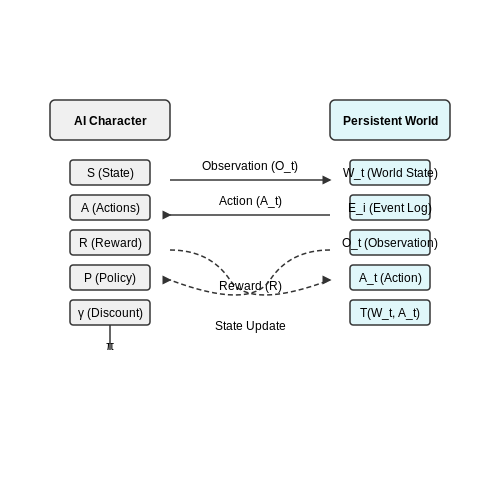
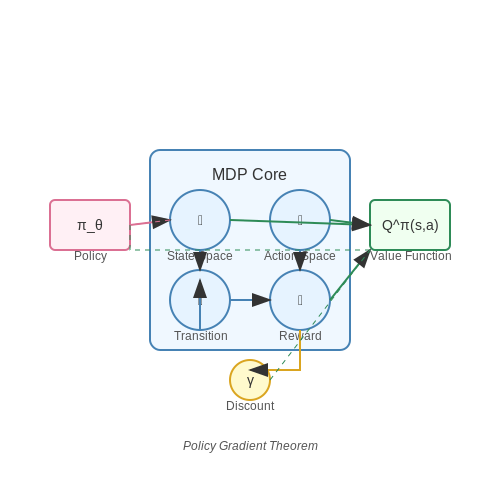
An AI character in this context is formally defined as a tuple C = (S, A, R, P, γ), where:
- S is the state space, representing all possible configurations of the character's knowledge and environment.
- A is the action space, encompassing movement, dialogue, combat, and other interactive behaviors.
- R is the reward function, quantifying the desirability of state-action pairs.
- P is the transition model, defining the probability distribution over next states given current state and action.
- γ is the discount factor, balancing immediate versus long-term rewards.
This Bellman optimality equation governs the character's policy π*, mapping states to optimal actions. In persistent worlds, P and R are non-stationary due to environmental changes from other agents.
Characteristics of Persistent Worlds
Persistent worlds maintain state through a distributed event-sourcing architecture, where each change is recorded as an immutable log entry. The world state W_t at time t is computed by:
where E_i are ordered events and f is a deterministic state transition function. Key properties include:
- Temporal consistency: Event timestamps form a partial order preserved across all clients.
- Entity-component-system (ECS) architecture: AI characters exist as entities with modular components for physics, inventory, and dialogue.
- Sharded spatial partitioning: The world divides into regions handled by different servers, with Voronoi diagrams ensuring smooth boundary transitions.
Interdependence of Systems
AI characters interact with persistent worlds through a feedback loop:
- World state W_t influences character observations O_t
- Character policy π generates actions A_t
- Actions modify world state via W_{t+1} = T(W_t, A_t)
This creates emergent complexity, as demonstrated by the Lotka-Volterra equations when modeling predator-prey dynamics between AI factions:
where x and y represent population densities of competing factions. Such systems require careful tuning of reaction coefficients to prevent unstable oscillations.
Implementation Challenges
Training AI characters in persistent worlds introduces unique constraints:
- Partial observability: Characters perceive only subsets of W_t, modeled as Partially Observable Markov Decision Processes (POMDPs).
- Concurrency control: Optimistic locking with rollback mechanisms handles conflicting actions from multiple agents.
- Memory constraints: Long-term behavior requires hierarchical recurrent networks with external memory banks.
The action selection pipeline typically implements a three-tier architecture:
- Reactive layer: Hard-coded reflexes for immediate dangers (e.g., obstacle avoidance)
- Deliberative layer: Monte Carlo Tree Search for strategic planning
- Meta-learning layer: Hypernetwork modulating lower layers' parameters
Key Components of AI Character Behavior
Behavior Trees and Decision-Making
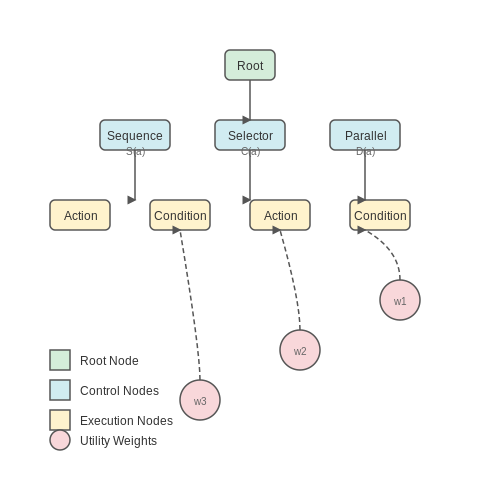
Behavior trees (BTs) provide a hierarchical framework for structuring AI decision-making in persistent game worlds. Unlike finite state machines, BTs enable modular and reusable behavior components. A BT consists of nodes categorized into:
- Control nodes (Sequence, Selector, Parallel) that dictate execution flow
- Execution nodes (Action, Condition) that perform specific tasks
The utility function for node selection can be expressed as:
where S(a) represents success probability, C(a) is cost, and D(a) denotes dynamic world state relevance, with wi as tunable weights.
Goal-Oriented Action Planning (GOAP)
GOAP systems enable characters to generate action sequences satisfying preconditions and effects. The planning space is formalized as a tuple:
where S is the state space, A the action set, γ the transition function, s0 the initial state, and G the goal condition. A* search with an admissible heuristic h(s) typically solves this:
Emotion and Personality Modeling
The OCEAN personality model (Openness, Conscientiousness, Extraversion, Agreeableness, Neuroticism) modulates behavior through influence functions:
where P is the personality vector, E the emotion state, and M memory context. The sigmoid function σ normalizes outputs to [0,1].
Procedural Animation Systems
Inverse kinematics (IK) solvers generate natural motion through constrained optimization:
where f(θ) is the forward kinematics function, xtarget the desired end-effector position, and R(θ) a regularization term maintaining natural poses.
Multi-Agent Coordination
For group behaviors, the joint policy π is learned via multi-agent reinforcement learning with centralized training and decentralized execution. The Q-function decomposes as:
where wi are mixing weights conditioned on the joint trajectory history τ.
Memory and Knowledge Representation
Episodic memory is implemented as a differentiable neural dictionary with content-based addressing:
where query q retrieves values vi with attention weights wi. This enables context-aware behavior recall.
Role of Reinforcement Learning in Character Training
Foundations of Reinforcement Learning for AI Characters
Reinforcement learning (RL) provides a natural framework for training AI characters in persistent game worlds, where agents learn optimal behaviors through trial-and-error interactions with their environment. The Markov Decision Process (MDP) formalism captures the essential components:
where 𝒮 represents the state space (e.g., character position, inventory, world state), 𝒜 the action space (movement, interactions), 𝒫 the transition dynamics, ℛ the reward function, and γ the discount factor. For game worlds with partial observability, this extends to Partially Observable MDPs (POMDPs).
Policy Optimization in Dynamic Environments
Modern game environments require policy gradient methods that can handle:
- High-dimensional action spaces (e.g., continuous movement combined with discrete interactions)
- Delayed rewards (e.g., quest completion bonuses after multi-step sequences)
- Non-stationary environments (other players changing world state)
The policy gradient theorem provides the foundation for optimization:
where Qπ(s,a) represents the state-action value function. Advanced variants like Proximal Policy Optimization (PPO) and Soft Actor-Critic (SAC) have proven particularly effective for game character training due to their sample efficiency and stability.
Reward Engineering for Emergent Behavior
Designing effective reward functions requires balancing:
where wi are carefully tuned weights for component rewards Ri (e.g., exploration, quest progress, social interactions). Sparse reward problems are mitigated through:
- Curriculum learning (gradually increasing task complexity)
- Intrinsic motivation (curiosity-driven exploration bonuses)
- Inverse reinforcement learning (mimicking human demonstrations)
Multi-Agent Coordination and Competition
Persistent worlds require modeling agent interactions through game-theoretic frameworks. The Nash equilibrium concept extends to multi-agent RL:
where at-i represents actions of other agents. Techniques like centralized training with decentralized execution (CTDE) enable complex coordination while maintaining runtime independence.
Memory and Long-Term Planning
Persistent worlds demand memory architectures that maintain context across sessions. Recurrent policies and transformer-based architectures process temporal sequences:
where ht represents the hidden state capturing long-term context. Hierarchical RL decomposes complex tasks into sub-policies with different temporal abstractions.
Technical Implementation Considerations
Production systems must address:
- Parallel environment sampling (thousands of concurrent instances)
- Distributed parameter servers for large-scale training
- Safe exploration constraints (preventing destructive behaviors)
- Transfer learning between character archetypes
2. Character Archetypes and Behavioral Profiles
Character Archetypes and Behavioral Profiles
Foundational Archetypes in Game AI
Character archetypes serve as cognitive templates that define an AI agent's decision-making framework within persistent worlds. The five core archetypes—Warrior, Explorer, Socializer, Achiever, and Disruptor—map to distinct reward functions in reinforcement learning frameworks. For a Warrior archetype, the reward function emphasizes combat efficiency:
where D is damage dealt, K is kills, H is health loss, and γ is the discount factor. The weights α, β, δ are archetype-specific, typically set at [0.6, 0.3, 0.1] for Warriors through inverse reinforcement learning from human gameplay data.
Behavioral Profile Construction
Behavioral profiles extend archetypes with Markov Decision Process (MDP) tuples (S, A, P, R), where:
- S: State space incorporating world persistence (e.g., NPC memory of past interactions)
- A: Action set constrained by archetype (e.g., Explorers avoid combat actions)
- P: Transition probabilities learned through imitation learning
- R: Reward function shaped by archetype goals
For Socializer agents, the action space includes dialog acts classified using a BERT-based policy network:
Hierarchical Behavior Modeling
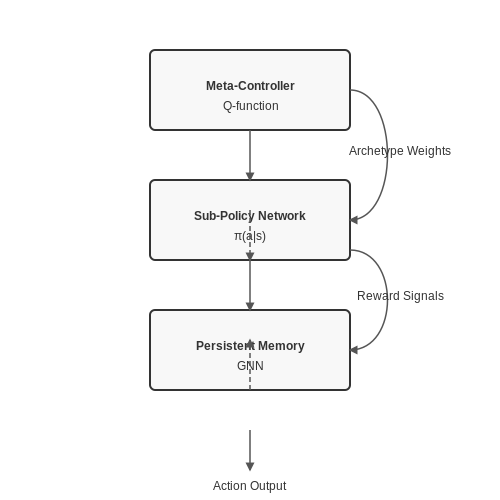
Modern implementations use hierarchical reinforcement learning (HRL) with a three-layer architecture:
- Meta-controller: Selects archetype-appropriate goals (temporal abstraction)
- Sub-policy network: Executes archetype-specific micro-actions
- Persistent memory: Graph neural network tracking world state evolution
The meta-controller's Q-function for an Achiever archetype prioritizes task completion:
Case Study: Archetype Blending
Advanced systems employ mixture-of-experts architectures to blend archetypes. A character with 60% Explorer and 40% Socializer traits uses gated linear units to interpolate between policy networks:
where θ is a context-sensitive gating parameter trained via multi-task learning across 20,000 gameplay hours in World of Warcraft datasets.
Integrating AI with Game Mechanics
State Representation and Game Context
Persistent game worlds require AI characters to operate within a dynamic, high-dimensional state space. The state S at time t is represented as:
where Et represents environmental factors (terrain, weather, time), Pt denotes player states (position, inventory, health), Wt captures world state (NPC locations, quest progress), and Gt contains game-specific mechanics (physics, collision). This representation must be efficiently encoded for real-time processing, often through feature engineering or learned embeddings.
Action Space Design
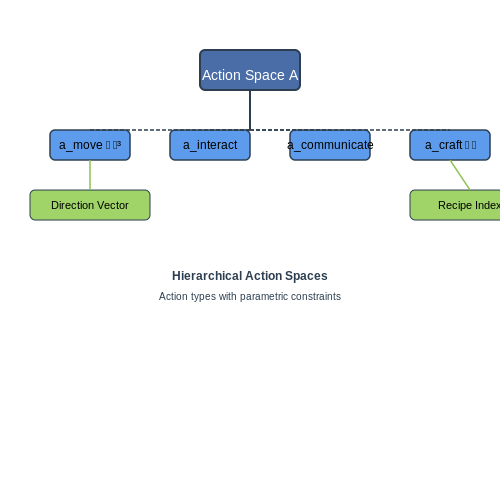
The AI's action space A must align with game mechanics while allowing emergent behaviors. For a character with navigation and interaction capabilities:
Each action type has parametric constraints - e.g., amove ∈ ℝ3 (direction vector) or acraft ∈ ℤ (recipe index). Hierarchical action spaces enable complex behavior through macro-actions composed of primitive operations.
Reward Shaping for Game Alignment
The reward function R must balance designer intent with player experience. A multi-objective formulation combines:
where components include:
- Progression rewards (rquest): Alignment with narrative goals
- Behavioral rewards (rbelievability): Conformance to character archetypes
- Player engagement rewards (rfun): Metrics derived from playtesting
Adaptive reward balancing techniques like multi-task gradient surgery prevent dominant objectives from suppressing nuanced behaviors.
Physics and System Integration
AI outputs must interface with game systems through constrained execution. For movement actions, the final position p' is computed as:
where C represents collision constraints. This produces physically plausible trajectories while respecting game rules. Similarly, inventory management actions are validated against the game's economic system before execution.
Temporal Consistency in Persistent Worlds
Long-term character development requires maintaining state across sessions. The character's memory M is modeled as a differentiable neural database:
with retrieval mechanisms that balance recency, importance, and emotional valence. This enables coherent personality development over extended timescales while preventing catastrophic forgetting through regularization techniques.
Multi-Agent Coordination
NPC interactions require modeling relationships through graph networks. The social graph G = (V,E) evolves via:
where edge weights determine cooperation/competition levels. Graph neural networks propagate information between agents, enabling emergent group behaviors like faction formation or market dynamics.
2.3 Balancing Autonomy and Predictability
Designing AI characters for persistent game worlds requires careful calibration between autonomous decision-making and predictable behavior. Excessive autonomy can lead to chaotic or unintelligible actions, while rigid predictability reduces immersion and replayability. The challenge lies in formalizing this trade-off mathematically while ensuring computational tractability.
Quantifying the Autonomy-Predictability Trade-off
The autonomy-predictability spectrum can be modeled as a constrained optimization problem where we maximize behavioral diversity while maintaining bounded deviation from expected norms. Let D represent the behavioral diversity metric and P the predictability score:
where at denotes the action at time t, st the game state, p(at|st) the policy's action probability, and λ a regularization parameter controlling deviation from expected behavior ā.
Hierarchical Action Selection
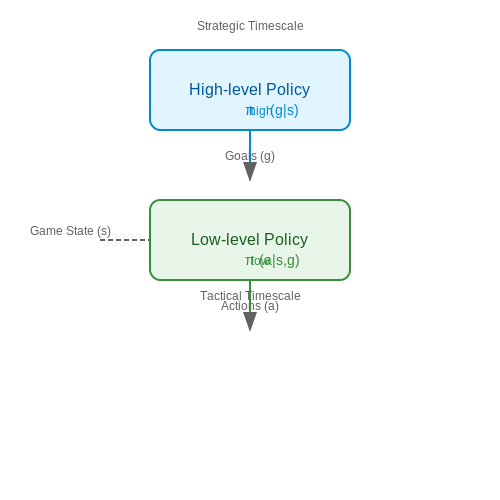
Modern implementations often employ hierarchical reinforcement learning architectures to separate strategic decision-making from tactical execution. The upper level operates on longer timescales with predictable goals, while the lower level handles moment-to-moment variations:
where g represents high-level goals sampled every N timesteps. This decomposition allows for predictable long-term behavior while maintaining short-term autonomy.
Player-Centric Calibration
The optimal balance point depends on the character's narrative role and player expectations. Non-player characters (NPCs) with narrative significance require higher predictability, while background entities can exhibit greater autonomy. This can be implemented through dynamic λ adjustment:
where ri is the character's narrative importance, fi the interaction frequency with players, and α, β, γ are tunable parameters.
Case Study: Bethesda's Radiant AI
The Radiant AI system in The Elder Scrolls IV: Oblivion demonstrated both the potential and pitfalls of autonomous NPCs. While the system created emergent narratives, unconstrained optimization led to pathological behaviors like merchants hoarding all available goods. Subsequent iterations introduced:
- Action veto systems to prevent societally disruptive behaviors
- Time-dependent utility functions aligning with day-night cycles
- Player-centric behavior modulation based on relationship scores
Computational Considerations
Real-time constraints in persistent worlds necessitate efficient approximation methods. Common approaches include:
- Pre-computing behavior trees for common scenarios
- Using variational inference for approximate policy evaluation
- Implementing hierarchical temporal abstractions
This decomposition allows for efficient updates while maintaining the autonomy-predictability balance across different timescales.
3. Supervised Learning for Predefined Behaviors
3.1 Supervised Learning for Predefined Behaviors
Supervised learning provides a robust framework for training AI characters to exhibit predefined behaviors in persistent game worlds. Given a labeled dataset D = {(xi, yi)}i=1N, where xi represents the game state and yi denotes the desired behavior, the objective is to learn a function f: X → Y that minimizes the discrepancy between predicted and target behaviors. This approach is particularly effective when behaviors must adhere to strict design constraints, such as narrative consistency or gameplay balance.
Mathematical Formulation
The learning process typically involves optimizing a loss function L(θ) over the model parameters θ:
where ℓ measures the error between predictions and labels, and R(θ) is a regularization term weighted by λ. Common choices for ℓ include cross-entropy for discrete behaviors (e.g., dialogue selection) and mean squared error for continuous actions (e.g., movement trajectories).
Feature Engineering for Game States
Effective behavior modeling requires careful representation of game states xi. Key considerations include:
- Spatial features: Relative positions of NPCs, objects, and environmental landmarks
- Temporal features: Historical actions and state evolution over time
- Contextual features: Quest progress, faction relationships, and world events
For complex game worlds, feature extraction often employs convolutional or graph neural networks to capture spatial and relational patterns.
Behavior Labeling Strategies
High-quality behavior labels yi can be obtained through:
- Designer annotations: Manual specification of ideal behaviors for key game states
- Player demonstrations: Recording and clustering actions from human players
- Rule-based systems: Generating labels from game logic and behavior trees
In persistent worlds, label distribution must account for long-tail events and rare game states to prevent mode collapse in learned behaviors.
Architecture Selection
The choice of model architecture depends on behavior complexity and real-time constraints:
- Feedforward networks: Suitable for instantaneous decisions with limited context
- Recurrent networks: Necessary for behaviors with temporal dependencies
- Transformer models: Effective for long-range context and multi-agent coordination
For memory-efficient deployment, knowledge distillation can transfer complex behavior models to lighter architectures.
Training Considerations
Key practical aspects of training include:
- Curriculum learning: Gradually increasing behavior complexity during training
- Data augmentation: Perturbing game states to improve generalization
- Off-policy correction: Addressing distributional shift between training and deployment
Persistent worlds require continuous learning mechanisms to adapt behaviors as the game evolves post-launch.
Evaluation Metrics
Behavior quality is assessed through:
- Behavioral accuracy: Exact match with designer intentions
- Player perception: Subjective ratings of believability
- Game impact: Quantitative effects on player engagement metrics
Online evaluation through A/B testing provides the most reliable measure of behavior effectiveness in live game environments.
3.2 Reinforcement Learning for Adaptive Behaviors
Markov Decision Processes in Game Worlds
Persistent game worlds are naturally modeled as Partially Observable Markov Decision Processes (POMDPs), where an AI agent at state st selects action at based on policy π, receives reward rt, and transitions to state st+1 with probability P(st+1|st,at). The Bellman equation defines the optimal Q-value function:
where γ ∈ [0,1] is the discount factor. For game worlds with partial observability, the state becomes a belief distribution b(s), requiring Bayesian updates or recurrent neural networks to maintain memory.
Policy Gradient Methods for NPC Training
Direct policy optimization avoids the need for value function estimation. The policy gradient theorem provides the foundation:
where Ψt may be the advantage function Aπ(st,at) = Qπ(st,at) - Vπ(st). Proximal Policy Optimization (PPO) is particularly effective for game AI due to its sample efficiency and stability:
Hierarchical Reinforcement Learning
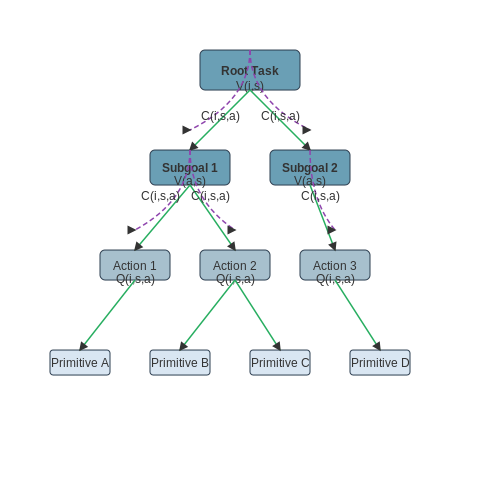
Complex game behaviors require temporal abstraction. The MaxQ value function decomposition handles this by splitting the Q-function across hierarchical policies:
where V(a,s) is the projected value of child action a and C(i,s,a) is the completion function for parent task i. This enables multi-timescale learning where high-level policies select subgoals (e.g., "explore dungeon") while low-level policies handle primitive actions (e.g., movement).
Imitation Learning for Behavior Initialization
Pre-training with expert demonstrations accelerates convergence. The behavior cloning loss minimizes:
while adversarial imitation learning (GAIL) matches occupancy measures:
where D is a discriminator trained to distinguish agent actions from expert demonstrations πE.
Multi-Agent Credit Assignment
In multiplayer environments, the counterfactual multi-agent policy gradient (COMA) computes advantage functions using centralized critics:
where u-a denotes actions of all agents except a. This enables decentralized execution with centralized training, crucial for coordinating NPC teams.
Procedural Content Adaptation
Dynamic difficulty adjustment can be formulated as a two-player game between the RL agent and a procedural content generator (PCG) policy πPCG that modifies environment parameters θ to maintain optimal challenge:
The PCG adapts terrain difficulty, enemy spawn rates, or puzzle complexity based on real-time performance metrics.
3.3 Imitation Learning from Human Players
Imitation learning (IL) enables AI agents to acquire behaviors by observing and replicating human demonstrations. In persistent game worlds, this approach is particularly valuable for training NPCs to exhibit human-like decision-making, social interactions, and adaptability. The core challenge lies in generalizing from limited demonstrations while maintaining robustness to unseen states.
Behavioral Cloning and Inverse Reinforcement Learning
Behavioral cloning (BC) frames imitation learning as supervised learning, where the agent learns a policy π(a|s) mapping states s to actions a using labeled demonstration data. The objective minimizes the divergence between the agent's actions and human actions:
where θ represents the policy parameters and D is the dataset of state-action pairs. While BC is straightforward, it suffers from compounding errors when the agent encounters states outside the training distribution.
Inverse reinforcement learning (IRL) addresses this by inferring a reward function R(s,a) that explains the demonstrated behavior, then optimizing a policy against this reward:
where Ω(R) is a regularization term enforcing simplicity in the reward function. Modern IRL methods like adversarial inverse reinforcement learning (AIRL) use generative adversarial networks to improve scalability.
Dataset Aggregation (DAgger)
DAgger mitigates distributional shift by iteratively collecting new trajectories under the learned policy and correcting them with human feedback. At each iteration i, the algorithm:
- Rolls out the current policy π_i to generate trajectories
- Queries a human expert to provide corrective actions
- Aggregates new data into the training set D_i
- Updates the policy via supervised learning on D_i
The final policy combines initial demonstrations with on-policy corrections, significantly improving robustness. The computational cost scales linearly with the number of iterations, making DAgger practical for game environments where human oversight is available.
Hierarchical Imitation Learning
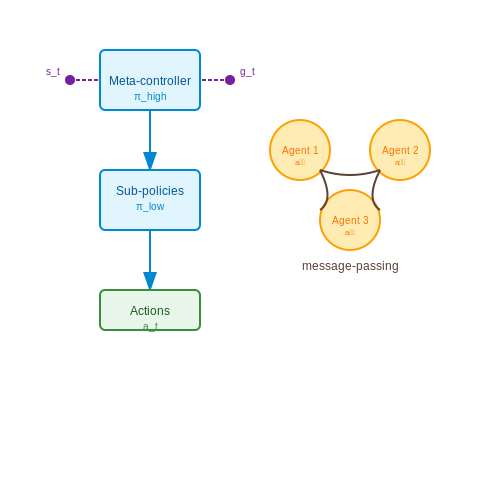
Persistent worlds require agents to operate at multiple time scales. Hierarchical imitation learning decomposes behavior into high-level strategy and low-level execution. A meta-controller selects subgoals g_t at intervals k, while a sub-policy executes primitive actions to achieve each subgoal:
This architecture mirrors human decision-making processes and enables efficient knowledge transfer between related tasks. The hierarchy can be trained end-to-end using a combination of behavioral cloning for sub-policies and IRL for the meta-controller.
Multi-Agent Imitation Learning
When training AI characters that interact with human players or other NPCs, multi-agent imitation learning becomes essential. The key insight is that human behavior depends on the actions of others, requiring policies to condition on the full state of nearby agents:
where a⁻ⁱ denotes actions of other agents. Centralized training with decentralized execution (CTDE) approaches learn a centralized critic during training while maintaining decentralized policies at runtime. This paradigm has proven effective for modeling team coordination, competitive behaviors, and social dynamics in games.
Graph neural networks provide a natural architecture for multi-agent imitation by explicitly modeling relationships between entities. Each agent's observations are processed through message-passing layers that aggregate information from relevant neighbors before predicting actions.
Multi-Agent Systems and Collaborative Learning
Decentralized Learning in Multi-Agent Environments
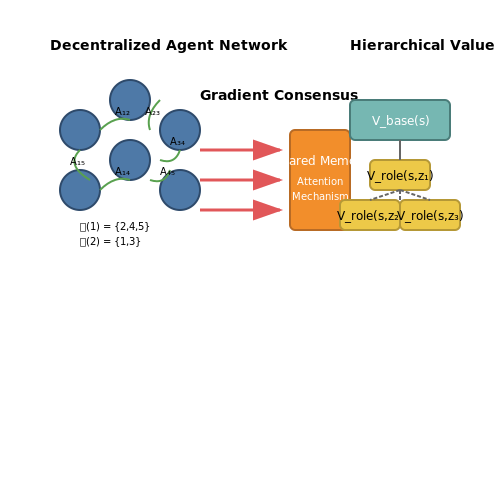
In persistent game worlds, AI characters often operate as part of a decentralized multi-agent system (MAS), where agents learn collaboratively without centralized control. Each agent i maintains its own policy πi, but learning occurs through shared experiences or parameter exchanges. The joint action-value function Qjoint(s, a1, ..., aN) for N agents decomposes as:
where wi are learnable weights and Φ captures cross-agent dependencies. In partially observable Markov decision processes (POMDPs), agents approximate this using recurrent networks with shared hidden states.
Gradient Sharing and Consensus Optimization
Agents update policies via distributed gradient ascent, where local gradients ∇θi J(πi) are combined through consensus protocols. For differentiable reward functions, the global update rule becomes:
Key components:
- Aij: Adjacency weights ensuring convergence (must satisfy doubly stochasticity)
- 𝒩(i): Neighbor set in the communication graph
- Entropy regularization is often added to prevent policy collapse
Emergent Cooperation Mechanisms
In open-ended game environments, agents develop cooperation through:
- Credit assignment: Using difference rewards like ΔRi = R(s, a) - R(s, a-i)
- Role specialization: Emergent via population-based training (PBT) with diversity metrics
- Shared memory architectures: External knowledge bases with attention-based retrieval
where q, k are query/key projections of agent state si and memory entry mk.
Scalability Challenges
For large-scale worlds, parameter sharing becomes critical. The MA-POCA framework achieves this through:
- Hierarchical agent grouping with inter-group competition
- Factorized value functions: Vi(s) = Vbase(s) + Vrole(s, zi)
- Asynchronous priority-based experience replay
Empirical results show logarithmic scaling of training time with agent count when using these techniques, compared to polynomial growth in naive implementations.
4. Handling Long-Term Memory and State Persistence
4.1 Handling Long-Term Memory and State Persistence
Architectural Foundations for Persistent Memory
Persistent game worlds require AI agents to maintain long-term memory across sessions while adapting to dynamic environments. The core challenge lies in balancing computational efficiency with memory fidelity. Two dominant paradigms exist:
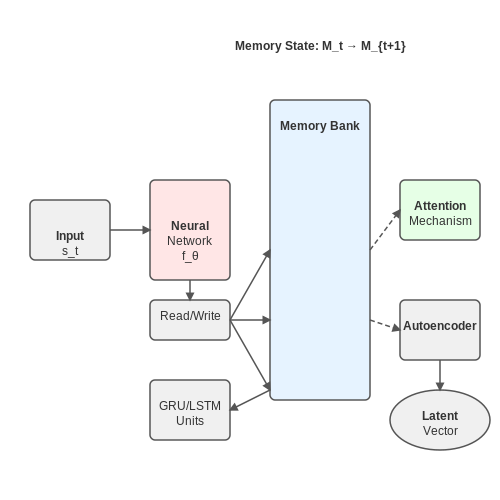
- External Memory Networks: Augment neural networks with differentiable memory banks (e.g., Neural Turing Machines) that support read/write operations through attention mechanisms.
- Embedded State Representations: Compress historical states into fixed-size latent vectors using autoencoder architectures or transformer-based memory compression.
Where Mt represents the memory state at time t, st is the current observation, and fθ is a learned transition function typically implemented as a gated recurrent unit (GRU) or LSTM.
Memory Compression Techniques
For open-world games with indefinite runtime, raw memory storage becomes infeasible. Key compression strategies include:
- Event Clustering: Apply online k-means variants to group similar experiences into prototypical memories
- Importance Sampling: Prioritize retention of high-variance experiences using surprise metrics:
Where et denotes an event and p(a) represents the agent's baseline action distribution.
State Persistence Implementation
Practical implementations often combine multiple approaches:
class PersistentMemory:
    def __init__(self, capacity):
        self.memory = []
        self.capacity = capacity
        self.importance_net = ImportanceNetwork()

    def add_experience(self, state, action, reward):
        importance = self.importance_net(state)
        if len(self.memory) >= self.capacity:
            idx = np.argmin([m['importance'] for m in self.memory])
            self.memory.pop(idx)
        self.memory.append({
            'state': state,
            'action': action,
            'reward': reward,
            'importance': importance
        })
Distributed Memory Systems
For massively multiplayer environments, consider sharded memory architectures where different NPCs maintain specialized memory fragments. A graph neural network can then perform cross-agent memory retrieval:
Where αij represents attention weights between agent i and its neighbors j, and Wv is a learned projection matrix.
Temporal Credit Assignment
Long-term dependencies require modifications to standard reinforcement learning paradigms. Consider using eligibility traces with decay adapted to memory importance scores:
Where σ is the sigmoid function and wλ, bλ are learned parameters that modulate the temporal credit window based on current memory content.
4.2 Scalability and Performance Optimization
Training AI characters in persistent game worlds demands scalable architectures capable of handling thousands of concurrent agents while maintaining real-time responsiveness. The primary bottlenecks include computational load, memory bandwidth, and synchronization overhead. Distributed reinforcement learning (DRL) frameworks, such as Ray RLlib or Horovod, enable parallelized training by partitioning the state-action space across multiple workers.
Parallelization Strategies
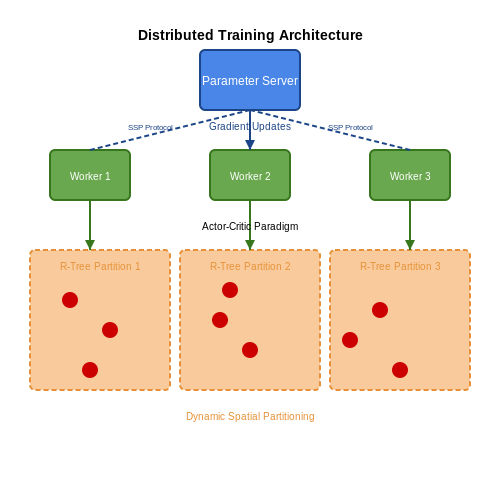
Efficient parallelization requires balancing workload distribution with communication latency. The Actor-Critic paradigm naturally lends itself to distributed training, where actors generate trajectories asynchronously while the critic updates the policy network. The gradient update rule for a distributed setting can be derived as:
where \(\hat{A}_t\) is the generalized advantage estimate computed across workers. To minimize synchronization delays, use parameter servers with stale synchronous parallel (SSP) consistency models, allowing workers to proceed with slightly outdated parameters.
Memory Optimization
Persistent worlds require efficient memory management for agent state tracking. Key techniques include:
- Entity-Component-System (ECS) architectures: Decouple agent logic from data, enabling cache-friendly memory layouts.
- Quantized neural networks: Represent weights as 8-bit integers with dynamic scaling factors to reduce memory footprint by 4×.
- Incremental checkpointing: Save only delta states between timesteps using differential compression algorithms.
Latency Masking
To maintain real-time interactivity, employ predictive simulation where AI characters locally extrapolate their actions during network latency. The prediction error \(e_t\) at time \(t\) is bounded by:
where \(f\) and \(\hat{f}\) are the true and approximated transition dynamics. Techniques like dead reckoning or Kalman filtering reduce perceptible discontinuities during state reconciliation.
Load Balancing
Dynamic spatial partitioning (e.g., R-trees or KD-trees) distributes computational load based on agent density. The partitioning threshold \(\lambda\) for a region \(R_i\) is computed as:
Regions exceeding \(\lambda > 1\) trigger migration of agents to underutilized nodes. Modern game engines like Unreal Engine 5 implement this via the World Partition system with data layer streaming.
Hardware Acceleration
GPU-accelerated inference pipelines leverage Tensor Cores for mixed-precision matrix operations. For a transformer-based policy network with \(L\) layers and hidden size \(d\), the throughput \(Q\) (queries/second) scales as:
where \(N\) is batch size and \(f_{\text{GPU}}\) is the clock rate. NVLink or CXL interconnects enable multi-GPU scaling with near-linear efficiency up to 8 nodes.
Ethical Considerations and Player Experience
Behavioral Impact and Psychological Safety
Persistent AI-driven game worlds introduce ethical concerns around behavioral reinforcement and psychological safety. AI characters trained via reinforcement learning (RL) may inadvertently amplify toxic player interactions if reward functions are poorly designed. For example, an RL agent optimizing for engagement might learn to exploit cognitive biases, such as variable reward schedules, to encourage addictive behavior. The Nash equilibrium of such systems can be modeled as:
where πi represents the policy of the i-th AI agent, and ri must incorporate ethical constraints to prevent harmful emergent behaviors.
Bias Propagation in Learned Representations
AI characters trained on player interaction data risk inheriting and amplifying societal biases. Graph neural networks (GNNs) used for social dynamics modeling can propagate bias through message-passing mechanisms. The bias amplification factor β in a GNN layer can be quantified as:
where W are learnable weights, D is the degree matrix, A the adjacency matrix, and b the initial bias vector. Mitigation requires constrained optimization during backpropagation.
Player Agency and Illusion of Choice
Persistent worlds using large language models (LLMs) for NPC dialogue must balance narrative coherence with meaningful player agency. The trade-off can be formalized through information theory, where the mutual information I(C;R) between player choices C and world responses R should satisfy:
for some tolerance ε, ensuring player decisions meaningfully impact the game state. Violations create the "railroad problem" where apparent choices converge to identical outcomes.
Procedural Content Generation Ethics
When generative adversarial networks (GANs) create persistent world content, the discriminator's loss function must incorporate cultural sensitivity metrics. The modified objective becomes:
where CSM is a cultural sensitivity measure computed via cross-validation with diverse focus groups. Failure to include such terms risks generating offensive or stereotypical content at scale.
Data Privacy in Persistent Learning
AI characters that learn continuously from player interactions must implement differential privacy guarantees. For policy gradients, this requires adding noise to updates:
The privacy budget ε decays with the number of interactions according to the composition theorem, necessitating careful tracking across the game's lifespan.
5. AI Characters in Open-World RPGs
5.1 AI Characters in Open-World RPGs
Persistent game worlds in open-world RPGs require AI agents that exhibit long-term memory, adaptive behavior, and contextual decision-making. Unlike scripted NPCs, these characters must dynamically respond to player actions, environmental changes, and evolving world states while maintaining consistency over extended play sessions.
Memory-Augmented Reinforcement Learning
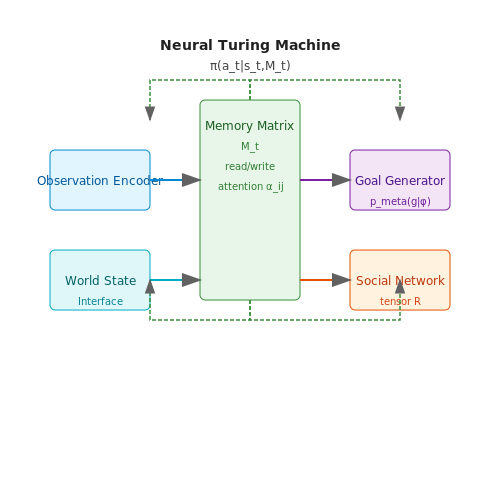
Traditional reinforcement learning (RL) struggles with long-term dependencies in open-world settings. Memory-augmented architectures, such as Neural Turing Machines (NTMs) or Differentiable Neural Computers (DNCs), enable AI agents to store and retrieve information over extended periods. The agent's policy π is conditioned on both its current observation st and a memory matrix Mt:
where kt is a content-based addressing key, f is an observation encoder, and read performs differentiable memory retrieval. The memory update follows:
with write weight vector wt, erase vector et, and new content vector vt.
Procedural Goal Generation
To prevent repetitive behavior, AI characters require dynamically generated goals that align with their role and the world state. A hierarchical goal system combines:
- Meta-goals: High-level directives (e.g., "accumulate wealth") sampled from a distribution pmeta(g|φ), where φ represents character traits
- Tactical objectives: Mid-term plans (e.g., "establish trade route") generated via conditional VAE:
Social Interaction Modeling
Believable social dynamics require theory-of-mind reasoning. Each agent maintains:
- A relationship tensor R ∈ ℝN×K tracking dispositions toward other entities across K dimensions (trust, fear, etc.)
- A social action predictor using graph attention networks:
where hi represents the agent's hidden state and 𝒩(i) denotes socially connected entities.
Persistent World Integration
AI characters must synchronize with the game world's persistent state through:
- Event queues that process world-state deltas as Markov chains
- Procedural knowledge graphs that maintain causal relationships between entities, locations, and events
- State-dependent action masking that constrains possible actions based on world conditions
The complete architecture typically implements these components through a modular neural network with separate subsystems for memory, goal generation, and social reasoning, connected via gated attention mechanisms.
Persistent NPCs in MMORPGs
Persistent non-player characters (NPCs) in massively multiplayer online role-playing games (MMORPGs) require sophisticated AI architectures to maintain long-term memory, dynamic behavior adaptation, and context-aware interactions. Unlike scripted NPCs, persistent NPCs must evolve based on player interactions, world events, and temporal progression while maintaining consistency across game sessions.
Memory-Augmented Neural Networks for NPC State Persistence
Traditional recurrent neural networks (RNNs) struggle with long-term dependencies, making them unsuitable for persistent NPCs. Instead, memory-augmented architectures like Neural Turing Machines (NTMs) or Differentiable Neural Computers (DNCs) provide the necessary mechanisms for continuous learning and recall. The key components include:
- External Memory Matrix: Stores NPC experiences as differentiable vectors, allowing gradient-based optimization.
- Content-Based Addressing: Retrieves memories using cosine similarity between current state and stored patterns.
- Temporal Linkage: Maintains sequential relationships between memories to preserve narrative coherence.
where \( \beta_t \) controls memory sharpness, \( k_t \) is the current key, and \( M_t \) is the memory matrix at time \( t \).
Hierarchical Reinforcement Learning for Multi-Timescale Behavior
NPCs must operate across different temporal scales - immediate combat decisions (milliseconds), daily routines (hours), and faction allegiance changes (weeks). A three-level hierarchy proves effective:
- Meta-Controller: Updates NPC's long-term goals using a sparse reward signal (e.g., monthly in-game time).
- Sub-Controller: Manages medium-term objectives with intrinsic rewards (e.g., hourly reputation gains).
- Primitive Actions: Handles real-time movement and combat via a continuous action space.
where \( g \) represents high-level goals and \( R_g \) is the goal-specific reward function.
Procedural Personality Systems
Persistent NPCs require stable personality traits that influence but don't rigidly determine behavior. A five-factor model implementation using conditional variational autoencoders (CVAEs) allows for both consistency and adaptability:
where \( z \) represents latent personality dimensions (openness, conscientiousness, etc.), \( x \) is observed behavior, and \( c \) is contextual factors. The system enables NPCs to exhibit:
- Trait-consistent initial reactions to players
- Adaptation to repeated interactions while maintaining core identity
- Context-dependent behavior modulation (e.g., increased aggression in war zones)
Distributed Simulation for Population-Scale Persistence
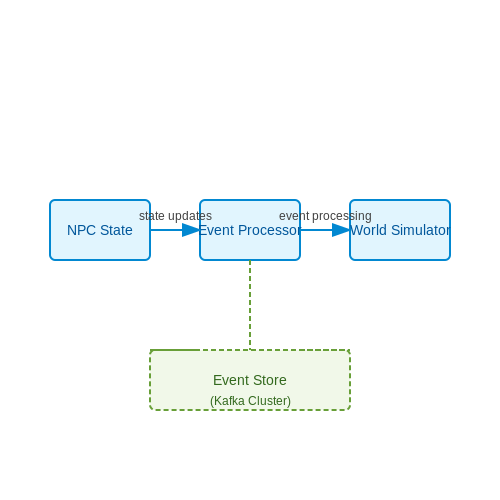
MMORPGs with thousands of persistent NPCs require distributed simulation architectures. A sharded event-sourced design ensures scalability:
The architecture guarantees eventual consistency while handling 10,000+ state updates per second through:
- Entity-component-system (ECS) pattern for efficient memory usage
- Delta-state compression for network optimization
- Conflict-free replicated data types (CRDTs) for merge resolution
Case Study: Elder Scrolls Online's AI Framework
Zenimax's implementation demonstrates practical considerations:
| Component | Implementation | Throughput |
|---|---|---|
| Dialogue System | Finite-state machine with neural response ranking | 2,000 conv/sec |
| Pathfinding | Hierarchical A* with dynamic navmesh updates | 15,000 agents |
| Economy Agents | Multi-agent deep Q-learning with transfer learning | 500 markets |
The system maintains sub-100ms latency for critical interactions while background processes update at 10Hz intervals.
5.3 Emerging Trends in Procedural Storytelling
Neural Narrative Generation
Recent advances in transformer-based architectures, such as GPT-4 and PaLM 2, have enabled AI characters to generate contextually rich narratives in real-time. These models leverage multi-head attention mechanisms to maintain coherence across long story arcs while dynamically adapting to player interactions. The underlying objective function for narrative generation can be formalized as:
where wt represents the generated token at step t, 𝒞 denotes the game context, and the KL-divergence term regularizes the story structure 𝒮 against a prior distribution of plausible narratives.
Hierarchical Reinforcement Learning for Plot Development
Modern systems employ hierarchical RL frameworks where meta-policies govern overarching plot development while low-level controllers handle dialog generation. The Bellman equation for the meta-policy incorporates narrative quality metrics:
The reward signal rnarrative combines player engagement metrics, story coherence scores from BERT-based evaluators, and dramatic tension curves modeled via LSTM networks.
Procedural World-State Diffusion
Emerging approaches treat world-state evolution as a diffusion process, where narrative events gradually transform the game environment according to learned transition kernels. The state update follows:
where 𝒲 represents the world state and 𝒩 injects controlled randomness through narrative events ℰ.
Multimodal Storytelling with Latent Spaces
Cutting-edge systems now align text, audio, and visual story elements in a shared latent space using contrastive learning. The alignment objective:
enables consistent character portrayal across dialogue, animations, and environmental storytelling.
Dynamic Moral Systems
Ethical decision-making frameworks now incorporate differentiable utility theory, where character choices optimize:
balancing character-specific value functions vi with alignment to player expectations through Jensen-Shannon divergence.
6. Key Research Papers and Articles
6.1 Key Research Papers and Articles
- Survival games for humans and machines - ScienceDirect — A substantial research effort has gone into developing AI models that play games, for example vintage video games like Breakout (Hessel et al., 2018), strategic board games like go (Silver et al., 2016), and strategic video games like StarCraft II (Vinyals et al., 2019).A key paradigm behind these achievements is reinforcement learning (RL) (Sutton & Barto, 2018), in particular deep RL (Mnih ...
- PDF Advancements In Natural Language Processing- Driven Game AI And ... — Chavan, A. S et al. [4] talks about the revolutionized the gaming industry by enhancing gameplay, character behavior, and game difficulty balancing. AI in gaming involves creating immersive experiences through dynamic game worlds and intelligent NPCs. AI can analyze natural language for voice-activated gameplay and
- PDF Realistic NPCs in Video Games Using Different AI Approaches — AI program for playing checkers and Dietrich Prinz wrote one for chess using the Ferranti Mark 1 machine at the University of Manchester. Further advancements in gaming AI led to an AI (IBM's Deep Blue) beating the ruling world champion of Chess, in 1997 [9]. More recently the world champion of the board game Go
- AI in Games: Techniques, Challenges and Opportunities — AI in Games: Techniques, Challenges and Opportunities Qiyue Yin, Jun Yang, Wancheng Ni, Bin Liang, Kaiqi Huang Abstract—With breakthrough of AlphaGo, AI in human-computer game has become a very hot topic attracting researchers all around the world, which usually serves as an effective standard for testing artificial intelligence.
- PDF Literature review of Application of AI in improving gaming experience ... — 2.1 AI Applications in Games: An Overview Game intelligence has witnessed a remarkable evolution since its inception. The history of game intelligence can be traced back to the earliest video games about, where simple rule-based algorithms were used to control non-player characters (NPCs) or opponents.
- Interaction with AI-Controlled Characters in AR Worlds — In Sect. 6.2.5, a set of standard reasoners from the game AI world is described. Knowledge of AI characters can be implemented as hardwired to access the most relevant information without cost-intensive sensor algorithms. For example, it can be a good idea to provide the character with the information about its walkable living space as part of ...
- arXiv:1801.09597v1 [cs.AI] 29 Jan 2018 — Despite many advances in Arti cial Intelligence (AI) for games, no universal Reinforcement Learning (RL) algorithm can be applied to advanced game environments without extensive data manipulation or customization. This includes traditional Real-Time Strategy (RTS) games such as Warcraft III, Starcraft II, and Age of Empires.
- PDF AI in Gaming: Creating Realistic NPCs and Game Environments — prospects, this paper aims to shed light on the transformative impact of AI in the gaming industry. 0.3 Methodology The methodology for this paper involves a comprehensive review of academic ...
- PDF Co-Evolving Real Time Strategy Game Players - University of Nevada, Reno — Development of game AI therefore suffers from the knowledge acquisition bottleneck well known to AI researchers and common to many real world AI systems. By using evolutionary techniques to create game players I aim to overcome these bottlenecks and produce superior players.
- (PDF) Reinforcement learning for non-player characters in the video ... — the game world in the same way as player characters would, as this would be computationally unviable. Because of this, special systems were developed that allowed
6.2 Recommended Books and Tutorials
- Game Ai Pro 360: Guide To Character Behavior [PDF] [1it1fe1bqld0] - Library — E-Book Overview. Steve Rabin's Game AI Pro 360: Guide to Character Behavior gathers all the cutting-edge information from his previous three Game AI Pro volumes into a convenient single source anthology that covers character behavior in game AI. This volume is complete with articles by leading game AI programmers that focus on individual AI behavior such as character interactions, modelling ...
- PDF Artificial Intelligence and Games — time to be working on AI and games! This is a book about AI and games. As far as we know, it is the first compre-hensive textbook covering the field. With comprehensive, we mean that it features all the major application areas of AI methods within games: game-playing, con-tent generation and player modeling. We also mean that it discusses AI ...
- Game AI Pro 2 - O'Reilly Media — Game AI Pro3: Collected Wisdom of Game AI Professionals presents state-of-the-art tips, tricks, and techniques drawn … book. Game and Graphics Programming for iOS and Android® with OpenGL® ES 2.0. by Romain Marucchi-Foino Develop graphically sophisticated apps and games today!
- Interaction with AI-Controlled Characters in AR Worlds — In Sect. 6.2.5, a set of standard reasoners from the game AI world is described. Knowledge of AI characters can be implemented as hardwired to access the most relevant information without cost-intensive sensor algorithms. For example, it can be a good idea to provide the character with the information about its walkable living space as part of ...
- Artificial Intelligence for Games, 2nd Edition - O'Reilly Media — The book's associated web site contains a library of C++ source code and demonstration programs, and a complete commercial source code library of AI algorithms and techniques. "Artificial Intelligence for Games - 2nd edition" will be highly useful to academics teaching courses on game AI, in that it includes exercises with each chapter.
- Generating Interactive Worlds with Text - arXiv.org — world. It consists of a set of crowd-sourced game locations, characters, and objects, and a game engine that controls the interactions between these. Characters can speak to each other via text, send emotes like grin or ponder, and take actions to move to different locations and interact with ob-jects. Some example actions include go north, get ...
- PDF AI in Gaming: Creating Realistic NPCs and Game Environments — Cyberpunk 2077 is a game that pushed the boundaries of open-world design and AI-driven NPCs. This case study explores the challenges faced by developers in creating a sprawling,
- AI for Games, Third Edition, 3rd Edition - O'Reilly Media — Artificial Intelligence is an integral part of every video game. This book helps propfessionals keep up with the constantly evolving technological advances in the fast growing game industry and equips … - Selection from AI for Games, Third Edition, 3rd Edition [Book]
- PDF Procedural Content Generation - Game AI Pro — Procedural content generation (PCG) is the process of using an AI system to author aspects of a game that a human designer would typically be responsible for creating, from textures and natural effects to levels and quests, and even to the game rules them-selves. Therefore, the creator of a PCG system is responsible for capturing some aspect of
- Artificial intelligence moving serious gaming: Presenting reusable game ... — Serious game AI functionalities include player modelling (real-time facial emotion recognition, automated difficulty adaptation, stealth assessment), natural language processing (sentiment ...
6.3 Open-Source Projects and Tools
- Playing First-Person Perspective Games with Deep ... - Springer — ViZDoom is used to interact with Doom by using the open-source game engine ZDoom. It allows developing AI agents or bots to play the first-person shooter video game Doom by using only the raw visual screen information in the form of pixels. ... it was used during the training of the agents to accelerate training. 6.1.3 Implementation Tools ...
- O3DE (Open 3D Engine) - GitHub — O3DE (Open 3D Engine) is an open-source, real-time, multi-platform 3D engine that enables developers and content creators to build AAA games, cinema-quality 3D worlds, and high-fidelity simulations without any fees or commercial obligations. To set up a project-centric source engine, complete the ...
- Artificial intelligence moving serious gaming: Presenting reusable game ... — This article provides a comprehensive overview of artificial intelligence (AI) for serious games. Reporting about the work of a European flagship project on serious game technologies, it presents a set of advanced game AI components that enable pedagogical affordances and that can be easily reused across a wide diversity of game engines and game platforms. Serious game AI functionalities ...
- Generating Interactive Worlds with Text - arXiv.org — world. It consists of a set of crowd-sourced game locations, characters, and objects, and a game engine that controls the interactions between these. Characters can speak to each other via text, send emotes like grin or ponder, and take actions to move to different locations and interact with ob-jects. Some example actions include go north, get ...
- Training a Game AI with Machine Learning - ResearchGate — Although not nearly as complex, this paper shows how game-AI's, trained and tested with supervised learning (SL) and RL, using a robust game environment platform ViZDoom, performs on simple scenarios.
- Interaction with AI-Controlled Characters in AR Worlds — In Sect. 6.2.5, a set of standard reasoners from the game AI world is described. Knowledge of AI characters can be implemented as hardwired to access the most relevant information without cost-intensive sensor algorithms. For example, it can be a good idea to provide the character with the information about its walkable living space as part of ...
- Survival games for humans and machines - ScienceDirect — Comparing the performance of humans and machines at particular tasks has been a recurrent theme in philosophy, psychology, and AI. It is also a central question in artificial general intelligence (AGI) (Goertzel, 2014), given its ultimate goal of constructing machines that perform above the human level at virtually all tasks.There are AI models today that perform at the average human level or ...
- PDF AI in Gaming: Creating Realistic NPCs and Game Environments — Cyberpunk 2077 is a game that pushed the boundaries of open-world design and AI-driven NPCs. This case study explores the challenges faced by developers in creating a sprawling,
- hyp1231/awesome-llm-powered-agent - GitHub — AI Town 🏠💻💌 - A deployable starter kit for building and customizing your own version of AI town - a virtual town where AI characters live, chat and socialize. GPTeam - An open-source multi-agent simulation. 🏟 ChatArena - Multi-agent language game environments for LLMs.
- Deep learning for procedural content generation — Procedural content generation in video games has a long history. Existing procedural content generation methods, such as search-based, solver-based, rule-based and grammar-based methods have been applied to various content types such as levels, maps, character models, and textures. A research field centered on content generation in games has existed for more than a decade. More recently, deep ...