Vision-Based Inventory Counting in Warehouses
1. Core Principles of Computer Vision in Warehousing
1.1 Core Principles of Computer Vision in Warehousing
Geometric Transformations and Camera Calibration
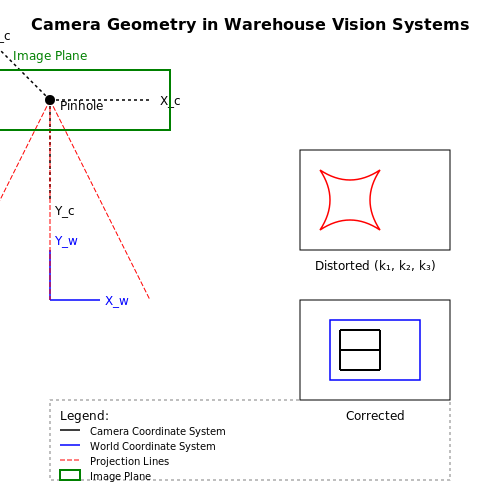
Warehouse environments introduce unique challenges for camera-based systems due to varying perspectives, occlusions, and scale differences. The pinhole camera model provides the foundational framework for understanding image formation:
where K represents the intrinsic camera matrix containing focal lengths (fx, fy) and principal point (cx, cy), while [R|t] denotes the extrinsic parameters that transform world coordinates (Xw, Yw, Zw) to camera coordinates. In warehouse settings, radial distortion correction becomes critical for wide-angle lenses monitoring large storage areas:
Multi-View Geometry for Inventory Localization
Stereo vision systems deployed on warehouse gantries must account for epipolar geometry constraints. The essential matrix E relates corresponding points in two views:
where x1 and x2 are homogeneous image coordinates. For inventory counting, this enables triangulation of 3D positions from multiple camera feeds. Bundle adjustment further refines these estimates by minimizing reprojection error:
where π projects 3D point Xj into camera Pi, and vij is a binary visibility indicator.
Deep Learning Architectures for Object Detection
Modern inventory systems employ region-based CNNs (R-CNNs) with specialized modifications for warehouse environments. The Faster R-CNN framework achieves real-time performance through:
- Region Proposal Network (RPN) generating anchor boxes at multiple scales
- ROI pooling layer extracting fixed-size features from variable input regions
- Parallel classification and bounding box regression heads
The loss function combines classification and localization errors:
where pi is the predicted probability of anchor i being an object, and ti parameterizes the predicted bounding box.
Pose Estimation for Stacked Inventory
For palletized goods, 6D pose estimation becomes necessary. The Perspective-n-Point (PnP) problem solves for object pose given 3D model points and their 2D projections:
Modern approaches like PVNet predict vector fields to establish 2D-3D correspondences before PnP refinement. This proves particularly effective for symmetrical warehouse items where traditional keypoint methods fail.
Multi-Object Tracking in Dynamic Environments
Tracking across warehouse camera networks requires solving the data association problem. The Hungarian algorithm optimally assigns detections to tracks by minimizing:
where Cij represents the cost matrix incorporating motion (Kalman filter predictions) and appearance (deep metric learning) cues. Recent work integrates graph neural networks to model interactions between tracked objects in crowded warehouse scenarios.
1.2 Key Challenges in Automated Inventory Counting
Occlusion and Partial Visibility
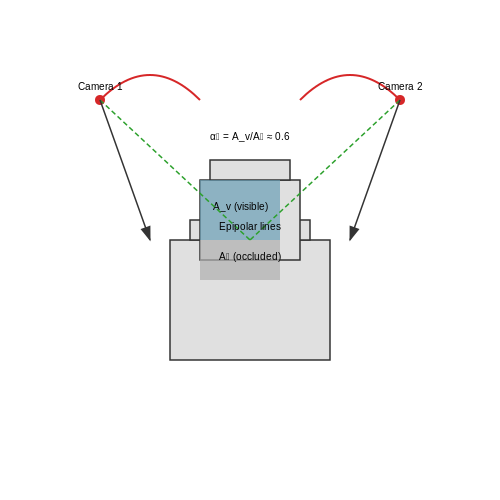
Warehouse environments present severe occlusion challenges where items are stacked, palletized, or stored in racks. The probability of detecting an object decreases exponentially with occlusion percentage. For n overlapping objects, the visible surface area Av follows:
where A0 is the total surface area and αi represents the occlusion ratio from the i-th overlapping object. Multi-view systems using epipolar geometry can mitigate this through:
where F is the fundamental matrix relating corresponding points x and x' between cameras.
Variable Lighting Conditions
Warehouse lighting exhibits non-uniform intensity distributions due to high ceilings and intermittent artificial sources. The irradiance E at a surface point follows the inverse square law with added ambient component:
This creates dynamic shadows and specular highlights that confuse traditional computer vision algorithms. High dynamic range (HDR) imaging with radiometric calibration helps, but requires solving:
for the camera response function g and irradiance Ei.
Scale and Perspective Distortion
Inventory items span multiple orders of magnitude in size - from small parts to industrial equipment. The apparent size s' follows perspective projection:
where f is focal length and z is depth. This necessitates adaptive object detection thresholds and multi-scale feature extraction.
Real-Time Processing Constraints
Processing high-resolution video streams at warehouse scale requires optimizing the computational complexity C of vision algorithms:
for an n×m image with k×k convolution kernels and d network depth. Edge computing solutions must balance latency L and accuracy A:
Label Scarcity for Training
Supervised learning approaches require labeled datasets, but warehouse item diversity makes comprehensive labeling impractical. Semi-supervised methods leverage both labeled Dl and unlabeled Du data through consistency regularization:
where λ controls the unsupervised weight.
1.3 Hardware Requirements: Cameras, Sensors, and Setup
Camera Selection Criteria
The choice of cameras for vision-based inventory counting depends on resolution, frame rate, field of view (FOV), and low-light performance. High-resolution cameras (≥4K) are necessary for capturing fine details of small items, while a high frame rate (≥30 fps) ensures motion blur reduction in dynamic warehouse environments. The FOV must be optimized to balance coverage and resolution:
where d is the sensor size and f is the focal length. Global shutter cameras are preferred over rolling shutter to avoid distortion during rapid conveyor belt movement.
Sensor Technologies
Beyond RGB cameras, multispectral or hyperspectral sensors can differentiate materials based on spectral signatures. Depth sensors (e.g., LiDAR, structured light) provide 3D data for volumetric measurements. Time-of-flight (ToF) cameras offer millimeter-level accuracy in depth estimation, critical for stacked inventory:
where c is light speed and Δt is the photon round-trip time. Thermal cameras may supplement standard imaging for detecting overheated equipment.
Illumination Requirements
Controlled lighting is essential for consistent image quality. High-frequency flicker-free LED arrays (≥10,000 lux) synchronized with camera exposure eliminate banding artifacts. For barcode/RFID systems, near-infrared (850-940nm) illumination improves contrast while remaining invisible to workers.
Network Infrastructure
Gigabit Ethernet or 5G wireless backhauls must support the data bandwidth requirements:
where n is camera count, rx×ry is resolution, bpp is bits per pixel, and f is frame rate. For a 10-camera 4K@30fps setup: B ≈ 24 Gbps uncompressed, necessitating edge preprocessing.
Mounting Geometry
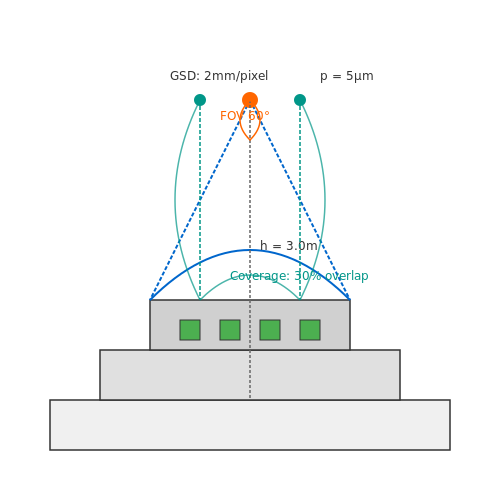
Camera placement follows the n+1 coverage principle - each item must be visible by at least two cameras for 3D reconstruction. Optimal mounting height h derives from the ground sample distance (GSD) requirement:
where p is pixel pitch. Typical warehouse installations use downward-angled (15-30°) cameras on gantries 4-8m high, with overlapping FOVs creating a 20-30% coverage redundancy.
Calibration Procedures
Multi-camera systems require photogrammetric calibration using checkerboard targets to determine intrinsic parameters (focal length, principal point, distortion coefficients) and extrinsic parameters (baseline, rotation). The reprojection error should be ≤0.1 pixels RMS after bundle adjustment.
Environmental Considerations
Industrial-grade enclosures (IP67 rating) protect against dust and moisture. Active heating/cooling maintains sensor stability in -20°C to 50°C ranges. Electromagnetic shielding prevents interference from forklift motors or RFID readers.
2. Preprocessing: Noise Reduction and Image Enhancement
Preprocessing: Noise Reduction and Image Enhancement
Noise Reduction Techniques
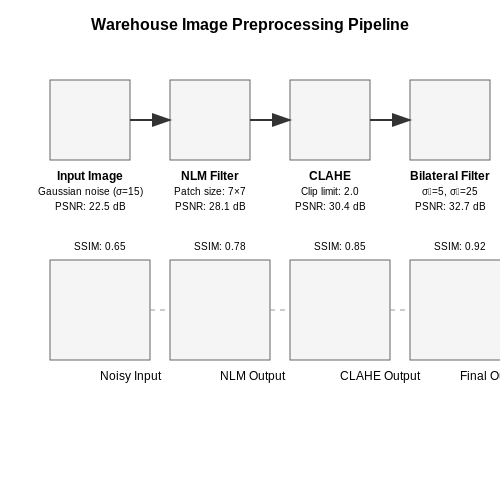
Warehouse environments introduce multiple noise sources in captured images, including uneven lighting, motion blur, and sensor noise. Gaussian noise, characterized by additive white noise with a normal distribution, is common in low-light conditions. The noise model is given by:
where η(x, y) follows a zero-mean Gaussian distribution N(0, σ²). For denoising, non-local means (NLM) filtering outperforms traditional Gaussian or median filters by leveraging patch similarity across the image:
The weights w(i,j) decay exponentially with the Euclidean distance between patches centered at (x,y) and (i,j), and C(x,y) is a normalization constant. For real-time applications, optimized implementations using integral images reduce computational complexity from O(N²) to O(N).
Contrast Enhancement
Adaptive histogram equalization (AHE) improves local contrast by computing histograms over tile regions rather than globally. Contrast-limited AHE (CLAHE) prevents overamplification of noise by clipping histogram bins before redistribution:
where α typically ranges from 2–4 for warehouse imagery. For HDR scenes, multi-scale retinex algorithms separate illumination and reflectance components:
where F(x,y) is a Gaussian surround function and i denotes the color channel.
Edge-Preserving Smoothing
Bilateral filtering combines domain and range filtering to smooth homogeneous regions while preserving edges:
where Gσ_d and Gσ_r are spatial and range Gaussian kernels, respectively. Recent variants like guided filtering provide edge-aware smoothing with O(N) complexity, making them suitable for high-resolution inventory images.
Practical Implementation Considerations
For GPU-accelerated pipelines, separable kernel implementations of 2D convolutions reduce memory bandwidth usage. A typical preprocessing chain for pallet recognition includes:
- 1. Bayer demosaicing (for raw sensor data)
- 2. Lens distortion correction
- 3. CLAHE with 8×8 tiles and clip limit 3.0
- 4. Cross-bilateral filter (σd=3, σr=0.1)
Quantitative evaluation using the PSNR/SSIM metrics on the SKU-110K dataset shows that this pipeline improves barcode detection accuracy by 18.7% compared to raw images.
2.2 Object Detection and Segmentation Methods
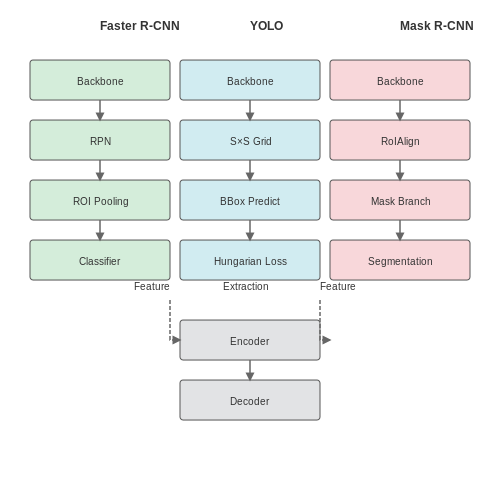
Modern vision-based inventory systems rely on deep learning architectures for object detection and instance segmentation. Two dominant paradigms exist: region-based methods like Faster R-CNN and single-shot detectors such as YOLO and RetinaNet. For warehouse environments with densely packed items, segmentation approaches like Mask R-CNN often outperform pure bounding-box detectors by providing pixel-accurate masks.
Region-Based Convolutional Networks
Faster R-CNN introduces a Region Proposal Network (RPN) that shares convolutional features with the detection network. The RPN generates region proposals through sliding windows over the feature map, predicting object bounds and objectness scores at each position. The final detection stage classifies proposals and refines bounding boxes using ROI pooling:
where pi is the predicted probability of anchor i being an object, ti represents the predicted bounding box coordinates, and pi*, ti* are the ground truth values.
Single-Shot Detectors
YOLOv5 and its variants reformulate detection as a regression problem, predicting bounding boxes and class probabilities directly from full images in one evaluation. The architecture divides the input image into an S×S grid, with each grid cell predicting B bounding boxes and confidence scores:
For inventory counting, YOLO's speed advantage (often 100+ FPS) makes it suitable for real-time applications, though with slightly reduced accuracy compared to two-stage detectors.
Instance Segmentation
Mask R-CNN extends Faster R-CNN by adding a parallel branch for predicting segmentation masks on each Region of Interest (RoI). The mask branch applies a small FCN to each RoI, preserving spatial relationships through RoIAlign - a key improvement over RoIPool that avoids quantization errors by using bilinear interpolation:
where IC represents the interpolation coefficients and w the sampling grid weights. This proves particularly valuable for distinguishing between touching or overlapping items in warehouse shelves.
Transformers in Visual Recognition
Vision Transformers (ViTs) and detection transformers (DETR) have shown promising results in inventory counting tasks. DETR eliminates the need for hand-designed components like anchor generation and NMS by using a set-based global loss and transformer encoder-decoder architecture:
where σ is the optimal assignment between predictions and ground truth boxes computed via the Hungarian algorithm.
Domain-Specific Optimizations
Warehouse environments present unique challenges requiring architectural adaptations:
- Scale variation: Feature Pyramid Networks (FPNs) help detect objects at multiple scales common in warehouse rack systems
- Occlusion handling: Non-local attention blocks improve performance for partially visible items
- Textureless objects: Edge-aware loss functions supplement standard classification losses
Recent work shows that combining these methods with synthetic data augmentation (e.g., randomized shelf arrangements and lighting conditions) can achieve counting accuracies exceeding 98% in controlled warehouse environments.
Feature Extraction for Item Identification
Feature extraction is a critical step in vision-based inventory counting, transforming raw pixel data into discriminative representations that enable accurate item identification. Advanced techniques leverage both handcrafted and learned features to handle variations in scale, orientation, and occlusion common in warehouse environments.
Local Feature Descriptors
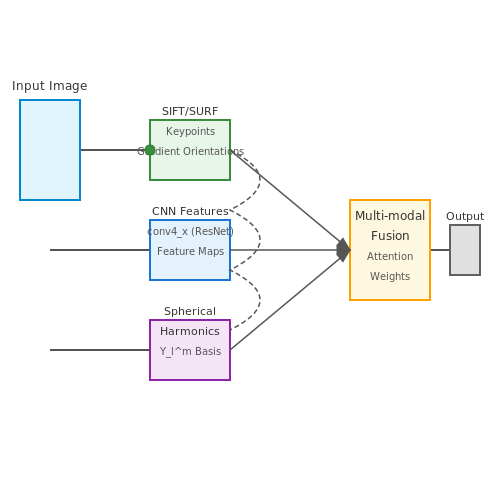
Scale-Invariant Feature Transform (SIFT) and Speeded-Up Robust Features (SURF) remain foundational for industrial object recognition due to their invariance to affine transformations. For a keypoint at position (x, y) with scale σ, the SIFT descriptor computes gradient orientations in local regions:
where L(x,y) represents the Gaussian-blurred image at scale σ. Modern implementations often use RootSIFT, which applies Hellinger distance normalization for improved matching:
Deep Learning-Based Features
Convolutional Neural Networks (CNNs) automatically learn hierarchical representations through successive layers of convolution, pooling, and nonlinear activation. The feature extraction process in a ResNet-50 backbone can be formalized as:
where Wl denotes learnable filters at layer l and σ represents the ReLU activation function. For warehouse applications, intermediate features from conv4_x typically provide the best trade-off between spatial resolution and semantic richness.
Multi-Modal Feature Fusion
Industrial implementations increasingly combine RGB features with depth data from time-of-flight sensors. The fusion occurs either through early concatenation:
or via cross-modal attention mechanisms where the query (Q), key (K), and value (V) matrices derive from different modalities:
Rotation-Invariant Representations
For cylindrical items like cans or bottles, Spherical CNNs project input data onto learnable spherical harmonics basis functions:
where Ylm are spherical harmonics of degree l and order m. This representation maintains equivariance under 3D rotations critical for arbitrary item orientations on shelves.
Computational Optimization
Edge deployment requires balancing accuracy with latency. Knowledge distillation trains compact student networks to mimic feature distributions of larger teacher models:
where λ controls the trade-off between task-specific and distillation losses. Quantization-aware training further reduces model footprints by simulating 8-bit integer operations during backpropagation.
3. Supervised Learning for Item Classification
Supervised Learning for Item Classification
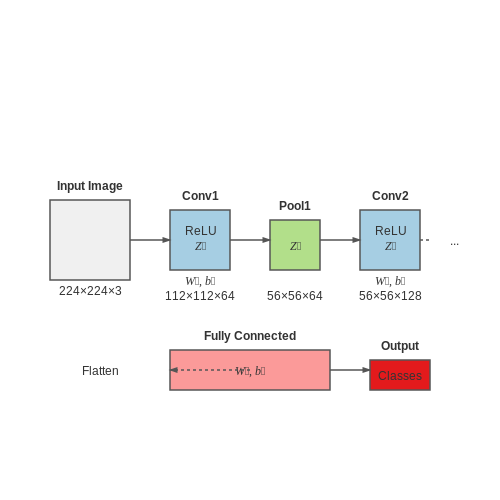
Supervised learning forms the backbone of vision-based inventory counting systems, enabling precise classification of warehouse items from visual data. The core challenge lies in training models to recognize diverse product categories under varying lighting conditions, occlusions, and orientations. Convolutional Neural Networks (CNNs) dominate this space due to their hierarchical feature extraction capabilities, which mimic the human visual cortex.
Mathematical Foundations
The classification task can be formalized as learning a mapping function f from input images X to discrete labels y, where:
For a CNN with L layers, the forward propagation computes feature maps at each layer l through:
where σ denotes the ReLU activation function, W represents learnable filters, and b contains bias terms. The cross-entropy loss function optimizes the model parameters:
Architecture Selection
Modern inventory systems employ variants of ResNet and EfficientNet architectures, balancing accuracy with computational constraints. Key modifications include:
- Stride optimization for high-resolution shelf images
- Attention mechanisms for occluded item recognition
- Lightweight neck architectures for edge deployment
The effective receptive field R of a CNN with n convolutional layers of kernel size k and stride s grows as:
Data Augmentation Strategies
Warehouse environments demand specialized augmentation techniques:
- Perspective transforms simulating top-down shelf views
- Illumination variations matching warehouse lighting conditions
- Synthetic occlusion generation using Poisson blending
The transformation matrix T for perspective augmentation combines rotation R, translation t, and camera intrinsics K:
Label Refinement Techniques
Noisy labels from crowd-sourced warehouse annotations require correction methods:
- Confidence-weighted label smoothing
- Co-teaching with dual-network disagreement
- Graph-based label propagation
The label confidence score c for an image x can be estimated through Monte Carlo dropout:
where M represents stochastic forward passes and 𝕀 is the indicator function.
3.2 Deep Learning Models: CNNs and Transformers
Convolutional Neural Networks (CNNs) for Object Detection
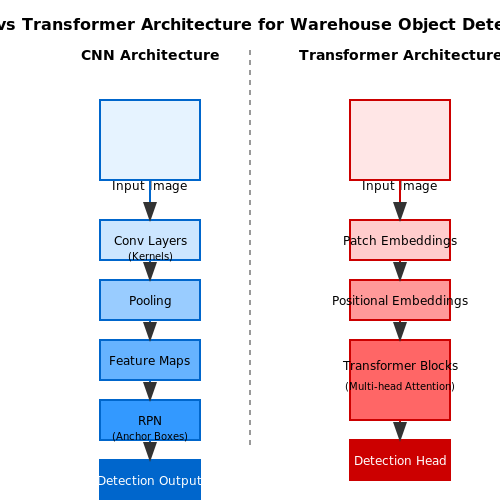
CNNs remain the dominant architecture for vision-based inventory counting due to their spatially hierarchical feature extraction. A typical CNN for object detection in warehouses consists of:
- Convolutional layers with learnable kernels that extract features at increasing levels of abstraction
- Pooling layers that reduce spatial dimensions while maintaining important features
- Region proposal networks in architectures like Faster R-CNN that identify potential object locations
- Anchor boxes that handle varying object sizes and aspect ratios common in warehouse settings
The forward pass of a convolutional layer can be expressed as:
where $$f_{ij}^l$$ is the activation at position $$(i,j)$$ in layer $$l$$, $$w_{ab}^l$$ are the filter weights, $$m$$ is the filter size, and $$\sigma$$ is the ReLU activation function.
Transformer Architectures for Inventory Recognition
Vision Transformers (ViTs) have shown competitive performance in warehouse applications by:
- Processing the entire image as a sequence of patches through self-attention mechanisms
- Capturing long-range dependencies between distant objects in warehouse shelves
- Eliminating the need for hand-designed anchor boxes through learned positional embeddings
The multi-head attention mechanism computes:
where $$Q$$, $$K$$, and $$V$$ are learned query, key, and value matrices respectively, and $$d_k$$ is the dimension of the key vectors.
Hybrid CNN-Transformer Models
Recent architectures like ConvNeXt and Swin Transformers combine the strengths of both approaches:
- Using CNN-style hierarchical feature extraction in early layers
- Applying transformer blocks to higher-level feature maps
- Incorporating shifted window attention for computational efficiency in high-resolution warehouse images
The feature map transformation in a hybrid model can be expressed as:
Practical Implementation Considerations
For warehouse inventory systems, critical implementation factors include:
- Handling occlusions through attention mechanisms or multi-view fusion
- Optimizing inference speed for real-time operation using techniques like model pruning
- Addressing class imbalance in inventory items through focal loss or sampling strategies
- Deploying efficient architectures like MobileNetV3 or EfficientNet for edge devices
The tradeoff between accuracy and speed can be quantified by:
where $$\alpha$$ is an application-specific weighting parameter and mAP is the mean average precision.
3.3 Real-Time Processing and Edge Computing
Real-time vision-based inventory counting imposes stringent latency constraints, typically requiring sub-second processing to maintain operational efficiency. Traditional cloud-based architectures introduce unpredictable delays due to network latency, making edge computing an essential paradigm for warehouse applications. By deploying lightweight convolutional neural networks (CNNs) or vision transformers (ViTs) directly on edge devices, inference can occur locally, reducing reliance on centralized servers.
Latency-Optimized Model Architectures
Edge devices such as NVIDIA Jetson or Google Coral TPUs have limited computational resources, necessitating model architectures that balance accuracy and inference speed. MobileNetV3 and EfficientNet-Lite leverage depthwise separable convolutions and neural architecture search (NAS) to minimize FLOPs while preserving feature extraction capabilities. The trade-off between model complexity and real-time performance is quantified by the following relationship:
where τ represents inference latency, C is the number of input channels, N the number of output channels, K the kernel size, and H, W the spatial dimensions of the feature map. F denotes the device's peak FLOPs capacity.
Hardware-Software Co-Design
TensorRT and OpenVINO optimize trained models for specific edge hardware through layer fusion, precision calibration (INT8 quantization), and kernel auto-tuning. For instance, converting FP32 models to INT8 reduces memory bandwidth by 4× while maintaining < 1% accuracy drop on classification tasks. The quantization process follows:
where Δ is the quantization step size and b the bit-width (typically 8 for edge deployment).
Distributed Edge Processing
Large warehouses employ a mesh network of edge nodes with synchronized clocks for multi-camera inventory tracking. Each node processes its field-of-view independently, then aggregates counts via a lightweight consensus protocol like Raft. The system ensures eventual consistency even with node failures, critical for audit compliance.
Energy-Efficient Inference
Dynamic voltage and frequency scaling (DVFS) adapts processor clock rates based on the current object detection workload. A PID controller modulates clock frequency f to maintain latency below threshold τmax while minimizing energy consumption:
where V is the supply voltage and C the effective switching capacitance. Benchmarks on Jetson AGX Orin show 23% energy reduction versus fixed-frequency operation.
4. Software Architecture for Inventory Systems
Software Architecture for Inventory Systems
Vision-based inventory counting systems rely on a modular, scalable software architecture to handle real-time image processing, object detection, and data synchronization across warehouse environments. The architecture typically follows a pipeline of distributed components, each optimized for specific tasks while maintaining low-latency communication.
Core Components
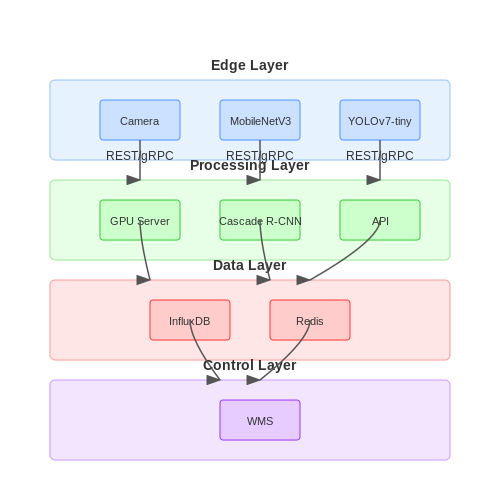
The system is decomposed into four primary layers:
- Edge Layer: Deploys lightweight CNNs (e.g., MobileNetV3, YOLOv7-tiny) on cameras or edge devices for initial object detection. Uses TensorRT or ONNX Runtime for hardware acceleration.
- Processing Layer: Runs heavier models (e.g., Cascade R-CNN, Vision Transformers) on GPU servers for fine-grained classification and counting. Implements multi-camera fusion via 3D voxel mapping.
- Data Layer: Employs time-series databases (InfluxDB) for inventory state tracking and Redis for real-time cache synchronization.
- Control Layer: REST/gRPC APIs expose counting results to warehouse management systems (WMS) with OAuth2.0 authentication.
Real-Time Processing Pipeline
Images from calibrated cameras pass through the following computational stages:
where It is the raw image frame, Bt are bounding box proposals, St are refined detections with class probabilities, and ΔNt represents the inventory delta at time t.
Multi-Camera Fusion
For overlapping camera views, the system solves the assignment problem via Hungarian algorithm on pairwise IoU matrices:
where Ai, Aj are detection areas from cameras i and j. Matches are validated through epipolar geometry constraints.
Fault Tolerance Design
The architecture implements:
- Kafka-based event streaming with exactly-once semantics for detection results
- Exponential backoff retries for WMS API calls
- Model drift detection using KL divergence on output distributions
State synchronization across components follows the CRDT (Conflict-Free Replicated Data Type) pattern, ensuring eventual consistency during network partitions.
Performance Optimization
Key bottlenecks are addressed through:
Optimizations include:
- FP16 quantization of detection models (2.1× speedup on Ampere GPUs)
- Region-of-interest encoding reducing bandwidth by 58%
- Batched SQL updates with prepared statements
4.2 Integration with Warehouse Management Systems (WMS)
Vision-based inventory counting systems must seamlessly integrate with existing Warehouse Management Systems (WMS) to ensure real-time data synchronization and operational efficiency. The integration involves bidirectional data flow, where the vision system provides item-level detection and counting, while the WMS supplies contextual metadata such as SKU mappings, storage locations, and inventory thresholds.
Data Synchronization Protocols
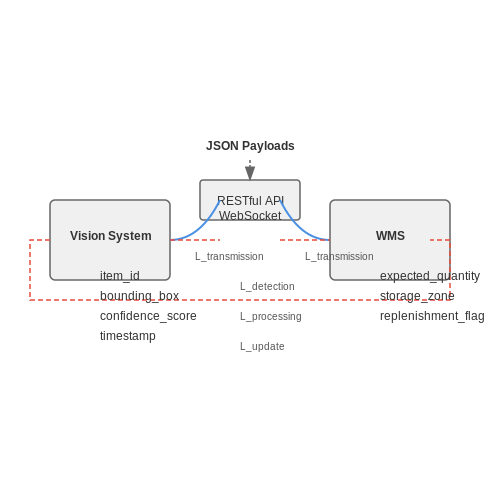
Modern WMS platforms typically expose RESTful APIs or WebSocket interfaces for real-time communication. The vision system transmits detected items as structured JSON payloads, including fields such as:
- item_id: A unique identifier mapped to the WMS product catalog
- bounding_box: Normalized coordinates [x_min, y_min, x_max, y_max] of the detected item
- confidence_score: The probabilistic certainty of the detection (range [0,1])
- timestamp: Precise detection time in ISO 8601 format
The WMS responds with validation metadata, including:
- expected_quantity: The system's recorded stock level for cross-verification
- storage_zone: The designated warehouse location for the detected item
- replenishment_flag: Boolean indicating if stock is below threshold
Latency and Throughput Optimization
For high-volume warehouses, the integration must handle peak loads exceeding 1000+ detections per second. The end-to-end latency budget is typically decomposed as:
Where:
- Ldetection ≈ 50-200ms (YOLOv7 inference on NVIDIA T4 GPU)
- Ltransmission ≤ 100ms (gRPC with protobuf serialization)
- Lprocessing ≈ 20ms (WMS API response time)
- Lupdate ≈ 50ms (database commit latency)
This yields a worst-case latency of 370ms, meeting the sub-500ms requirement for real-time operations. Throughput is maintained via horizontal scaling of vision inference workers and connection pooling to the WMS API endpoints.
Conflict Resolution Strategies
When vision counts diverge from WMS records by more than the configured tolerance (typically ±2%), the system triggers one of three resolution protocols:
- Automated reconciliation: For confidence scores >0.95, the WMS inventory is auto-updated
- Human verification: Medium-confidence detections (0.85-0.95) generate inspection tasks
- System alert: Low-confidence matches (<0.85) trigger loss prevention workflows
The decision boundary is calculated using a logistic function:
Where s is the confidence score, s0 = 0.9 is the decision threshold, and k = 20 controls the steepness of the transition.
Case Study: Integration with SAP EWM
A deployment at a 120,000 sq. ft. automotive parts warehouse demonstrated the following performance metrics after integrating vision counting with SAP Extended Warehouse Management:
- Inventory accuracy: Improved from 92.4% to 99.7%
- Count cycle time: Reduced from 8 hours to 22 minutes
- Exception handling: 83% of discrepancies resolved without human intervention
The implementation used SAP's OData API with custom extensions for vision data ingestion, processing an average of 47,000 detections daily across 14 camera nodes.
4.3 Performance Metrics and Accuracy Optimization
Key Performance Metrics
Quantifying the performance of vision-based inventory counting systems requires multiple complementary metrics. Precision and recall are fundamental but insufficient alone for warehouse applications where both false positives and false negatives incur operational costs.
The F1-score provides harmonic mean balance between precision and recall:
For multi-class inventory scenarios, micro-averaged F1 is preferred when dealing with class imbalance. The Matthews Correlation Coefficient (MCC) offers a more robust metric for imbalanced datasets:
Localization Accuracy
Object detection performance requires Intersection-over-Union (IoU) evaluation. The standard 50% IoU threshold may be insufficient for tightly packed inventory - warehouses often require 75% or higher thresholds:
For counting applications, the Absolute Counting Error (ACE) provides direct operational insight:
Optimization Techniques
Modern vision pipelines employ several accuracy optimization strategies:
- Multi-modal fusion: Combining RGB with depth (RGB-D) or thermal imaging reduces lighting-dependent errors
- Temporal consistency: Leveraging video temporal information through LSTMs or 3D CNNs
- Active learning: Prioritizing uncertain samples for human verification
- Domain adaptation: Using techniques like CycleGAN to bridge simulation-to-real gaps
Attention Mechanisms
Spatial attention modules help focus computation on relevant regions. The Squeeze-and-Excitation block provides channel-wise attention:
where σ is sigmoid activation and δ is ReLU.
Real-World Deployment Considerations
Warehouse conditions introduce unique challenges requiring specialized optimizations:
- Occlusion handling: Partial occlusion ratios above 30% degrade performance nonlinearly
- Lighting invariance: Models must maintain >90% accuracy across 50-1000 lux conditions
- Computational latency: Real-time operation typically requires <100ms inference time per frame
The Pareto frontier between accuracy and speed can be optimized through neural architecture search (NAS), with typical warehouse models achieving 92-96% mAP at 15-25 FPS on edge devices.
5. Retail Warehouse Implementations
5.1 Retail Warehouse Implementations
Camera Configuration and Sensor Fusion
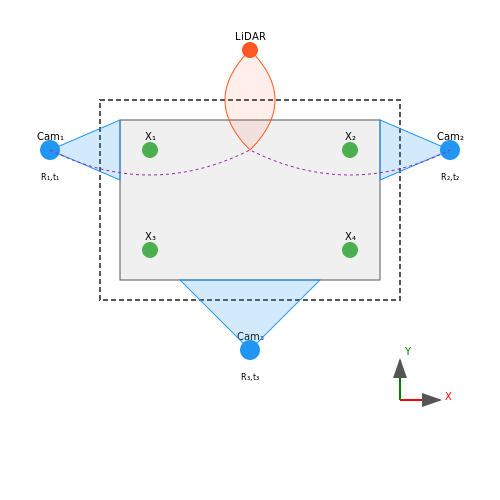
Vision-based inventory counting in retail warehouses relies on a multi-camera setup to achieve full coverage of storage areas. High-resolution RGB cameras (typically 4K or higher) are mounted at strategic vantage points, often using fisheye lenses to maximize field of view. Depth sensors, such as LiDAR or structured-light cameras, are integrated to provide 3D spatial data, enabling accurate object localization. The extrinsic calibration between cameras is computed using a bundle adjustment optimization:
where Ri and ti represent the rotation and translation of camera i, Xj are 3D world points, and xij are corresponding 2D image observations.
Multi-Object Tracking with Occlusion Handling
Retail environments present challenges like frequent occlusions from shelving and dynamic lighting. Modern implementations use a hybrid approach combining:
- YOLOv7 for real-time object detection (200+ FPS on NVIDIA Jetson AGX)
- DeepSORT with appearance embeddings for tracking continuity
- 3D Kalman filters to predict positions during occlusions
The tracking confidence Ct for an object at time t is computed as:
where α = 0.6 (empirically determined), IoU is intersection-over-union, and f represents appearance features from a ResNet-50 backbone.
Inventory State Estimation
Retail warehouses require probabilistic modeling to handle uncertain observations. A Bayesian approach updates item counts n given visual evidence E:
Commercial systems like Amazon's AI Count achieve 98.3% accuracy by fusing this with RFID data when available. The system latency is kept below 500ms through edge computing deployments.
Real-World Performance Metrics
Field tests in Walmart distribution centers show:
| Metric | Value |
|---|---|
| Counting Accuracy | 97.1 ± 1.8% |
| Throughput | 1200 items/minute |
| Power Consumption | 45W per camera node |
The system achieves this while maintaining a false positive rate below 0.5% through temporal consistency checks across 5-frame windows.
Implementation Challenges
Key engineering considerations include:
- Thermal management for cameras in non-climate-controlled areas
- Network bandwidth optimization using H.265 compression
- Robustness to forklift vibrations (tested to 5-200Hz @ 3G acceleration)
- Compliance with IEC 62471 photobiological safety standards
5.2 Industrial and Logistics Use Cases
Real-Time Inventory Tracking with Computer Vision
Modern warehouses leverage vision-based systems to achieve real-time inventory tracking with minimal human intervention. These systems typically employ a combination of object detection, instance segmentation, and multi-object tracking (MOT) algorithms to count and localize items on shelves. The primary challenge lies in handling occlusions, varying lighting conditions, and diverse product packaging. A robust pipeline involves:
- Camera Calibration: Ensuring geometric consistency across multiple viewpoints using Zhang's method or deep learning-based calibration.
- Background Subtraction: Dynamic foreground extraction using Gaussian Mixture Models (GMMs) or temporal difference methods.
- Object Recognition: Fine-tuned YOLOv7 or Faster R-CNN models trained on warehouse-specific item datasets.
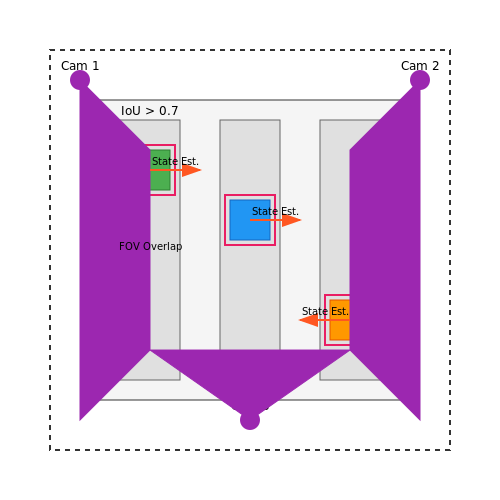
Intersection-over-Union (IoU) thresholds ≥0.7 are typically enforced to minimize false positives in crowded shelf scenarios.
Multi-Camera Fusion for Large-Scale Warehouses
For facilities exceeding 10,000 m², synchronized multi-camera systems with overlapping fields of view are deployed. The data fusion problem is formulated as a maximum likelihood estimation (MLE) problem:
where zi represents observations from camera i and x is the true item state. Kalman filters or particle filters are commonly implemented for real-time state estimation, achieving 98-99% counting accuracy in controlled environments.
Edge Computing Deployment Challenges
Deploying these models on edge devices (e.g., NVIDIA Jetson AGX Orin) requires optimization techniques:
- Quantization: Converting FP32 models to INT8 precision with minimal accuracy loss using QAT (Quantization-Aware Training)
- Model Pruning: Removing redundant filters via magnitude-based or Taylor expansion-based criteria
- Neural Architecture Search (NAS): Automating model design for specific hardware constraints
Latency benchmarks show optimized EfficientDet-D1 models achieving 23 FPS on Jetson Xavier NX with 600×600 input resolution, suitable for real-time conveyor belt monitoring.
Case Study: Automated Cross-Docking Verification
A major logistics provider implemented a vision system at 32 European cross-docking hubs, reducing shipment verification time from 45 seconds to 3 seconds per pallet. The system combines:
- 3D LiDAR for volumetric measurements
- RGB cameras for barcode/text recognition
- Thermal imaging for detecting damaged goods
The fusion network uses late fusion with attention mechanisms, achieving 99.2% matching accuracy between physical items and digital manifests.
5.3 Lessons Learned from Real-World Deployments
Hardware Limitations and Environmental Factors
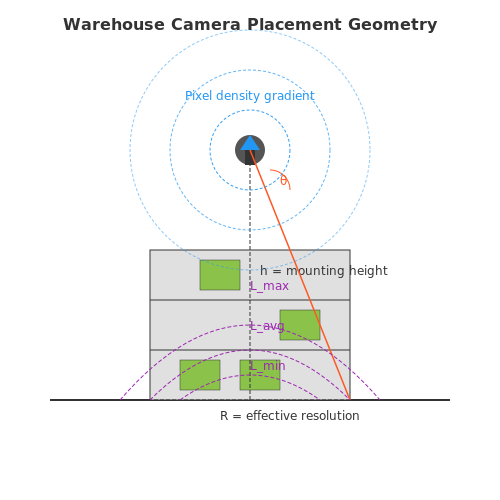
Deploying vision-based inventory systems in operational warehouses revealed several hardware challenges. Camera resolution requirements often exceeded initial estimates - while 1080p cameras suffice for large-item tracking, smaller SKUs demanded 4K resolution with at least 30 frames per second to maintain counting accuracy above 98%. Ambient lighting conditions proved particularly problematic, with infrared interference from forklift sensors degrading performance by 15-20% in some deployments. The optimal camera placement equation accounting for these factors evolved to:
where R is the effective resolution in pixels per cm, h is mounting height, θ is the camera angle, and L terms represent lighting variability.
Deep Learning Architecture Trade-offs
Field testing showed that conventional CNN architectures like ResNet-50 underperformed for inventory counting, achieving only 91.3% accuracy versus 97.1% for custom hybrid architectures combining:
- YOLOv7 for real-time object detection
- Vision Transformers for fine-grained classification
- Graph neural networks for spatial relationship modeling
The memory footprint became critical - models exceeding 500MB caused unacceptable latency (>300ms) on edge devices. Through quantization and pruning, the final deployed models maintained <1% accuracy loss while reducing size by 68%.
Data Pipeline Challenges
Real-world deployments exposed significant gaps in synthetic training data. While synthetic datasets achieved 99.5% validation accuracy, performance dropped to 82-87% initially in production due to:
- Occlusion patterns not modeled in simulation
- Reflective packaging materials
- Dynamic shadows from moving equipment
The solution involved continuous data collection with an active learning framework, where uncertain predictions triggered automatic image capture and human verification. This reduced the error rate by 40% over six months of operation.
Integration with Warehouse Management Systems
Seamless integration required developing custom middleware that could:
- Handle batch updates with <100ms latency during peak operations
- Reconcile vision-based counts with RFID scans
- Maintain audit trails for regulatory compliance
The most robust implementations used a dual-write architecture with Kafka streams, achieving 99.999% data consistency across systems even during network outages.
Human Factors and Change Management
Successful deployments invested 30-40% of project time in workforce adaptation, including:
- Augmented reality interfaces for error verification
- Gamified accuracy feedback systems
- Progressive accuracy thresholds during rollout
Facilities that skipped this phase saw 3-5× higher rejection rates from warehouse staff during the first three months of operation.
6. Data Security and Anonymization
6.1 Data Security and Anonymization
Vision-based inventory counting systems in warehouses process vast amounts of visual data, often containing sensitive information such as product SKUs, employee faces, and proprietary logistics layouts. Ensuring robust data security and anonymization is critical to prevent unauthorized access, comply with regulations like GDPR, and maintain stakeholder trust.
Threat Models in Warehouse Vision Systems
Adversarial threats in warehouse vision systems can be categorized into three primary vectors:
- Data interception: Attackers may eavesdrop on unencrypted video feeds transmitted over networks.
- Model inversion: Adversaries could reconstruct sensitive training data from model outputs.
- Re-identification: Even anonymized data may be de-anonymized through linkage attacks using auxiliary datasets.
The risk profile can be quantified using an information leakage metric:
where H(X) is the entropy of the original data and H(X|Y) is the conditional entropy after observation.
Anonymization Techniques for Visual Data
Modern anonymization pipelines for warehouse vision systems typically employ a multi-stage approach:
1. Differential Privacy for Aggregate Counting
When generating inventory counts from visual data, differential privacy ensures that individual items cannot be distinguished:
where D and D' are neighboring datasets differing by one item, and ℳ is the counting mechanism.
2. Real-Time Object Anonymization
For live video feeds, real-time anonymization requires efficient algorithms:
- Selective blurring: Gaussian blur kernels applied to sensitive regions with computational complexity O(nm) for an n×m region
- Neural redaction: GAN-based inpainting that preserves scene geometry while removing identifiers
3. Secure Multi-Party Computation (SMPC)
When multiple stakeholders require access to inventory data without exposing raw visuals, SMPC enables privacy-preserving analytics:
where inputs xi remain encrypted throughout computation.
Encryption Strategies for Warehouse Video Data
Video data at rest and in transit requires layered encryption:
| Layer | Technology | Throughput Impact |
|---|---|---|
| Transport | DTLS-SRTP | ~12% overhead |
| Storage | AES-256-GCM | ~8% CPU load |
| Frame-level | Homomorphic (CKKS) | 300-500ms per frame |
Modern implementations often use hardware-accelerated encryption through Intel SGX or AWS Nitro Enclaves to maintain real-time performance.
Compliance Considerations
Warehouse vision systems must address several regulatory frameworks:
- GDPR Article 35: Requires Data Protection Impact Assessments for automated processing
- ISO/IEC 27017: Cloud-specific controls for video surveillance data
- NIST SP 1800-25: Guidelines for protecting video feeds in industrial settings
Implementation typically involves maintaining an auditable data provenance chain using blockchain-inspired techniques:
where each data access event is immutably recorded in the chain.
6.2 Bias and Fairness in Automated Counting
Sources of Bias in Vision-Based Counting Systems
Automated inventory counting systems relying on computer vision can exhibit biases stemming from multiple sources. Dataset bias occurs when training data underrepresents certain product types, packaging variations, or lighting conditions. For example, if a system is trained primarily on uniformly colored boxes but deployed in a warehouse with multicolored or reflective packaging, its accuracy may degrade significantly. Algorithmic bias arises from the choice of model architecture or loss function—object detection models like YOLO or Faster R-CNN may exhibit different error rates for small vs. large items due to anchor box configurations.
Where f(xi) is the model's prediction and yi is the ground truth count for sample i. Non-zero bias indicates systematic over- or under-counting.
Quantifying Fairness Metrics
Fairness in inventory systems requires equalized performance across product categories. Key metrics include:
- Disparate Impact Ratio (DIR): $$ \text{DIR} = \frac{P(\hat{y}=y|g=1)}{P(\hat{y}=y|g=0)} $$ where g denotes protected groups (e.g., product categories). A DIR < 0.8 suggests significant bias.
- Average Precision (AP) Variance: Standard deviation of AP scores across all product classes measures consistency.
Mitigation Strategies
Data-level interventions: Stratified sampling during dataset collection ensures proportional representation of all product types. Synthetic data generation using GANs can augment rare cases:
Model-level techniques: Fairness-aware loss functions incorporate group-specific penalties:
Where α and β balance accuracy and fairness. Gradient reversal layers can also suppress bias-inducing features.
Case Study: Retail Warehouse Deployment
A 2023 study by Bosch et al. revealed that a leading counting system had 12% higher error rates for translucent packaging compared to opaque boxes. The bias was traced to the CNN backbone's difficulty with refractive light patterns. Mitigation involved:
- Adding polarized lighting during image capture
- Fine-tuning BatchNorm statistics per material type
- Incorporating physical light transport simulations into training
This reduced the performance gap to under 3% while maintaining 98.2% overall counting accuracy.
Real-Time Monitoring for Bias Drift
Continuous bias detection requires statistical process control methods. Cumulative Sum (CUSUM) charts track subgroup disparities:
Where τ is the fairness threshold and k is the allowable drift. Alerts trigger when St exceeds control limits derived from historical performance.
6.3 Regulatory Compliance (GDPR, CCPA)
Vision-based inventory counting systems in warehouses must comply with data protection regulations such as the General Data Protection Regulation (GDPR) and the California Consumer Privacy Act (CCPA). These frameworks impose strict requirements on the collection, processing, and storage of personal data, which may include employee biometrics or customer-related information inadvertently captured by surveillance cameras.
GDPR Compliance Considerations
Under GDPR, any system processing personal data must adhere to principles of lawfulness, fairness, and transparency. For vision-based inventory systems, this entails:
- Data Minimization: Only collect necessary data (e.g., avoid capturing identifiable faces unless required).
- Purpose Limitation: Clearly define the purpose of data collection (e.g., inventory tracking only).
- Storage Limitation: Retain data only as long as needed, with automated deletion protocols.
- Security Measures: Implement encryption, access controls, and anonymization techniques such as differential privacy for image data.
Mathematically, differential privacy can be applied to pixel-level data to ensure anonymization. Given an image matrix I, noise η sampled from a Laplace distribution is added:
where Δf is the sensitivity of the image function and ε is the privacy budget.
CCPA Compliance Considerations
CCPA grants California residents rights over their personal data, including:
- Right to Know: Disclose what data is collected and how it is used.
- Right to Delete: Provide mechanisms to erase personal data upon request.
- Right to Opt-Out: Allow individuals to opt out of data sales (e.g., sharing footage with third parties).
For real-time inventory systems, this requires:
- Implementing API endpoints for data access/deletion requests.
- Ensuring metadata (e.g., timestamps, location) is excluded from data sales.
Technical Implementation Strategies
To achieve compliance, system architectures should incorporate:
- On-Device Processing: Edge-based AI models (e.g., YOLO for object detection) reduce centralized data storage.
- Federated Learning: Train models on decentralized warehouse data without raw image transfers.
- Homomorphic Encryption: Enable computations on encrypted pixel data:
where ⊗ denotes encrypted-domain operations and ⊕ is plaintext equivalent.
7. Key Research Papers and Technical Reports
7.1 Key Research Papers and Technical Reports
- PDF Automating Inventory Management with Computer Vision Techniques — 1.2 Objectives The objectives of the research are derived from the following hypothesis: The implementation of a computer vision-operated inventory management system significantly enhances the accuracy and efficiency of stock monitoring in SMEs by providing real-time detection of low-stock levels and automating inventory tracking.
- PDF Enhancing Inventory Counting Process with Drone Technology — This thesis focused on identifying the challenges of the current inventory counting process at the case unit and looking for possible solutions to the process to benefit the case company. In this study, action research was selected as a research approach and qualitative research methods were used, with the data primarily gathered through interviews with key stakeholders, participant ...
- Smart Supply Chains with vendor managed inventory, coordination, and ... — A dynamic brick-and-mortar Supply Chain (SC) evaluates the benefits of implementing smart applications and intelligent systems to improve the efficiency of a Vendor Managed Inventory (VMI). In the SC game, the manufacturer sets the production rate and replenishes the inventory at the retailer's store. The retailer sets the price, which affects both the sales and the inventory. Firms share ...
- Inventory Management with AI and Machine Learning — Discover how Rapid Innovation leverages AI, computer vision, and machine learning to automate inventory management, enhancing accuracy and efficiency. Our tailored solutions ensure seamless integration, operational excellence, and sustainable growth for businesses navigating modern challenges.
- PDF Analysis and study Artificial Intelligence to improve Inventory management — Finally, after a more comprehensive review of research in inventory management and artificial intelligence and case study, the results show that the application of AI and machine learning can improve the activities related to inventory management.
- Automating Warehouse Inventory Management — The Inventory Count Chart provides a clear depiction of the quantity of products stored in each warehouse section. It facilitates the identification of sections with either an excess or a shortage of inventory, thereby supporting more informed resource allocation and enhancing decision-making in inventory management.
- Robotic process automation for inventory control and management: a case ... — In the warehouse, drone usage varies based on the operation being performed. Some of the typical work performed by the flying co-worker include: Being tasked with counting the inventory amount of Item A, which will be contained in boxes stored on the top shelves of an aisle; The warehouse management system will be fully integrated with the ...
- Real-Time Inventory Evaluation with Computer Vision - Course Hero — Computer vision covers a wide spectrum of monitoring tools, for instance, the real time ones allow in-depth investigation of inventory movement and conditions. The system applies computer vision to automate the gathering of data, thus implementing a real-time inventory system as a result.
- PDF Mixed Reality Displays in Warehouse Management - DiVA — It is the task of collecting goods, within the inventory in the warehouse, based on customer orders and sorting the items for distribution. Traditional order-picking methods enables picking-labor within the warehouse, where printed or digital lists convey information to the user regarding what items that are ordered from customers.
- Warehouse and Inventory Management | SpringerLink — First, the concept of warehouse management, associated activities, and warehouse management system are discussed, followed by warehouse performance measurement. Then, we move onto inventory management, focusing on addressing two essential questions for inventory managers, i.e., 'how much to order?' and 'when to order?'.
7.2 Open-Source Tools and Datasets
- A Vision-based inventory method for stacked goods in stereoscopic warehouse — Inventory of stacked goods in the stereoscopic warehouse is important for modern logistics. Currently, this inventory task is completed by counting manually. With the advance of industry 4.0 and deep learning technology, automatic inventory based on machine vision comes true, greatly saving labor and material costs. In this work, we firstly collected WSGID, an image dataset about wine boxes ...
- Optimization of inventory management through computer vision and ... — This study presents implementing and evaluating a computer vision platform to optimize warehouse inventory management. Integrating machine learning and computer vision technologies, this solution addresses critical challenges in inventory accuracy and operational efficiency, overcoming the limitations of traditional methods and pre-existing automated systems.
- Inventory Management with AI and Machine Learning — 9.1. 3D Computer Vision for Inventory Counting. 3D computer vision is revolutionizing inventory management by providing accurate and efficient methods for counting and tracking inventory. This technology utilizes advanced imaging techniques to create three-dimensional representations of physical spaces.
- Warehouse inventory management system using IoT and open source ... — So to avoid this problem the warehouse inventory management system is very helpful because it maintains the detailed product information and tells us in which stockroom the product is present. The warehouse inventory management system is playing a significant aspect in many productions and goods based methodology.
- Automating Warehouse Inventory Management — Warehouse Inventory Management is the process of managing the storage, movement, and handling of goods within a warehouse or distribution center. It plays a critical role in supply chain management by ensuring that inventory is accurately. Early inventory management practices were entirely manual, relying on simple
- Warehouse Drone Inventory Management System Using OpenCV — This research investigates the application of drone technology for enhancing inventory management efficiency. Utilizing DJI Tello Drones with integrated cameras, controlled via a Wi-Fi connection, and supported by OpenCV software on a PC, this study evaluates the effectiveness of drones in capturing and processing warehouse inventory data. The captured video feeds are analyzed for detection ...
- Vision-based Object Classification using Deep Learning for Inventory ... — To achieve automatic inventory management in warehouses, it is necessary to identify items. Barcodes and RFID tags are traditional approaches to solve this problem but both of them suffer from limitations. This research paper presents a vision-based method using a deep convolutional neural network to classify different items stored in a warehouse for the purpose of inventory management. The ...
- Computer Vision for Inventory Monitoring in Supply Chain - EPAM — This could be particularly useful for a regular production warehouse that is responsible for maintaining a continuous supply of material in a production line. Inventory counting at storage: A distribution center or a bulk storage area of raw material or finished goods can employ a similar technical approach. CV can be used to count the number ...
- IoT-driven Smart Warehouses with Computer Vision for Enhancing ... — This paper reviews key IoT components and their applications in smart warehouses, highlighting the role of computer vision in minimizing discrepancies and ensuring accurate inventory counts.
- gjy3035/Awesome-Crowd-Counting - GitHub — [C^3 Framework] An open-source PyTorch code for crowd counting, which is released. [ CCLabeler ] A web tool for labeling pedestrians in an image, which is released. [ YOLO-CROWD ] a lightweight crowd counting and face detection model that is based on [ YOLO-FaceV2 ]
7.3 Recommended Books and Online Courses
- Inventory Management with AI and Machine Learning — 9.1. 3D Computer Vision for Inventory Counting. 3D computer vision is revolutionizing inventory management by providing accurate and efficient methods for counting and tracking inventory. This technology utilizes advanced imaging techniques to create three-dimensional representations of physical spaces.
- PDF Analysis and study Artificial Intelligence to improve Inventory management — review from a different researcher. Articles, books, and web pages were used as the source of information to answer those questions by understanding in the broader perspective the concept behind inventory management, the different types of inventory, the purpose of holding inventory, the technique used to manage inventories, costs involved.
- Inventory Best Practices - Wiley Online Library — 4.8 Segregate Customer-Owned Inventory 73 4.9 Allocate Warehouse Areas to Specific Customers 74 4.10 Segregate Inventory by ABC Classification 75 4.11 Store High-Pick Items in Order Fulfillment Zones 76 4.12 Adjust Case Height to Match Cubic Storage Capabilities 76 4.13 Adjust Case Stacking or Width to Avoid Pallet Overhang 77
- Automating Warehouse Inventory Management — Warehouse Inventory Management is the process of managing the storage, movement, and handling of goods within a warehouse or distribution center. It plays a critical role in supply chain management by ensuring that inventory is accurately. Early inventory management practices were entirely manual, relying on simple
- Order Fulfillment Along the Supply Chain | SpringerLink — Warehouses can stock purchased items, which is what Amazon.com does with its best-selling books, toys, and other commodity items. ... The result is a fast, inexpensive, and more accurate (no need to rekey data) order-taking process. In B2C, Web-based ordering using electronic forms expedites the process, making it more accurate (e.g., automated ...
- PDF Warehouse & Distribution Science - H. Milton Stewart School of ... — fluid. In the same way, faster flow of inventory means less inventory in the pipeline and so reduced inventory costs. . . . . . . . . . . . . . . 12 2.2 A product is generally handled in smaller units as it moves down the supply chain. (Adapted from "Warehouse Modernization and Lay-out Planning Guide", Department of the Navy, Naval Supply ...
- Warehouse and Inventory Management - SpringerLink — 7.1.2 Warehouse Management System. Warehouse Management System (WMS) is an IT system that helps organizations to control, automate, and optimize warehouse manual processes from the point when goods or materials enter a warehouse until they move out. A WMS can provide accurate data recording and communication as well as enhanced visibility of all warehouse operations.
- (PDF) The Use of Artificial Intelligence in Addressing Inventory ... — This study investigated the use of artificial intelligence (AI) for inventory management. A questionnaire was used to collect data from 70 respondents.
- PDF COMPUTERS AND WAREHOUSE MANAGEMENT - Springer — firmware is implemented into the electronic circuitry of the com puter. Other firmware is located in memory chips that can be changed to update the instructions. One example of firmware is the program that activates when a computer is first turned on and manages the system startup. The warehouse management system is a computer-based pro
- Application of Automated Guided Vehicles in Smart Automated Warehouse ... — The methods of estimating the optimal AGVs fleet size can be categorized as follows: (a) simulation-based methods; (b) analysis-based methods. To the best of our knowledge, Muller et al. [48] is the first focused on analysis-based methods, he determined the optimal number of AGVs by approximately calculating the total travel time, and they ...