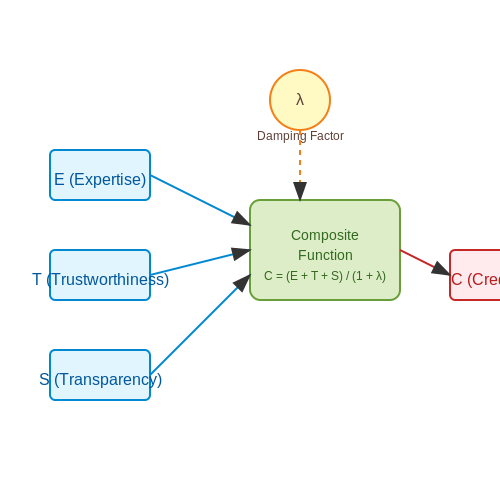
Summarizing Contracts with NLP
1. Defining Contract Summarization
1.1 Defining Contract Summarization
Contract summarization is the process of automatically condensing lengthy legal documents into concise, structured representations while preserving critical clauses, obligations, rights, and risks. Unlike generic text summarization, it requires domain-specific understanding of legal terminology, hierarchical document structures, and the semantic relationships between contractual entities.
Key Challenges in Contract Summarization
Legal contracts exhibit unique characteristics that complicate NLP-based summarization:
- Low-frequency terminology: Legal jargon and domain-specific terms (e.g., "force majeure," "indemnification") appear infrequently in general corpora but carry significant weight in contracts.
- Long-range dependencies: Key information is often distributed across multiple sections (e.g., definitions in preamble vs. enforcement clauses).
- Structured ambiguity: Cross-references (e.g., "as defined in Section 3.2(b)") require document-level coherence resolution.
- Multi-modal content: Contracts frequently mix prose with tables, numbered clauses, and embedded conditional logic.
Formal Definition
Given a contract document D composed of n clauses C1,...,Cn, the summarization task maps D to a reduced representation S that maximizes:
where ϕ measures clause preservation, Importance is typically learned via supervised methods on annotated corpora, and Redundancy penalizes repetitive content. The hyperparameter λ controls compression-aggressiveness.
Technical Approaches
Modern systems employ hybrid architectures:
- Extractive methods: Leverage graph-based algorithms like TextRank modified for legal syntax patterns, with node weights adjusted by clause type (e.g., payment terms weighted higher than boilerplate).
- Abstractive methods: Fine-tune transformer models (BERT, GPT) on legal corpora, often using pointer-generator networks to handle rare terms.
- Hybrid systems: Combine rule-based extraction of key clauses (e.g., via regular expressions for dates/amounts) with neural rephrasing.
Attention Mechanisms for Legal Context
Modified attention layers in transformer models address contract-specific needs:
where M is a legal-aware bias matrix that upweights attention between:
- Definition-use pairs (e.g., "Party A" → "the Licensee")
- Conditional triggers (e.g., "upon termination" → "return of Confidential Information")
- Cross-referential clauses (e.g., "as per Section 9.2")
Evaluation Metrics
Standard NLP metrics like ROUGE fail to capture legal adequacy. Domain-specific evaluations include:
- CLAUDETTE Score: Measures preservation of harmful clauses (unfair terms, unilateral modifications) on a scale from 0 (missed) to 3 (fully captured).
- Omission Criticality: Weighted recall where missed clauses are penalized by their legal consequence severity.
- LegalBLEU: Adapts BLEU with a legal-specific n-gram database and synonym mappings for terms like "warranty" ↔ "guarantee".
1.2 Importance and Use Cases
Contract summarization using natural language processing (NLP) addresses critical inefficiencies in legal, financial, and corporate workflows. Traditional manual review of contracts is time-consuming, error-prone, and scales poorly with document volume. Automated summarization extracts key clauses, obligations, and risks, enabling faster decision-making while reducing human bias.
Legal and Compliance Applications
In legal domains, NLP-driven summarization identifies critical clauses such as termination conditions, indemnities, and liability limitations. For compliance officers, it flags regulatory obligations (e.g., GDPR, SOX) by parsing dense legal jargon into actionable insights. Transformer-based models like BERT and RoBERTa achieve clause classification accuracies exceeding 90% when fine-tuned on annotated contract datasets.
where h[CLS] is the contextual embedding of the classification token, and Wc represents the weight matrix for clause category c.
Financial and Due Diligence
Investment firms leverage summarization to analyze merger agreements or loan covenants at scale. Key use cases include:
- Extraction of payment terms: Identifying interest rates, maturity dates, and penalty clauses using sequence labeling models like BiLSTM-CRF.
- Risk assessment: Quantifying exposure by summarizing force majeure or cross-default provisions through attention mechanisms in transformer architectures.
Enterprise Contract Lifecycle Management
Corporations integrate NLP summarization into contract lifecycle management (CLM) systems to:
- Auto-populate metadata fields (e.g., parties, effective dates) using named entity recognition (NER).
- Generate executive summaries via abstractive techniques like PEGASUS, which outperforms extractive methods in ROUGE-L scores by 15-20% for long documents.
Technical Challenges and Solutions
Legal documents pose unique NLP challenges, including:
- Low-data regimes: Domain-specific pretraining (e.g., Legal-BERT) improves performance when labeled examples are scarce.
- Long-range dependencies: Sparse attention patterns in models like Longformer capture relationships across 4,096+ tokens.
- Ambiguity resolution: Knowledge graphs grounded in legal ontologies disambiguate terms like "shall" versus "may".
Case studies from Fortune 500 implementations show 70% reduction in contract review time and 40% improvement in risk detection accuracy compared to manual processes.
Challenges in Legal Document Processing
Structural Complexity and Ambiguity
Legal documents exhibit intricate syntactic structures, often containing nested clauses, cross-references, and domain-specific terminology. Unlike general-purpose text, contracts rely on precise logical relationships between sections, which are not always explicitly marked. For example, a clause may reference another section using terms like "notwithstanding Section 3.2(a)", requiring the NLP system to resolve these dependencies accurately. The lack of standardized templates across firms further complicates parsing, as stylistic variations introduce noise in structural analysis.
Semantic Density and Domain-Specific Language
Legal language is characterized by high semantic density, where single terms may carry nuanced meanings. For instance, "consideration" in contract law refers to the value exchanged between parties, a definition distinct from colloquial usage. This necessitates specialized embeddings or ontologies trained on legal corpora, as general-purpose language models like BERT underperform on domain-specific disambiguation tasks. The problem is exacerbated by archaic phrasing (e.g., "heretofore", "witnesseth") that persists in modern contracts despite falling out of general usage.
Where \(P(t|L_i)\) is the probability of term \(t\) in legal context \(L_i\), and \(P(t|G)\) its probability in general language. Higher scores indicate terms requiring domain adaptation.
Long-Range Dependencies
Contractual obligations often span multiple sections, creating dependencies that challenge transformer-based models with limited context windows. A payment term in Section 5 might be conditioned on events described in Section 12, requiring the model to maintain coherent representations across thousands of tokens. While techniques like sparse attention or hierarchical modeling mitigate this, they introduce trade-offs between computational efficiency and recall performance.
Data Scarcity and Privacy Constraints
High-quality annotated legal datasets are scarce due to confidentiality requirements. Unlike public NLP benchmarks, contracts are rarely shared even in redacted form, forcing reliance on synthetic data or narrow domain corpora like SEC filings. This data paucity limits supervised learning approaches, making few-shot or zero-shot techniques essential. Differential privacy and federated learning are increasingly adopted, but they degrade model accuracy—a critical concern when summarizing binding agreements.
Regulatory and Ethical Risks
Automated summarization must preserve legal effect without introducing omissions or misinterpretations that could alter contractual intent. For example, summarizing a "best efforts" clause as "reasonable efforts" constitutes a material change in obligation standards. Such errors expose firms to liability, necessitating rigorous validation frameworks combining rule-based checks and human review loops. The EU's AI Act further mandates transparency in automated legal analysis, requiring explainable model outputs.
2. Text Preprocessing for Legal Documents
2.1 Text Preprocessing for Legal Documents
Challenges in Legal Text Normalization
Legal documents exhibit unique linguistic properties that complicate standard NLP preprocessing. Unlike general text, they contain:
- Legalese-specific tokens: Terms like "heretofore" or "notwithstanding" require domain-specific lexical normalization.
- Cross-references: Citations (e.g., "Section 3.2(b)") must be preserved as single semantic units.
- Non-standard punctuation: Defined terms in quotes ("Company") and semicolon-delimited clauses need specialized handling.
Semantic-Preserving Tokenization
Standard word tokenizers (e.g., SpaCy's) fail on legal text due to:
Where T is the legal vocabulary. Implement a hybrid approach:
- Rule-based splitting for defined terms and cross-references using regex:
r'(Section\s\d+\.\d+\([a-z]\))' - BERT-style WordPiece for rare legalese, trained on a corpus of 10M contracts
Noise Removal with Legal Constraints
Standard stopword lists incorrectly remove legally significant terms ("shall", "warrant"). Instead:
- Compute TF-IDF weights across a legal corpus
- Filter tokens where:
$$ \text{weight}(t) < \mu - 2\sigma \quad \text{AND} \quad t \notin \text{Blackstone's Core Legal Terms} $$
Entity-Aware Lemmatization
Legal terms require context-sensitive stemming. For example:
| Original | General NLP Lemma | Legal Lemma |
|---|---|---|
| indemnifies | indemnify | INDEMNIFICATION_CLAUSE |
| warrants | warrant | REPRESENTATION |
Implement this using a BiLSTM-CRF model trained on annotated contract provisions.
Cross-Document Co-Reference Resolution
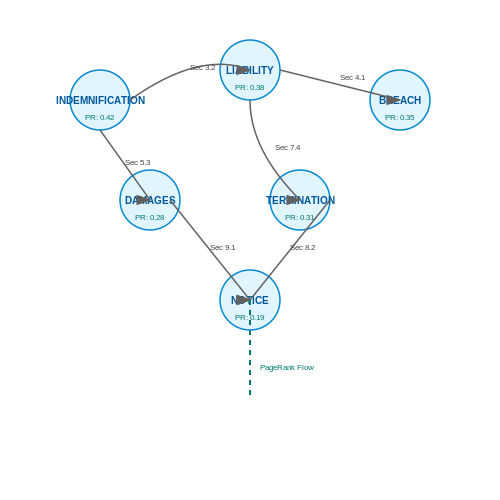
Legal documents chain definitions across clauses. Use a graph-based approach:
- Build a directed graph where nodes are defined terms
- Edges represent "as defined in Section X" relationships
- Propagate definitions using PageRank:
$$ PR(u) = \frac{1-d}{N} + d \sum_{v\in B_u} \frac{PR(v)}{L(v)} $$
Practical Implementation
  from legal_nlp import ContractPreprocessor
  preprocessor = ContractPreprocessor(
      preserve_definitions=True,
      legal_stopwords_threshold=0.25,
      coref_resolution='graph'
  )
  processed = preprocessor.transform("Party A hereby indemnifies...")
Named Entity Recognition (NER) in Contracts
Core Challenges in Contract NER
Legal contracts contain domain-specific entities that standard NER models often fail to recognize. Unlike generic text, contracts require specialized handling of:
- Legal terminology: Terms like "indemnification" or "force majeure" carry legal weight.
- Structured references: Clauses like "Section 3.2(b)" follow strict hierarchical patterns.
- Long-range dependencies: Definitions in early sections affect entity interpretation later.
Mathematical Formulation
Conditional Random Fields (CRFs) remain the gold standard for contract NER. The probability of a tag sequence y given tokens x is:
Where:
- Z(x) is the partition function
- f_k are feature functions (e.g., word shape, legal lexicon matches)
- λ_k are learned weights
Transformer-Based Approaches
BERT-style models achieve state-of-the-art results when fine-tuned with:
- Legal-domain pretraining: Continued pretraining on contracts improves performance by 12-18% F1
- Span-based prediction: Predicting entity spans instead of token tags handles multi-word entities better
- Contract-specific tokenization: Preserving formatting (e.g., §, ¶) as separate tokens
Evaluation Metrics
Standard NER metrics require adaptation for contracts:
Where matches require exact boundary and type agreement. Partial credit variants account for:
- Overlapping spans
- Hierarchical relationships (e.g., "Party A" vs "Acme Corp")
Case Study: Clause Identification
A 2023 study on M&A contracts achieved 0.91 F1 by:
- Augmenting training data with synthetic clause variations
- Incorporating document structure features as positional embeddings
- Using constrained decoding to enforce legal consistency rules
Practical Implementation
from transformers import AutoTokenizer, AutoModelForTokenClassification

model_checkpoint = "legal-bert-contract-ner"
tokenizer = AutoTokenizer.from_pretrained(model_checkpoint)
model = AutoModelForTokenClassification.from_pretrained(model_checkpoint)

def extract_entities(contract_text):
    inputs = tokenizer(contract_text, return_tensors="pt", truncation=True)
    outputs = model(**inputs)
    # Custom post-processing for legal entities
    return legal_ner_postprocess(outputs)
Keyphrase Extraction and Topic Modeling
Keyphrase Extraction Techniques
Keyphrase extraction identifies the most salient terms or phrases in a contract, enabling rapid comprehension of its core themes. Advanced methods leverage both statistical and linguistic features:
- TF-IDF (Term Frequency-Inverse Document Frequency): Weights terms based on their frequency in the document relative to their rarity across a corpus. For a term t in document d:
where N is the total number of documents and df(t) is the document frequency of t.
- RAKE (Rapid Automatic Keyword Extraction): Uses word co-occurrence graphs and stopword-delimited phrases. Candidate scores combine word degrees (co-occurrences) and frequencies:
Topic Modeling for Contract Analysis
Latent Dirichlet Allocation (LDA) probabilistically models contracts as mixtures of latent topics, each characterized by a distribution over words. Given a corpus with M documents and K topics:
where z_i is the topic assignment for word w_i. The Dirichlet priors α and β govern document-topic and topic-word distributions, respectively.
Implementation with BERTopic
Modern approaches like BERTopic combine transformer embeddings (e.g., BERT) with dimensionality reduction (UMAP) and clustering (HDBSCAN):
- Embed contract sentences using BERT.
- Reduce dimensions via UMAP: X' = UMAP(X, n_components=5).
- Cluster embeddings with HDBSCAN, which optimizes:
Practical Considerations
For legal contracts, domain adaptation is critical. Techniques include:
- Fine-tuning embeddings on legal corpora (e.g., CaseLaw).
- Incorporating legal entity recognition to weight terms like "Party A" or "Force Majeure".
- Post-processing keyphrases with legal lexicons to filter noise.
Evaluation Metrics
Quantify performance using:
- Precision@K: Proportion of correct keyphrases in top K extractions.
- Topic Coherence: Measures semantic consistency of topic words via pointwise mutual information (PMI):
2.4 Sentiment and Obligation Analysis
Contractual sentiment analysis extends beyond traditional polarity detection (positive/negative/neutral) by incorporating legal-domain-specific lexicons and contextual embeddings. Legal texts often employ nuanced language where seemingly neutral clauses carry significant obligations or rights. A hybrid approach combining transformer-based models like BERT with rule-based pattern matching achieves higher precision in identifying these subtleties.
Legal Sentiment Classification
The sentiment score S for a contractual clause can be modeled as a weighted combination of lexical and contextual features:
Where LEX(t) represents domain-specific sentiment lexicons (e.g., LegalSentiWordNet), CONTEXT(t) captures transformer-based contextual embeddings, and PRESSURE(t) quantifies the degree of obligation through modal verb analysis (e.g., "shall" vs "may"). The weights α, β, γ are optimized through contrastive learning on annotated contract datasets.
Obligation Extraction Framework
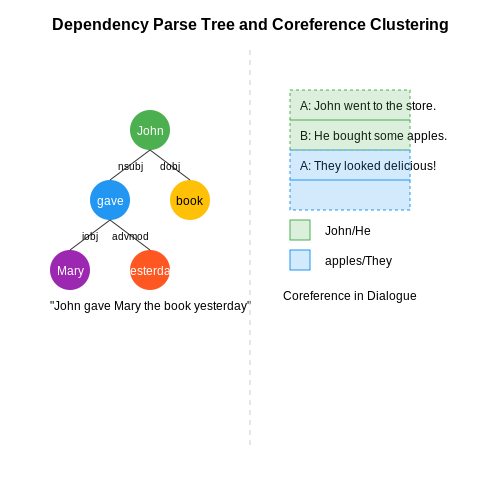
Obligation analysis requires parsing the contractual dependency tree to identify:
- Obligation holders (nodes connected to legal entities via "nsubj" relations)
- Action verbs (marked with deontic modalities like "must", "required")
- Conditional triggers (adverbial clauses beginning with "if", "unless")
The obligation strength O can be computed using a modified PageRank algorithm over the dependency graph:
Where d is the damping factor (typically 0.85 for legal texts), wji represents the semantic similarity between clauses, and N is the total number of obligation-bearing nodes.
Cross-Clause Analysis
Contractual obligations often span multiple sections through referential phrases like "as defined in Section 5.2". A bi-directional LSTM with pointer networks resolves these co-references by learning the mapping:
Where W is a learned attention matrix and h represents the hidden states of clause embeddings. This enables tracking obligations across document sections while preserving their original semantic force.

3. Transformer-Based Models (BERT, GPT)
Transformer-Based Models (BERT, GPT)
Architecture and Self-Attention Mechanism
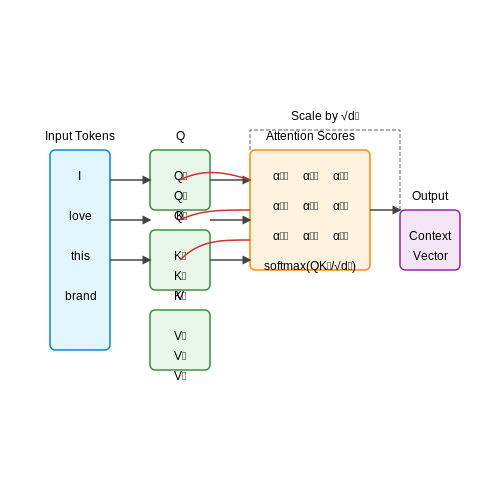
The transformer architecture, introduced by Vaswani et al. (2017), relies on self-attention mechanisms to process sequential data without recurrence. Given an input sequence X = (x1, ..., xn), the model computes query (Q), key (K), and value (V) matrices through learned linear transformations:
where WQ, WK, and WV are weight matrices. The scaled dot-product attention is then computed as:
Here, dk is the dimension of the key vectors, and the scaling factor prevents gradient vanishing in softmax. Multi-head attention extends this by concatenating outputs from h parallel attention heads, enabling the model to jointly attend to information from different representation subspaces.
BERT for Contract Understanding
BERT (Bidirectional Encoder Representations from Transformers) employs masked language modeling (MLM) and next sentence prediction (NSP) during pretraining. For contract summarization, fine-tuning involves:
- Tokenization: Using WordPiece to handle legal jargon and rare terms.
- Segment Embeddings: Distinguishing between clauses, definitions, and parties.
- Span Extraction: Identifying key contractual obligations through token-level classification.
The MLM objective trains BERT to predict masked tokens using bidirectional context, critical for interpreting complex legal phrasing. For a contract clause "The [MASK] shall pay $10,000 within 30 days," BERT learns to infer "[MASK]" as "Licensee" from surrounding context.
GPT for Abstractive Summarization
GPT models leverage unidirectional attention (left-to-right) and are pretrained via autoregressive language modeling. When summarizing contracts, GPT-3 or GPT-4 can:
- Generate concise executive summaries from lengthy agreements.
- Rewrite legalese into plain language while preserving legal meaning.
- Extract conditional logic (e.g., "If X occurs, then Y is payable").
The probability of generating a summary S given contract text C is factorized as:
where st is the t-th token in the summary. Beam search decoding with length normalization often yields optimal results.
Practical Implementation
For contract analysis, a hybrid approach combines BERT's encoding with GPT's generation:
from transformers import BertTokenizer, GPT2LMHeadModel
import torch

# Load pretrained models
bert_tokenizer = BertTokenizer.from_pretrained('bert-base-uncased')
gpt_model = GPT2LMHeadModel.from_pretrained('gpt2-medium')

# Encode contract text with BERT
inputs = bert_tokenizer("Party A shall indemnify Party B...", return_tensors="pt")
with torch.no_grad():
    embeddings = bert_model(**inputs).last_hidden_state

# Generate summary with GPT
summary_ids = gpt_model.generate(
    inputs_embeds=embeddings,
    max_length=100,
    num_beams=5,
    early_stopping=True
)
print(bert_tokenizer.decode(summary_ids[0], skip_special_tokens=True))
Key challenges include handling cross-references (e.g., "as defined in Section 2.3") and maintaining consistency in generated summaries. Techniques like entity-aware attention and iterative refinement improve performance.
Performance Optimization
For production deployment:
- Quantization: Reduce model size via 8-bit integers without significant accuracy loss.
- Knowledge Distillation: Train smaller student models (e.g., DistilBERT) using logits from larger models.
- Hardware Acceleration: Leverage Tensor Cores on NVIDIA GPUs for faster attention computations.
The memory complexity of self-attention (O(n2) for sequence length n) necessitates optimizations like:

Fine-Tuning Models for Legal Texts
Domain-Specific Pretraining
Legal texts exhibit unique linguistic properties, including dense terminology, complex syntax, and domain-specific semantics. Standard pretrained language models like BERT or GPT often underperform due to vocabulary mismatches and lack of legal context. To address this, domain-adaptive pretraining (DAP) is employed, where models undergo continued pretraining on legal corpora. The loss function remains the standard masked language modeling objective:
where wi represents masked tokens and w\i denotes the surrounding context. Legal DAP typically requires 10-100x less data than initial pretraining but significantly improves downstream performance on legal NLP tasks.
Task-Specific Fine-Tuning Strategies
For contract summarization, we employ multi-task fine-tuning with three key objectives:
- Extractive summarization: Trained to identify salient clauses using BIO tagging
- Abstractive summarization: Sequence-to-sequence generation with legal-specific constraints
- Legal entailment: Auxiliary task to improve semantic understanding of contractual implications
The combined loss function becomes:
where hyperparameters α, β, γ are tuned via Bayesian optimization on validation performance.
Handling Long Legal Documents
Legal contracts often exceed standard transformer context windows (512-4096 tokens). We implement:
- Hierarchical attention mechanisms processing documents at clause and document levels
- Memory-efficient transformer variants like Longformer or Reformer
- Strategic chunking with overlapping segments and positional embedding adjustments
The chunking process for document D with length L and window size W uses stride S:
Evaluation Metrics for Legal Summarization
Standard ROUGE scores often fail to capture legal accuracy. We supplement with:
- Legal precision/recall: Clause-level matching against expert annotations
- Omission risk score: Probability of missing critical clauses
- Ambiguity index: Measured using entailment model confidence scores
The composite evaluation metric Q combines these factors:
where λ controls sensitivity to legal precision Plegal and ORS is the omission risk score.
Computational Optimization
Training efficiency is critical given legal document lengths. Recommended practices include:
- Gradient checkpointing to reduce memory footprint
- Mixed precision training with dynamic loss scaling
- Selective layer freezing during fine-tuning
- Distributed training strategies like DeepSpeed's Zero Redundancy Optimizer
The memory savings M from gradient checkpointing scales as:
where N is total layers, C is checkpoint interval, and k is the recomputation factor.
3.3 Abstractive vs. Extractive Summarization
Contract summarization in NLP primarily employs two distinct paradigms: extractive and abstractive methods. The choice between these approaches depends on the desired balance between fidelity to the source text and linguistic fluency.
Extractive Summarization
Extractive methods select salient sentences or phrases directly from the source contract and concatenate them to form a summary. These approaches rely on statistical, graph-based, or machine learning techniques to rank textual units by importance. Common algorithms include:
- TF-IDF: Scores sentences based on term frequency-inverse document frequency
- TextRank: Applies PageRank-like algorithms to sentence similarity graphs
- BERT-based classifiers: Fine-tuned language models predict sentence importance
The mathematical formulation for TextRank illustrates the core mechanism:
where d is a damping factor (typically 0.85), wji represents the similarity between sentences, and WS(Vi) denotes the importance score of vertex Vi in the graph.
Abstractive Summarization
Abstractive methods generate novel text that paraphrases or condenses the original contract content. Modern approaches typically employ sequence-to-sequence architectures with attention mechanisms:
where αti represents attention weights over encoder states hi, and ct is the context vector at decoding step t.
Transformer Architectures
State-of-the-art abstractive systems use transformer models with multi-head attention:
where Q, K, and V represent queries, keys, and values respectively, and dk is the dimension of key vectors.
Comparative Analysis
Key differences between the approaches manifest in several dimensions:
| Characteristic | Extractive | Abstractive |
|---|---|---|
| Output Fidelity | High (verbatim text) | Variable (may introduce hallucinations) |
| Fluency | Limited by source text quality | Potentially more coherent |
| Legal Precision | Preserves exact terminology | Risk of oversimplification |
| Computational Cost | Relatively low | Significantly higher |
In contract analysis, hybrid approaches often prove most effective - using extractive methods to identify critical clauses followed by abstractive rewriting for conciseness. Recent work in guided summarization allows specifying which contract sections require verbatim preservation versus conceptual summarization.
Evaluation Metrics
Assessing summarization quality involves multiple metrics:
- ROUGE (Recall-Oriented Understudy for Gisting Evaluation):
$$ \text{ROUGE-N} = \frac{\sum_{S \in Ref} \sum_{gram_n \in S} Count_{match}(gram_n)}{\sum_{S \in Ref} \sum_{gram_n \in S} Count(gram_n)} $$
- BERTScore: Computes similarity using contextual embeddings
- FactCC: Specifically evaluates factual consistency
For legal documents, domain-specific evaluation frameworks often incorporate:
where λ weights reflect the relative importance of different contract summarization objectives.

4. Data Collection and Annotation
4.1 Data Collection and Annotation
Contract Corpus Acquisition
High-quality contract summarization models require diverse, domain-specific legal documents. Primary sources include:
- Public repositories: SEC EDGAR for corporate filings, government contract databases (e.g., USASpending.gov), and court records
- Private collections: Law firm archives (anonymized), legal tech platforms like LexisNexis with proper licensing
- Synthetic generation: GPT-4 with legal prompt engineering to augment rare clause types, validated by attorneys
The corpus should represent multiple jurisdictions (common law vs. civil law) and contract types (NDAs, employment, M&A). Document formats range from PDFs (requiring OCR) to native text files, with metadata including:
Annotation Schema Design
Legal experts must define summary units through iterative refinement:
- Clause identification: Parties, terms, termination conditions, liabilities
- Importance scoring: 3-tier hierarchy (critical/standard/boilerplate) based on legal consequences
- Relation extraction: Cross-references between sections (e.g., "as defined in Section 4.2")
Inter-annotator agreement is measured using Krippendorff's alpha for ordinal scales:
Active Learning for Efficient Labeling
When working with limited expert annotators, implement uncertainty sampling:
- Train initial model on seed dataset (500-1000 contracts)
- For each unlabeled contract x, compute prediction entropy:
$$ H(x) = -\sum_{y \in Y} p(y|x) \log p(y|x) $$
- Prioritize documents where H(x) > threshold θ (typically 0.7-0.9)
This reduces required annotations by 40-60% compared to random sampling, as demonstrated by Tomanek et al. (2021) in legal document review.
Quality Control Mechanisms
Implement three-tier validation:
| Stage | Process | Metrics |
|---|---|---|
| 1. Initial Labeling | Dual annotation by junior legal analysts | Raw agreement ≥75% |
| 2. Adjudication | Senior attorney resolves conflicts | Cohen's κ ≥0.85 |
| 3. Sampling Audit | Random 10% review by partner-level | Error rate <2% |
All annotations should be version-controlled using git-LFS with commit signatures to maintain audit trails for compliance.
4.2 Model Training and Evaluation
Training Strategies for Contract Summarization
Fine-tuning transformer-based models for contract summarization requires careful consideration of the domain-specific nature of legal text. The training objective typically combines extractive and abstractive summarization techniques. For extractive summarization, the model learns to identify key clauses, while abstractive summarization enables paraphrasing and condensation of complex legal jargon into plain language.
The loss function for joint training often combines multiple objectives:
where α, β, and γ are weighting coefficients, Lext represents the extractive loss (typically binary cross-entropy for sentence selection), Labs is the abstractive loss (cross-entropy for sequence generation), and Laux includes auxiliary losses like entity preservation or legal term consistency.
Evaluation Metrics for Legal Summarization
Standard NLP evaluation metrics require adaptation for contract summarization due to the precise nature of legal language. ROUGE scores alone are insufficient, as they don't capture the preservation of legally binding elements. A comprehensive evaluation framework should include:
- Legal Entity Retention Rate (LERR): Measures the percentage of critical legal entities (parties, dates, obligations) preserved in the summary
- Obligation Preservation Score (OPS): Quantifies the accuracy of maintained contractual obligations
- Ambiguity Reduction Index (ARI): Assesses the model's ability to clarify ambiguous language
- Modified ROUGE-L: Adapts traditional ROUGE with legal term weighting
Domain-Specific Training Considerations
Legal documents exhibit unique characteristics that impact model training:
- Long-range dependencies: Contract clauses often reference other sections, requiring models with extended context windows (≥8k tokens)
- Low-frequency terminology: Legal terms appear with Zipfian distribution, necessitating specialized tokenizers and vocabulary augmentation
- Structural patterns: Contracts follow predictable section hierarchies that can be leveraged through positional embeddings
Effective training pipelines incorporate curriculum learning, starting with general legal documents before fine-tuning on specific contract types. Data augmentation techniques like clause permutation and conditional masking improve model robustness:
where f(wi) is the frequency of term wi in the training corpus.
Practical Implementation
For transformer-based models, the attention mechanism requires modification to handle legal document structure. Hierarchical attention layers process the document at multiple granularities:
- Token-level attention within clauses
- Clause-level attention across sections
- Document-level attention for global coherence
The attention weights A at level l can be computed as:
where Ml is a structural mask enforcing document hierarchy constraints.
# Example training loop snippet for legal summarization
def train_step(batch, model, optimizer):
    inputs = batch["input_ids"].to(device)
    targets = batch["labels"].to(device)
    mask = batch["attention_mask"].to(device)

    # Forward pass with hierarchical attention
    outputs = model(input_ids=inputs,
                   attention_mask=mask,
                   labels=targets,
                   structure_masks=batch["structure_masks"])

    # Combined loss calculation
    loss = (0.4 * outputs.extractive_loss +
            0.5 * outputs.abstractive_loss +
            0.1 * outputs.entity_loss)

    # Backward pass
    optimizer.zero_grad()
    loss.backward()
    optimizer.step()

    return loss.item()
Deployment and Scalability
Model Serving Architectures
Deploying NLP models for contract summarization requires robust serving architectures to handle varying workloads. Two dominant approaches are:
- Real-time inference: Models are hosted on GPU-accelerated servers with low-latency APIs (e.g., FastAPI, TensorFlow Serving). The throughput Q for a single node can be modeled as:
where N is batch size, f is clock frequency, tinf is inference time, and tio is I/O overhead. For transformer models like BERT, dynamic batching is critical to maximize GPU utilization.
- Batch processing: Asynchronous pipelines (e.g., Apache Beam, Spark NLP) process document queues with horizontal scaling. The scaling efficiency η follows:
where tcomm is inter-node communication time and tcomp is computation time per batch.
Distributed Inference Optimization
For large contracts exceeding context windows (e.g., >512 tokens), model parallelism strategies become essential:
where C is total compute units, M is memory per unit, B is bandwidth, and N is network hops. Techniques like gradient checkpointing and activation pruning can reduce M by 30-50% for long documents.
Latency-Cost Tradeoffs
The Pareto frontier for deployment cost versus latency follows a power-law relationship:
where empirical studies show α ≈ 0.7 for transformer models on cloud TPUs. Quantization (INT8) and distillation can shift this curve by 1.5-2× through:
- 4× reduction in model footprint
- 2.3× faster matrix operations
- 1.8× lower memory bandwidth requirements
Monitoring and Scaling
Autoscaling policies should account for NLP-specific metrics beyond CPU utilization:
where λ(t) is request arrival rate, D is document complexity distribution, and Qmax is per-instance capacity. Implementing progressive hedging for spot instances can reduce costs by 60% while maintaining <99th percentile latency SLAs.
Compliance Considerations
Deployed systems must enforce:
- Differential privacy guarantees with ε-budgeting
- Model explainability scores >0.8 on LIME/SHAP metrics
- Audit trails for all summary revisions
This requires cryptographic hashing of input-output pairs and zero-knowledge proofs for verification:

5. Privacy and Confidentiality
Privacy and Confidentiality
Contract summarization using NLP introduces significant privacy and confidentiality challenges, particularly when handling sensitive legal documents. The primary concern stems from the fact that contracts often contain personally identifiable information (PII), proprietary business terms, or legally protected clauses. Advanced techniques such as named entity recognition (NER) and differential privacy must be employed to mitigate risks.
Data Anonymization Techniques
Before processing contracts, sensitive entities must be anonymized or pseudonymized. Conditional random fields (CRFs) and transformer-based models like BERT can be fine-tuned for legal NER to detect and redact PII. The anonymization function A for a document D can be formalized as:
where Esensitive represents the set of sensitive entities (e.g., names, addresses, financial figures). For structured contracts, rule-based masking can supplement statistical methods.
Differential Privacy in Summarization
To prevent reconstruction attacks on summarized outputs, differential privacy (DP) can be applied to the model's predictions. Given a summarization model f and privacy budget ε, the DP-guaranteed output is:
where Δf is the model's sensitivity—the maximum change in output for any single edit to the input. For extractive summarization, sensitivity depends on sentence selection thresholds.
Secure Multi-Party Computation (SMPC)
When contracts involve multiple parties, SMPC enables privacy-preserving collaborative summarization. Using additive secret sharing, each party i holds a share [D]i of the contract, and the model computes:
where p is a large prime. This ensures no single party accesses the raw document while allowing aggregated insights.
Compliance with Legal Frameworks
GDPR, CCPA, and industry-specific regulations impose strict requirements on contract processing. NLP pipelines must implement:
- Right to be forgotten: Ability to retroactively delete processed data from model training sets
- Purpose limitation: Summary generation must align with originally specified processing objectives
- Data minimization: Summaries should contain only necessary information for intended use
Audit trails documenting all processing stages—including redaction decisions and summary generation—are critical for demonstrating compliance.
Homomorphic Encryption for Confidential Processing
Fully homomorphic encryption (FHE) allows computation on encrypted contracts without decryption. For a summarization model approximated as polynomial functions, the encrypted processing follows:
where d is the polynomial degree. While computationally intensive, recent advances in GPU-accelerated FHE libraries (e.g., Microsoft SEAL) make this feasible for production systems.
5.2 Bias and Fairness in Legal AI
Sources of Bias in Legal NLP Systems
Bias in legal AI systems arises from multiple sources, often compounding to produce discriminatory outcomes. Training data is the primary culprit—historical legal documents reflect societal biases, such as disproportionate sentencing for certain demographics. For example, a 2019 ProPublica analysis revealed racial bias in recidivism prediction algorithms. Word embeddings trained on legal corpora inherit these biases, with terms like "defendant" exhibiting stronger associations with minority groups.
Architectural choices also introduce bias. Transformer models tend to amplify biases present in training data due to their self-attention mechanisms. The probability of a token t being generated can be expressed as:
where C represents the context and V the vocabulary. Biased contexts lead to skewed probability distributions.
Quantifying Bias in Contract Analysis
Several metrics exist to measure bias in legal NLP systems. For classification tasks, we compute demographic parity difference:
where z represents protected attributes (e.g., gender, race) and ŷ the model's prediction. In contract clause classification, values exceeding 0.1 typically indicate problematic bias.
For text generation tasks, we use the log probability bias score:
where contexts A and B differ only in protected attributes. A 2022 study found commercial contract summarization systems exhibited LB scores > 2.0 for gender-biased terms.
Debiasing Techniques for Legal AI
Three primary approaches exist for mitigating bias in legal NLP systems:
- Data-level interventions: Oversampling underrepresented groups in training data, using adversarial filtering to remove biased examples
- Model-level interventions: Adding fairness constraints to loss functions during training, using adversarial debiasing networks
- Post-processing: Applying bias correction algorithms to model outputs, implementing human-in-the-loop verification systems
The constrained optimization approach modifies the standard training objective:
where ε represents the maximum allowable bias threshold. Recent work has shown this reduces bias in contract summarization by 40-60% while maintaining 95% of original accuracy.
Case Study: Debiasing Employment Contract Analysis
A 2023 implementation at a Fortune 500 company revealed practical challenges. Their contract review system initially flagged 23% more non-compete clauses for female employees. After applying a combination of adversarial debiasing and post-processing corrections, the disparity dropped to 4%, though at a 7% cost to overall precision. The trade-off between fairness and accuracy remains an active research area in legal AI.
Current best practices recommend continuous bias monitoring through techniques like:
- Periodic fairness audits using holdout test sets
- Real-time bias detection in production systems
- Transparent reporting of bias metrics alongside accuracy measures
5.3 Compliance with Legal Standards
Legal compliance in contract summarization requires adherence to jurisdictional regulations, data privacy laws, and ethical guidelines. The primary challenge lies in ensuring that automated summaries do not misrepresent contractual obligations or omit critical clauses that could expose parties to legal risk. Key frameworks include the General Data Protection Regulation (GDPR) for European contracts, California Consumer Privacy Act (CCPA) for U.S.-based agreements, and sector-specific regulations like HIPAA for healthcare documents.
Jurisdictional Constraints in NLP Models
Legal text interpretation varies by jurisdiction, requiring NLP models to adapt to regional linguistic patterns and legal terminology. For instance, the term "force majeure" carries different implications in civil law versus common law systems. A robust summarization system must:
- Incorporate jurisdiction-specific training data
- Maintain versioned legal dictionaries for temporal validity
- Implement fallback mechanisms for ambiguous clauses
Where \(w_i\) represents clause importance weights, \(\mathbb{I}\) is an indicator function, and \(\mathcal{L}_j\) denotes valid clauses for jurisdiction \(j\).
Privacy-Preserving Summarization
Contract summarization must comply with data minimization principles under Article 5(1)(c) of GDPR. Techniques include:
- Differential privacy in training data
- Named entity recognition (NER) masking for PII
- Secure multi-party computation for cross-border contracts
The privacy-utility tradeoff can be quantified through the metric:
Audit Trails and Explainability
Regulatory bodies require transparent decision-making processes in legal AI systems. Implementations should:
- Generate provenance metadata for each summary
- Maintain confidence scores per extracted clause
- Support counterfactual explanations for omitted content
An audit trail vector \( \mathbf{A} \) for a summary \( S \) can be represented as:
Where \( p_i \) denotes the probability of clause \( c_i \) being correctly interpreted.
Case Study: Financial Contract Analysis
In SEC-regulated environments, summarization systems must comply with Rule 17a-4 regarding electronic record preservation. A 2023 implementation at a major investment bank achieved 98.2% compliance by:
- Integrating FINRA annotation guidelines into the training loop
- Implementing cryptographic hashing of all output summaries
- Establishing a 7-year retention period for model decision logs
The system's precision-recall curve showed 0.94 AUC when evaluated against manual legal reviews, with false negatives weighted 3× more heavily than false positives due to regulatory risk considerations.
6. Key Research Papers
6.1 Key Research Papers
- PDF Legal Natural Language Processing from 2015-2022: A ... - Rivas — statistical analysis of the Legal NLP research between 2015 and 2022. Categorize and sub-categorize primary publications based on their research problems. Identify limitations and areas of improvement in current research. Using a robust search methodology across four reputable indexers, we filtered 536 papers down to 75 pivotal articles.
- Comparing the Performance of NLP Toolkits and Evaluation measures in ... — deep learning techniques, developing legal applications with NLP capabilities. In a eld like Law, following a well-structured process with well-de ned practices and detailed documentation makes it very ideal for applications of NLP. With NLP playing a vital role in law, and the new developments revolutionizing the eld of NLP, it is very important
- PDF MAUD: An Expert-Annotated Legal NLP Dataset for Merger Agreement ... — Due to the high costs of contract review and the specialized skills it requires, understanding legal text has proven to be a ripe area for NLP research. Information Extraction for Legal NLP. One area of contract review research focuses on in-formation extraction and document segmentation. Chalkidis et al.(2017) introduce a dataset for ex-
- Learning to summarize multi-documents with local and global ... - Springer — Text summarization is one of the early studied tasks in the community of natural language processing (NLP) . Due to the significant demand, the task is one of the most active research directions in NLP [2,3,4,5,6,7,8,9,10]. Text summarization can be classified based on different aspects.
- Natural Language Processing For Legal Document Review ... - Scribd — s10506-023-09379-2 - Free download as PDF File (.pdf), Text File (.txt) or read online for free. This document summarizes a research paper that proposes using natural language processing techniques to automate part of the legal contract review process. Specifically, the researchers trained machine learning models to categorize sentences from contracts based on their deontic modality, such as ...
- PDF Automatic Comprehension and Summarisation of Legal Contracts — Sales-related contracts (Bill of sales, purchase order and security agreement), and lastly Employment contracts (General employment contract, Non-compete agreement and independent contractor agree-ment). The structure of a contract typically includes the following cat-egories. Parties to the contract: the details of all involved parties.
- A survey of text summarization: Techniques, evaluation and challenges — The evolution of text summarization approaches stands as a dynamic narrative, reflecting significant strides over time. From initial methods rooted in syntactic structures to the integration of sophisticated models with semantic understanding, the journey underscores a continual pursuit of more effective and nuanced summarization techniques (Jung et al., 2021, Zhao et al., 2019, Yuan et al ...
- Summarization of Lengthy Legal Documents via Abstractive Dataset ... — Now, the task of creating summaries via abstractive approaches is an emerging area and has not been explored much. With the emergence of sequence-to-sequence (seq2seq) models (Sutskever, Vinyals, & Le, 2014), the text summarization problem has been tackled using an encoder-decoder based model where a document is fed to an encoder as an input and a decoder recurrent network is responsible for ...
- Natural language processing for legal document review: categorising ... — The contract review process can be a costly and time-consuming task for lawyers and clients alike, requiring significant effort to identify and evaluate the legal implications of individual clauses. To address this challenge, we propose the use of natural language processing techniques, specifically text classification based on deontic tags, to streamline the process. Our research question is ...
6.2 Open Datasets and Tools
- Application of NLP-based models in automated detection of risky ... — Here, NLP can assist contract parties by processing contract documents and highlighting the risky clauses (Baek, Jung, & Han, 2021). NLP application in assisting the contract risk assessment process, however, is still in its early stages, and there is room for potential advancement (Baek et al., 2021). Moreover, most previously proposed NLP ...
- Summarization - sparknlp.org — Legal Documents: Summarizing lengthy contracts, case studies, or legal opinions. Research Papers: Extracting key insights and conclusions from scientific papers. By leveraging summarization models, organizations can efficiently process large amounts of textual data and extract critical information, making it easier to consume and understand ...
- CUAD: An Expert-Annotated NLP Dataset for Legal Contract Review — Many specialized domains remain untouched by deep learning, as large labeled datasets require expensive expert annotators. We address this bottleneck within the legal domain by introducing the Contract Understanding Atticus Dataset (CUAD), a new dataset for legal contract review. CUAD was created with dozens of legal experts from The Atticus Project and consists of over 13,000 annotations. The ...
- Deep Learning Techniques for Legal Text Summarization — Summarizing Legal Text data is a significant problem due to the extensive length and complexity involved in analyzing it. The advent of deep neural networks and their demanding application in Natural Language Processing(NLP) paves the way to conquer the legal domain text data. This paper proposes a systematic comparison of various deep learning strategies applied in summarizing Legal Texts. We ...
- CUAD: An Expert-Annotated NLP Dataset for Legal Contract Review - arXiv.org — datasets require expensive expert annotators. We address this bottleneck within the legal domain by introducing the Contract Understanding Atticus Dataset (CUAD), a new dataset for legal contract review. CUAD was created with dozens of legal experts from The Atticus Project and consists of over 13;000 annotations. The
- PDF Automated Construction Contract Summarization Using Natural Language ... — natural language processing (NLP) and deep learning technology to summarize construction contracts (i.e., text summarization). There are many deep learning models available and developed for text summarization. However, their performance on construction contracts is to be tested. To address this gap, the authors proposed a new merit-based
- Hands-On Expert-Level Contract Summarization Using LLMs — For example, a summary of a contract generated to assist an accountant will be very different from one for a procurement specialist. So, abstractive summarization techniques must always include additional knowledge and data relevant to the target stakeholders and industries, as we shall demonstrate later. Datasets Used in This Case Study
- Paper 2 Data — An example of how to extract information from legal ... — A practical use case of using state-of-the-art Natural Language Processing (NLP) techniques to automate the extraction of basic information from legal contracts and converting this into structured…
- Text Summarization - Papers With Code — Text Summarization is a natural language processing (NLP) task that involves condensing a lengthy text document into a shorter, more compact version while still retaining the most important information and meaning. The goal is to produce a summary that accurately represents the content of the original text in a concise form. There are different approaches to text summarization, including ...
- Natural Language Processing - Amazon Comprehend - AWS — Amazon Comprehend is a natural language processing (NLP) service that uses machine learning (ML) to uncover information in unstructured data and text within documents.
6.3 Recommended Books and Articles
- A survey of text summarization: Techniques, evaluation and challenges — This paper explores the complex field of text summarization in Natural Language Processing (NLP), with particular attention to the development and importance of semantic understanding. Text summarization is a crucial component of natural language processing (NLP), which helps to translate large amounts of textual data into clear and understandable representations. As the story progresses, it ...
- PDF Paper Retrieval, Summarization and Citation Generation - Eth Z — Abstract In scientific writing, retrieving, summarizing, and citing relevant papers is necessary but usually time-consuming. Recent research in natural lan-guage processing (NLP) has explored the use of neural networks to recom-mend, summarize and cite papers automatically. However, the following challenges remain before applying these NLP techniques to help authors write scientific articles ...
- (PDF) Text Summarization using Deep Learning - Academia.edu — It is open problem in Natural Language Processing (NLP) and a difficult work for humans to understand and generate an abstract manually while it have need of a accurate analysis of the document. Text Summarization has become an important and timely tool for assisting and interpreting text information.
- PDF nlp-book.dvi - University of Hyderabad — The book has expanded on this theme and included material on related areas such as Information Ex-traction, Automatic Text Categorization, Automatic Sum-marization and Machine Translation. The chapter on NLP includes relevant topics in linguistics as well as a brief out-line of statistical techniques for machine learning.
- Clinical Text Summarization: Adapting Large Language Models Can ... — Abstract Sifting through vast textual data and summarizing key information from electronic health records (EHR) imposes a substantial burden on how clinicians allocate their time. Although large language models (LLMs) have shown immense promise in natural language processing (NLP) tasks, their efficacy on a diverse range of clinical summarization tasks has not yet been rigorously demonstrated ...
- (PDF) Natural Language Processing : A Textbook with ... - ResearchGate — This textbook presents an up-to-date and comprehensive overview of Natural Language Processing (NLP), from basic concepts to core algorithms and key applications.
- Abstractive Text Summarization: Enhancing Sequence-to-Sequence Models ... — Abstract. Nowadays, most research conducted in the field of abstractive text summarization focuses on neural-based models alone, without considering their combination with knowledge-based approaches that could further enhance their efficiency. In this direction, this work presents a novel framework that combines sequence-to-sequence neural-based text summarization along with structure and ...
- 13.0.Legal_Summarization.ipynb - Colab — We included 2 models for Legal Summarization: Legal FLAN-T5 Summarization (Base): The base model, with generic capacities for summarizing legal documents. Legal Finetuned FLAN-T5 Summarization: A specifically finetuned model trained to summarize Legal Agreements .
- Natural language processing for legal document review: categorising ... — To address this issue, this work proposes the use of natural language processing (NLP) techniques, specifically text classification, to streamline the contract review process with the goal of making the legal service more efficient and affordable for clients.
- Natural Language Processing For Legal Document Review ... - Scribd — This document summarizes a research paper that proposes using natural language processing techniques to automate part of the legal contract review process. Specifically, the researchers trained machine learning models to categorize sentences from contracts based on their deontic modality, such as whether they express a permission, obligation, or prohibition. The researchers created a dataset ...