AI Dungeon-Style Generators Explained
1. What Are AI Dungeon-Style Generators?
AI Dungeon-Style Generators Explained
1.1 What Are AI Dungeon-Style Generators?
AI Dungeon-style generators are a class of interactive narrative systems that leverage large-scale language models to dynamically generate text-based adventures in response to user inputs. These systems operate on principles of conditional text generation, where the model's output is conditioned not only on the immediate user prompt but also on a dynamically evolving context window that includes prior interactions, world state, and latent narrative structure.
At their core, these generators implement a form of constrained sampling from the language model's probability distribution, where the sampling space is shaped by:
- Explicit game state variables (e.g., character attributes, inventory)
- Implicit narrative coherence constraints
- User-defined world-building parameters
- Dynamically updated memory mechanisms
The technical architecture typically combines several transformer-based components:
where xt represents the generated text at turn t, h<t is the interaction history, and st denotes the system state vector. The generation process involves multiple specialized sampling techniques:
- Top-k sampling with dynamic temperature adjustment
- Beam search constrained by narrative consistency metrics
- Discriminative reranking of candidate generations
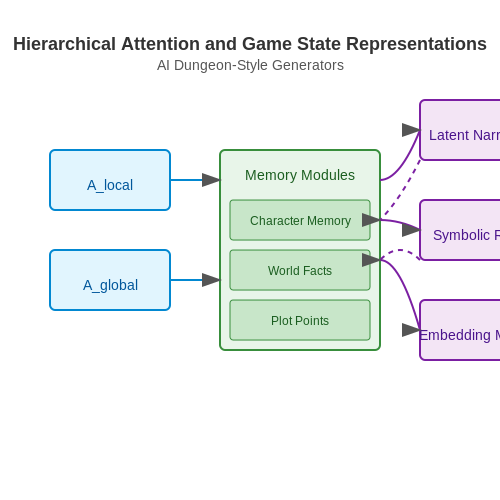
Advanced implementations incorporate retrieval-augmented generation (RAG) architectures, where relevant context is dynamically retrieved from both the immediate session history and external knowledge bases. The system maintains multiple parallel representations of game state:
- A latent narrative trajectory in the language model's hidden states
- Explicit symbolic representations of game entities and relationships
- Embedding-based similarity metrics for continuity checking
Recent innovations in this space include the use of hierarchical attention mechanisms that separately model:
where Mi represents different memory modules (e.g., character memory, world facts, plot points). The most sophisticated systems employ reinforcement learning with human feedback (RLHF) to optimize for both coherence and entertainment value, using reward functions of the form:
Practical implementations must address several key challenges: maintaining narrative consistency across long contexts (often exceeding 10k tokens), preventing catastrophic forgetting of established facts, and balancing user agency with coherent storytelling. State-of-the-art solutions employ:
- Dynamic context window management
- Explicit entity tracking databases
- Contrastive learning for consistency preservation
- Adversarial training to detect and repair narrative contradictions
Core Components of Text-Based Adventure AI
Language Model Architecture
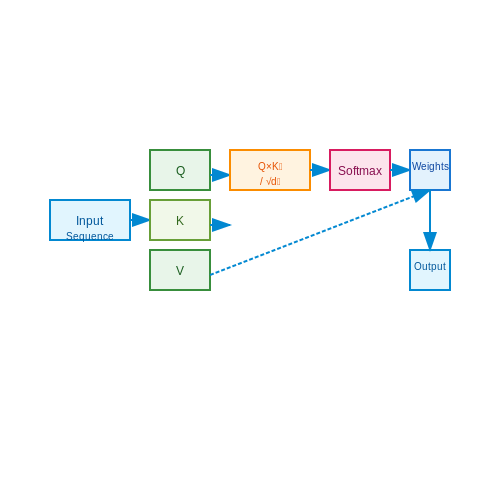
The foundation of AI Dungeon-style generators lies in transformer-based language models, typically fine-tuned variants of GPT or similar architectures. These models employ self-attention mechanisms to process input sequences and generate coherent, context-aware text. The self-attention operation can be expressed as:
where Q, K, and V represent queries, keys, and values matrices respectively, and dk is the dimension of the key vectors. For text adventure generation, the model must maintain long-range dependencies across player inputs, game state, and narrative history.
State Representation and Memory
Effective adventure generators require explicit mechanisms for tracking game state. This is typically implemented through:
- Short-term context: The immediate conversation history stored in the transformer's context window (typically 2048-4096 tokens)
- Long-term memory: External databases or vector stores that maintain persistent world state
- Character embeddings: Learned representations of NPC personalities and traits
The state update function for a typical implementation might be formalized as:
where st is the current state, at is the player action, and ht represents the hidden state of the language model.
Action Space and Constrained Generation
Unlike open-ended dialogue systems, text adventures require controlled generation that respects game mechanics. This is achieved through:
- Constrained beam search: Modifying the decoding process to enforce grammatical and game-logic constraints
- Action templates: Predefined structures for valid player commands (e.g., "go [direction]", "use [item]")
- Reward modeling: Reinforcement learning from human feedback to align outputs with desired adventure game characteristics
The constrained decoding objective can be expressed as:
where φi are constraint functions and λ controls their relative importance.
World Consistency Mechanisms
Maintaining narrative coherence requires specialized techniques:
- Entity tracking: Coreference resolution systems that maintain consistent references to characters and objects
- Fact verification: Cross-checking generated content against established world facts
- Consistency embeddings: Learned representations that encode world rules and relationships
Modern systems often implement these through auxiliary neural modules that operate in parallel with the main language model, sharing gradients during training but maintaining separate inference-time computations.
Multi-Agent Simulation
Advanced implementations employ separate agent models for different in-game entities:
where each NPC agent i has its own parameters φi and memory mi,t-1. These agents interact through a shared environment model that resolves conflicts and maintains global consistency.
Historical Evolution of Interactive Storytelling AI
The development of AI-driven interactive storytelling systems traces its roots to early text-based adventure games and symbolic AI approaches. In the 1970s, systems like Colossal Cave Adventure (1976) demonstrated primitive rule-based narrative generation, where pre-authored text fragments were stitched together based on player input. These systems relied on finite-state machines and simple pattern matching, lacking true generative capability.
Early Symbolic Approaches (1980s–1990s)
Research in the 1980s introduced more sophisticated symbolic architectures. Michael Lebowitz's UNIVERSE (1985) used hierarchical planning to generate soap opera narratives, while James Meehan's TALE-SPIN (1976) employed goal-driven character simulation. These systems formalized narrative as a sequence of actions satisfying character goals, modeled via first-order logic:
However, these systems suffered from combinatorial explosion in branching narratives and required exhaustive domain authoring. The 1990s saw probabilistic enhancements with systems like MINSTREL (Turner, 1993), which incorporated case-based reasoning and weak constraints to improve coherence.
Statistical Revolution (2000s–2010s)
The advent of statistical language models and machine learning shifted the paradigm. Dramatis (2004) used hidden Markov models to predict plot transitions, while Versu (2013) employed hierarchical Bayesian networks to model character behavior. The key innovation was treating narrative as a sequence prediction problem:
where wt represents narrative events and ht the latent state. These models could generalize beyond hand-authored rules but struggled with long-term coherence.
Neural Era (2015–Present)
Transformer architectures revolutionized the field by enabling open-ended generation. AI Dungeon (2019) demonstrated the viability of fine-tuned large language models (LLMs) like GPT-2 for interactive storytelling. The attention mechanism allowed modeling of nonlinear narrative dependencies:
Contemporary systems like InferKit and NovelAI employ techniques like reinforcement learning from human feedback (RLHF) to align outputs with narrative conventions. The latest frontier involves retrieval-augmented generation (RAG) architectures that combine parametric memory with external knowledge bases.
Challenges and Open Problems
Despite advances, key limitations persist. The context window problem restricts coherent long-form generation, while character consistency remains challenging due to the auto-regressive nature of LLMs. Current research explores neurosymbolic hybrids and dynamic memory networks to address these issues, with systems like DALL·E 3 demonstrating multimodal narrative potential.
2. Language Models and Their Role in Narrative Generation
2.1 Language Models and Their Role in Narrative Generation
Modern AI-driven narrative generators, such as those powering AI Dungeon, rely on large-scale autoregressive language models trained on vast textual corpora. These models operate by estimating the conditional probability distribution of the next token given a sequence of preceding tokens, formalized as:
where wt represents the token at position t and w1:t-1 denotes the preceding token sequence. Transformer-based architectures, particularly variants of GPT (Generative Pre-trained Transformer), achieve this through stacked self-attention layers that capture long-range dependencies in the input sequence.
Attention Mechanisms and Contextual Embeddings
The key innovation enabling coherent narrative generation lies in the transformer's multi-head attention mechanism, which computes weighted sums of value vectors based on query-key similarity:
where Q, K, and V represent queries, keys, and values matrices respectively, and dk is the dimension of the key vectors. This architecture allows the model to dynamically focus on relevant portions of the context window when generating each new token.
Temperature Sampling for Creative Control
During inference, narrative generators employ stochastic decoding strategies to balance creativity and coherence. Temperature scaling modifies the output probability distribution before sampling:
where zt represents the logits for token t, |V| is the vocabulary size, and τ is the temperature parameter. Lower values (τ → 0) produce more deterministic outputs, while higher values (τ → 1) increase randomness.
Fine-Tuning for Narrative Coherence
Base language models undergo additional training phases to specialize in interactive storytelling:
- Domain adaptation: Continued pre-training on narrative texts (novels, scripts, RPG transcripts)
- Reinforcement learning: Human feedback used to optimize for engagement metrics
- Constrained generation: Techniques like nucleus sampling (top-p) to maintain topic focus
The resulting systems demonstrate emergent capabilities in maintaining character consistency, plot coherence, and contextual awareness across multi-turn interactions. Recent architectures like GPT-3 and beyond achieve this through scale effects, with models exceeding 175 billion parameters exhibiting improved few-shot narrative generation abilities.
Memory and State Tracking
Advanced implementations incorporate explicit memory mechanisms to overcome the fixed-context window limitation of pure transformer models. This often takes the form of:
- Database-augmented retrieval of relevant facts
- Compressed memory tokens that summarize prior interactions
- External knowledge graphs for entity relationship tracking
These components work in concert with the base language model to enable persistent world-building across extended narrative sessions.
Fine-Tuning Models for Adventure-Specific Contexts
Domain Adaptation via Transfer Learning
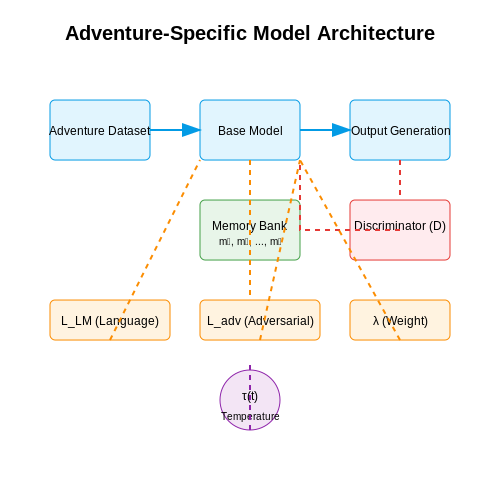
Fine-tuning pre-trained language models for adventure-specific generation involves domain adaptation through transfer learning. Given a base model M pre-trained on general text corpora, we optimize its parameters θ using a specialized adventure dataset Dadv. The objective function combines the original language modeling loss LLM with an auxiliary adventure-specific loss Ladv:
where λ controls the trade-off between general language coherence and adventure-style generation. Typical values range from 0.3 to 0.7, depending on the desired balance.
Contextual Prompt Engineering
Adventure generators require carefully constructed prompt templates that encode:
- Genre-specific keywords (fantasy, sci-fi, horror)
- Character archetypes (warrior, mage, rogue)
- World-building constraints (magic systems, technology levels)
The prompt embedding p is concatenated with the user input u before being fed to the model:
Temperature Scheduling for Creative Control
Unlike standard text generation, adventure systems benefit from dynamic temperature τ during sampling:
where t is the generation step and β controls the decay rate. This allows for:
- High creativity (τ ≈ 1.0) during world-building phases
- Low variability (τ ≈ 0.3) during critical plot decisions
Memory-Augmented Architectures
Long-term coherence is maintained through external memory banks that store:
- Character state vectors (health, inventory, relationships)
- Location descriptors (previously visited areas)
- Plot point embeddings (key events, unresolved conflicts)
The memory retrieval mechanism uses sparse attention over K memory slots:
where q is the current hidden state and d is the embedding dimension.
Adversarial Style Training
A discriminator network D is trained concurrently to distinguish between:
- Human-written adventure narratives
- Model-generated text
The generator G receives gradient signals from D through the loss:
where z represents the latent story state. This approach significantly improves stylistic consistency with human-authored content.
2.3 Handling Player Input and Dynamic Story Adaptation
Input Parsing and Semantic Representation
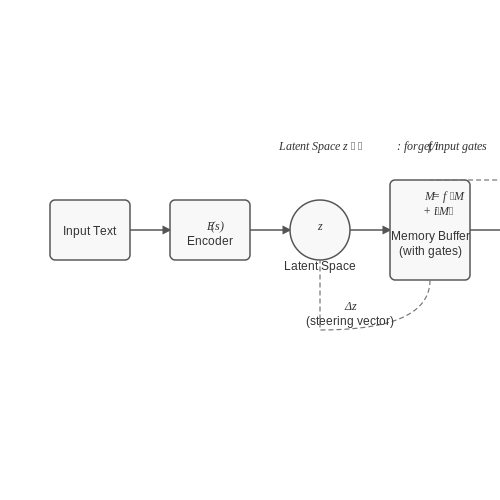
Player input in AI Dungeon-style generators is typically unstructured natural language, requiring robust parsing to extract actionable semantic meaning. Modern systems employ transformer-based encoders (e.g., BERT or GPT variants) to map input text s to a latent representation z:
where Eθ is the encoder with parameters θ. The latent space z is optimized for story coherence by minimizing the Kullback-Leibler divergence between the encoder's output distribution and a prior distribution p(z|x) conditioned on the current story context x:
Contextual Memory and State Tracking
Dynamic adaptation requires maintaining a differentiable memory buffer Mt at timestep t, updated via a gated mechanism:
where ft (forget gate), it (input gate), and M̃t (candidate memory) are computed from the current input and story state. This architecture enables:
- Long-term coherence: Critical plot elements persist across hundreds of tokens
- Dynamic reweighting: Attention mechanisms adjust memory recall based on relevance
Action Space Formulation
Player actions are modeled as transitions in a latent narrative graph. Each valid action a corresponds to a vector in the decoder's output space, constrained by:
where φ is a policy network and Jφ its Jacobian. The rank constraint ensures diverse, non-degenerate actions.
Real-Time Adaptation Techniques
State-of-the-art systems use:
- Prompt engineering: Dynamically inserted control tokens guide generation (e.g., [PLOT_TWIST])
- Constrained decoding: Finite-state automata restrict output to grammatically valid story continuations
- Reward shaping: Discriminator networks provide dense rewards for coherence metrics
Case Study: Latent Space Steering
By projecting the latent trajectory z1:t onto principal components of the training corpus, systems can detect and correct narrative drift:
where v1 is the top eigenvector of the story corpus covariance matrix and μ its mean.
3. Transformer-Based Models for Coherent Storytelling
3.1 Transformer-Based Models for Coherent Storytelling
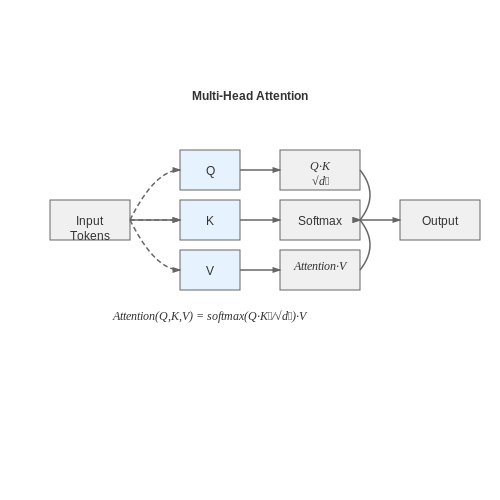
Transformer-based models have revolutionized natural language generation by enabling long-range coherence in storytelling. Unlike recurrent architectures, transformers leverage self-attention mechanisms to capture dependencies across arbitrary distances in the input sequence. The core innovation lies in the scaled dot-product attention, which computes relevance scores between all pairs of tokens:
Where Q, K, and V represent queries, keys, and values matrices respectively, and dk is the dimension of the key vectors. This mechanism allows the model to dynamically focus on relevant context when generating each token.
Architectural Innovations for Narrative Generation
Modern story generators build upon the original transformer architecture with several key modifications:
- Causal masking ensures autoregressive properties by preventing the model from attending to future tokens during generation
- Positional embeddings inject information about token order, critical for maintaining narrative flow
- Multi-head attention enables the model to jointly attend to information from different representation subspaces
The complete transformer block for story generation can be expressed as:
where FFN represents a position-wise feed-forward network with ReLU activation.
Training Paradigms for Coherence
Effective story generation requires specialized training approaches beyond standard language modeling:
- Teacher forcing during training where the model receives the ground truth previous tokens
- Beam search during inference to maintain multiple plausible narrative paths
- Top-k sampling with temperature adjustment to balance creativity and coherence
The training objective maximizes the likelihood of the next token given the previous context:
where θ represents the model parameters and x<t denotes all tokens before position t.
Practical Implementation Considerations
Building an AI Dungeon-style generator requires addressing several engineering challenges:
- Memory management for handling long context windows (often 2048+ tokens)
- Efficient attention computation using techniques like memory caching for incremental generation
- Fine-tuning strategies on domain-specific story corpora to improve narrative quality
The computational complexity of self-attention scales quadratically with sequence length (O(n2d)), making optimizations crucial for practical deployment. Recent approaches like sparse attention patterns or memory compression help mitigate this bottleneck.
Case Study: GPT-3 for Interactive Fiction
OpenAI's GPT-3 demonstrates the capabilities of large transformer models for story generation. With 175 billion parameters and trained on diverse internet text, it can:
- Maintain character consistency across thousands of tokens
- Adapt narrative style based on user prompts
- Generate branching plotlines while preserving logical coherence
The model's few-shot learning capability allows it to mimic specific genres or author styles with minimal examples, making it particularly suitable for interactive storytelling applications.
3.2 Reinforcement Learning for Player-Driven Narratives
Reinforcement learning (RL) provides a robust framework for dynamically adapting narratives based on player interactions. Unlike supervised learning, which relies on static datasets, RL agents learn through trial and error, optimizing a reward function that aligns with narrative coherence, player engagement, and creative novelty. This makes RL particularly suited for AI Dungeon-style generators, where player actions must steer the story in real time.
Markov Decision Processes in Narrative Generation
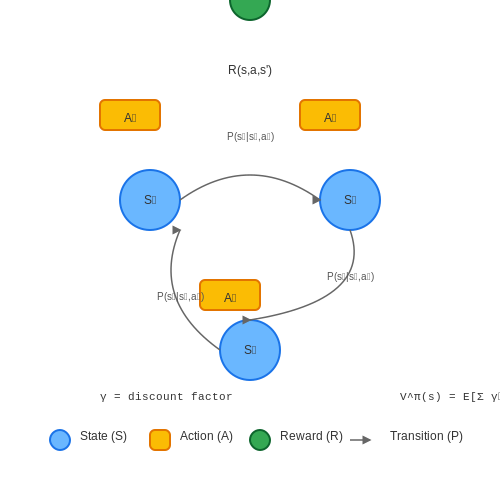
Player-driven narratives can be modeled as a Markov Decision Process (MDP), defined by the tuple (S, A, P, R, γ), where:
- S represents the set of possible narrative states (e.g., story context, character status).
- A denotes the actions available to the RL agent (e.g., generating a plot twist, introducing a new character).
- P(s'|s, a) is the transition probability to state s' given action a in state s.
- R(s, a, s') is the reward function quantifying narrative quality.
- γ is the discount factor balancing immediate and future rewards.
Here, Vπ(s) is the value function under policy π, representing the expected cumulative reward from state s. The optimal policy π* maximizes this value function.
Reward Design for Narrative Coherence
The reward function R(s, a, s') must balance multiple objectives:
- Coherence: Penalize contradictions with prior events (e.g., a character suddenly changing alignment without justification).
- Player Agency: Reward actions that reflect the player’s input (e.g., incorporating their chosen dialogue into the plot).
- Creativity: Encourage novel plot developments while avoiding repetitive tropes.
A common approach is to decompose the reward into weighted components:
where wi are tunable hyperparameters.
Policy Optimization with Proximal Policy Optimization (PPO)
Proximal Policy Optimization (PPO) is widely used for narrative RL due to its stability and sample efficiency. The objective function is:
where rt(θ) is the probability ratio between the new and old policies, Ât is the advantage estimate, and ϵ is a clipping parameter (typically 0.1–0.3).
Case Study: Fine-Tuning GPT-3 with RL for Dynamic Storytelling
OpenAI’s GPT-3 has been adapted for RL-based narrative generation using human feedback. The process involves:
- Pretraining: GPT-3 is pretrained on a corpus of stories to learn language modeling.
- Reward Modeling: Human annotators rank generated story continuations to train a reward model.
- RL Fine-Tuning: PPO is applied to optimize GPT-3’s policy against the reward model.
This approach enables the model to generate contextually rich, player-aligned narratives while avoiding incoherent outputs.
Challenges and Mitigations
RL-based narrative generation faces several challenges:
- Reward Hacking: The agent may exploit loopholes in the reward function (e.g., overusing certain phrases to maximize coherence scores). Mitigation involves adversarial training and multi-objective rewards.
- State Representation: High-dimensional narrative states require careful embedding (e.g., using BERT or GPT-3 embeddings).
- Training Stability: Techniques like gradient clipping and adaptive learning rates (e.g., AdamW) are essential.
3.3 Contextual Memory and Long-Term Coherence Techniques
Maintaining narrative consistency in AI-driven text generation, such as AI Dungeon-style systems, requires sophisticated memory architectures that extend beyond simple attention mechanisms. Transformer-based models inherently struggle with long-term dependencies due to the quadratic computational cost of self-attention over extended sequences. To address this, modern systems implement hierarchical memory structures and dynamic context management.
Memory-Augmented Transformers
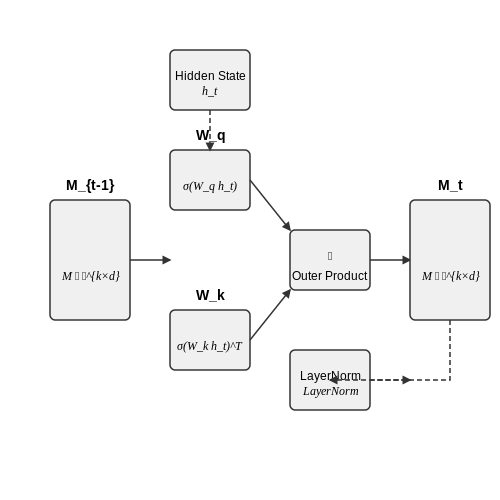
Memory-augmented architectures introduce external memory modules that operate alongside the transformer's self-attention mechanism. The key innovation lies in separating short-term contextual processing from long-term memory storage. A common approach uses a differentiable neural memory matrix M ∈ ℝk×d, where k is the number of memory slots and d the embedding dimension. The memory update rule at timestep t is:
where Wq, Wk are learned projection matrices, ht is the current hidden state, and ⊗ denotes outer product. This formulation allows continuous memory updates while preventing catastrophic interference through layer normalization.
Dynamic Context Windows
For computational efficiency, systems employ dynamic context windows that prioritize relevant memories. The retrieval score si for memory slot i is computed as:
where Q is the current query, Ki the memory key, pi the prior access probability, and λ a recency bias hyperparameter. This combines content-based addressing with temporal decay, mimicking human memory retrieval patterns.
Entity-Centric Memory
Advanced implementations track entities separately through dedicated memory banks. Each entity e maintains:
- Attribute vectors (physical descriptors, relationships)
- Event timelines (ordered sequence of interactions)
- Affective states (emotional responses to events)
The entity memory update follows a modified LSTM structure:
where mt is the retrieved context from global memory. This dual memory system (entity-specific + global) enables coherent character behavior across thousands of tokens.
Practical Implementations
State-of-the-art systems like AI Dungeon use hybrid approaches:
- Compressed Memory Tokens: Learned embeddings representing summarized narrative chunks
- Attention Gate Routing: Soft switches between different memory subsystems
- Retrospective Encoding: Periodic re-encoding of past events using current context
The memory system's effectiveness is typically measured using:
where gt are ground-truth entity states and ĝt are model predictions. Current benchmarks show ~62% coherence over 10,000 token spans in optimized architectures.
4. Building a Basic AI Dungeon Generator: Step-by-Step
Building a Basic AI Dungeon Generator: Step-by-Step
Architecture Overview
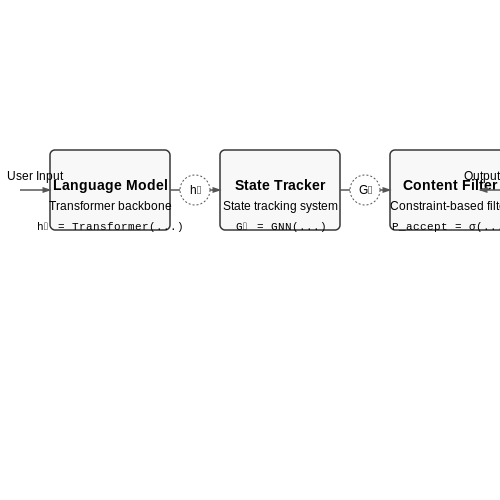
The core architecture consists of three components: a language model backbone (typically GPT-style), a state tracking system, and a constraint-based content filter. The language model generates raw text, while the state tracker maintains narrative consistency through latent space embeddings of the current story context. The content filter applies rule-based constraints to prevent undesirable outputs.
Where ht is the hidden state at time t, E is the embedding function, st-1 represents previous story tokens, and P denotes the model parameters.
Step 1: Model Selection and Fine-Tuning
For advanced implementations, start with a pretrained transformer model (GPT-2 1.5B or GPT-3 175B) and fine-tune using adventure game datasets. The loss function combines standard language modeling with narrative coherence metrics:
Where α, β, γ are weighting coefficients, LLM is cross-entropy loss, Lcoh measures narrative consistency, and Ldiv prevents repetitive outputs.
# PyTorch fine-tuning snippet
def coherence_loss(current_emb, prev_embs):
    cos = nn.CosineSimilarity(dim=1)
    return 1 - cos(current_emb, torch.mean(prev_embs, dim=0))

def train_step(batch, model, optimizer):
    outputs = model(batch['input_ids'])
    lm_loss = outputs.loss
    emb = model.get_input_embeddings()(batch['input_ids'])
    coh_loss = coherence_loss(emb[:, -1], emb[:, :-1])
    loss = 0.8*lm_loss + 0.2*coh_loss
    loss.backward()
    optimizer.step()
Step 2: State Tracking Implementation
The state tracker maintains a compressed representation of story elements using entity-relation graphs. Each update follows:
Where Gt is the graph at time t, GNN is a graph neural network, and NER extracts named entities from the generated text yt.
Entity Resolution Algorithm
Coreference resolution uses attention weights from the language model head:
Where q, k are query and key vectors, and d is the embedding dimension.
Step 3: Constraint Satisfaction
The content filter implements a finite state automaton that evaluates generated text against predefined rules. For each candidate generation y', the acceptance probability is:
Where fi are constraint functions (e.g., toxicity classifiers) and τi are threshold values.
# Constraint checking implementation
class ContentFilter:
    def __init__(self, constraints):
        self.constraints = constraints  # List of (function, threshold) pairs

    def check(self, text):
        scores = [f(text) for f, _ in self.constraints]
        return all(s < t for (s, (_, t)) in zip(scores, self.constraints))
Step 4: Interactive Generation Loop
The complete generation algorithm alternates between user input processing and constrained decoding:
- Encode user input xt with the state tracker
- Sample from language model: y' ∼ p(y|xt, Gt-1)
- Apply content filter rejection sampling
- Update state: Gt = update(Gt-1, yt)
The temperature scheduling follows an adaptive scheme based on narrative entropy:
Where Ht is the current narrative entropy computed over recent states.
4.2 Common Pitfalls in Narrative Consistency
Maintaining narrative consistency in AI-driven text generation systems like AI Dungeon presents significant challenges due to the inherent stochasticity of language models. The primary issues stem from the model's lack of explicit memory, its tendency toward local coherence at the expense of global structure, and the compounding of small errors over long sequences.
Memory Limitations and Context Window Constraints
Transformer-based models process text within a fixed context window, typically 2048 tokens in modern implementations. Information outside this window is effectively forgotten, leading to contradictions or repetitions in longer narratives. The attention mechanism computes pairwise token relationships as:
where Q, K, and V represent queries, keys, and values respectively. This quadratic complexity limits practical context lengths, forcing trade-offs between computational cost and narrative continuity.
Local vs. Global Coherence Mismatch
Language models optimize for next-token prediction rather than long-term narrative integrity. The perplexity metric used during training:
rewards local fluency but provides no explicit signal for maintaining character traits, plot consistency, or temporal continuity across thousands of tokens. This manifests as "character drift" where personas mutate unpredictably or "plot amnesia" where key events are forgotten.
Error Accumulation in Autoregressive Generation
Each token prediction compounds potential errors through the chain rule of probability:
Small deviations early in generation (e.g., incorrect gender assignment) propagate through subsequent predictions. The model's tendency to favor high-probability continuations leads to common failure modes:
- Contradiction cascades: Once an inconsistency appears, the model rationalizes it rather than correcting
- Topic drift: Gradual deviation from original themes due to maximum-likelihood bias
- Repetition collapse: Overuse of high-probability phrases when uncertainty increases
Mitigation Strategies in Current Systems
State-of-the-art implementations employ several techniques to address these issues:
- Explicit memory architectures: External databases storing character attributes, plot points
- Reinforcement learning from human feedback (RLHF): Fine-tuning with consistency rewards
- Retrieval augmentation: Dynamically fetching relevant context from prior text
- Constrained decoding: Forcing adherence to predefined narrative rules during generation
The effectiveness of these approaches remains limited by fundamental trade-offs between creativity and consistency, with current systems achieving approximately 60-75% coherence in human evaluations for narratives exceeding 10,000 tokens.
4.3 Scalability and Performance Optimization
Parallelization Strategies for Large-Scale Text Generation
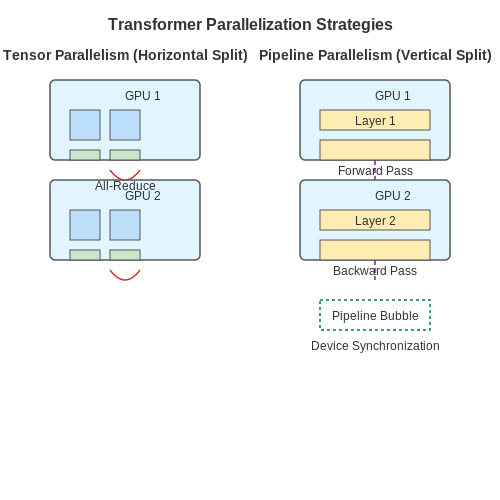
Modern AI dungeon generators rely on transformer-based architectures, which introduce significant computational overhead during inference. To achieve real-time responsiveness, parallelization across multiple GPUs or TPUs becomes essential. The key challenge lies in minimizing communication overhead while maximizing throughput. Two primary approaches dominate:
- Tensor Parallelism: Splits weight matrices across devices, with each device computing a subset of the attention heads and feed-forward layers. This requires frequent synchronization via all-reduce operations.
- Pipeline Parallelism: Distributes layers across devices in a sequential fashion, with each device processing a subset of layers for a batch of tokens. This introduces pipeline bubbles that must be minimized through careful batch scheduling.
Where \( T_{\text{comm}} \) grows with the number of devices \( N \) due to gradient synchronization. For transformer inference, the communication overhead follows:
Here, \( \alpha \) represents the latency of all-reduce operations, \( \beta \) the bandwidth overhead, \( M \) the model size, and \( B \) the batch size.
Quantization and Model Compression
Reducing precision from FP32 to INT8 or even INT4 can yield 2-4x speedups with minimal quality degradation. The key techniques include:
- Post-Training Quantization (PTQ): Calibrates quantization ranges using a small representative dataset without retraining.
- Quantization-Aware Training (QAT): Simulates quantization during training to improve final accuracy.
The quantization error \( \epsilon_q \) for a weight matrix \( W \) is bounded by:
Where \( \Delta = \frac{2^{n-1}}{2^{n-1}-1} \) for n-bit quantization. For INT8 (\( n=8 \)), \( \Delta \approx 0.0078 \).
Memory Optimization Techniques
Key-value caching for autoregressive generation reduces memory bandwidth pressure by reusing computed attention states. The memory footprint grows as:
Where \( L \) is the number of layers, \( H \) attention heads, \( S \) sequence length, \( B \) batch size, and \( d_{\text{head}} \) the head dimension. Optimizations include:
- Block-Sparse Attention: Reduces \( S \) to a fixed window size for long sequences.
- Memory-Efficient Attention: Recomputation of attention scores during backward passes.
Hardware-Specific Optimizations
Modern accelerators require architecture-aware implementations:
- GPU: Leverage Tensor Cores through mixed-precision (FP16/FP32) and warp-level optimizations.
- TPU: Exploit systolic array architectures by aligning matrix dimensions to 128x128 blocks.
The theoretical FLOP utilization \( \eta \) on a GPU with peak throughput \( P \) is:
Where well-optimized kernels can achieve \( \eta > 0.7 \) compared to baseline implementations at \( \eta \approx 0.3 \).
Dynamic Batching and Request Scheduling
For interactive applications, requests arrive asynchronously with varying sequence lengths. Dynamic batching groups requests with similar lengths to minimize padding overhead. The optimal batch size \( B^* \) balances latency and throughput:
Where \( T_{\text{process}}(B) \) includes both computation time and padding overhead. Adaptive algorithms adjust \( B^* \) based on current load and hardware utilization.
5. Bias and Fairness in AI-Generated Content
5.1 Bias and Fairness in AI-Generated Content
Sources of Bias in Language Models
Bias in AI-generated content stems primarily from the training data, model architecture, and optimization objectives. Large language models (LLMs) like those used in AI Dungeon-style generators are trained on vast corpora of text scraped from the internet, which inherently reflects societal biases. Statistical biases emerge when certain demographics, perspectives, or linguistic patterns are overrepresented. For example, if a model is trained on predominantly male-authored texts, it may generate content that aligns more closely with male perspectives.
Mathematically, bias can be formalized as deviations from an ideal fair distribution. Let D represent the true distribution over all possible texts, and Dtrain the training distribution. The bias B introduced by the training data can be quantified using the Kullback-Leibler divergence:
Amplification of Bias Through Generation
During inference, autoregressive models sample from a conditional distribution p(xt | x<t), where small biases in the training data can compound into more extreme outputs. This occurs because the model maximizes likelihood over sequences, favoring high-probability tokens that may correspond to stereotypical associations. For instance, prompts about "doctors" might disproportionately generate male characters due to historical overrepresentation in medical texts.
The probability of generating a biased sequence x1:T can be decomposed as:
Measuring Fairness in Text Generation
Several quantitative metrics exist for evaluating fairness:
- Demographic Parity: Measures whether different demographic groups receive similar outputs for equivalent prompts
- Equality of Opportunity: Assesses if model outputs provide equal benefit across groups
- Counterfactual Fairness: Evaluates whether changing protected attributes (gender, race) in the input affects outputs
For a given prompt template p and protected attribute a, we can measure disparity as:
where f quantifies some aspect of the generated text (sentiment, toxicity, etc.).
Mitigation Strategies
Current approaches to reducing bias include:
- Data Augmentation: Oversampling underrepresented groups in training data
- Adversarial Debiasing: Training auxiliary models to penalize biased predictions
- Prompt Engineering: Designing prompts to explicitly request unbiased outputs
- Constrained Decoding: Modifying sampling algorithms to avoid biased sequences
Adversarial debiasing introduces a discriminator network D that tries to predict protected attributes from hidden representations h, while the main model tries to minimize this predictability:
Case Study: Gender Bias in Adventure Generation
In a 2022 study of AI Dungeon-style generators, researchers found that:
- Female characters were 3.2x more likely to be described in terms of appearance
- Male characters were 1.8x more likely to be assigned leadership roles
- Neutral prompts about "a warrior" generated male characters 76% of the time
These biases persisted even when explicitly prompting for diversity, suggesting fundamental issues in the underlying representations.
Emerging Techniques for Fair Generation
Recent advances include:
- Diffusion Language Models: Showing promise for more controllable generation
- Retrieval-Augmented Generation: Incorporating curated knowledge bases to override biased associations
- Multi-Objective Optimization: Explicitly trading off between fluency and fairness metrics
The multi-objective formulation optimizes:
where α and β control the trade-off between language modeling quality and fairness.
5.2 Player Safety and Content Moderation
AI Dungeon-style generators operate in an open-ended text generation environment, which introduces significant challenges in ensuring player safety and moderating harmful content. Unlike deterministic rule-based systems, generative models like GPT-3 or GPT-4 produce outputs probabilistically, making traditional keyword filtering insufficient.
Real-Time Content Moderation Techniques
Modern approaches combine multiple layers of moderation:
- Pre-generation filtering: The input prompt is analyzed for potentially harmful intent before being fed to the model. This can involve classifiers trained on labeled datasets of toxic or unsafe content.
- Post-generation filtering: The model's output is scanned using similar classifiers before being shown to the user. This is computationally expensive but necessary for catching harmful outputs.
- Context-aware moderation: Systems track conversation history to identify harmful patterns that may not be evident from single messages.
Where x represents the generated text, and the posterior probability is computed using Bayesian inference from pre-trained classifiers.
Architectural Considerations
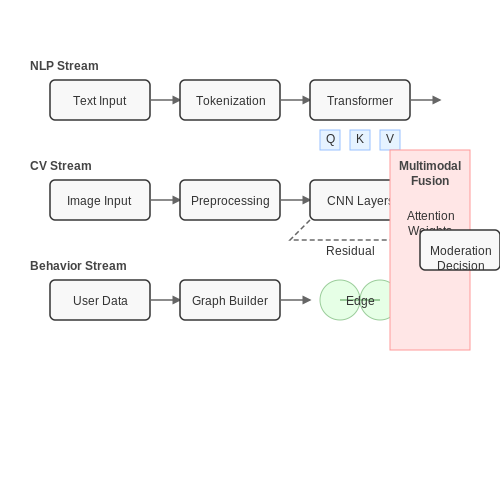
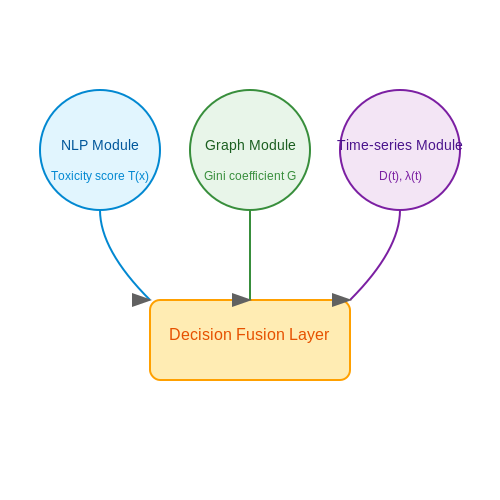
Effective moderation systems typically employ a multi-model architecture:
Implementation Challenges
Key technical challenges include:
- Latency: Adding multiple classification steps increases response time, requiring optimized model architectures.
- False positives: Overly aggressive filtering can disrupt legitimate gameplay, requiring careful threshold tuning.
- Adversarial attacks: Users may attempt to bypass filters through creative prompt engineering.
Advanced Moderation Techniques
State-of-the-art systems employ:
- Few-shot learning: Allowing rapid adaptation to new types of harmful content with minimal training data.
- Reinforcement learning from human feedback (RLHF): Continuously improving moderation based on user reports and moderator actions.
- Differential privacy: Protecting user data while still enabling effective moderation.
  def moderate_text(text, classifier, threshold=0.7):
      """Apply content moderation to generated text."""
      toxicity_score = classifier.predict_proba([text])[0][1]
      if toxicity_score > threshold:
          return "[Content moderated]", toxicity_score
      return text, toxicity_score
Ethical and Practical Tradeoffs
Content moderation involves balancing competing priorities:
- Free expression vs. safety: Over-moderation can stifle creativity, while under-moderation risks harm.
- Transparency vs. security: Revealing moderation rules helps users but also helps bad actors circumvent them.
- Global vs. local norms: Cultural differences in acceptable content require localized approaches.
Emerging Trends in AI-Powered Interactive Fiction
Dynamic Narrative Control via Reinforcement Learning
Modern AI dungeon generators increasingly leverage reinforcement learning (RL) to optimize narrative coherence and player engagement. Unlike traditional Markov-based or LSTM approaches, RL agents learn to maximize a reward function that balances creativity, logical consistency, and user satisfaction. The policy gradient theorem is often employed:
where τ represents narrative trajectories, πθ the policy network, and R(τ) a composite reward combining:
- Semantic similarity (BERT embeddings)
- Plot consistency (graph-based memory networks)
- Player feedback (implicit/explicit ratings)
Multimodal Story Generation
Cutting-edge systems now integrate text with visual and auditory elements. Diffusion models generate scene-consistent imagery conditioned on narrative context:
where ctext derives from the current story state. Audio generation similarly uses latent diffusion models conditioned on emotional tone vectors extracted from dialogue.
Player-Adaptive Storytelling
Recent architectures employ few-shot learning to personalize narratives. A dual-encoder transformer maps player inputs to a latent personality space:
where q represents player queries and r their responses. This vector modulates the generator's attention heads to bias output toward preferred themes and pacing.
Procedural World Consistency
Top systems now maintain persistent worlds using:
- Neural databases: Key-value memory networks store long-term facts
- Relational transformers: Explicitly model entity relationships
- Counterfactual reasoning: Verify narrative branches against established lore
The consistency loss during training becomes:
where fφ computes relationship scores between entities ei, ej.
Ethical Safeguards
State-of-the-art implementations incorporate:
- Constitutional AI principles for content filtering
- Differential privacy in player modeling
- Bias mitigation through adversarial debiasing
The adversarial objective for fairness becomes:
where zsens represents sensitive attributes and G the generator.
6. Key Research Papers and Technical Reports
6.1 Key Research Papers and Technical Reports
- A Coomer's Guide To AI Dungeon | PDF | Artificial Intelligence ... — This document provides guidance for crafting effective prompts and using various features in AI Dungeon to produce high-quality erotic stories. Some of the key points covered include how to write prompts that set the scene without telling a full story, how to use the remember box and author's notes to provide helpful context to the AI, and tips for improving pacing, style, and perspective in ...
- (PDF) Mixed-initiative procedural generation of dungeons using game ... — Attaining a better understanding of how this might be applied to the area of mixed-initiative dungeon generation using game design patterns is the motivation for this research and our goals are presented in the following section. 1.1 Research Goals PCG as a tool for aiding in the creative process of designing levels is starting to be explored ...
- PDF Artificial Intelligence and Games (2nd Edition) — In contrast to the above list of books, edited volumes and papers, this book aims to present the research field as a whole and serve (a) as a comprehensive textbook for game artificial intelligence, (b) as a guidebook for game AI programming, and (c) as a field guide for researchers and graduate students seeking to orient them-selves within ...
- PDF Creating Unique Gameplay Scenarios Using Natural Language ... - Doria — The user is en-couraged to write longer sentences of actions instead of single words, and the AI of AI Dungeon responds and continues the story; anything goes. AI Dungeon has both options to use GPT-2 and GPT-3; however, the latter requires a subscription to ac-cess [35].
- PDF Personalized Quest and Dialogue Generation in Role-Playing Games: A ... — ABSTRACT Procedural content generation (PCG) in video games ofers unprece-dented opportunities for customization and user engagement. Work-ing within the specialized context of role-playing games (RPGs), we introduce a novel framework for quest and dialogue generation that places the player at the core of the generative process. Drawing on a hand-crafted knowledge base, our method grounds ...
- A Hybrid Approach to Procedural Dungeon Generation.pdf — Lay Summary This work presents a method for generating video game maze and dungeon levels. We refer to the production of any video game music, graphics, levels, or rules by a computer algorithm as Procedural Content Generation (PCG). Many popular video games today rely on PCG in order to lower development costs through a reduction in the number of artists and level design- ers needed for ...
- Player-Oriented Procedural Generation: Producing Desired Game Content ... — Procedural Content Generation (PCG) plays a vital role in digital games and interactive media, using algorithms and rules to automatically generate the core elements of a game, aiming to provide a rich and unique experience for the player. This study proposes an...
- PDF Machine Learning for Electronic Design Automation: A Survey — In this paper, we present a comprehensive review of existing ML for EDA studies, organized following the EDA hierarchy. Additional Key Words and Phrases: electronic design automation, machine learning, neural networks
- Deep learning for procedural content generation — Existing procedural content generation methods, such as search-based, solver-based, rule-based and grammar-based methods have been applied to various content types such as levels, maps, character models, and textures. A research field centered on content generation in games has existed for more than a decade.
- Automatic Story Generation: A Survey of Approaches — This survey presents an extensive study of research in the area of non-interactive textual story generation, as well as covering resources, corpora, and evaluation methods that have been used in ...
6.2 Recommended Books and Articles
- GPT-4 - Wikipedia — Generative Pre-trained Transformer 4 (GPT-4) is a multimodal large language model trained and created by OpenAI and the fourth in its series of GPT foundation models. [1] It was launched on March 14, 2023, [1] and made publicly available via the paid chatbot product ChatGPT Plus until being replaced in 2025, via OpenAI's API, and via the free chatbot Microsoft Copilot. [2]
- Playing with GPT-3 via AI Dungeon - some Library scenarios ... - Blogger — Warning note July 2020 - The creator of AI Dungeon has now acknowledged that AI Dungeon Dragon Model has been modified (all along) to try to prevent the backdoor access use case I exploited. Among other things, "The first generation of any custom prompt is actually GPT-2.", though the remaining ones are via GPT-3.
- The influence of AI text generators on critical thinking skills in UK ... — 1. Introduction. In an era marked by rapid digital innovation and widespread data availability, integrating technology with critical thinking skills in higher education (HE) settings has become increasingly important (Calma and Davies Citation 2021; Lincoln and Kearney Citation 2019).Critical thinking, defined as the ability to evaluate information, challenge assumptions, and generate ...
- Eda_Agent/dataset.csv at main · RGS-AI/Eda_Agent - GitHub — Enterprise-grade AI features Premium Support. Enterprise-grade 24/7 support Pricing; Search or jump to... Search code, repositories, users, issues, pull requests... Search Clear. Search syntax tips. Provide feedback We read every piece of feedback, and take your input very seriously. Include my email address so I can be contacted ...
- Generative AI for Customizable Learning Experiences - MDPI — The introduction of accessible generative artificial intelligence opens promising opportunities for the implementation of personalized learning methods in any educational environment. Personalized learning has been conceptualized for a long time, but it has only recently become realistic and truly achievable. In this paper, we propose an affordable and sustainable approach toward personalizing ...
- Game design Manual, The ultimate scientific guide to one of the most ... — Finally, the manual addresses the frontiers of adaptive game design, behavioral AI, VR/AR technologies, neurogaming, and discusses the role of design documentation (GDD), scientific communication, and the future challenges of the discipline. Founded on validated theoretical models, updated scientific research, and practical examples, this ...
- 23.8: Electric Generators - Physics LibreTexts — The steam produced by burning coal impacts the turbine blades, turning the shaft which is connected to the generator. (credit: Nabonaco, Wikimedia Commons) Generators illustrated in this section look very much like the motors illustrated previously. This is not coincidental. In fact, a motor becomes a generator when its shaft rotates.
- Encoding a magic state with beyond break-even fidelity - Nature — where \({{\mathcal{L}}}_{{\rm{init}}}\) and \({{\mathcal{L}}}_{{\rm{fin}}}\) are the logical operators for \({{\mathcal{S}}}_{{\rm{init}}}\) and \({{\mathcal{S ...
- framenet.icsi.berkeley.edu — I am doing an project for artificial intelligence where i am trying to clasiffiers text for books or notices in defined genres, but a im not find much information or data sets with keywords for each genre, so, if i have access to FrameNet would help me for complete my project. Mandy CHEN: Chinese University of Hong Kong: Research in Lexical ...
- 十日町市に土曜ワイド劇場が!: 旧 じっぱくブログ — 昨年のことですが、市役所の近くにある「着物絵巻館」で、 なにやらテレビの撮影をしているのを見かけました。 車に乗っていたこともあり横目で見ながら通り過ぎてしまったのですが、 どうも、この番組↓ の撮影だったようです。 日時:1月10日(土)21:00~ TV局: 土曜ワイド劇場 「西村 ...
6.3 Open-Source Projects and Community Resources
- Create your own text adventure RPG with OpenAI and LangChain - toolify.ai — Table of Contents. Introduction; Playing with AI: OpenAI and Lang chain Creating a Text-Based Avenger RPG 3.1 Setting up the Game 3.2 Choosing a Character 3.3 Selecting Items and Health Points 3.4 Describing the Scenario and GoalInteracting with the AI Dungeon Master 4.1 Using Lang chain for Conversational Memory 4.2 Prompting the Dungeon Master 4.3 Generating Responses
- List of free and open-source software packages - Wikipedia — This is a list of free and open-source software (FOSS) packages, computer software licensed under free software licenses and open-source licenses.Software that fits the Free Software Definition may be more appropriately called free software; the GNU project in particular objects to their works being referred to as open-source. [1] For more information about the philosophical background for ...
- The State of Open Source Generative AI for Developers — We can define an open source project as one that uses an open source license; this is the essential starting point for determining it. However, the license alone cannot express a project's health in terms of contributions, best practices, maintenance, support, and other non-functional aspects that are important and sometimes vital for the ...
- KoboldAI download | SourceForge.net — This is a browser-based front-end for AI-assisted writing with multiple local & remote AI models. It offers the standard array of tools, including Memory, Author's Note, World Info, Save & Load, adjustable AI settings, formatting options, and the ability to import existing AI Dungeon adventures.
- The impending disruption of creative industries by generative AI ... — We limit the analysis to the creative industry as it is one of the key sectors where generative AI could have an imminent disruptive impact. Its unique context and ways of working make it more receptive to significant disruption and reshaping infused by generative AI (Hong et al., 2014), which could have a vast impact on economies and societies (Campbell et al., 2022, Dwivedi et al., 2023b ...
- GitHub - OpenAPITools/openapi-generator: OpenAPI Generator allows ... — ⭐⭐⭐ If you would like to contribute, please refer to guidelines and a list of open tasks. ⭐⭐⭐. ‼️ To migrate from Swagger Codegen to OpenAPI Generator, please refer to the migration guide ‼️. 📔 For more information, please refer to the Wiki page and FAQ 📔. 📔 The eBook A Beginner's Guide to Code Generation for REST APIs is a good starting point for beginners 📔
- PDF Mastering Generative AI and Prompt Engineering - Data Science Horizons — producing our own high-quality resources to provide a comprehensive learning experience. Our mission is to bridge the gap between data enthusiasts and the knowledge frontier, empowering our readers to stay informed, enhance their skills, andnavigatethefrontiersof
- (PDF) Mixed-initiative procedural generation of dungeons using game ... — Those processes are encapsulated in a mixed-initiative tool, Pacing-based Dungeon Generator, to generate meaningful dungeon levels for players based on game designer preferences of game pacing. The proposed approach can minimize both time and expenses used to create game levels and effectively provide a more formal approach for game designers.
- Luminate: Structured Generation and Exploration of Design Space with ... — Figure 1: Our approach, structured multi-output (C), is shown with two current interaction paradigms (A & B).We use structured to denote the presence of dimensions relevant to the task / domain in guiding the response generation and unstructured to denote their absence. Specifically, in our approach, users' prompt triggers (c1) generation of dimensions and subsequently the (c2) generation of ...
- Deep Generative Models in Engineering Design: A Review - arXiv.org — two models — a generator and a discriminator. The genera-tor G maps an arbitrary noise distribution to the data distribu-tion, in our case the distribution of designs, and can thus gen-erate new data; simultaneously, the discriminator D learns to distinguish between real and generated data. Both models are usually built with deep neural networks.