


A child lost alarm circuit
#child safety
#alarm circuit
#security
#lost child prevention
#family safety
#sound alarm
#warning system
#safety device
#tracking
#parental control

Description: Children often go missing, causing immense suffering and economic losses for families. This situation also presents opportunities for unscrupulous child traffickers to exploit. To address this issue, a radio alarm system has been designed, which consists of a transmitter worn by the child or elderly person and a receiver held by the guardian. When the child or elderly individual moves beyond a distance of 3-4 meters from the guardian (parent or caregiver), the guardian receives an alarm sound. Due to the short distance, the individual can be located quickly and easily. This device is particularly suitable for crowded environments such as shopping malls and public events. The system comprises a transmitter and a receiver, with the following circuit principles:
1. The transmitter circuit, illustrated in Figure 13-3a, operates when transistor VT3 conducts, providing a positive bias to transistors VT1 and VT2. This configuration forms a self-excited multivibrator that generates an oscillation frequency between 1600 and 1800 kHz. The frequency selection circuit, comprising inductors L1, L2, and capacitor Ct, allows for adjustment of the transmitted signal's frequency, which is then radiated through a magnetic antenna. The inductors L1 and L2 are constructed with Si-coated wire, having 80 and 40 turns respectively, while the tuning capacitor C1 ranges from 5 to 30 pF.
2. The receiver circuit, depicted in Figure 13-32b, utilizes an antenna L1 to capture the transmitter's signal. The tuning circuit, comprised of L2 and G, selects the remote control signal that matches the transmitter's frequency. The received signal, being very weak, is amplified through a multi-stage amplifier formed by transistors VT1, VT2, and VT3. A four-push sound integrated circuit then generates an audible alert. Due to the low output power, the final stage transistor VT4 enhances the signal to drive a loudspeaker, which emits a sound to alert the guardian to locate the lost child.
This radio alarm system effectively combines simplicity and functionality, providing a reliable solution for ensuring the safety of children and elderly individuals in crowded spaces. The design emphasizes ease of use and rapid response, crucial factors in emergency situations. Children lost a phenomenon often happens, look around, the family should not have brought enormous suffering and economic losses; in addition, also points to unscrupulous child traffickers an opportunity to exploit. For this reason, the design of a radio alarm, children or elderly old man wearing a transmitter, guardianship person with a receiver. When a child or aged man leaving guardian (parent or nanny) Ji from 3-4m, guardian receiving the alarm sound, due to the short distance, it can be found quickly, easily lost.
The device is particularly suitable for the holiday shopping malls, Alhambra and other crowded situations. The device consists of a transmitter and a receiver, whose circuit and principle is as follows: (1) transmitter circuit transmitter circuit shown in Figure 13-3 2a.
When the VT3 conduction, to VT1, VTZ with a positive bias. VT1, VT2 composition self-excited multivibrator start work. Generating a frequency of 1600 ~ 1800kHz frequency oscillation amplitude signal, the Li, L2 and Ct harmonic oscillation frequency selection circuit, c] to adjust the size of the heap transmit signal frequency must be selected in the spring, the magnet antenna out. Wherein Lj, respectively Si-coated wire gauze keys. 80 turns and 40 turns, the tuning capacitor c1 is 5-30pF. The other as shown in FIG. (2) a receiver circuit 13-32b receiver circuit as shown in FIG. Upon receiving antenna Li receiver to the transmitter signal, the L2 and G tuning circuit select remote control signal with the frequency of the transmitter, the received signal is very weak emblem, the VT1, VT2, VT3 multi-stage amplifier, four push sound integrated musical work, due to lower output power, after the last stage VT4 enlarge the loudspeaker Island L work, issued music, remind guardians to find lost children.
1. The transmitter circuit, illustrated in Figure 13-3a, operates when transistor VT3 conducts, providing a positive bias to transistors VT1 and VT2. This configuration forms a self-excited multivibrator that generates an oscillation frequency between 1600 and 1800 kHz. The frequency selection circuit, comprising inductors L1, L2, and capacitor Ct, allows for adjustment of the transmitted signal's frequency, which is then radiated through a magnetic antenna. The inductors L1 and L2 are constructed with Si-coated wire, having 80 and 40 turns respectively, while the tuning capacitor C1 ranges from 5 to 30 pF.
2. The receiver circuit, depicted in Figure 13-32b, utilizes an antenna L1 to capture the transmitter's signal. The tuning circuit, comprised of L2 and G, selects the remote control signal that matches the transmitter's frequency. The received signal, being very weak, is amplified through a multi-stage amplifier formed by transistors VT1, VT2, and VT3. A four-push sound integrated circuit then generates an audible alert. Due to the low output power, the final stage transistor VT4 enhances the signal to drive a loudspeaker, which emits a sound to alert the guardian to locate the lost child.
This radio alarm system effectively combines simplicity and functionality, providing a reliable solution for ensuring the safety of children and elderly individuals in crowded spaces. The design emphasizes ease of use and rapid response, crucial factors in emergency situations. Children lost a phenomenon often happens, look around, the family should not have brought enormous suffering and economic losses; in addition, also points to unscrupulous child traffickers an opportunity to exploit. For this reason, the design of a radio alarm, children or elderly old man wearing a transmitter, guardianship person with a receiver. When a child or aged man leaving guardian (parent or nanny) Ji from 3-4m, guardian receiving the alarm sound, due to the short distance, it can be found quickly, easily lost.
The device is particularly suitable for the holiday shopping malls, Alhambra and other crowded situations. The device consists of a transmitter and a receiver, whose circuit and principle is as follows: (1) transmitter circuit transmitter circuit shown in Figure 13-3 2a.
When the VT3 conduction, to VT1, VTZ with a positive bias. VT1, VT2 composition self-excited multivibrator start work. Generating a frequency of 1600 ~ 1800kHz frequency oscillation amplitude signal, the Li, L2 and Ct harmonic oscillation frequency selection circuit, c] to adjust the size of the heap transmit signal frequency must be selected in the spring, the magnet antenna out. Wherein Lj, respectively Si-coated wire gauze keys. 80 turns and 40 turns, the tuning capacitor c1 is 5-30pF. The other as shown in FIG. (2) a receiver circuit 13-32b receiver circuit as shown in FIG. Upon receiving antenna Li receiver to the transmitter signal, the L2 and G tuning circuit select remote control signal with the frequency of the transmitter, the received signal is very weak emblem, the VT1, VT2, VT3 multi-stage amplifier, four push sound integrated musical work, due to lower output power, after the last stage VT4 enlarge the loudspeaker Island L work, issued music, remind guardians to find lost children.

High-Output Pulsed-Tone/Light-Activated Alarm Circuit
This circuit is capable of generating up to 1 W of audio power to drive a speaker or horn. When the CDS cell is exposed to light, its resistance decreases, activating NOR gate (a). This activation causes gates (a) and...

Elderly lost alarm circuit
The circuit utilizes an RMIB multivibrator component that operates at a maximum distance. When the distance exceeds a specific threshold, the output pin of the receiver goes low, effectively stopping the oscillation. The NE555 multivibrator, which is part of the...

Easy Alarms Police / Ambulance Electronic
The following circuit illustrates the electronic diagram design for police and ambulance alarms. Features include simplicity and ease of assembly, as well as cost-effectiveness.
This electronic schematic represents a basic alarm system intended for use in police and ambulance applications. The...

Locker Guard Locker Security Alarm Circuit Anti Theft
Locker Guard Circuit Diagram. This compact circuit is designed to protect a locker or almirah from burglary. If the locker is opened while in the armed state, the circuit triggers a loud police siren to deter the burglary attempt.
The Locker...

Security-door-ajar-alarm
The TL3019 device activates, or goes low, when a south pole of a magnet approaches the chip face. In this example, there are five doors, each equipped with a magnet embedded in its edge, with the south pole facing outward....
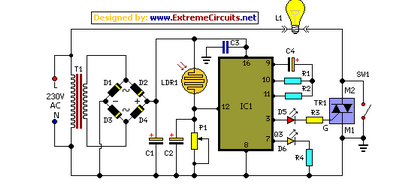
Midnight Security Light Circuit Schematic
Most thefts occur after midnight when individuals enter the second phase of sleep known as 'paradoxical sleep.' Here is an energy-saving circuit that causes...
An energy-saving circuit designed for security applications can be particularly beneficial during the late-night hours when individuals...

A three-alarm phase circuits
The circuit features intermediate relays KAi, KA2, and KA3, which are connected to the outlet end of the low-voltage circuit breakers. An alarm circuit is linked to a backup power supply or a battery power supply. This configuration serves to...

House Alarm Loop
This circuit features open and closed loop contacts (switches 1, 2, 3) that activate the alarm, which remains activated for 5 to 10 minutes. The triggering delay for entrance and exit is set to 27 seconds. Additionally, this simple alarm...

Security Monitor
This circuit can be utilized in a garden setting to detect unusual sounds or wildlife noises. It can also monitor sounds around a car parked in a remote location. The cable used for the setup can either be visible or...