


A Cmos 4060 Burglar Alarm circuit
#CMOS 4060
#burglar alarm
#siren
#PIR
#SCR
#timer
#security system
#normally-closed input
#entry delay
#exit delay
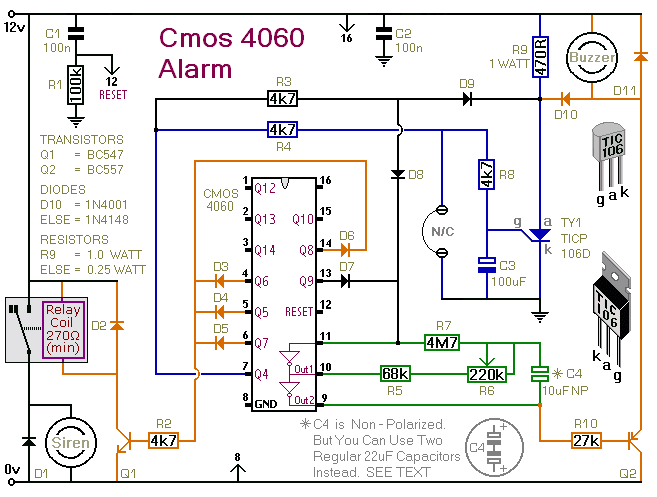
Description: This is a single-zone alarm system featuring automatic exit, entry, and siren cut-off timers. It is designed to accommodate various types of normally-closed input devices, including magnetic reed contacts, foil tape, and passive infrared sensors (PIRs). Additionally, it is straightforward to incorporate a normally-open trigger. Upon activation, the siren will sound for a predetermined duration before automatically shutting off and remaining inactive thereafter. The alarm system will not reactivate once silenced. The circuit serves as an excellent introduction to the CMOS 4060 and the silicon-controlled rectifier (SCR).
The single-zone alarm circuit primarily utilizes a CMOS 4060 timer IC, which provides the necessary timing functions for exit, entry, and siren cut-off operations. The CMOS 4060 is known for its low power consumption and versatility in timing applications. It features an integrated oscillator that can be configured to set the desired timing intervals for the alarm's operation.
The circuit is designed to accept normally-closed input devices, which means that when these devices are in their default state (closed), they allow current to flow. If any of these devices are triggered (opened), it activates the alarm. Commonly used input devices include magnetic reed switches, which are often used in door and window sensors, foil tape that can detect tampering, and passive infrared sensors that sense motion.
In addition to these input devices, the alarm system also provides the flexibility to incorporate normally-open triggers. These triggers can be used in scenarios where a momentary switch or other devices may be utilized to activate the alarm system temporarily.
The siren output is controlled through an SCR, which acts as a switch that can handle high current loads required to drive the siren. When the alarm is activated, the CMOS 4060 generates a pulse that turns on the SCR, allowing current to flow to the siren. The duration of the siren's sound is determined by the timing configuration of the CMOS 4060. Once the timer elapses, the SCR is turned off, cutting power to the siren and preventing any reactivation until the system is reset.
The overall design ensures that the alarm system is user-friendly, with clear timing functions and reliable operation. This circuit serves as an educational tool for understanding basic alarm system principles and the functionality of key components such as the CMOS 4060 and SCR in practical applications.This is a single zone alarm - with automatic exit, entry and siren cut-off timers. It will accommodate all the usual types of normally-closed input devices - such as magnetic reed contacts, foil tape, PIRs etc. But it`s easy to add a normally-open trigger. When the alarm is activated - the siren will sound for a fixed length of time. Then it will switch off - and remain off. The alarm will not reactivate. The Circuit offers a good introduction to the Cmos 4060 and the SCR..
The single-zone alarm circuit primarily utilizes a CMOS 4060 timer IC, which provides the necessary timing functions for exit, entry, and siren cut-off operations. The CMOS 4060 is known for its low power consumption and versatility in timing applications. It features an integrated oscillator that can be configured to set the desired timing intervals for the alarm's operation.
The circuit is designed to accept normally-closed input devices, which means that when these devices are in their default state (closed), they allow current to flow. If any of these devices are triggered (opened), it activates the alarm. Commonly used input devices include magnetic reed switches, which are often used in door and window sensors, foil tape that can detect tampering, and passive infrared sensors that sense motion.
In addition to these input devices, the alarm system also provides the flexibility to incorporate normally-open triggers. These triggers can be used in scenarios where a momentary switch or other devices may be utilized to activate the alarm system temporarily.
The siren output is controlled through an SCR, which acts as a switch that can handle high current loads required to drive the siren. When the alarm is activated, the CMOS 4060 generates a pulse that turns on the SCR, allowing current to flow to the siren. The duration of the siren's sound is determined by the timing configuration of the CMOS 4060. Once the timer elapses, the SCR is turned off, cutting power to the siren and preventing any reactivation until the system is reset.
The overall design ensures that the alarm system is user-friendly, with clear timing functions and reliable operation. This circuit serves as an educational tool for understanding basic alarm system principles and the functionality of key components such as the CMOS 4060 and SCR in practical applications.This is a single zone alarm - with automatic exit, entry and siren cut-off timers. It will accommodate all the usual types of normally-closed input devices - such as magnetic reed contacts, foil tape, PIRs etc. But it`s easy to add a normally-open trigger. When the alarm is activated - the siren will sound for a fixed length of time. Then it will switch off - and remain off. The alarm will not reactivate. The Circuit offers a good introduction to the Cmos 4060 and the SCR..

Three-minute-timer
When S1 is off, C1 charges to within 0.5 V of the battery voltage through diode D1 and resistor R4. When S1 is closed, the anode of the PUT rises to the positive supply voltage. The PUT does not conduct...

Shed/Garage Alarm
This is a simple single-zone burglar alarm circuit. Its features include automatic exit and entry delays. It is designed to be used with the usual types of normally-closed input devices such as magnetic reed contacts, micro switches, foil tape, and...

HIGH POWER SIREN
IC1a and IC1b are configured as a slow astable multivibrator, while IC1c and IC1d are set up as a fast astable multivibrator. Both configurations are of the "gated" type, allowing them to be activated or deactivated through push button PB1....
One-IC two-tones Siren
This circuit is designed for children's entertainment and is suitable for installation on bicycles, battery-powered cars, and motorcycles, as well as in models and other games. When switch SW1 is positioned as indicated in the circuit diagram, it reproduces the...
A Cmos 4060 Burglar Alarm
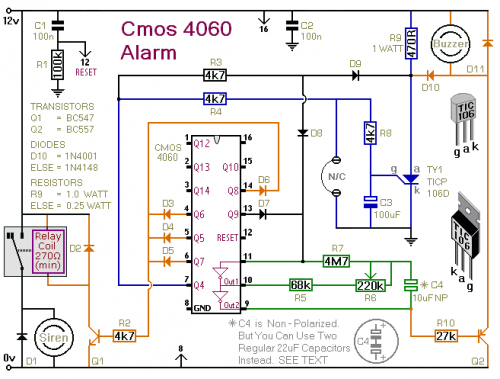
This is a single-zone alarm system featuring automatic exit, entry, and siren cut-off timers. It accommodates various types of normally-closed input devices, including magnetic reed contacts, foil tape, passive infrared sensors (PIRs), and more. Additionally, it is straightforward to incorporate...
Timer circuit
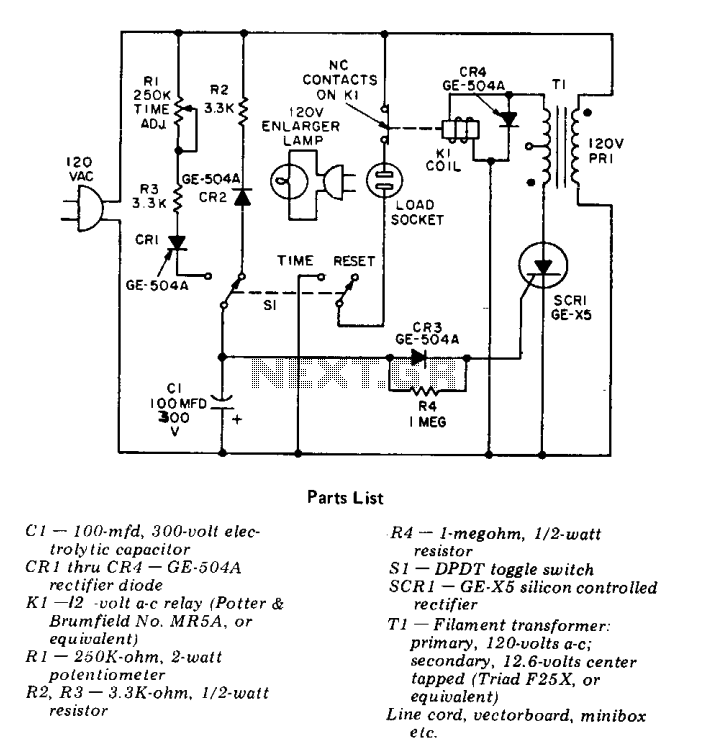
This precision solid-state time delay circuit features both delayed off and delayed on switch functions, which can be interchanged by simply swapping the relay contacts.
The described time delay circuit is designed to provide precise control over the timing of switching...
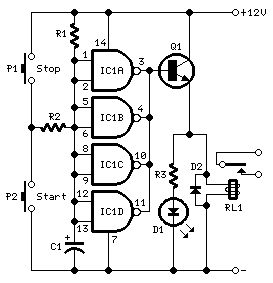
long delay timer schematics
This timer is designed to automatically switch off a portable radio after a set period, allowing users to relax without worrying about battery drain. Resistor R1 and capacitor C1 create a long time constant. When switch P2 is momentarily closed,...
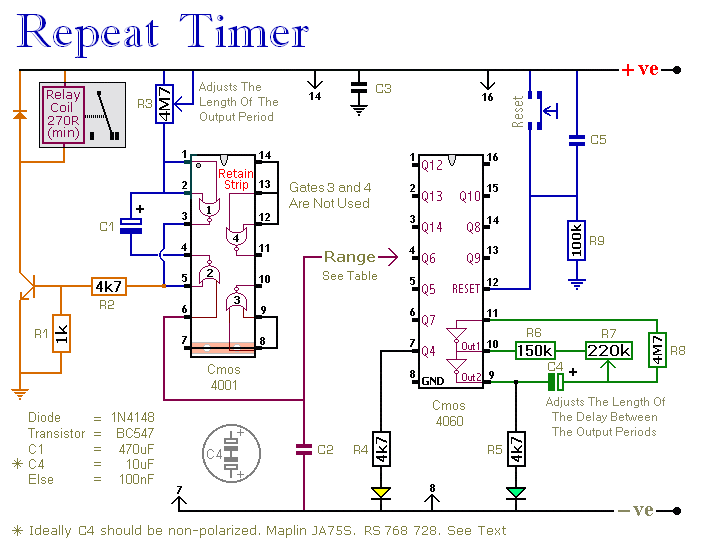
a regularly repeating interval timer
This circuit features an adjustable output timer capable of re-triggering at specified intervals. The output duration can range from a fraction of a second to over half an hour, and it can be configured to repeat at regular intervals spanning...

Ambulance (Hee-Haw) Siren
The circuit consists of two multivibrators. The first multivibrator controls the speed of the transition from 'hee' to 'haw' and operates at a low frequency.
The circuit features two distinct multivibrator configurations, which can be identified as an astable multivibrator and...