


LOUD BIKE SIREN
#5558 dual opamp
#NPN transistors
#triangle wave
#astable multivibrator
#siren
#volume control
#9V battery
#sound generator
#distortion control
#frequency variation

Description: Utilizes a 5558 dual operational amplifier and four general-purpose NPN transistors to generate a triangle wave. This wave can be distorted using a 10k symmetry control, allowing for either a fast or slow rise time for the sawtooth waveform applied as base bias to an astable multivibrator formed by transistors Q1 and Q2. The circuit operates with a reasonably low drain current when powered by a 9-V radio battery. The repetition rate can be adjusted from a long wail to a rapid warble, and the output volume can be varied from soft to loud.
The circuit design leverages the 5558 dual op-amp to create a stable triangle wave generator. The triangle wave output is essential for generating the desired sound effects in the siren application. The symmetry control, a 10k potentiometer, plays a crucial role in adjusting the rise and fall times of the triangle wave, thereby influencing the timbre and character of the output sound. This feature allows for customization of the siren's tone, making it more versatile for various applications.
The output from the triangle wave generator is fed into an astable multivibrator configuration formed by two NPN transistors, Q1 and Q2. This configuration allows the circuit to oscillate, producing a square wave that can be modulated into different sound patterns. The choice of general-purpose NPN transistors ensures that the circuit can be easily assembled and maintained, as these components are widely available.
Powering the circuit with a 9-V radio battery ensures that it remains portable and suitable for applications such as bicycle alarms. The low drain current is advantageous, prolonging battery life and enhancing the practicality of the design. The repetition rate of the sound output can be adjusted, allowing users to switch between a long wailing sound for alerts and a rapid warble for attention-grabbing effects.
Volume control is another critical aspect of this circuit, enabling the user to adjust the loudness from a soft warning to a significantly louder alarm. This feature is particularly useful in different environments, where the ambient noise levels may vary.
Construction details provided in the original article recommend using a removable mounting system for the circuit, especially when installed on bicycles, to prevent theft. This practical consideration enhances the usability of the electronic siren in real-world scenarios, making it a valuable addition for safety and security applications.Uses 5558 dual opamp and four general-purpose NPN transistors to generate triangle wave that can be distorted by 10k symmetry control to give either fast or slow rise for sawtooth applied as base bias to astable MVBR Q1-Q2. Drain is reasonably low with 9-V radio battery, Repetition rate can be varied from long wail to rapid warble, and volume changed from soft to annoying.
The circuit design leverages the 5558 dual op-amp to create a stable triangle wave generator. The triangle wave output is essential for generating the desired sound effects in the siren application. The symmetry control, a 10k potentiometer, plays a crucial role in adjusting the rise and fall times of the triangle wave, thereby influencing the timbre and character of the output sound. This feature allows for customization of the siren's tone, making it more versatile for various applications.
The output from the triangle wave generator is fed into an astable multivibrator configuration formed by two NPN transistors, Q1 and Q2. This configuration allows the circuit to oscillate, producing a square wave that can be modulated into different sound patterns. The choice of general-purpose NPN transistors ensures that the circuit can be easily assembled and maintained, as these components are widely available.
Powering the circuit with a 9-V radio battery ensures that it remains portable and suitable for applications such as bicycle alarms. The low drain current is advantageous, prolonging battery life and enhancing the practicality of the design. The repetition rate of the sound output can be adjusted, allowing users to switch between a long wailing sound for alerts and a rapid warble for attention-grabbing effects.
Volume control is another critical aspect of this circuit, enabling the user to adjust the loudness from a soft warning to a significantly louder alarm. This feature is particularly useful in different environments, where the ambient noise levels may vary.
Construction details provided in the original article recommend using a removable mounting system for the circuit, especially when installed on bicycles, to prevent theft. This practical consideration enhances the usability of the electronic siren in real-world scenarios, making it a valuable addition for safety and security applications.Uses 5558 dual opamp and four general-purpose NPN transistors to generate triangle wave that can be distorted by 10k symmetry control to give either fast or slow rise for sawtooth applied as base bias to astable MVBR Q1-Q2. Drain is reasonably low with 9-V radio battery, Repetition rate can be varied from long wail to rapid warble, and volume changed from soft to annoying.
Article gives construction details, and recommends use of removable mounting on bike to avoid theft.-R. Megirian, Simple Electronic Siren, 73 Magazine, Oct.1977.p176-177.

Two-tone-siren
This siren provides a constant audio output while alternating between two distinct tones. The LM13080 is configured to oscillate at a fundamental frequency. This frequency can be modified by connecting a 200 kΩ charging resistor in parallel with the feedback...

Hee-haw
The circuit utilizes two gates from a 7400 integrated circuit, cross-connected to create an astable multivibrator that is driven by the one pulse per second output from a digital clock integrated circuit. Additionally, the circuit incorporates a low-frequency astable modulator...
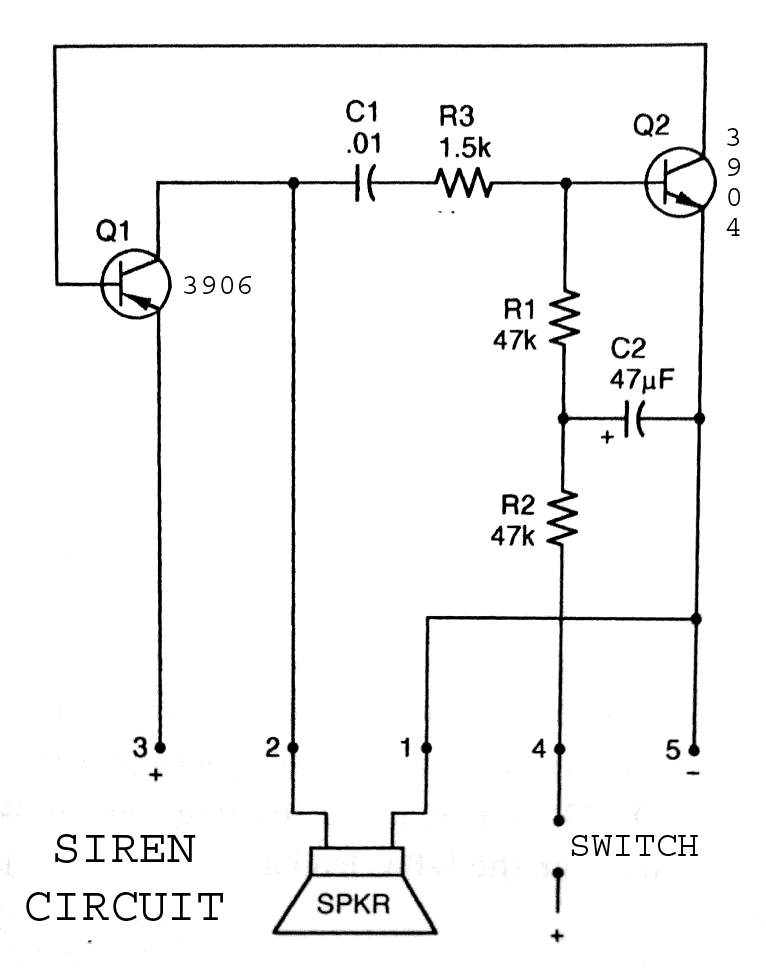
3904 3906 Siren Circuit
3904 3906 Siren Circuit. The circuit generates a wailing siren sound when the switch is activated.
The 3904 3906 Siren Circuit is designed to produce a distinctive wailing sound, commonly used in alarm systems and signaling devices. The circuit utilizes bipolar...

Astable Multivibrator
This circuit is an astable multivibrator designed to alternately flash two LEDs. The resistor (R) and capacitor (C) values determine the frequency of the flashing, while the 470-ohm collector load resistors limit the current to approximately 20 milliamps when the...

Triangle- And Square-Wave Generator Circuit
The circuit generates precision triangle and square waves. The output amplitude of the square wave is determined by the output swing of operational amplifier A1, while the ratio of resistors R1 to R2 sets the amplitude of the triangle wave....

9-V-battery-life-extender
The circuit provides a minimum output of 7 V until the 9-V battery voltage drops below 2 V. When the battery voltage is above 7 V, the MAX630's IC pin is low, placing it in shutdown mode, which consumes only...

how to get more power out of a astable multivibrator
Powering this circuit with a 6V alkaline battery operates effectively with 100µF capacitors. However, there is an issue when attempting to replace the LED with a DPDT relay; a 6V relay previously available does not activate. Additionally, when using a...
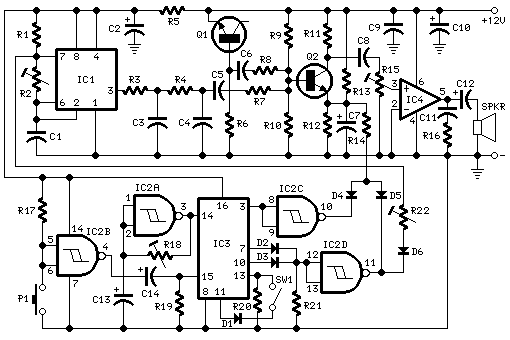
Cuckoo-song Generator
Agreeable, very close sound imitation Suitable for sound effects, door-bells etc. This circuit generates a two-tone effect very much alike the cuckoo song. It can be used for door-bells or other purposes thanks to a built-in audio amplifier and loudspeaker....

Automatic volume change with the ambient noise control circuit
Automatic volume adjustment with ambient noise control circuit. In car stereos and similar devices, the ambient noise level varies during high-speed and low-speed driving or while stationary, leading to different volume requirements. A fixed volume adjustment method may negatively impact...