


Smart Car Alarm Timer Automotive-Circuits
#car alarm
#timer
#automotive
#security
#delay circuit
#smart alarm
#vehicle protection
#electronics
#circuit design
#safety

Description: This circuit diagram represents a smart car alarm timer. This design is more advanced compared to traditional car alarm systems. When activated, the alarm remains active for 80 seconds, following an initial delay of 15 seconds.
The smart car alarm timer circuit integrates several key components to achieve its functionality. At the core of the design is a microcontroller or timer IC, which governs the timing sequence of the alarm. Upon activation, the circuit initiates a 15-second delay, during which the system prepares for the alarm signal. This delay can be implemented using a resistor-capacitor (RC) network or programmed within a microcontroller, depending on the complexity and requirements of the design.
Once the 15 seconds elapse, the alarm is triggered, and it remains active for a total duration of 80 seconds. This is typically achieved through a relay or transistor switch that controls the power to the alarm sounder, which could be a siren or a buzzer. The choice of sounder influences the overall effectiveness of the alarm, as a louder sound can deter potential intruders more effectively.
Additionally, the circuit may include various sensors, such as motion detectors or door sensors, which can serve as triggers for the alarm. These sensors enhance the security features of the system by detecting unauthorized access or movement around the vehicle. The integration of a reset mechanism can also be beneficial; this allows the user to deactivate the alarm manually or automatically after the designated time period.
Power supply considerations are crucial for ensuring the reliability of the alarm system. The circuit should be designed to operate efficiently from the vehicle's battery, with appropriate voltage regulation to prevent damage to sensitive components. Furthermore, incorporating a backup power source, such as a capacitor or rechargeable battery, can provide additional reliability in case of power interruptions.
Overall, this smart car alarm timer circuit represents a significant advancement in vehicle security technology, combining efficient timing mechanisms with enhanced detection capabilities to provide a robust alarm system.This is the circuit diagram of smart car alarm timer. This circuit is clever compared to common car alarm design. When this car alarm timer circuit is activated it will make the alarm remains activated for 80 seconds. It has 15 seconds dela..
The smart car alarm timer circuit integrates several key components to achieve its functionality. At the core of the design is a microcontroller or timer IC, which governs the timing sequence of the alarm. Upon activation, the circuit initiates a 15-second delay, during which the system prepares for the alarm signal. This delay can be implemented using a resistor-capacitor (RC) network or programmed within a microcontroller, depending on the complexity and requirements of the design.
Once the 15 seconds elapse, the alarm is triggered, and it remains active for a total duration of 80 seconds. This is typically achieved through a relay or transistor switch that controls the power to the alarm sounder, which could be a siren or a buzzer. The choice of sounder influences the overall effectiveness of the alarm, as a louder sound can deter potential intruders more effectively.
Additionally, the circuit may include various sensors, such as motion detectors or door sensors, which can serve as triggers for the alarm. These sensors enhance the security features of the system by detecting unauthorized access or movement around the vehicle. The integration of a reset mechanism can also be beneficial; this allows the user to deactivate the alarm manually or automatically after the designated time period.
Power supply considerations are crucial for ensuring the reliability of the alarm system. The circuit should be designed to operate efficiently from the vehicle's battery, with appropriate voltage regulation to prevent damage to sensitive components. Furthermore, incorporating a backup power source, such as a capacitor or rechargeable battery, can provide additional reliability in case of power interruptions.
Overall, this smart car alarm timer circuit represents a significant advancement in vehicle security technology, combining efficient timing mechanisms with enhanced detection capabilities to provide a robust alarm system.This is the circuit diagram of smart car alarm timer. This circuit is clever compared to common car alarm design. When this car alarm timer circuit is activated it will make the alarm remains activated for 80 seconds. It has 15 seconds dela..

case stepper
Beige Bag Software has been offering affordable and innovative circuit design tools since 1990. B2 Spice provides schematics as well as analog, digital, and mixed-mode electronic circuit simulation. It integrates with EAGLE and CADSTAR PCB software.
B2 Spice is a powerful...
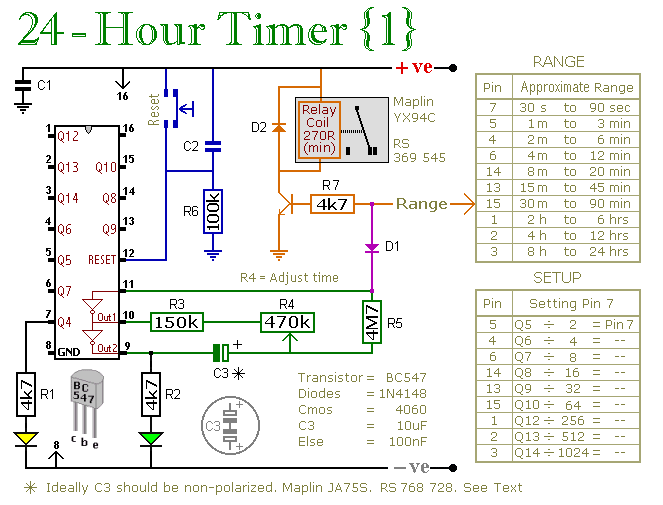
24 Hour Timer
These two circuits are multi-range timers that offer periods of up to 24 hours and beyond. Both circuits are fundamentally similar, with the key distinction being that Version 1 energizes the relay when the time expires, while Version 2 de-energizes...

Switch Timer For Bathroom Light
This 9-minute timer switch can be utilized to control lighting in a toilet or bathroom. The timer is activated by pressing switch S1 and deactivated by pressing S1 again. If the timer is not manually turned off, the light will...

Timer circuit
The schematic diagram is straightforward. SW1 is a pushbutton used to start the timer. The outputs are set to logic level 0 when the timer is inactive and to logic level 1 when the timer is triggered. The relay driver...

The Time Delay Circuit
The duration for which the circuit remains active is determined by the time required for the stored electrical current to leak back into the circuit, which keeps the transistor and the entire circuit energized. A resistor is present that limits...
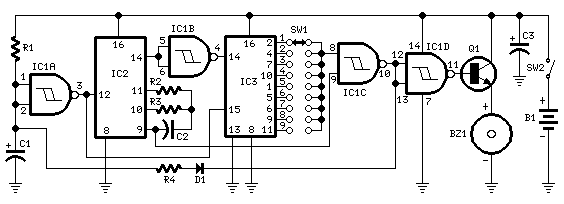
Jogging Timer
This circuit was developed since a number of visitors of this website requested a timer capable of emitting a beep after one, two, three minutes and so on, for jogging purposes. As shown in the Circuit diagram, SW1 is a...

Bedside Lamp Timer
The purpose of this circuit is to power a lamp or other apparatus for a specified duration (30 minutes in this case) and then turn it off. It is particularly useful for reading in bed at night, as it automatically...
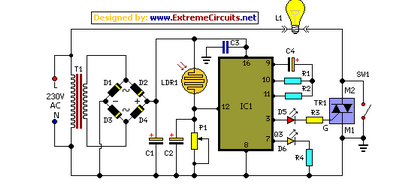
Midnight Security Light Circuit Schematic
Most thefts occur after midnight when individuals enter the second phase of sleep known as 'paradoxical sleep.' Here is an energy-saving circuit that causes...
An energy-saving circuit designed for security applications can be particularly beneficial during the late-night hours when individuals...

Delayed Car Door Alarm
Opening a car's door is a straightforward activity that typically requires no special skills. It is a routine task that is generally trouble-free; however, issues can occasionally arise.
The process of opening a car door involves several mechanical and electronic components...