


Tablet Reminder Uses Watch Module
#reminder
#watch module
#NOR gate
#RS flipflop
#medicine
#alarm
#diode
#timer
#health
#daily reminder

Description: This device serves as a daily medication reminder. It incorporates a crystal watch and a 4001 quad 2-input NOR gate, with two of the gates (IC1a & IC1b) configured as an RS flip-flop. The watch is programmed to alert at tablet time, typically in the mornings, when an alarm is triggered by a high signal through diode D1, which sets the RS flip-flop. This action activates the oscillator formed by gates IC1c and IC1d, which in turn drives an LED with a 10% duty cycle. A 10nF capacitor resets the watch alarm when a positive voltage is detected on pin 3 of IC1. The circuit operates at a low current consumption of only 50 µA using a 3V battery.
The medication reminder device is designed to provide an effective solution for individuals needing assistance in adhering to their medication schedules. The core of the system is a crystal watch, which ensures accurate timekeeping, while the 4001 quad 2-input NOR gate serves as the primary logic component. The RS flip-flop configuration, utilizing gates IC1a and IC1b, allows for a stable state to be maintained until the alarm is triggered.
When the set time for medication arrives, a high signal is generated through diode D1, leading to the setting of the RS flip-flop. This mechanism ensures that the alarm can be activated reliably at the designated time. The oscillator, constructed with gates IC1c and IC1d, functions to produce a periodic output that drives an LED indicator. The choice of a 10% duty cycle for the LED ensures that it flashes at intervals that are noticeable yet conserves battery power.
The inclusion of a 10nF capacitor plays a crucial role in the reset function of the watch alarm. When a positive voltage is detected on pin 3 of IC1, the capacitor discharges, effectively resetting the alarm and preparing the system for the next cycle. This design element contributes to the overall reliability of the device.
Operating at a mere 50 µA with a 3V battery, the circuit is highly efficient, allowing for extended use without frequent battery replacements. This low power consumption is particularly advantageous for a device intended for daily use, ensuring that users can rely on its functionality without the inconvenience of constant charging or battery changes. The combination of these elements creates a user-friendly and effective medication reminder system.This device is used as a reminder to take medicine every day. This device actually contains a crystal watch and a 4001 quad 2-input NOR gate with two of the gates (IC1a & IC1b) wired as an RS flipflop. The watch is set to tablet time , usually mornings, when an alarm is activated with a high signal fed via diode D1 which sets the RS flipflop and
enables the oscillator comprising gates IC1c & IC1d. This drives the LED with a 10% duty cycle. The 10nF capacitor resets the watch alarm when positive voltage appears on pin 3 of IC1. The circuit consumes only 50 µA with a 3V battery.
The medication reminder device is designed to provide an effective solution for individuals needing assistance in adhering to their medication schedules. The core of the system is a crystal watch, which ensures accurate timekeeping, while the 4001 quad 2-input NOR gate serves as the primary logic component. The RS flip-flop configuration, utilizing gates IC1a and IC1b, allows for a stable state to be maintained until the alarm is triggered.
When the set time for medication arrives, a high signal is generated through diode D1, leading to the setting of the RS flip-flop. This mechanism ensures that the alarm can be activated reliably at the designated time. The oscillator, constructed with gates IC1c and IC1d, functions to produce a periodic output that drives an LED indicator. The choice of a 10% duty cycle for the LED ensures that it flashes at intervals that are noticeable yet conserves battery power.
The inclusion of a 10nF capacitor plays a crucial role in the reset function of the watch alarm. When a positive voltage is detected on pin 3 of IC1, the capacitor discharges, effectively resetting the alarm and preparing the system for the next cycle. This design element contributes to the overall reliability of the device.
Operating at a mere 50 µA with a 3V battery, the circuit is highly efficient, allowing for extended use without frequent battery replacements. This low power consumption is particularly advantageous for a device intended for daily use, ensuring that users can rely on its functionality without the inconvenience of constant charging or battery changes. The combination of these elements creates a user-friendly and effective medication reminder system.This device is used as a reminder to take medicine every day. This device actually contains a crystal watch and a 4001 quad 2-input NOR gate with two of the gates (IC1a & IC1b) wired as an RS flipflop. The watch is set to tablet time , usually mornings, when an alarm is activated with a high signal fed via diode D1 which sets the RS flipflop and
enables the oscillator comprising gates IC1c & IC1d. This drives the LED with a 10% duty cycle. The 10nF capacitor resets the watch alarm when positive voltage appears on pin 3 of IC1. The circuit consumes only 50 µA with a 3V battery.

Repeating Timer 4
This circuit is the inverse of Repeating Timer No. 3. Its operation can be restricted to nighttime hours. The variable resistor (preset) allows selection of the darkness level at which the timer will activate.
The described circuit functions as a light-activated...
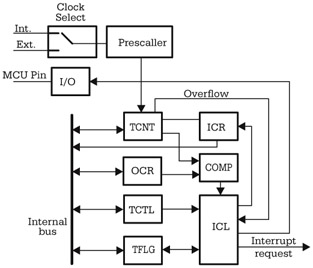
Using the MCU Timers
Although there are significant variations between different implementations of the general-purpose timer in various microcontrollers, many similarities exist in the principles of operation and the structure of the timer subsystem. The central element of the timer subsystem is a counter,...

A Regularly Repeating Interval Timer circuit
This circuit features an adjustable output timer capable of re-triggering at regular intervals. The output duration can range from a fraction of a second to over half an hour, and it can be configured to recur at regular intervals from...

sweep
The diode D13 is responsible for providing different timings for the forward sweep and the retrace, with the retrace occurring at a faster rate than the forward sweep. It generates outputs that inform the blanking circuit when to blank and...

Timed Safety Circuit Circuit
When switch SI is closed, pin 9 of operational amplifier U1 goes low, activating transistor Q1 for a predetermined duration. If switch S2 is closed during this time, transistor Q2 is activated for another predetermined duration. Resistors R1 and R13...

A Timer That Re-Triggers At Regular Intervals
This circuit features an adjustable output timer that can re-trigger at regular intervals. The output duration can range from a fraction of a second to half an hour or more, and it can be configured to recur at intervals from...

Long Delay Timer Circuit
This timer is designed primarily to turn off a portable radio after a set duration. This feature allows users to relax on the beach or in a hammock, confident that the device will automatically power down after a specified period,...

timer control 1 15 minutes by triac 2n6075 and lm555 lm358
Most timer circuits are often used with electrical transformers operating at low voltages such as 9V and 12V, and they incorporate electrical control relays. The timer can be set for durations ranging from 1 to 15 minutes.
Timer circuits are essential...

Sequential-timer
The timer circuit provides independent control over the output's on and off intervals, which can vary from 0.055 seconds to 30 minutes, and remains relatively unaffected by power-line transients. IC1 is a CMOS programmable timer chip that consists of 24...