


10 Watt TDA2002 Amplifier Circuit
#TDA2002
#power amplifier
#audio amplifier
#short circuit protection
#thermal protection
#low impedance
#IC module
#external components
#LM383 replacement

Description: This is a power amplifier circuit built using the TDA2002 power amplifier IC module. It serves as a replacement for the original LM383, which is no longer available. The circuit is easy to assemble and requires a minimal number of external components. The module features both short circuit protection and thermal protection. It can drive loads as low as 1.6 ohms and is capable of delivering over 10 watts from a 16V supply. The compact amplifier is designed around the TDA2002 IC, which can deliver 4W RMS at 4 ohms. The supply voltage can range from 8V to 18V, and the IC can tolerate transient voltage peaks of up to 28V without sustaining damage. The TDA2002 maintains additional advantages such as a very low number of external components, ease of assembly, and savings in space and cost. The device offers a high output current capability of up to 3.5A and exhibits very low harmonic and crossover distortion. Complete operational safety is ensured through protection against DC and AC short circuits between all pins and ground, as well as thermal overload protection.
The TDA2002 power amplifier circuit is designed for applications requiring efficient amplification with minimal component count. The circuit's architecture allows it to operate effectively within a wide voltage range, making it versatile for various power supply configurations. The TDA2002 IC is housed in a compact package, facilitating easy integration into both DIY projects and commercial products.
The circuit typically includes a few passive components such as resistors and capacitors, which are essential for setting the gain and ensuring stability. The input stage of the amplifier may incorporate a capacitor to block any DC offset from the source, allowing only the AC audio signal to pass through. This is crucial for maintaining signal integrity and preventing unwanted distortion.
The output stage of the amplifier is robust, capable of handling low impedance loads, which is particularly beneficial in applications such as automotive audio systems or portable speaker designs. The short circuit protection feature is vital for preventing damage to the IC in case of accidental shorts, while the thermal protection ensures that the amplifier operates within safe temperature limits, thus enhancing the longevity of the device.
In terms of performance, the TDA2002 is noted for its low harmonic and crossover distortion, making it suitable for high-fidelity audio applications. The ability to deliver significant power output while maintaining sound quality makes this amplifier an excellent choice for both hobbyists and professionals looking to create reliable audio amplification solutions. Overall, the TDA2002 power amplifier circuit exemplifies a practical design that balances performance, safety, and ease of use.This is a power amplifier circuit which built using a TDA2002 power amplifier IC module. These are replacements for the original LM383 which is no longer available. It is easy to build and has a minimum of external components. The module has both short circuit protection and thermal protection. It can drive loads as low as 1. 6 ohm and is capable o f delivering over 10 watts from a 16 V supply. The small amplifier is constructed around the TDA2002 IC, capable of delivering 4Wrms at 4ohms. The supply voltage may be anywhere between 8 and 18V, and the IC will accept transient voltage peaks of up to 28V without damage. The additional features of TDA 2002, very low number of external components, ease of assembly, space and cost saving, are maintained.
The device provides a high output current capability (up to 3. 5A) very low harmonic and cross-over distortion. Completely safe operation is guaranteed due to protection against DC and AC short circuit between all pins and ground, thermal over-range.
The TDA2002 power amplifier circuit is designed for applications requiring efficient amplification with minimal component count. The circuit's architecture allows it to operate effectively within a wide voltage range, making it versatile for various power supply configurations. The TDA2002 IC is housed in a compact package, facilitating easy integration into both DIY projects and commercial products.
The circuit typically includes a few passive components such as resistors and capacitors, which are essential for setting the gain and ensuring stability. The input stage of the amplifier may incorporate a capacitor to block any DC offset from the source, allowing only the AC audio signal to pass through. This is crucial for maintaining signal integrity and preventing unwanted distortion.
The output stage of the amplifier is robust, capable of handling low impedance loads, which is particularly beneficial in applications such as automotive audio systems or portable speaker designs. The short circuit protection feature is vital for preventing damage to the IC in case of accidental shorts, while the thermal protection ensures that the amplifier operates within safe temperature limits, thus enhancing the longevity of the device.
In terms of performance, the TDA2002 is noted for its low harmonic and crossover distortion, making it suitable for high-fidelity audio applications. The ability to deliver significant power output while maintaining sound quality makes this amplifier an excellent choice for both hobbyists and professionals looking to create reliable audio amplification solutions. Overall, the TDA2002 power amplifier circuit exemplifies a practical design that balances performance, safety, and ease of use.This is a power amplifier circuit which built using a TDA2002 power amplifier IC module. These are replacements for the original LM383 which is no longer available. It is easy to build and has a minimum of external components. The module has both short circuit protection and thermal protection. It can drive loads as low as 1. 6 ohm and is capable o f delivering over 10 watts from a 16 V supply. The small amplifier is constructed around the TDA2002 IC, capable of delivering 4Wrms at 4ohms. The supply voltage may be anywhere between 8 and 18V, and the IC will accept transient voltage peaks of up to 28V without damage. The additional features of TDA 2002, very low number of external components, ease of assembly, space and cost saving, are maintained.
The device provides a high output current capability (up to 3. 5A) very low harmonic and cross-over distortion. Completely safe operation is guaranteed due to protection against DC and AC short circuit between all pins and ground, thermal over-range.

TDA 7053 Stereo Audio Amplifier Circuit
This is a 1-watt stereo audio amplifier circuit utilizing the TDA 7053 integrated circuit from Philips. It is specifically designed for battery operation, delivering 1 watt per channel from a 6V DC supply. The circuit operates optimally between 6V and...

Schematic Diagram LM1877 Audio power amplifier circuit
This audio amplifier circuit is designed to deliver 2W per channel continuously into 8-ohm loads. The LM1877 is engineered to function with a minimal number of external components while still offering flexibility for applications in stereo phonographs, tape recorders, AM-FM...

three level audio power indicator
This circuit is designed to indicate the power output level of any audio amplifier. It is simple, portable, and displays three power levels that can be adjusted to any desired value.
The circuit operates by measuring the output voltage from the...
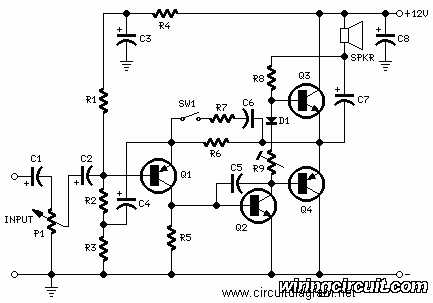
2 Watt Mini Audio Amplifier
This circuit is inexpensive, easy to assemble, and quite straightforward. It is a general audio amplifier that can be used with computers, CD players, or other devices that have a headphone output. The circuit was intentionally designed without the use...

Miniature Audio Amplifier Circuit
This miniature audio amplifier provides an output of up to 250mW and can function as a final stage audio amplifier for radio sets. The schematic is straightforward, featuring one BC transistor.
The described miniature audio amplifier is designed for efficient amplification...

Simple home audio power amplifier circuit schematic
This document presents a new audio power amplifier schematic utilizing TIP darlington pair transistors. It is suitable for both home audio and car audio amplifiers. The TIP142 and TIP147 darlington pair transistors create a push-pull high-power amplifier configuration, while two...

20Db-audio-booster
The amplifier's gain is nominally 20 dB. Its frequency response is primarily influenced by the values of a few components, mainly C1 and R1. The values in the schematic diagram yield a response of ±3.0 dB from approximately 120 Hz...

OddWatt Audio 5751 SRPP / KT88 Push-Pull Monoblock Tube Amplifier Kits
One of the advantages of hosting a hobby website is the opportunity to connect with individuals via email who share similar interests. Since posting Bruce's initial OddWatt project on the site, communication has occurred with numerous DIY hobbyists who have...

1,5V Earphones Audio Amplifier
This audio amplifier circuit, connected to 32 Ohm impedance mini-earphones, can detect very remote sounds. Useful for theatre, cinema and lecture goers: every word will be clearly heard. You can also listen to your television set at a very low...