


211 SET amp built
#211 SET amp
#vacuum tube
#audio amplifier
#valve amplifier
#speaker impedance
#unused
#loose component
#vintage
#high voltage
#tube amp

Description: The amplifier appears to be unused and still has the protective plastic film attached. One of the 211 tubes has a loose component rattling inside, necessitating the acquisition of a replacement. The positioning of the six smaller valves is unclear, as well as the appropriate speaker impedance to use.
The amplifier in question is a high-fidelity audio device, characterized by its use of 211 vacuum tubes, which are known for their ability to deliver high-quality sound. The unit's unused condition, indicated by the presence of the protective plastic film, suggests that it has not been subjected to operational wear, making it a potentially valuable component for audio enthusiasts or professionals.
However, the presence of a loose component within one of the 211 tubes raises concerns regarding the integrity and functionality of the circuit. This issue necessitates the replacement of the affected tube to ensure optimal performance. The 211 tube typically operates in a high-voltage environment and is critical for amplification stages within the circuit.
The inquiry regarding the positioning of the six smaller valves indicates a need for clarity on the circuit layout. Proper placement of these valves is essential for maintaining signal integrity and achieving the desired tonal characteristics of the amplifier. The schematic should provide detailed information on the pin configuration and layout to facilitate accurate installation.
Additionally, the question about speaker impedance is crucial, as the amplifier's performance can be significantly affected by mismatched impedance. The selection of appropriate speakers, typically rated in ohms, must align with the amplifier's output specifications to prevent damage and ensure efficient power transfer. Common impedance values for speakers range from 4 to 16 ohms, and the amplifier's manual or specifications should provide guidance on the optimal impedance for use.
In summary, the amplifier requires attention to both the replacement of the defective 211 tube and clarification on the valve positioning and speaker impedance to ensure proper functionality and performance. A detailed schematic would be beneficial in addressing these concerns, providing a comprehensive overview of the circuit design and component specifications.The amp appears to be unused, still has the plastic film stuck to it. One of the 211`s has a loose component rattling around inside so we will need to get one of those. As I said in my earlier post, it is the possitioning of the 6 smaller valves that we are stuck for and what ohms speakers to use. Anyone know Thanks The amp appears to be unused, still has the plastic film stuck to it. One of the 211`s has a loose component rattling around inside so we will need to get one of those. As I said in my earlier post, it is the possitioning of the 6 smaller valves that we are stuck for and what ohms speakers to use. Anyone know Thanks
The amplifier in question is a high-fidelity audio device, characterized by its use of 211 vacuum tubes, which are known for their ability to deliver high-quality sound. The unit's unused condition, indicated by the presence of the protective plastic film, suggests that it has not been subjected to operational wear, making it a potentially valuable component for audio enthusiasts or professionals.
However, the presence of a loose component within one of the 211 tubes raises concerns regarding the integrity and functionality of the circuit. This issue necessitates the replacement of the affected tube to ensure optimal performance. The 211 tube typically operates in a high-voltage environment and is critical for amplification stages within the circuit.
The inquiry regarding the positioning of the six smaller valves indicates a need for clarity on the circuit layout. Proper placement of these valves is essential for maintaining signal integrity and achieving the desired tonal characteristics of the amplifier. The schematic should provide detailed information on the pin configuration and layout to facilitate accurate installation.
Additionally, the question about speaker impedance is crucial, as the amplifier's performance can be significantly affected by mismatched impedance. The selection of appropriate speakers, typically rated in ohms, must align with the amplifier's output specifications to prevent damage and ensure efficient power transfer. Common impedance values for speakers range from 4 to 16 ohms, and the amplifier's manual or specifications should provide guidance on the optimal impedance for use.
In summary, the amplifier requires attention to both the replacement of the defective 211 tube and clarification on the valve positioning and speaker impedance to ensure proper functionality and performance. A detailed schematic would be beneficial in addressing these concerns, providing a comprehensive overview of the circuit design and component specifications.The amp appears to be unused, still has the plastic film stuck to it. One of the 211`s has a loose component rattling around inside so we will need to get one of those. As I said in my earlier post, it is the possitioning of the 6 smaller valves that we are stuck for and what ohms speakers to use. Anyone know Thanks The amp appears to be unused, still has the plastic film stuck to it. One of the 211`s has a loose component rattling around inside so we will need to get one of those. As I said in my earlier post, it is the possitioning of the 6 smaller valves that we are stuck for and what ohms speakers to use. Anyone know Thanks

simulation Understanding a high voltage generator circuit
A high voltage power supply DC converter that operates between 3V to 500V has been suggested for use with Geiger tubes. However, during simulation, the output remained at nearly 9V, which matches the input voltage. The schematic drawn has only...

1.5 12W audio amplifier circuit diagram
Although the integrated circuit (IC) has largely replaced this circuit, the flexibility of the discrete device design still makes it practical. The components are readily available and cannot easily be eliminated. If desired, a small piece of metal can be...

7W Mono Audio Amplifier Kit
7W Mono Audio Amplifier Kit - This compact amplifier is designed around the TDA2003 integrated circuit, which can provide 7 watts of audio power into a 4-ohm load.
The 7W Mono Audio Amplifier Kit utilizes the TDA2003 IC, a popular choice...
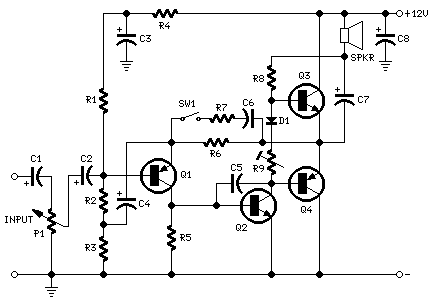
2W Amplifier
Designed for self-powered 8, 4 & 2 Ohm loudspeakers. This amplifier was designed to be self-contained in a small loudspeaker box. It can be fed by Walkman, Mini-Disc, iPod and CD players, computers and similar devices fitted with line or...

Miniature Audio Amplifier Circuit
This miniature audio amplifier provides an output of up to 250mW and can function as a final stage audio amplifier for radio sets. The schematic is straightforward, featuring one BC transistor.
The described miniature audio amplifier is designed for efficient amplification...

5 watt class a audio amplifier circuit
This solid-state push-pull single-ended Class A circuit is capable of providing sound quality comparable to that of valve amplifiers. It delivers an output power of 6.9W when measured across an 8 Ohm loudspeaker cabinet load, with reduced total harmonic distortion...

9V to 13.5kV Inverter Circuit Schematic Diagram
This high voltage source consists of an inverter built around a transistor that generates pulses of 150V. These pulses are supplied to an inverter made of a thyristor and a capacitor, which is connected in series with transformer T2. The...

TDA Amplifier Circuits
The TDA integrated circuit series is highly regarded and widely utilized in amplifier designs and projects. TDA audio amplifier circuits are primarily produced by Philips and SGS-THOMSON. The most commonly used ICs include the TDA2030 and TDA2003 for small audio...

Stereo Audio Amplifier 2x2W or mono 5W ( TEA2025 )
These circuits are based on TEA2025, a monolithic integrated audio amplifier in a 16-pin plastic dual in-line package manufactured by UTC. The circuit includes an internal thermal protector and is designed for portable cassette players and radios. It can also...