


60W Linear Amplifier
#linear amplifier
#IRF840
#power mosfet
#60W
#audio amplifier
#power transistors
#voltage
#current
#electronics
#circuit design

Description: This circuit utilizes the power MOSFET IRF840 for a 60-watt linear amplifier. The IRF series of power transistors are available in various voltage and current ratings.
The described circuit employs the IRF840, which is a high-voltage N-channel MOSFET, suitable for applications requiring significant power handling capabilities. The IRF840 has a maximum drain-source voltage of 500V and can handle a continuous drain current of up to 8A, making it ideal for a 60-watt linear amplifier design.
In the schematic, the MOSFET is typically configured in a common-source arrangement to achieve voltage amplification. The input signal is fed into the gate terminal through a coupling capacitor, which blocks any DC offset and allows only the AC component of the signal to pass. A resistor is often connected between the gate and source terminals to ensure the MOSFET is turned off when no input signal is present, preventing unwanted oscillations.
The drain terminal is connected to the load, which in this case would be a speaker or similar output device, while a power supply is connected to the source terminal. The amplifier's performance can be enhanced by incorporating feedback mechanisms, which can stabilize the gain and improve linearity. Additionally, heat sinking may be necessary to dissipate the heat generated by the MOSFET during operation, especially at higher power levels.
Overall, the circuit design must consider the biasing conditions, load impedance, and power supply characteristics to ensure optimal performance of the linear amplifier using the IRF840 MOSFET.This circuit using power mosfet IRF840 for 60 Watt linear amplifier. The IRF series of power transistors are available in various voltage and ..
The described circuit employs the IRF840, which is a high-voltage N-channel MOSFET, suitable for applications requiring significant power handling capabilities. The IRF840 has a maximum drain-source voltage of 500V and can handle a continuous drain current of up to 8A, making it ideal for a 60-watt linear amplifier design.
In the schematic, the MOSFET is typically configured in a common-source arrangement to achieve voltage amplification. The input signal is fed into the gate terminal through a coupling capacitor, which blocks any DC offset and allows only the AC component of the signal to pass. A resistor is often connected between the gate and source terminals to ensure the MOSFET is turned off when no input signal is present, preventing unwanted oscillations.
The drain terminal is connected to the load, which in this case would be a speaker or similar output device, while a power supply is connected to the source terminal. The amplifier's performance can be enhanced by incorporating feedback mechanisms, which can stabilize the gain and improve linearity. Additionally, heat sinking may be necessary to dissipate the heat generated by the MOSFET during operation, especially at higher power levels.
Overall, the circuit design must consider the biasing conditions, load impedance, and power supply characteristics to ensure optimal performance of the linear amplifier using the IRF840 MOSFET.This circuit using power mosfet IRF840 for 60 Watt linear amplifier. The IRF series of power transistors are available in various voltage and ..
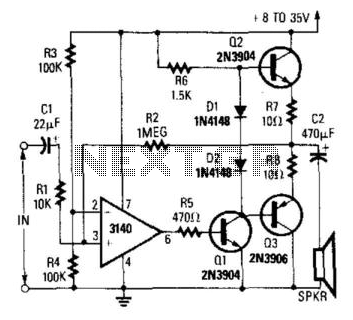
Simple Op Amp Audio Amplifier
A CA3140 operational amplifier drives a complementary output stage consisting of transistors Q1, Q2, and Q3. The output power is influenced by the supply voltage and the thermal dissipation limits of transistors Q2 and Q3. Under optimal conditions, the output...

2 x 60 W audio amplifier circuit
The circuit diagram presented is for a 2 x 60 Watt stereo amplifier utilizing the LM4780 from National Semiconductors. The LM4780 is an excellent audio amplifier integrated circuit capable of delivering 60W RMS power output per channel into 8-ohm speakers....

450w audio power amplifier circuit
Below is a circuit of power amplifiers with a power output of 450 watts in mono mode. These amplifiers are frequently utilized in high-power applications, suitable for events, and designed for enclosed spaces. This amplifier is appropriate for woofers and...

200 Watt High Quality Audio Amplifier
This high-power audio amplifier provides top-quality performance for loudspeakers with an impedance of 4 to 8 ohms. It operates within a frequency range of 20 to 20,000 Hz and requires a voltage supply of 24 to 36 volts, with a...

16w bridge amplifier using lm383
The following diagram illustrates a 16W bridge audio amplifier circuit. The design incorporates two LM383 power ICs in a head connection, making this amplifier a head amplifier. The LM383 is an older model that has been discontinued, which may make...

845 20W A1 class monotriode amplifier
This project is finalized, that means it is no longer experimental. This amplifier, although limited in output power (20W), has been designed to give the best listening pleasure. No compromise has been made during components choice: the 845 output triode...

200 Watt audio power amplifier
Here I propose a project of an AB class power amplifier, at its simplest, assembled with common components (not very expensive), based on traditional diagrams: a symmetrical differential input stage, a cascode stage driver, and a MOSFET output stage. The...

50MW Audio Amplifier circuit
This weblog focuses on electronic circuit schematics, PCB design, DIY kits, and electronic project diagrams. The following describes a small audio amplifier, similar to those found in medium-sized transistor radios. The input stage is biased to ensure equal power distribution...
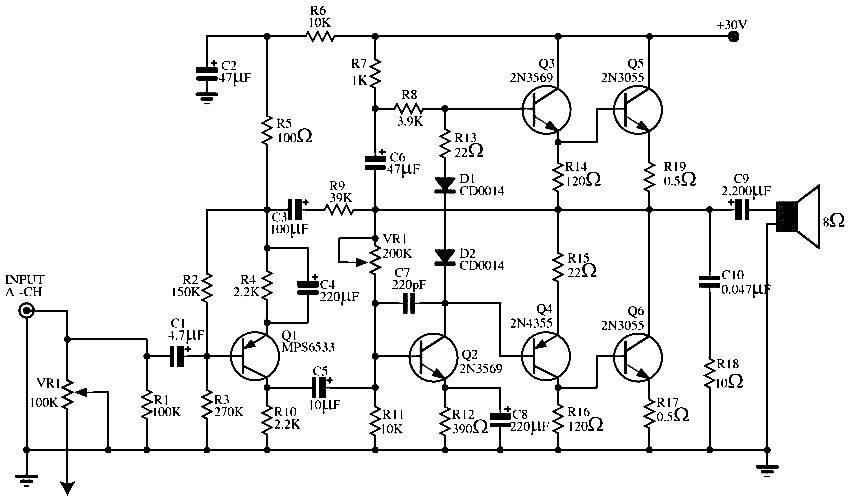
audio power amplifier circuit 140 w
More:
The input data lacks specific content, providing only placeholders without any detailed information.
In the context of electronic schematics, a comprehensive description typically involves detailing the components, their interconnections, and the overall functionality of the circuit. Each component,...