


Active speaker amplifier circuit
#active speaker
#TDA1521
#NE5532
#dual-channel
#audio amplifier
#stereo amplifier
#power amplifier
#sound system
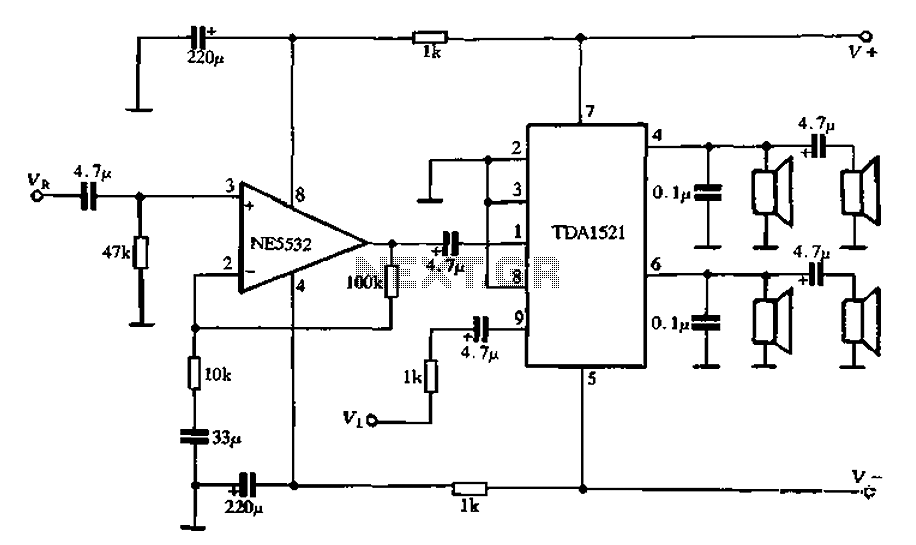
Active speaker with amplifier circuit TDA1521 and NE5532, featuring dual-channel input and dual-channel output.
The active speaker circuit utilizes the TDA1521 integrated circuit, which serves as the power amplifier. This IC is designed for high-efficiency amplification, providing a robust output suitable for driving speaker loads. The TDA1521 operates with a supply voltage ranging from 12V to 28V, allowing for flexibility in power supply design. It incorporates thermal protection and short-circuit protection, ensuring reliable operation under varying load conditions.
The NE5532 is employed in this circuit as a low-noise audio operational amplifier, providing high fidelity signal processing. This dual-channel op-amp is known for its excellent bandwidth and slew rate, making it ideal for audio applications. It can be configured in various ways, such as inverting or non-inverting configurations, to suit the specific requirements of the audio signal path.
In this design, the dual-channel input allows for stereo audio signals to be processed, with the NE5532 amplifying the incoming audio signals before they are fed into the TDA1521 for final amplification. The output stage of the TDA1521 drives the connected speakers, delivering clear and powerful sound reproduction.
The circuit typically includes additional passive components such as resistors and capacitors for biasing, filtering, and stability purposes. Proper layout and grounding techniques are crucial to minimize noise and interference, ensuring optimal performance of the active speaker system. Overall, this configuration is well-suited for applications requiring high-quality audio amplification in compact designs.Active speaker with amplifier circuit TDA1521 and NE5532 composed of dual-channel input dual channel output.
The active speaker circuit utilizes the TDA1521 integrated circuit, which serves as the power amplifier. This IC is designed for high-efficiency amplification, providing a robust output suitable for driving speaker loads. The TDA1521 operates with a supply voltage ranging from 12V to 28V, allowing for flexibility in power supply design. It incorporates thermal protection and short-circuit protection, ensuring reliable operation under varying load conditions.
The NE5532 is employed in this circuit as a low-noise audio operational amplifier, providing high fidelity signal processing. This dual-channel op-amp is known for its excellent bandwidth and slew rate, making it ideal for audio applications. It can be configured in various ways, such as inverting or non-inverting configurations, to suit the specific requirements of the audio signal path.
In this design, the dual-channel input allows for stereo audio signals to be processed, with the NE5532 amplifying the incoming audio signals before they are fed into the TDA1521 for final amplification. The output stage of the TDA1521 drives the connected speakers, delivering clear and powerful sound reproduction.
The circuit typically includes additional passive components such as resistors and capacitors for biasing, filtering, and stability purposes. Proper layout and grounding techniques are crucial to minimize noise and interference, ensuring optimal performance of the active speaker system. Overall, this configuration is well-suited for applications requiring high-quality audio amplification in compact designs.Active speaker with amplifier circuit TDA1521 and NE5532 composed of dual-channel input dual channel output.

2x60 Watt Stereo Audio Amplifier LM4780
What is so special? First of all, it has a very low harmonic distortion. Typically, manufacturers indicate the maximum power of their products with a harmonic content of 10%. In contrast, this chip achieves a harmonic distortion of only 0.5%...

Three circuits of preamp tone controls by NE5532
A high-quality preamplifier with tone controls consisting of three circuits. The NE5532 is chosen as the main integrated circuit due to its ultra-low noise properties, making it a popular choice in fine audio applications. Although these circuits are older designs,...

30w power amp tda2040 schematic
This small and compact stereo amplifier is powerful and can easily replace a broken amplifier or be used in new constructions, or to create an active speaker, when combined with a preamplifier. Its remarkable features make it a true Hi-Fi...

Hi Fi Amplifier circuit
A simple Hi-Fi amplifier circuit diagram with a schematic for creating an audio amplifier design using the TDA 2616 IC. This is a stereo power amplifier suitable for radio, tape, and television applications, delivering 2 x 12 watts, totaling 24...

4x15Watt 12volt power audio amplifier
While I would have liked a 4 channel chip with about 20 Watt per channel, the local parts store didn't have any yet, so I opted for two TA8215AH stereo chips, selected by their low price in this particular store....

5 Watt Class-A Audio Amplifier Circuit diagram
This solid-state push-pull single-ended Class A circuit is designed to deliver sound quality comparable to valve amplifiers, providing an output power of 6.9W measured across an 8 Ohm loudspeaker cabinet load. It features reduced total harmonic distortion (THD), increased input...

18W Audio Amplifier
High Quality very simple unit - No need for a preamplifier. Can be directly connected to CD players, tuners and tape recorders. Don't exceed 23 + 23V supply. Q3 and Q4 must be mounted on heatsink. D1 must be in...
Amplifier circuits
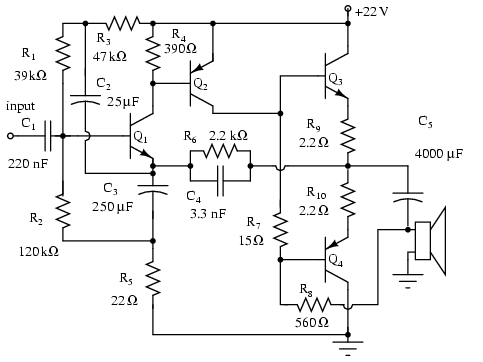
Note that Q3 and Q4 in the figure below are complementary, with Q3 being an NPN transistor and Q4 being a PNP transistor. This circuit is suitable for moderate power audio amplifiers. For a detailed explanation of this circuit, refer...

20 watt power amplifier
This integrated circuit (IC) chip is specifically designed for power boosting applications in automobiles. It features self-protection mechanisms against short circuits and thermal issues. In the bridge configuration depicted, it can deliver 20 watts of power to a 2-ohm speaker...