


Circuit of power audio amplifier with circuit integrated tda2030 car amplifier 14 watts rms
#audio amplifier
#TDA2030
#class AB
#14 watts
#car amplifier
#monolithic
#power amplifier
#integrated circuit
#audio
#Pentawat

Description: The TDA2030 is a monolithic integrated circuit in a Pentawat® package designed to function as a Class AB audio amplifier. It typically delivers up to 14 watts of output power (with a distortion rate of 0.5%) at 14V with a 4-ohm load. The guaranteed output power is 12 watts for a 4-ohm load and 8 watts for an 8-ohm load. The integrated circuit includes built-in protection features. The TDA2030 can operate with a simple power supply, providing 14 watts with a 15-volt source. This power supply should consist of a transformer, rectifiers, and adequate filter capacitors, and a regulated supply is not necessary. To protect the circuit, a 3-amp fuse should be used in the positive line of the amplifier. A heat sink is required for the TDA2030 integrated circuit; the appropriate heat sink specifications can be found in the datasheet. The TDA2030 is widely available and cost-effective. For a bridge configuration, it can deliver up to 28 watts at 14V. The circuit can be powered by car batteries for extended periods without the need for recharging. The TDA2030 is commonly employed as a power amplifier in home theater systems, which may claim output power ratings of 1000 watts. However, a single TDA2030 provides 14 watts, and thus five TDA2030s would yield less than 100 watts RMS. Utilizing the TDA2030 as a power amplifier in surround systems is a viable option, particularly in bridge mode for subwoofer applications, which enhances power output.
The TDA2030 audio amplifier circuit is designed for versatility, allowing for various configurations to suit different audio applications. The typical application involves connecting the TDA2030 to a power supply that provides a voltage range suitable for the desired output. The circuit should include a transformer to step down the AC voltage, followed by a rectifier to convert the AC voltage to DC. Filter capacitors are essential to smooth out the DC voltage and minimize ripple, ensuring stable operation of the amplifier.
In terms of circuit protection, the inclusion of a 3-amp fuse in the positive supply line is crucial to prevent damage from overcurrent conditions. The fuse should be rated appropriately to allow normal operation while providing a safeguard against potential faults.
The use of a heat sink is also critical for the TDA2030 to dissipate heat generated during operation, especially when driving higher loads. The datasheet provides detailed specifications for selecting an appropriate heat sink based on the expected power output and thermal conditions.
For applications requiring increased output power, the TDA2030 can be configured in a bridge mode, effectively doubling the output power to 28 watts at 14V. This configuration is particularly advantageous for subwoofer applications in home theater systems, where enhanced bass response is desired.
When utilizing the TDA2030 in automotive applications, the circuit's ability to operate directly from a car battery is beneficial, allowing for portable audio solutions without the need for frequent recharging.
Overall, the TDA2030 is a robust and efficient choice for audio amplification, suitable for a wide range of applications from home theaters to portable audio systems. Its availability and affordability make it an attractive option for both hobbyists and professionals in the audio engineering field.TDA2030 is a circuit integrated monolithic in Pentawat ® package, to be used as class audio amplifier AB. Typically he supplies up to 14 Watts of potency (d=0. 5%) @ 14V/4 ©. The guaranteed potency is 12W in a load of 4 © and 8 watts in a load of 8 ©. Integrated him/it bill with circuits of component protection. Audio amplifier with having integrated tda2030, using source of simple feeding, for potency of 14 watts with a source of 15 volts. That source should be with transformer, rectificators and good filter capacitors, there is not need of regulated source. for protection of the circuit to use a fuse of 3 amperes in the line of +b of the amplifier. Use a heat-sink of heat in the circuit integrated tda2030. See the datasheet of the tda 2030 to know which heat-sink to use. That integrated it is cheaply and easy to find at the market. For a version in bridge for until 28 watts@14v and version using symmetrical source sees the datasheet of the tda2030.
That circuit can be fed by car batteries by good time without needing to recharge her. The tda2030 is usually found as amplifier of stage of potency of systems of home theater, it is in those that promise 1000 Watts of potency. For now a tda2030 supplies 14 watts, then 5 tda2030 supplies less than 100 watts rms. But that is a good idea, to use the tda2030 as amplifier of potency of systems surround, for the subwoofer the ideal is an assembly in bridge for more potency.
The TDA2030 audio amplifier circuit is designed for versatility, allowing for various configurations to suit different audio applications. The typical application involves connecting the TDA2030 to a power supply that provides a voltage range suitable for the desired output. The circuit should include a transformer to step down the AC voltage, followed by a rectifier to convert the AC voltage to DC. Filter capacitors are essential to smooth out the DC voltage and minimize ripple, ensuring stable operation of the amplifier.
In terms of circuit protection, the inclusion of a 3-amp fuse in the positive supply line is crucial to prevent damage from overcurrent conditions. The fuse should be rated appropriately to allow normal operation while providing a safeguard against potential faults.
The use of a heat sink is also critical for the TDA2030 to dissipate heat generated during operation, especially when driving higher loads. The datasheet provides detailed specifications for selecting an appropriate heat sink based on the expected power output and thermal conditions.
For applications requiring increased output power, the TDA2030 can be configured in a bridge mode, effectively doubling the output power to 28 watts at 14V. This configuration is particularly advantageous for subwoofer applications in home theater systems, where enhanced bass response is desired.
When utilizing the TDA2030 in automotive applications, the circuit's ability to operate directly from a car battery is beneficial, allowing for portable audio solutions without the need for frequent recharging.
Overall, the TDA2030 is a robust and efficient choice for audio amplification, suitable for a wide range of applications from home theaters to portable audio systems. Its availability and affordability make it an attractive option for both hobbyists and professionals in the audio engineering field.TDA2030 is a circuit integrated monolithic in Pentawat ® package, to be used as class audio amplifier AB. Typically he supplies up to 14 Watts of potency (d=0. 5%) @ 14V/4 ©. The guaranteed potency is 12W in a load of 4 © and 8 watts in a load of 8 ©. Integrated him/it bill with circuits of component protection. Audio amplifier with having integrated tda2030, using source of simple feeding, for potency of 14 watts with a source of 15 volts. That source should be with transformer, rectificators and good filter capacitors, there is not need of regulated source. for protection of the circuit to use a fuse of 3 amperes in the line of +b of the amplifier. Use a heat-sink of heat in the circuit integrated tda2030. See the datasheet of the tda 2030 to know which heat-sink to use. That integrated it is cheaply and easy to find at the market. For a version in bridge for until 28 watts@14v and version using symmetrical source sees the datasheet of the tda2030.
That circuit can be fed by car batteries by good time without needing to recharge her. The tda2030 is usually found as amplifier of stage of potency of systems of home theater, it is in those that promise 1000 Watts of potency. For now a tda2030 supplies 14 watts, then 5 tda2030 supplies less than 100 watts rms. But that is a good idea, to use the tda2030 as amplifier of potency of systems surround, for the subwoofer the ideal is an assembly in bridge for more potency.
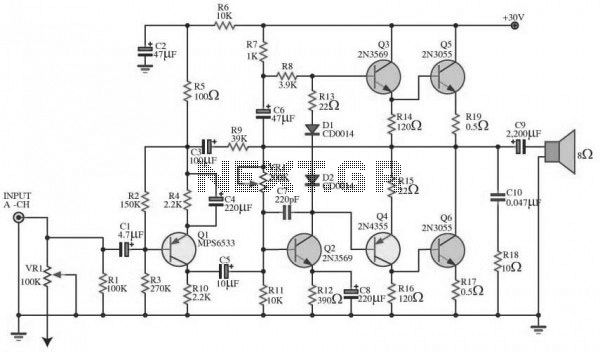
Audio Amplifier Diagram
The circuit is based on four integrated circuits: TL072, TL074, MN3101, and MN3004, which produce four output channels for surround audio, specifically targeting center, rear, front right, and front left audio. It is a compact amplifier capable of delivering 7W...

Audio Amplifer Circuit 230W With MOSFET IRFP2409240
This is a simple LED-powered audio amplifier circuit utilizing a MOSFET amplifier with the TL071C operational amplifier. It can deliver up to 45 W into an 8-ohm load. The circuit incorporates the MOSFETs IRFP240 and IRFP9240, which are recommended for...

Audio Amplifier 25 Watt
The following circuit illustrates an audio amplifier circuit diagram with a power output of 25 watts. Features include its widespread use in nearly all mass-market stereo receivers produced, providing enhanced sound quality.
This audio amplifier circuit is designed to deliver a...
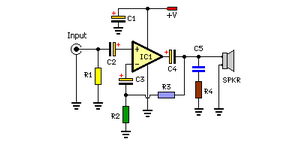
8 Watt Audio Power Amplifier Schematic
Useful circuit for self-powered speakers, radios, and TVs; can be used as a car power amplifier. Here is the schematic for an 8-watt audio power amplifier.
The described circuit serves as an 8-watt audio power amplifier, suitable for various applications, including...

Audio
This device is a 2 x 2, 500W RMS stereo amplifier that is super-light and features a switching-mode power supply. The design only displays one channel, but the power supply supports both channels. The amplifier should be duplicated, but the...

Mini Audio Amplifier Circuit Schematic Diagram BC547 Transistor
The following circuit presents a Mini Audio Amplifier Circuit Schematic Diagram. Features include a power consumption of less than 3mA, a small output, and the use of a push-pull configuration.
The Mini Audio Amplifier Circuit is designed to amplify low-level audio...

Schematic Diagram LM1877 Audio power amplifier circuit
This audio amplifier circuit is designed to deliver 2W per channel continuously into 8-ohm loads. The LM1877 is engineered to function with a minimal number of external components while still offering flexibility for applications in stereo phonographs, tape recorders, AM-FM...

Automatic Fader Circuit
In this circuit, audio input to the control channel is amplified and rectified by diodes D1 and D2. This direct current level activates LED D3 through transistor Q2. The illumination from LED D3 causes R9, a light-dependent resistor, to reduce...
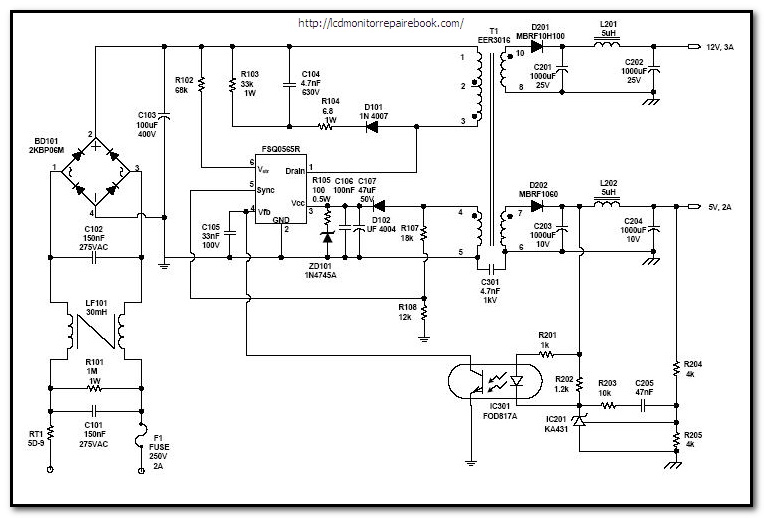
Power Quality for Audio Systems
Power supplies: Linear or SMPS (Switched Mode). A distinction is made between linear and switch mode power supplies. What is the difference? A power supply fundamentally is an...
Power supplies are essential components in electronic circuits, providing the necessary voltage and...