


Class-A MOSFET Amplifier by 2SK1058
#Class-A
#MOSFET
#2SK1058
#audio amplifier
#valve preamp
#low distortion
#high fidelity
#single watt
#efficient speakers

Description: This Class A amplifier utilizes a 12AU7-based valve preamp, delivering exceptionally pure sound quality. Although distortion levels are unknown, the amplifier exhibits a fine grain and delicately textured audio output. With an output of only one watt, it requires efficient speakers. The bass performance exceeds design expectations, and the amplifier drives 12-inch, 63-liter, 3-way speakers with ease.
The Class A amplifier circuit typically features a single-ended design, where the output stage operates in the linear region for the entirety of the audio waveform. The 12AU7 vacuum tube serves as the primary amplification element, renowned for its warm sound characteristics and low distortion levels in audio applications. This tube operates at a relatively low plate voltage, allowing for a smooth and rich tonal quality.
The input stage of the amplifier may include a coupling capacitor to block any DC offset from the source, ensuring that only the AC audio signal is amplified. The output stage is designed to provide a maximum of one watt, which is suitable for driving high-efficiency speakers, often rated at 90 dB or higher. This output power is sufficient for small to medium-sized listening environments, where the purity of sound is prioritized over sheer volume.
In terms of frequency response, the amplifier's design likely includes passive components such as resistors and capacitors that shape the audio signal, maintaining clarity in the mid-range while allowing for extended bass response. The bass performance described as exceeding design predictions can be attributed to the amplifier's ability to provide ample current to the speakers, allowing them to reproduce lower frequencies more effectively than anticipated.
The overall circuit layout should be carefully designed to minimize noise and interference, with attention paid to grounding and shielding techniques. Proper layout ensures that the delicate audio signals are preserved, contributing to the amplifier's fine grain and textured sound quality. The choice of high-quality components, such as capacitors and resistors, further enhances the performance, ensuring that the amplifier delivers an engaging listening experience.
In summary, this Class A amplifier configuration with a 12AU7 valve preamp exemplifies a commitment to audio fidelity, offering a rich, nuanced sound that complements efficient speaker designs, making it an excellent choice for audiophiles seeking a high-quality listening experience.I am using this Class A Amplifier with a 12AU7 based valve preamp. It produces the most purest sound. I have no idea of distortion levels etc. but it has a very fine grain and delicately textured quality. With only one watt of output efficient speakers must be used. Bass is better than the design predicts and the amp drives my 12 ³ 63L based 3-wa y speakers with ease. Disclaimer All files are found using legitimate search engine techniques. This site does not and will not condone hacking into sites to create the links it list. We will and do assume that all links found on the search engines we use are obtained in a legal manner and the webmasters are aware of the links listed on the search engines. If you find a URL that belongs to you, and you did not realize that it was "open to the public", please use the report button to notify the blogmaster of your request to remove it or it will remove within 24 hours.
This is not an invitation for webblog haters to spam with requests to remove content they feel that is objectionable and or unacceptable. Proof of URL ownership is required. NOTICE: This Blog Has Already Been Reviewed And Accepted By Blogger. com
The Class A amplifier circuit typically features a single-ended design, where the output stage operates in the linear region for the entirety of the audio waveform. The 12AU7 vacuum tube serves as the primary amplification element, renowned for its warm sound characteristics and low distortion levels in audio applications. This tube operates at a relatively low plate voltage, allowing for a smooth and rich tonal quality.
The input stage of the amplifier may include a coupling capacitor to block any DC offset from the source, ensuring that only the AC audio signal is amplified. The output stage is designed to provide a maximum of one watt, which is suitable for driving high-efficiency speakers, often rated at 90 dB or higher. This output power is sufficient for small to medium-sized listening environments, where the purity of sound is prioritized over sheer volume.
In terms of frequency response, the amplifier's design likely includes passive components such as resistors and capacitors that shape the audio signal, maintaining clarity in the mid-range while allowing for extended bass response. The bass performance described as exceeding design predictions can be attributed to the amplifier's ability to provide ample current to the speakers, allowing them to reproduce lower frequencies more effectively than anticipated.
The overall circuit layout should be carefully designed to minimize noise and interference, with attention paid to grounding and shielding techniques. Proper layout ensures that the delicate audio signals are preserved, contributing to the amplifier's fine grain and textured sound quality. The choice of high-quality components, such as capacitors and resistors, further enhances the performance, ensuring that the amplifier delivers an engaging listening experience.
In summary, this Class A amplifier configuration with a 12AU7 valve preamp exemplifies a commitment to audio fidelity, offering a rich, nuanced sound that complements efficient speaker designs, making it an excellent choice for audiophiles seeking a high-quality listening experience.I am using this Class A Amplifier with a 12AU7 based valve preamp. It produces the most purest sound. I have no idea of distortion levels etc. but it has a very fine grain and delicately textured quality. With only one watt of output efficient speakers must be used. Bass is better than the design predicts and the amp drives my 12 ³ 63L based 3-wa y speakers with ease. Disclaimer All files are found using legitimate search engine techniques. This site does not and will not condone hacking into sites to create the links it list. We will and do assume that all links found on the search engines we use are obtained in a legal manner and the webmasters are aware of the links listed on the search engines. If you find a URL that belongs to you, and you did not realize that it was "open to the public", please use the report button to notify the blogmaster of your request to remove it or it will remove within 24 hours.
This is not an invitation for webblog haters to spam with requests to remove content they feel that is objectionable and or unacceptable. Proof of URL ownership is required. NOTICE: This Blog Has Already Been Reviewed And Accepted By Blogger. com

Mosfet 75W Power Amplifier
The MOSFETS we are dealing with are three terminal devices which are used to control electron flow in a circuit. Two of the pins (the source and drain) pass the current, and the third pin (the gate) is used to...

2x30watt home amplifier circuit
The audio amplifier circuit is highly suitable for home use, particularly with subwoofer or woofer speakers. Commonly referred to as a home amplifier, these audio amplifiers are based on integrated circuits (ICs), specifically the STK series, which includes models such...

300 Watt audio Amplifier
For many applications, there's no substitute for sheer power - low efficiency speakers, outdoor sound systems, or maybe you like the full flavor of the dynamic range of a high power amp. Whatever your requirement, this super power module should...

30W Power Audio Amplifier Circut
TIP141 is an NPN silicon power Darlington transistor designed for complementary use with TIP145, TIP146, and TIP147. It can handle up to 125 W at a case temperature of 25 °C, with a continuous collector current of 10 A and...

Low cost 20 w audio amplifier
This simple and inexpensive audio amplifier can be constructed using a couple of TO-220 monolithic Darlington transistors for the push-pull output stage. The frequency response is flat within 1 dB from 30 Hz to 200 kHz, with typical harmonic distortion...

200 Watt High Quality Audio Amplifier
This high-power audio amplifier provides top-quality performance for loudspeakers with an impedance of 4 to 8 ohms. It operates within a frequency range of 20 to 20,000 Hz and requires a voltage supply of 24 to 36 volts, with a...

Simple Hybrid Audio Amplifier Circuit
Here is an amplifier circuit based on the BUZ11, which can be replaced by an IRFZ34N, and an ECC83 can be used instead of the ECC88. In this case, the anode voltage should be reduced slightly to 155 V. The...
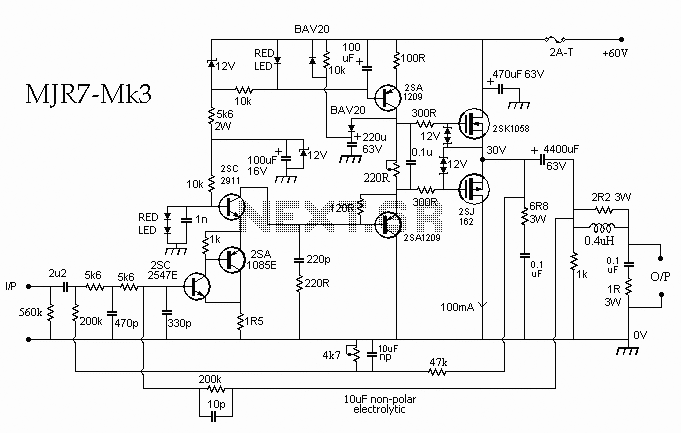
70W High Power Amplifier with MOSFET
This schematic diagram illustrates a 70W power amplifier utilizing MOSFET technology for audio systems. Alternative input stage transistors include the Toshiba 2SA970BL and 2SC2240BL, which serve as suitable substitutes for the Hitachi 2SA1085E.
The 70W power amplifier is designed to deliver...

mini and simple power amplifier
The image above depicts a miniature audio amplifier that is quite simple in design. A schematic for this audio amplifier is provided, which requires only a few components, as detailed in the accompanying diagram. This amplifier is inexpensive to construct...