


Class-A Power Amp
#Class-A
#power amp
#capacitors
#inductor
#hum reduction
#audio amplifier
#expensive components
#power supply
#Zen amplifier

Description: The capacitors needed for the power supply are massive to try to get rid of hum, and massive means expensive. The "improved" Zen is a little better, since it uses an inductor (or choke) in the supply - obviously the hum drove someone mad. Inductors are expensive too, and also hard to get, and the capacitance has been doubled in at least one version I have seen - ouch, this is seriously expensive! More: Well, actually I can see why it is popular. It satisfies the requirement of many amplifier builders, in that it is simple, stable, and very tolerant of layout and component variations. The sonic characteristics will also appeal to many, due to the valve-l
The power supply circuit described utilizes large capacitors to minimize hum, a common issue in audio amplifier designs. The significant capacitance is intended to smooth out voltage fluctuations, providing a stable DC output. However, the size and quality of these capacitors can lead to increased costs, which is a notable consideration for builders.
The "improved" Zen circuit introduces an inductor, or choke, in the power supply path. Inductors serve to further reduce ripple by opposing changes in current, thus enhancing the overall performance of the power supply. The use of an inductor can lead to a more refined audio output by mitigating high-frequency noise and hum, which is often a concern in audio applications.
It is important to note that while the addition of inductors can improve performance, they also contribute to the overall expense and complexity of the circuit. Availability of high-quality inductors can be limited, which may pose challenges for builders seeking to implement this design.
Moreover, the mention of increased capacitance in certain versions indicates a design evolution aimed at further improving performance. Doubling the capacitance can significantly enhance the power supply's ability to handle transient loads, providing a more robust and responsive audio experience.
The appeal of this design lies in its simplicity and stability, which are critical for many amplifier builders. The circuit's tolerance to variations in layout and components makes it accessible for both novice and experienced builders. Additionally, the sonic characteristics associated with this design, particularly in valve amplifiers, can attract enthusiasts seeking warm and rich audio reproduction.
Overall, this power supply design balances performance and cost, making it a viable option for audio amplifier applications while considering the trade-offs associated with component selection.The capacitors needed for the power supply are massive to try to get rid of hum, and massive means expensive. The "improved" Zen is a little better, since it uses an inductor (or choke) in the supply - obviously the hum drove someone mad.
Inductors are expensive too, and also hard to get, and the capacitance has been doubled in at least one version I have seen - ouch, this is seriously expensive! Well, actually I can see why it is popular. It satisfies the requirement of many amplifier builders, in that it is simple, stable, and very tolerant of layout and component variations. The sonic characteristics will also appeal to many, due to the valve-l
The power supply circuit described utilizes large capacitors to minimize hum, a common issue in audio amplifier designs. The significant capacitance is intended to smooth out voltage fluctuations, providing a stable DC output. However, the size and quality of these capacitors can lead to increased costs, which is a notable consideration for builders.
The "improved" Zen circuit introduces an inductor, or choke, in the power supply path. Inductors serve to further reduce ripple by opposing changes in current, thus enhancing the overall performance of the power supply. The use of an inductor can lead to a more refined audio output by mitigating high-frequency noise and hum, which is often a concern in audio applications.
It is important to note that while the addition of inductors can improve performance, they also contribute to the overall expense and complexity of the circuit. Availability of high-quality inductors can be limited, which may pose challenges for builders seeking to implement this design.
Moreover, the mention of increased capacitance in certain versions indicates a design evolution aimed at further improving performance. Doubling the capacitance can significantly enhance the power supply's ability to handle transient loads, providing a more robust and responsive audio experience.
The appeal of this design lies in its simplicity and stability, which are critical for many amplifier builders. The circuit's tolerance to variations in layout and components makes it accessible for both novice and experienced builders. Additionally, the sonic characteristics associated with this design, particularly in valve amplifiers, can attract enthusiasts seeking warm and rich audio reproduction.
Overall, this power supply design balances performance and cost, making it a viable option for audio amplifier applications while considering the trade-offs associated with component selection.The capacitors needed for the power supply are massive to try to get rid of hum, and massive means expensive. The "improved" Zen is a little better, since it uses an inductor (or choke) in the supply - obviously the hum drove someone mad.
Inductors are expensive too, and also hard to get, and the capacitance has been doubled in at least one version I have seen - ouch, this is seriously expensive! Well, actually I can see why it is popular. It satisfies the requirement of many amplifier builders, in that it is simple, stable, and very tolerant of layout and component variations. The sonic characteristics will also appeal to many, due to the valve-l

Changhong DVB-2000 digital satellite receiver switching power supply circuit
The Changhong DVB-2000 digital satellite receiver features a switching power supply circuit. This circuit primarily comprises a power input section, an oscillation switching circuit, and a DC output section. The power input circuit receives 22V AC from a step-down transformer,...

Power Audio Amplifier based on STK400xx
This is a power audio amplifier circuit based on the STK400xx series. It provides high-quality sound and is cost-effective, as the STK40xx series is affordably priced. The circuit can be easily constructed using only a few external components. The STKxxxx...

60W audio amplifier (2N3055)
This is a simple and low cost 60W power amplifier. The optimal supply voltage is around 50V, but this amp can work from 30 to 60V. The maximum input voltage is around 0.8 - 1V. As you can see, in...

Designing Multiple Output Power Supplies With Topswitch
This application note describes a digital blood pressure meter concept that utilizes integrated pressure sensor analog signal-conditioning circuitry, microcontroller hardware/software, and a liquid crystal display. The sensing system measures cuff pressure (CP) and extracts pulses for analysis to determine systolic...

BUZ902DP 300 Watt Audio Power Amplifier
The following circuit illustrates the BUZ902DP 300 Watt Audio Power Amplifier Circuit Diagram. Features include audio frequency linearity from 20 Hz to 20 kHz.
The BUZ902DP is a high-performance audio power amplifier designed to deliver up to 300 watts of output...

Low cost 20 w audio amplifier
This simple and inexpensive audio amplifier can be constructed using a couple of TO-220 monolithic Darlington transistors for the push-pull output stage. The frequency response is flat within 1 dB from 30 Hz to 200 kHz, with typical harmonic distortion...

Series Inductor Filter
In this arrangement, a high-value inductor or choke L is connected in series with the rectifier element and the load. The filtering action of an inductor filter depends on its property of opposing any change in the current flowing through...

200W Transistor Audio Amplifier Circuit
This audio amplifier circuit provides up to 200 W of high-quality output for loudspeakers with impedances ranging from 4 to 16 ohms. The operating voltage is between 24 and 36 V, with a maximum current of 5 A.
The audio amplifier...
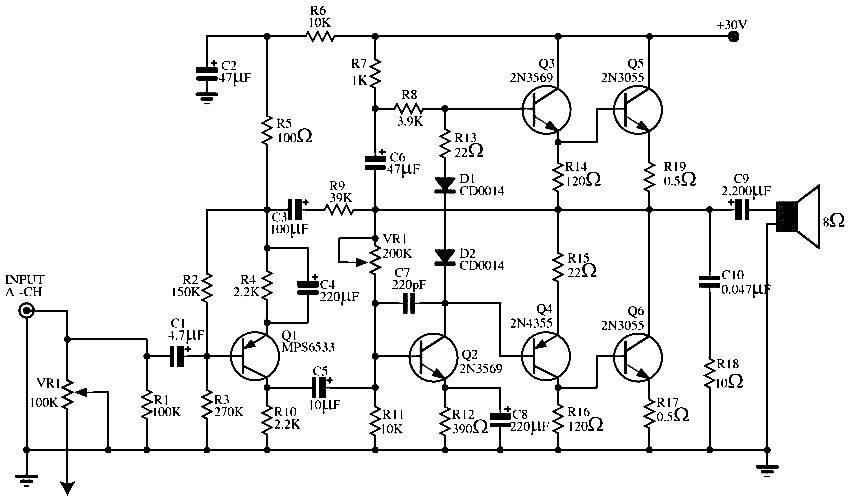
audio power amplifier circuit 140 w
More:
The input data lacks specific content, providing only placeholders without any detailed information.
In the context of electronic schematics, a comprehensive description typically involves detailing the components, their interconnections, and the overall functionality of the circuit. Each component,...