


Class D Audio Amplifier Matches Class AB With Higher Efficiency
#audio amplifier
#class D
#high voltage
#efficiency
#audio driver
#power amplifier
#sound system
#integrated circuit
#audio electronics
#class AB

Description: Class D audio amplifiers are now prepared to replace Class AB amplifiers. An integrated high-voltage audio driver simplifies the design and construction of high-power audio systems.
Class D audio amplifiers, also known as switching amplifiers, utilize pulse-width modulation (PWM) to convert input audio signals into high-frequency square waves. This method allows for greater efficiency compared to traditional Class AB amplifiers, which dissipate more heat during operation. The primary advantage of Class D amplifiers is their ability to deliver high power output while maintaining low thermal losses, making them ideal for applications requiring compact designs and high performance.
The integrated high-voltage audio driver plays a crucial role in the functionality of Class D amplifiers. It is responsible for driving the output stage of the amplifier, which usually consists of MOSFETs or IGBTs that switch on and off rapidly to modulate the audio signal. This driver is designed to handle high voltage levels, allowing the amplifier to produce significant output power suitable for driving speakers in various audio applications, from home theaters to professional sound systems.
In terms of design considerations, the layout of a Class D amplifier circuit is critical for minimizing electromagnetic interference (EMI) and ensuring stable operation. Careful attention should be paid to the placement of components, especially the power supply, output stage, and feedback loops. Additionally, the choice of passive components, such as inductors and capacitors, must be optimized to ensure the desired frequency response and minimize distortion.
Overall, the transition from Class AB to Class D amplifiers represents a significant advancement in audio amplification technology, providing higher efficiency, reduced heat generation, and the ability to drive larger loads without compromising audio quality.Class D audio amplifiers are now geared up to replace class AB An integrated high voltage audio driver facilitates the design and construction of a high power..
Class D audio amplifiers, also known as switching amplifiers, utilize pulse-width modulation (PWM) to convert input audio signals into high-frequency square waves. This method allows for greater efficiency compared to traditional Class AB amplifiers, which dissipate more heat during operation. The primary advantage of Class D amplifiers is their ability to deliver high power output while maintaining low thermal losses, making them ideal for applications requiring compact designs and high performance.
The integrated high-voltage audio driver plays a crucial role in the functionality of Class D amplifiers. It is responsible for driving the output stage of the amplifier, which usually consists of MOSFETs or IGBTs that switch on and off rapidly to modulate the audio signal. This driver is designed to handle high voltage levels, allowing the amplifier to produce significant output power suitable for driving speakers in various audio applications, from home theaters to professional sound systems.
In terms of design considerations, the layout of a Class D amplifier circuit is critical for minimizing electromagnetic interference (EMI) and ensuring stable operation. Careful attention should be paid to the placement of components, especially the power supply, output stage, and feedback loops. Additionally, the choice of passive components, such as inductors and capacitors, must be optimized to ensure the desired frequency response and minimize distortion.
Overall, the transition from Class AB to Class D amplifiers represents a significant advancement in audio amplification technology, providing higher efficiency, reduced heat generation, and the ability to drive larger loads without compromising audio quality.Class D audio amplifiers are now geared up to replace class AB An integrated high voltage audio driver facilitates the design and construction of a high power..

Audio power amplifier circuit LA4112 composition
Audio power amplifier circuit utilizing the LA4112 integrated power amplifier along with additional components as shown in the figure.
The audio power amplifier circuit based on the LA4112 integrated power amplifier is designed to deliver high-quality audio amplification for various applications....

10 Watt Audio Amplifier
This circuit is a general-purpose 10-W audio amplifier for moderate-power PA or modulator use in an AM transmitter. With higher voltages and a change in bias resistors, up to 30 W can be obtained.
The described audio amplifier circuit is designed...

100w-with-pcb-power-amplifier-circuit.html
Inspect the work for potential dry joints, shorts across adjacent tracks, or soldering flux residues, as these often lead to issues. Recheck all external connections to and from the circuit for any mistakes. Ensure that all polarized components are soldered...

4 Watt Amplifier with preamplifier
A small amplifier with nice characteristics: Tendency of catering: 15V. Force of expense: 4.2Wrms in the 4W. Minimal signal of entry: 94mVp-p with preamplifier, 0.65Vp-p without the preamplifier. More: Materially: R1=2.2kΩ R2=330kΩ R3=4.7kΩ logarithmic potentiometer R4=330Ω R5=1kΩ R6=1.5Ω C1, C6=100nF...

MicroFlash Schematic
The two resistors serve dual purposes. Firstly, they limit the current to a lower value in case of accidental contact with the circuit. Secondly, when the flash is activated, the main capacitor behaves like a short circuit to the power...
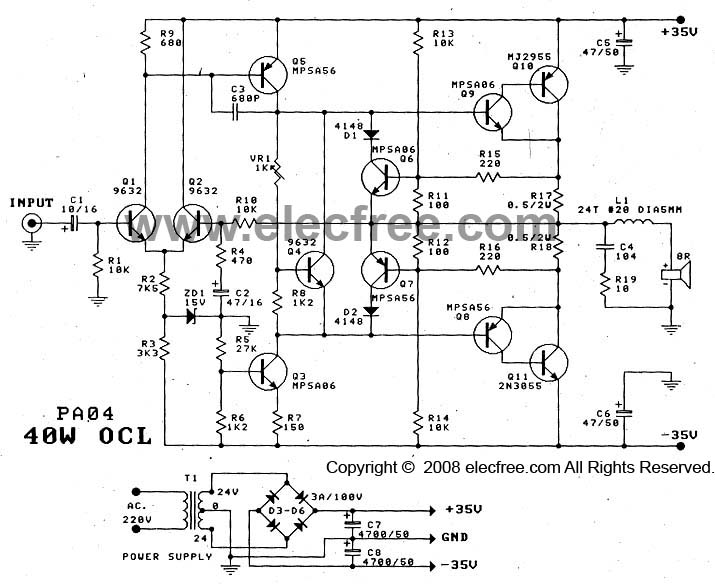
Power Amplifier OCL 40W by 2N3055+MJ2955
The 40W OCL amplifier using the 2N3055 and MJ2955 transistors is simple to construct and cost-effective. It requires a power supply of +35V and -35V with a current rating of 2A. The transistors 2N3055 and MJ2955 must be mounted on...

Irons intelligent control circuit
The intelligent control circuit for the iron is presented. This circuit utilizes the integrated circuit PT8A351X to manage functions such as direction detection, relay control, and LED indication. When the iron is positioned horizontally, it will power off after 30...

1.5W Audio Amplifier with IC SSM2211
The SSM22111 is a high-performance audio amplifier that delivers 1 W RMS of low distortion audio power into a bridge-connected 8-ohm speaker load (or 1.5 W RMS into a 4-ohm load). The SSM2211 operates over a wide temperature range and...

2 Watt Audio Amplifier
A 2 Watt audio amplifier made from discrete components. This was one of the earliest circuits that I ever designed and built, in Spring 1982. At that time I had only an analogue meter and a calculator to work with....