


Class push-pull tube power amplifier circuit diagram 2A3A
#push-pull
#tube amplifier
#2A3A
#transistor
#output transformer
#low resistance
#audio amplifier
#power amplifier
#impedance

Description: FIG. 2A3A is a low direct thermal resistance transistor with a resistance of only 800 ohms. The output transformer has a primary screen to load impedance of 3.5k ohms. The push-pull amplifier tube operates with a screen voltage ranging from 360 to 380V, while the cathode voltage to ground is between 60 to 80V. The total working current of the power amplifier is between 80 to 100mA, achieving a maximum output power of 15W. The machine exhibits a distortion factor of 1% to 2%, with a frequency response from 20Hz to 40kHz at ±2dB.
The circuit described includes a low direct thermal resistance transistor, identified as FIG. 2A3A, characterized by its minimal resistance of 800 ohms. This feature is particularly advantageous in high-efficiency applications, as it facilitates lower heat generation and improved thermal management. The output transformer is designed with a primary screen to load impedance of 3.5k ohms, which is essential for matching the impedance of the load to optimize power transfer and minimize signal loss.
In a push-pull amplifier configuration, the tube operates with a screen voltage between 360V and 380V. This high voltage is necessary to ensure that the output stage can drive the load effectively while maintaining linearity. The cathode voltage, which is referenced to ground, ranges from 60V to 80V, providing a suitable biasing condition for the tubes to operate efficiently.
The total working current of the power amplifier falls within the range of 80mA to 100mA, which is critical for determining the overall power output and efficiency of the amplifier circuit. The maximum output power is specified at 15W, indicating the capability of the amplifier to deliver substantial audio power for driving speakers or other loads.
The distortion factor of the amplifier is maintained between 1% and 2%, highlighting the circuit's ability to produce a clean and accurate audio signal. This low distortion is crucial for high-fidelity audio applications where signal integrity is paramount. Additionally, the frequency response of the amplifier spans from 20Hz to 40kHz with a variation of ±2dB, demonstrating its suitability for a wide range of audio frequencies, ensuring that both low and high frequencies are reproduced accurately without significant attenuation. This frequency response makes the amplifier ideal for various audio applications, including music playback and professional audio processing.FIG. 2A3A low direct thermal resistance transistor, its resistance is only 800, so the output transformer primary screen to screen to load impedance 3.5k Cong. Push-pull amplif ier tube screen voltage take 360 ~ 380V, cathode to ground voltage is 60 ~ 80V, total working current of the power amplifier 80 ~ 100mA, maximum output power up to 15W. The machine distortion factor of 1% to 2%, frequency response from 20Hz ~ 40kHz 2dB.
The circuit described includes a low direct thermal resistance transistor, identified as FIG. 2A3A, characterized by its minimal resistance of 800 ohms. This feature is particularly advantageous in high-efficiency applications, as it facilitates lower heat generation and improved thermal management. The output transformer is designed with a primary screen to load impedance of 3.5k ohms, which is essential for matching the impedance of the load to optimize power transfer and minimize signal loss.
In a push-pull amplifier configuration, the tube operates with a screen voltage between 360V and 380V. This high voltage is necessary to ensure that the output stage can drive the load effectively while maintaining linearity. The cathode voltage, which is referenced to ground, ranges from 60V to 80V, providing a suitable biasing condition for the tubes to operate efficiently.
The total working current of the power amplifier falls within the range of 80mA to 100mA, which is critical for determining the overall power output and efficiency of the amplifier circuit. The maximum output power is specified at 15W, indicating the capability of the amplifier to deliver substantial audio power for driving speakers or other loads.
The distortion factor of the amplifier is maintained between 1% and 2%, highlighting the circuit's ability to produce a clean and accurate audio signal. This low distortion is crucial for high-fidelity audio applications where signal integrity is paramount. Additionally, the frequency response of the amplifier spans from 20Hz to 40kHz with a variation of ±2dB, demonstrating its suitability for a wide range of audio frequencies, ensuring that both low and high frequencies are reproduced accurately without significant attenuation. This frequency response makes the amplifier ideal for various audio applications, including music playback and professional audio processing.FIG. 2A3A low direct thermal resistance transistor, its resistance is only 800, so the output transformer primary screen to screen to load impedance 3.5k Cong. Push-pull amplif ier tube screen voltage take 360 ~ 380V, cathode to ground voltage is 60 ~ 80V, total working current of the power amplifier 80 ~ 100mA, maximum output power up to 15W. The machine distortion factor of 1% to 2%, frequency response from 20Hz ~ 40kHz 2dB.

Transistor Radio Output Stages
The driver stage operates similarly to the previously described class A output stage, but it functions at a few milliamps, making efficiency less of a concern. The biasing configuration should be recognizable. Some circuits, including the one mentioned, incorporate an...

50 watt audio amplifier based on LM3876
LM3876-based 50-watt audio amplifier circuit. Operates from +/-35V DC. Simple design, low noise.
The LM3876 is a high-performance audio power amplifier designed for driving speakers in various audio applications. This particular circuit configuration enables the amplifier to deliver up to 50...

9V fm transmitter circuit design using transistors
The tuned coil L1 has two output tap points for the antenna connection, labeled "A" and "B." Both outputs are low-level, allowing the user to select between a stable low range or a more unstable but higher range. Tap B...
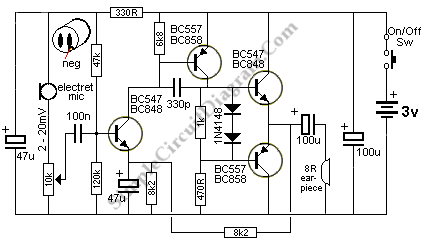
Small Amplifier Using Transistors
The output of this circuit is push-pull and consumes less than 3 mA (with no signal) but drives the earpiece to a very loud level when audio is detected.
This circuit operates in a push-pull configuration, which allows it to efficiently...
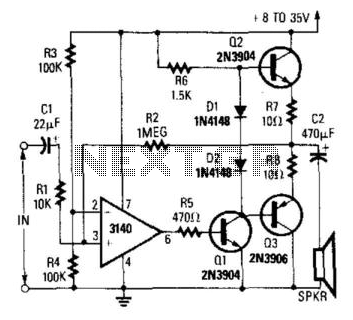
Simple Op Amp Audio Amplifier
A CA3140 operational amplifier drives a complementary output stage consisting of transistors Q1, Q2, and Q3. The output power is influenced by the supply voltage and the thermal dissipation limits of transistors Q2 and Q3. Under optimal conditions, the output...

Simple Transistor Reflex Receivers
This reflex radio project was inspired by Robert Bazian's design. His reflex radio is the "darndest" thing I have seen and his spectacular results inspired me to come up with my own version! These designs are similar to two-transistor circuits...

300B solid state
The classic 6-transistor circuit, prevalent in the 1960s and 70s, utilizes NPN output devices and features a relatively high bias level. It operates on a single rail, with input and output coupled through electrolytic capacitors. The design incorporates a clever...

Tube mic Connecting the capsule 2
Connecting a condenser capsule to the grid of a tube amplifier to build a tube microphone. This section discusses how to connect a capsule with two diaphragms to achieve a multi-pattern microphone. First, the different pickup patterns are examined: Omni,...

LA4550 audio amplifier circuit 4W 8 ohm 12V operation
The LA4550 audio amplifier operates in a BTL (Bridge-Tied Load) configuration. This amplifier is capable of delivering 4W into an 8-ohm load when powered by a 12V power supply.
The LA4550 is designed for audio amplification applications, particularly in situations where...