


DIY Class-A 2SK1058 MOSFET Amplifier Project
#Class-A
#MOSFET
#2SK1058
#audio amplifier
#single-ended
#DIY
#N-Channel
#Hitachi
#simple circuit
#power amplifier

Description: A straightforward DIY Class-A MOSFET amplifier project that utilizes a single Hitachi 2SK1058 N-channel MOSFET in a single-ended configuration.
This Class-A MOSFET amplifier design is characterized by its simplicity and effectiveness, making it suitable for audio amplification applications. The core component, the Hitachi 2SK1058, is a high-performance N-channel MOSFET known for its low on-resistance and high-speed switching capabilities. In a single-ended configuration, the amplifier operates with a single active device, which simplifies the circuit and reduces the component count.
The circuit typically consists of the following key elements: the 2SK1058 MOSFET, a biasing network, an input coupling capacitor, and an output coupling capacitor. The biasing network is crucial for establishing the proper operating point of the MOSFET, ensuring it operates in the linear region for optimal audio fidelity. Resistors are used to set the gate voltage, while a source resistor may be included to stabilize the operating point against variations in temperature and device characteristics.
The input signal is coupled to the gate of the MOSFET through a capacitor, which blocks any DC offset and allows only the AC audio signal to pass. The output is taken from the drain of the MOSFET, also through a coupling capacitor, which prevents any DC component from reaching the load, such as a speaker.
Power supply considerations are essential, with a well-regulated DC voltage source required to power the amplifier. The choice of power supply voltage will affect the output power and linearity of the amplifier. Additionally, proper heat dissipation measures, such as a heat sink, should be implemented to manage the thermal performance of the MOSFET during operation.
Overall, this DIY Class-A MOSFET amplifier project offers a practical introduction to audio amplification, showcasing the fundamental principles of MOSFET operation while providing a platform for further experimentation and enhancement.A very simple DIY Class-A MOSFET Amplifier Project that uses only a one Hitachi 2SK1058 N-Channel MOSFET in a single-ended circuit
This Class-A MOSFET amplifier design is characterized by its simplicity and effectiveness, making it suitable for audio amplification applications. The core component, the Hitachi 2SK1058, is a high-performance N-channel MOSFET known for its low on-resistance and high-speed switching capabilities. In a single-ended configuration, the amplifier operates with a single active device, which simplifies the circuit and reduces the component count.
The circuit typically consists of the following key elements: the 2SK1058 MOSFET, a biasing network, an input coupling capacitor, and an output coupling capacitor. The biasing network is crucial for establishing the proper operating point of the MOSFET, ensuring it operates in the linear region for optimal audio fidelity. Resistors are used to set the gate voltage, while a source resistor may be included to stabilize the operating point against variations in temperature and device characteristics.
The input signal is coupled to the gate of the MOSFET through a capacitor, which blocks any DC offset and allows only the AC audio signal to pass. The output is taken from the drain of the MOSFET, also through a coupling capacitor, which prevents any DC component from reaching the load, such as a speaker.
Power supply considerations are essential, with a well-regulated DC voltage source required to power the amplifier. The choice of power supply voltage will affect the output power and linearity of the amplifier. Additionally, proper heat dissipation measures, such as a heat sink, should be implemented to manage the thermal performance of the MOSFET during operation.
Overall, this DIY Class-A MOSFET amplifier project offers a practical introduction to audio amplification, showcasing the fundamental principles of MOSFET operation while providing a platform for further experimentation and enhancement.A very simple DIY Class-A MOSFET Amplifier Project that uses only a one Hitachi 2SK1058 N-Channel MOSFET in a single-ended circuit

2x300W or 600W Power audio Amplifier
The circuit is based around LM4702 manufactured by NATIONAL semiconductors and MJ11029-MJ11028 by ON semiconductors. It is a high fidelity audio power amplifier designed for demanding consumer and pro-audio applications. You can also use this circuit with AV receivers, audiophile...

High quality 10w audio amplifier
The circuit features a Class AB audio amplifier integrated circuit (IC) that necessitates only a minimal number of external components. This series is straightforward to construct. The 10W stereo amplifier circuit requires a stable power supply with a voltage of...

20W Class-A Amplifier
This amp uses the basic circuitry of the 60W power amp but modified for true Class-A operation. This amp has been built by several readers, and the reports I have received have been very positive. With simulations, everything appears to...

18w 18w stereo hi fi audio amplifier tda2030
A 2 x 18W Hi-Fi Stereo Power Amplifier is designed using two TDA2030 integrated circuits (ICs). This amplifier features excellent input sensitivity, low distortion, robust operating stability, and comprehensive protection against overloads and output short-circuits. It is suitable for use...

200 watt Audio amplifier with STK4050
This complete high quality, low noise mono audio power amplifier is based around the Hybrid Integrated Circuit STK4050 manufactured by Sanyo. The circuit incorporates volume and has a maximum music output power of 200W. The circuit incorporates an on board...
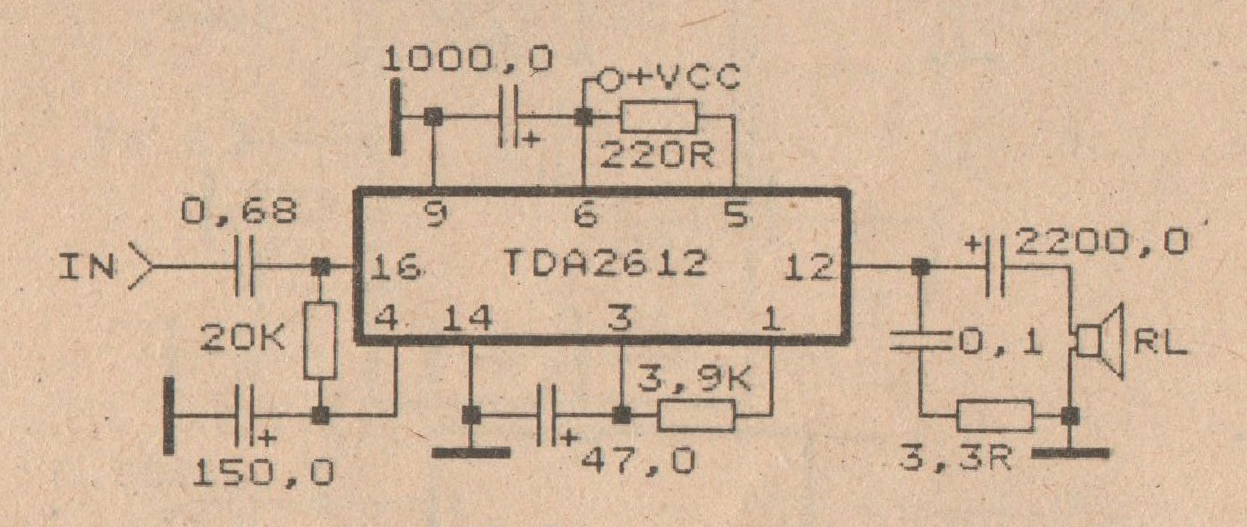
Schematic Audio Power Amplifier with IC TDA2612 Schematic Diagram
This amplifier circuit is based on the IC TDA2612 produced by Siemens. The minimum voltage required for this circuit is 10 volts, while the maximum voltage is 35 volts DC. The power output is 25 watts with a 4-ohm impedance....

hf 5 band mosfet amplifier
This project utilizes the IRF510 MOSFET, a widely available N-Channel enhancement mode power field effect transistor. It is designed to withstand specified levels of energy in breakdown avalanche mode. Unlike bipolar transistors, which are current-controlled and have lower input impedance,...

60 watt 2n3055 power amplifier
This architecture allows for a wide tolerance in component selection, enabling the use of various components that may be readily available. The transistors utilized can be any NPN type power transistor, excluding Darlington configurations. The output power is approximately 60W....

Bull horn
The input audio signal is connected to pin 3 of U1, an LM386 low-voltage amplifier, through capacitor C3 and resistor R1. The potentiometer R1 adjusts the drive or volume level. U1 functions as a driver stage, with a gain that...