


electret microphone amplifier
#electret microphone
#audio amplifier
#signal level
#decibels
#LINE level
#MIC level
#RMS voltage
#600 ohms

Description: Level refers to the relative strength of the signal and is measured in decibels. LINE level sources are much-amplified signals compared to MIC (microphone) level signals. Line level typically ranges from -10 to +4 dBm in strength, while MIC levels are generally around -60 dBm. The line output standard is designed to drive a load of 600 ohms or greater, with a mean signal level of 0.775V RMS. An exception exists for compact disc players, where the output level is most commonly 2V RMS.
The concept of signal levels is crucial in audio engineering, particularly when designing circuits that interface different types of audio equipment. LINE level signals are significantly stronger than MIC level signals, necessitating careful consideration when connecting devices to avoid distortion or damage.
In practical applications, LINE level signals are often used in professional audio equipment such as mixers, amplifiers, and recording devices. The standard output impedance of 600 ohms is important to ensure compatibility with a wide range of audio equipment, allowing for optimal signal transfer and minimizing loss.
When designing circuits that incorporate both LINE and MIC level inputs, it is essential to include appropriate preamplification stages for MIC signals to boost their levels to match LINE levels. This can be achieved using operational amplifiers configured as non-inverting amplifiers, which can provide the necessary gain while maintaining low noise characteristics.
Additionally, when dealing with compact disc players, which output at a higher level of 2V RMS, it is important to implement attenuation circuits if interfacing with equipment designed for standard LINE levels. This can be accomplished through passive voltage dividers or active circuits that adjust the signal level to prevent clipping and ensure a clean audio signal throughout the system.
In summary, understanding the differences between LINE and MIC level signals, as well as their respective output characteristics, is essential for the design and implementation of reliable audio circuits that maintain signal integrity across various devices.Level refers to the relative strength of the signal and is measured in decibels. LINE level sources are much-amplified signals over MIC (microphone) level signals. Line level is usually between -10 to +4 dbm in strength while MIC levels are normally -60 dbm. The line output standard designed to drive a load of 600 ohms or greater, at a mean signal level of 0. 775V RMS. An exception exists in respect of compact disc players, where the output level is most commonly 2V RMS.
The concept of signal levels is crucial in audio engineering, particularly when designing circuits that interface different types of audio equipment. LINE level signals are significantly stronger than MIC level signals, necessitating careful consideration when connecting devices to avoid distortion or damage.
In practical applications, LINE level signals are often used in professional audio equipment such as mixers, amplifiers, and recording devices. The standard output impedance of 600 ohms is important to ensure compatibility with a wide range of audio equipment, allowing for optimal signal transfer and minimizing loss.
When designing circuits that incorporate both LINE and MIC level inputs, it is essential to include appropriate preamplification stages for MIC signals to boost their levels to match LINE levels. This can be achieved using operational amplifiers configured as non-inverting amplifiers, which can provide the necessary gain while maintaining low noise characteristics.
Additionally, when dealing with compact disc players, which output at a higher level of 2V RMS, it is important to implement attenuation circuits if interfacing with equipment designed for standard LINE levels. This can be accomplished through passive voltage dividers or active circuits that adjust the signal level to prevent clipping and ensure a clean audio signal throughout the system.
In summary, understanding the differences between LINE and MIC level signals, as well as their respective output characteristics, is essential for the design and implementation of reliable audio circuits that maintain signal integrity across various devices.Level refers to the relative strength of the signal and is measured in decibels. LINE level sources are much-amplified signals over MIC (microphone) level signals. Line level is usually between -10 to +4 dbm in strength while MIC levels are normally -60 dbm. The line output standard designed to drive a load of 600 ohms or greater, at a mean signal level of 0. 775V RMS. An exception exists in respect of compact disc players, where the output level is most commonly 2V RMS.
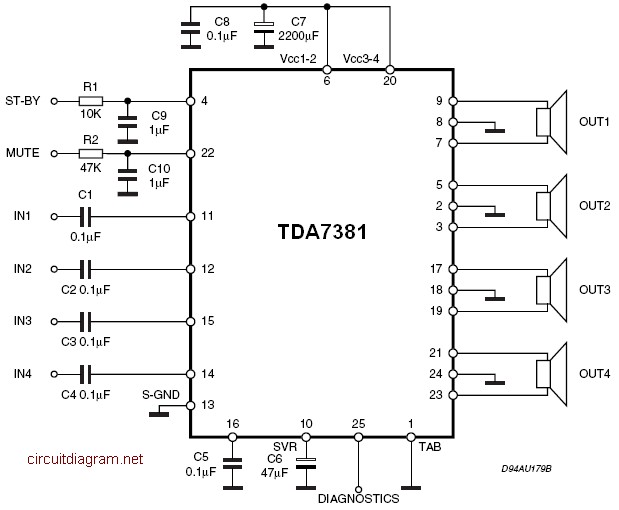
Audio Quad Audio Amplifier Circuit diagram with TDA7831 4G—25W
The amplifier is a quad amplifier circuit (amplifier with four inputs and four outputs) based on the TDA7381. This amplifier is designed for car audio systems, but it can also be utilized for other applications. The circuit has a very...

amplifier electronic circuits audio amp schematics 170w lm4651 lm4652
The ICs LM4651 and LM4652 are types of MOSFET integrated circuits and power amplifiers that include high-efficiency amplifiers, making them suitable for self-powered speakers, subwoofers, and high-quality car audio systems. The LM4651 is a fully integrated conventional pulse width modulation...

7 Watt Class B Audio Amplifier Circuit
This circuit design for an amplifier was created to address the gap in the 3-10 Watts power output range of audio amplifiers available in RED Free Circuit Designs. A straightforward, low-component-count amplifier was developed based on the successful 45 Watt...

STK4050V audio amplifier circuit
This 200-watt audio amplifier circuit diagram is based on the STK4050V high-power audio amplifier IC, designed to deliver up to 200 watts of audio power on a single channel. The STK4050V 200-watt audio amplifier circuit is pin-compatible with other STK...

18W Audio Amplifier
High Quality very simple unit - No need for a preamplifier. Can be directly connected to CD players, tuners and tape recorders. Don't exceed 23 + 23V supply. Q3 and Q4 must be mounted on heatsink. D1 must be in...

Bypassing tone controls from Dyna Pas preamp
Inquiring about a simple method to bypass the tone controls in the preamplifier, with the understanding that a feedback circuit may be involved, leading to uncertainty.
To bypass the tone controls in a preamplifier, one common method is to modify the...

4 x 25 W Car Amplifier TDA7381 Circuit
The TDA7381 is a Class AB audio power amplifier housed in a Flexiwatt25 package, specifically intended for car radio applications. This circuit can also be utilized for various other purposes. The fully complementary PNP/NPN output configuration enables a rail-to-rail output...

High quality 10w audio amplifier
The circuit features a Class AB audio amplifier integrated circuit (IC) that necessitates only a minimal number of external components. This series is straightforward to construct. The 10W stereo amplifier circuit requires a stable power supply with a voltage of...

KA2211 5.8W Stereo Audio Amplifier
The following schematic illustrates a 5.8W stereo power amplifier utilizing the Samsung IC KA2211. Each channel delivers a power output of 5.8W, resulting in a maximum combined output of 2 x 5.8W. The KA2211 is a dual audio power amplifier...