


Fet Amplifier With Offset Gate Bias Circuit
#FET
#MPF102
#gate bias
#amplifier
#transistor
#voltage bias
#signal amplification
#external voltage
#electronic circuit

Description: In this amplifier circuit, the gate of the MPF 102 is biased with an external voltage. This circuit achieves tighter control of the operating point and biasing conditions.
The amplifier circuit utilizing the MPF 102 field-effect transistor (FET) is designed to enhance the stability and performance of the amplification process. The MPF 102, known for its low noise characteristics and high input impedance, is particularly suitable for applications requiring precise signal amplification.
In this configuration, the gate of the MPF 102 is connected to an external voltage source, which serves to set the bias point of the transistor. This external biasing allows for improved control over the operating point, ensuring that the transistor remains in the desired region of operation, typically the saturation region for amplification purposes. The use of an external voltage rather than relying solely on the inherent characteristics of the transistor helps mitigate variations that may arise due to temperature changes or component tolerances.
The circuit may include additional components such as resistors and capacitors to form a biasing network, which further refines the operating conditions. Resistors connected to the gate can help stabilize the bias point by providing a defined path for the gate current, while capacitors can be employed for coupling and decoupling purposes, ensuring that AC signals are amplified effectively without distortion.
Overall, this amplifier circuit configuration is beneficial for applications that demand high fidelity and low distortion in signal processing, making it suitable for audio amplification, sensor signal conditioning, and communication systems. The precise control of the operating point achieved through external voltage biasing contributes significantly to the reliability and performance of the amplification circuitry. In this amplifier circuit, the gate of the MPF 102 is biased with an external voltage. This circuit achieves tighter control of the operating point and biasing conditions.
The amplifier circuit utilizing the MPF 102 field-effect transistor (FET) is designed to enhance the stability and performance of the amplification process. The MPF 102, known for its low noise characteristics and high input impedance, is particularly suitable for applications requiring precise signal amplification.
In this configuration, the gate of the MPF 102 is connected to an external voltage source, which serves to set the bias point of the transistor. This external biasing allows for improved control over the operating point, ensuring that the transistor remains in the desired region of operation, typically the saturation region for amplification purposes. The use of an external voltage rather than relying solely on the inherent characteristics of the transistor helps mitigate variations that may arise due to temperature changes or component tolerances.
The circuit may include additional components such as resistors and capacitors to form a biasing network, which further refines the operating conditions. Resistors connected to the gate can help stabilize the bias point by providing a defined path for the gate current, while capacitors can be employed for coupling and decoupling purposes, ensuring that AC signals are amplified effectively without distortion.
Overall, this amplifier circuit configuration is beneficial for applications that demand high fidelity and low distortion in signal processing, making it suitable for audio amplification, sensor signal conditioning, and communication systems. The precise control of the operating point achieved through external voltage biasing contributes significantly to the reliability and performance of the amplification circuitry. In this amplifier circuit, the gate of the MPF 102 is biased with an external voltage. This circuit achieves tighter control of the operating point and biasing conditions.

NOT circuit
A common-emitter transistor amplifier produces an output signal that is 180 degrees out of phase with the input signal, commonly referred to as an inverting amplifier. When the electrical path for amplifying the pulse signal is activated, this circuit functions...

Transistor Circuit Analysis
The schematic represents a relatively simple transistor circuit. Analyzing such schematics evokes memories of college days spent studying electrical engineering. However, the complexity of the schematic can be daunting after a long time away from the subject. To refresh knowledge,...

expandable transistor based burglar alarm
This transistor-based alarm system incorporates automatic exit and entry delays, along with a timed bell cut-off and system reset functionality. In addition to the exit/entry zone, the fundamental alarm board includes one instant zone, which is sufficient for many applications....

Block Transistor Radio
For those seeking a quicker and simpler build option, the Breadboard Six Transistor Radio Kit is highly recommended, albeit with a slightly different final appearance. This kit is a medium wave (MW) AM transistor radio that can be assembled without...

Common emitter amplifier input and output signals of the phase relationship
The common emitter amplifier circuit exhibits a specific phase relationship between its input and output signals. This configuration is widely utilized in various electronic devices primarily for its high voltage gain. However, the output impedance is higher than the input...
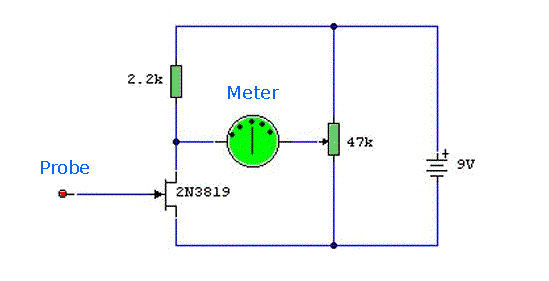
static detector negative ion detector
A sensitive detector for static electricity is based on a single Field Effect Transistor (FET). It can also be utilized to detect the presence of negative ions or to test a negative ion generator. This circuit takes advantage of the...

An adjustable bounce lighting circuit
A circuit involving oscillations is composed of a Houle Wang oscillator that utilizes a transistor configuration with components labeled Ti, n, and n, along with a composition of Q constants for the cycle. The waveform can be modified by changing...
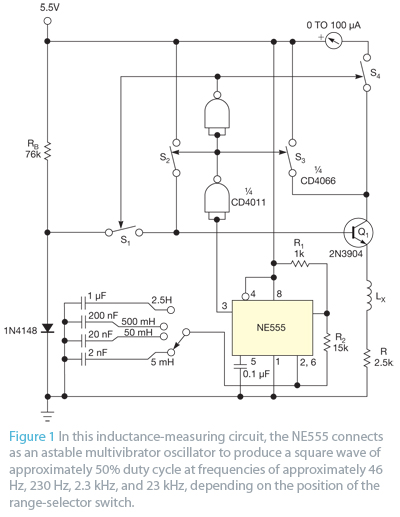
Use a transistor and an ammeter to measure inductance
Bipolar junction transistors transfer a current from a lower-resistance emitter to a higher-resistance collector. This property can be utilized to measure inductance.
Bipolar junction transistors (BJTs) are semiconductor devices that play a crucial role in electronic circuits by enabling the control...

Low Supply Rail Detection
This is a simple low supply rail detection circuit that is inexpensive and can be assembled in approximately 20 minutes. It operates with low power consumption, making it suitable for integration into battery-powered devices. The circuit utilizes three low-cost transistors...