


LME49810 IC For Power Amplifier
#LME49810
#power amplifier
#audio amplifier
#IC
#speaker
#impedance
#circuit diagram
#drive
#electronics
#sound

Description: The following circuit illustrates the LME49810 integrated circuit used in a power amplifier circuit diagram. Features include improved drive capability for 4-ohm speaker impedance.
The LME49810 is a high-performance audio power amplifier IC designed to deliver high output power with low distortion. It is particularly well-suited for driving speakers with a nominal impedance of 4 ohms, making it ideal for various audio applications, including home theater systems and professional audio equipment.
The circuit typically consists of the LME49810 connected to a power supply, with additional components such as resistors and capacitors to stabilize the operation and enhance performance. The power supply voltage should be selected based on the desired output power and the specifications of the LME49810, which can operate efficiently within a range of supply voltages.
Key features of the LME49810 include its ability to provide high output current, which is essential for driving low-impedance loads without significant distortion. The circuit design often incorporates feedback mechanisms to ensure linearity and minimize harmonic distortion, which is critical in high-fidelity audio applications.
In the schematic, the input stage typically includes capacitive coupling to block DC components from the audio source, allowing only the AC audio signal to pass through. The output stage is usually connected to a suitable heatsink to dissipate heat generated during operation, ensuring reliable performance over extended periods.
Overall, the LME49810 circuit is designed to deliver high-quality audio amplification, making it a popular choice among audio engineers and enthusiasts. Proper layout and component selection are crucial for achieving optimal performance and minimizing noise in the final audio output.The following circuit shows about LME49810 IC For Power Amplifier Circuit Diagram. Features: better drive 4 ? impedance of the speakers, for the ..
The LME49810 is a high-performance audio power amplifier IC designed to deliver high output power with low distortion. It is particularly well-suited for driving speakers with a nominal impedance of 4 ohms, making it ideal for various audio applications, including home theater systems and professional audio equipment.
The circuit typically consists of the LME49810 connected to a power supply, with additional components such as resistors and capacitors to stabilize the operation and enhance performance. The power supply voltage should be selected based on the desired output power and the specifications of the LME49810, which can operate efficiently within a range of supply voltages.
Key features of the LME49810 include its ability to provide high output current, which is essential for driving low-impedance loads without significant distortion. The circuit design often incorporates feedback mechanisms to ensure linearity and minimize harmonic distortion, which is critical in high-fidelity audio applications.
In the schematic, the input stage typically includes capacitive coupling to block DC components from the audio source, allowing only the AC audio signal to pass through. The output stage is usually connected to a suitable heatsink to dissipate heat generated during operation, ensuring reliable performance over extended periods.
Overall, the LME49810 circuit is designed to deliver high-quality audio amplification, making it a popular choice among audio engineers and enthusiasts. Proper layout and component selection are crucial for achieving optimal performance and minimizing noise in the final audio output.The following circuit shows about LME49810 IC For Power Amplifier Circuit Diagram. Features: better drive 4 ? impedance of the speakers, for the ..

soldano slo preamp
The AC load comprises a 2.2M resistor in parallel with a 330k resistor and the output impedance Zo of the normal channel's second stage. For audio frequencies, the output impedance is 74k plus the impedance of a 120pF capacitor in...

power amplifier class circuit
This design schematic represents a Class A power amplifier. It closely matches the operating parameters of Class B to facilitate comparison, particularly with a negative feedback (NFB) factor of 30dB at 20 kHz. The front end is similar to that...

11W Stereo/22W Mono Power Amp Using TDA1519C
Integrated AF power amplifiers have experienced significant advancements in recent years, offering enhanced power and ease of use. The TDA1519C from Philips features two power amplifiers that provide 11 W per channel in stereo mode or 22 W in mono...
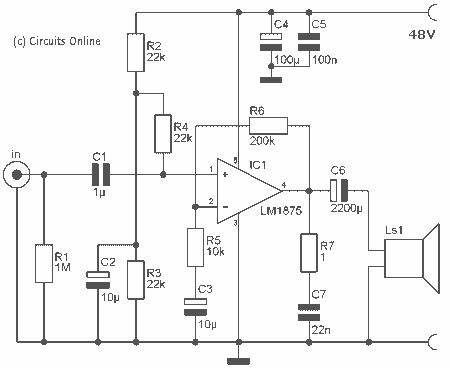
20 Watt audio Amplifier
This is a standard amplifier based on LM 1875. It can deliver 20 W, with an 8 Ω speaker and 60V power supply even 30 W.
The capacitors C4 and C5 should preferably be as close to the IC down. More:...

40W 4 channel audio amplifier
The integrated audio TDA8571J, designed for automotive applications, allows for the expansion of car radio sound or the connection of a portable MP3 player. Internally, the chip contains eight operational amplifiers set in a bridge configuration, enabling each speaker terminal...

Power Amplifier 6
This simple circuit is designed to provide an output power of approximately 1 watt when connected to a 9-volt power supply. The key advantage of this circuit is its use of a dual Darlington configuration, which increases the input impedance...

845 20W A1 class monotriode amplifier
This project is finalized, that means it is no longer experimental. This amplifier, although limited in output power (20W), has been designed to give the best listening pleasure. No compromise has been made during components choice: the 845 output triode...
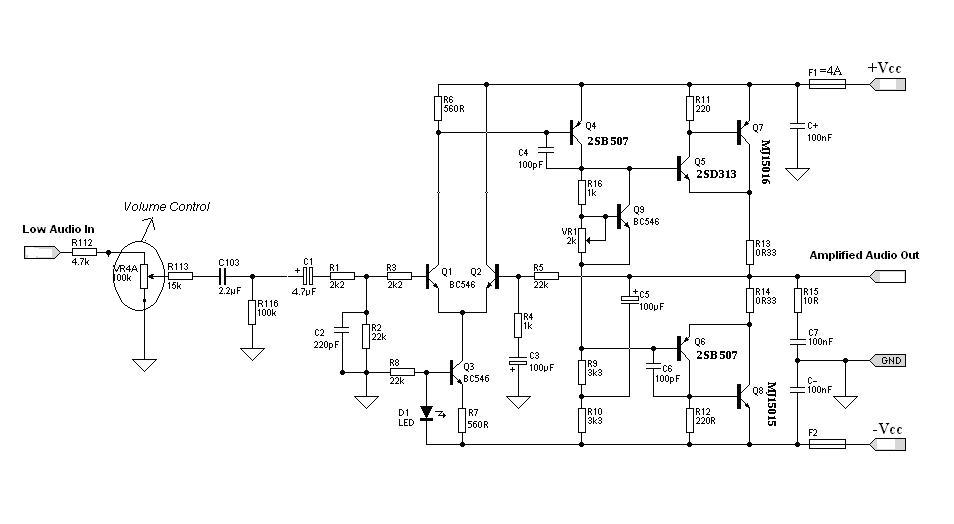
Hi-fi Audio Amplifier Circuit Design and implementation
Designing an audio amplifier from scratch using discrete components is an engaging task, as it enables users to create amplifiers that meet diverse requirements. Audio amplifiers can enhance low-level sounds from mobile devices, making them louder and more vibrant. Based...

Speaker to microphone converter circuit
This circuit provides a straightforward method for converting a loudspeaker into a microphone. When sound waves impact the diaphragm of the speaker, fluctuations occur in the coil, generating a small induced voltage that is typically low in magnitude and not...