


Mic Amplifier
#mic amplifier
#audio amplifier
#SONY
#microphone
#schematic
#no tuning
#immediate operation
#circuit design
#electronics

Description: Microphone amplifier schematic diagram. This circuit has been tested with three microphones: one from SONY and two from Chinese manufacturers, and it operates successfully with all. When assembled correctly, the device functions immediately without the need for tuning.
The microphone amplifier circuit is designed to amplify audio signals from various types of microphones, ensuring clear and robust output suitable for further processing or amplification. The schematic typically includes essential components such as operational amplifiers (op-amps), resistors, capacitors, and sometimes transistors, depending on the desired gain and frequency response characteristics.
In this particular design, the op-amp serves as the core amplification element. The choice of op-amp is crucial; it should have low noise and high input impedance to avoid loading the microphone. The circuit may employ a single-supply or dual-supply configuration, depending on the op-amp specifications and the intended application.
Resistors are used to set the gain of the amplifier. The gain can be adjusted by changing the feedback resistor values, allowing for flexibility in amplification levels. Capacitors are typically included in the circuit to filter out unwanted frequencies and to stabilize the power supply, ensuring that the output signal remains clean and free from distortion.
The circuit also includes a power supply section, which may consist of a voltage regulator to provide a stable voltage to the op-amp. Proper decoupling capacitors should be placed near the power pins of the op-amp to minimize noise from the power supply.
Overall, this microphone amplifier schematic is versatile, capable of handling different microphone types, and is designed for immediate functionality upon assembly, making it an excellent choice for various audio applications.Mic Amplifier schematic diagram. This circuit has been tried on three microphones, one from SONY, and then two Chinese, everything works! With the correct assembly of the device starts to work immediately, and does not need tuning.
The microphone amplifier circuit is designed to amplify audio signals from various types of microphones, ensuring clear and robust output suitable for further processing or amplification. The schematic typically includes essential components such as operational amplifiers (op-amps), resistors, capacitors, and sometimes transistors, depending on the desired gain and frequency response characteristics.
In this particular design, the op-amp serves as the core amplification element. The choice of op-amp is crucial; it should have low noise and high input impedance to avoid loading the microphone. The circuit may employ a single-supply or dual-supply configuration, depending on the op-amp specifications and the intended application.
Resistors are used to set the gain of the amplifier. The gain can be adjusted by changing the feedback resistor values, allowing for flexibility in amplification levels. Capacitors are typically included in the circuit to filter out unwanted frequencies and to stabilize the power supply, ensuring that the output signal remains clean and free from distortion.
The circuit also includes a power supply section, which may consist of a voltage regulator to provide a stable voltage to the op-amp. Proper decoupling capacitors should be placed near the power pins of the op-amp to minimize noise from the power supply.
Overall, this microphone amplifier schematic is versatile, capable of handling different microphone types, and is designed for immediate functionality upon assembly, making it an excellent choice for various audio applications.Mic Amplifier schematic diagram. This circuit has been tried on three microphones, one from SONY, and then two Chinese, everything works! With the correct assembly of the device starts to work immediately, and does not need tuning.

Audio 150W Car Power Amplifier
When the amplifier is installed inside the suitcase, it will require a change to stop working. The LA47536 has a control pin (pin 4) that requires a small voltage of up to 2V to turn on the amplifier. Transistors Q1...

Audio amplifier power supply design
This document discusses the advantages and disadvantages of various power supply technologies, along with the design considerations necessary for selecting and evaluating a mains transformer. It covers the pros and cons of external supplies, inrush current control, RF emissions from...

36 watt audio power amplifier using tda1562q
It is based on a Philips class-H audio amplifier integrated circuit and can deliver 36W RMS or 70W music power, all from a 13.8V supply. The new Mighty Midget Amplifier can produce approximately 36W RMS continuously into a 4-ohm load...

Understanding Mouthpiece or Microphone Earpiece and IHF or Buzzer Speakers Circuit on mobile phones
A mobile phone's microphone or mouthpiece is a component that converts sound signals into electrical signals. The earpiece speaker converts electrical signals back into sound signals, and similarly, the IHF, buzzer, or ringer speaker performs this function as well. A...
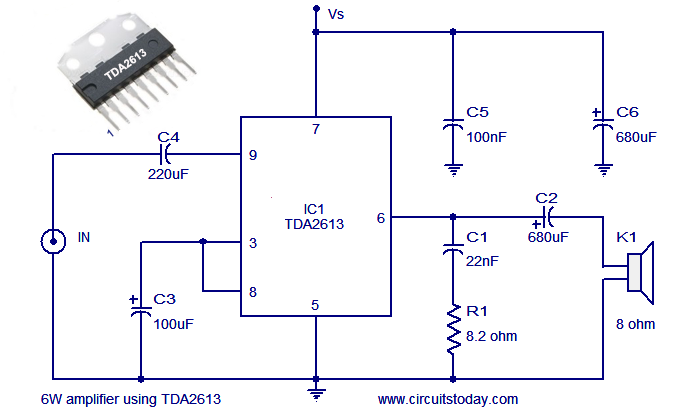
Audio power amplifier circuit using Hi Fi audio amplifier IC TDA2613
A simple and easy-to-build Hi-Fi audio power amplifier circuit is presented here. This 6-watt Hi-Fi audio amplifier circuit utilizes the TDA2613 integrated circuit (IC).
The circuit design employs the TDA2613, which is a high-performance audio amplifier IC known for its efficiency...

50 Watt Amplifier ICL8063
This is a handy, easy to build general purpose 50 watt amp. The amp has an input for a radio, TV, stereo or other line level device. It also has a phono input for a record player, guitar, microphone or...

300 Watt audio Amplifier
For many applications, there's no substitute for sheer power - low efficiency speakers, outdoor sound systems, or maybe you like the full flavor of the dynamic range of a high power amp. Whatever your requirement, this super power module should...

FET 12W Audio Power Amplifier circuit
A compact power amplifier that delivers high-quality sound. It incorporates a NE5534 operational amplifier, known for its excellent performance, capable of handling low loads, providing high speed, and exhibiting low distortion. Additionally, it features two V-MOSFET transistors at the output...

Super Simple 3 Watt Audio Power Amplifier
The circuit diagram presented is for a compact mini audio power amplifier that operates with a DC supply voltage ranging from 4.5 volts to a maximum of 18 volts. This amplifier utilizes the TDA1015 integrated circuit, produced by NXP Semiconductors,...