


Pre mic audio amplifier with ic LM386
#LM386
#audio amplifier
#condenser microphone
#pre-amplifier
#transistor
#9V power supply
#sound signal
#loudspeaker
#audio circuit

Description: This circuit amplifies sound signals from a condenser microphone to drive a small-sized loudspeaker. The key component is a pre-amplifier using a single transistor to increase the sound signal power before it is sent to an amplifier, specifically the integrated circuit LM386, which drives the loudspeaker. The circuit operates with a 9V power supply. The microphone (MIC1) captures sound signals, which are then amplified by the transistor (Q1). The amplified signal exits through the collector pin (C) and is coupled through capacitor C2. The variable resistor (VR1) adjusts the sound level before feeding into the input of IC1. The LM386 (IC1) is a 1-watt integrated circuit with pin 3 as the input. Capacitor C3 filters out noise from the input signal, grounding it. The amplified output is sent to pin 5, where capacitors C5 and resistor R5 further filter the signal before it is transmitted to the loudspeaker. Capacitor C6 enhances low-frequency sound quality before the audio reaches the loudspeaker.
The circuit serves as a basic audio amplification system designed for applications requiring sound signal enhancement from a microphone. The condenser microphone (MIC1) is responsible for converting acoustic signals into electrical signals. The transistor (Q1) acts as a pre-amplifier, providing initial gain to the weak microphone signal. The collector pin (C) of the transistor outputs the amplified signal, which is then coupled through capacitor C2 to block any DC offset while allowing the AC audio signal to pass.
The variable resistor (VR1) is crucial for adjusting the gain and ensuring that the audio output level is suitable for the application, preventing distortion or clipping of the audio signal. The LM386 integrated circuit is known for its low voltage operation and high efficiency in audio applications. With pin 3 designated as the input, the LM386 receives the amplified signal, while capacitor C3 serves to filter out any high-frequency noise that might interfere with the audio quality.
The output from the LM386 at pin 5 is further processed through capacitor C5 and resistor R5, which work together to eliminate any residual noise and ensure a clean audio signal is sent to the loudspeaker. Capacitor C6 is included to improve the low-frequency response of the audio output, enhancing the overall sound quality before it reaches the loudspeaker.
This circuit is suitable for various applications, including portable audio devices, small public address systems, and other scenarios where compact size and efficient power usage are essential. The use of the LM386 allows for a straightforward design, making it accessible for hobbyists and professionals alike.This circuit be signal sound expansion from condenser microphone give with small-sized loudspeaker. It compose the importance is part pre mic use transistor just one enlarge sound signal gives the power goes up change come to a part amplifier with the integrated circuit LM386 utter go out give aloudspeaker. When feed9V power supplyreach the circui t. The MIC1 and Q1 which be part pre mic, by mic will take sound signal has come in then deliver Q1 enlarge a signal has power size goes up to go out the way collector pin (C) change C2 coupling signal. Then deliver with VR1 for fine signal sound level gives with Input of IC1. Which IC1 numberLM386be theintegrated circuit amplifies1 watt size has pin 3 are input and have C3 will eradicate source noise with input signal discharge down ground.
When amplify finished will export come to the way output pin 5 by have C5 and R5 eradicate a signal takes to stir go out sound signal will have that to change go to still. The C6 coupling signal and enhance sound quality of low frequency improve. Before reach a loudspeaker makes a noise to come out.
The circuit serves as a basic audio amplification system designed for applications requiring sound signal enhancement from a microphone. The condenser microphone (MIC1) is responsible for converting acoustic signals into electrical signals. The transistor (Q1) acts as a pre-amplifier, providing initial gain to the weak microphone signal. The collector pin (C) of the transistor outputs the amplified signal, which is then coupled through capacitor C2 to block any DC offset while allowing the AC audio signal to pass.
The variable resistor (VR1) is crucial for adjusting the gain and ensuring that the audio output level is suitable for the application, preventing distortion or clipping of the audio signal. The LM386 integrated circuit is known for its low voltage operation and high efficiency in audio applications. With pin 3 designated as the input, the LM386 receives the amplified signal, while capacitor C3 serves to filter out any high-frequency noise that might interfere with the audio quality.
The output from the LM386 at pin 5 is further processed through capacitor C5 and resistor R5, which work together to eliminate any residual noise and ensure a clean audio signal is sent to the loudspeaker. Capacitor C6 is included to improve the low-frequency response of the audio output, enhancing the overall sound quality before it reaches the loudspeaker.
This circuit is suitable for various applications, including portable audio devices, small public address systems, and other scenarios where compact size and efficient power usage are essential. The use of the LM386 allows for a straightforward design, making it accessible for hobbyists and professionals alike.This circuit be signal sound expansion from condenser microphone give with small-sized loudspeaker. It compose the importance is part pre mic use transistor just one enlarge sound signal gives the power goes up change come to a part amplifier with the integrated circuit LM386 utter go out give aloudspeaker. When feed9V power supplyreach the circui t. The MIC1 and Q1 which be part pre mic, by mic will take sound signal has come in then deliver Q1 enlarge a signal has power size goes up to go out the way collector pin (C) change C2 coupling signal. Then deliver with VR1 for fine signal sound level gives with Input of IC1. Which IC1 numberLM386be theintegrated circuit amplifies1 watt size has pin 3 are input and have C3 will eradicate source noise with input signal discharge down ground.
When amplify finished will export come to the way output pin 5 by have C5 and R5 eradicate a signal takes to stir go out sound signal will have that to change go to still. The C6 coupling signal and enhance sound quality of low frequency improve. Before reach a loudspeaker makes a noise to come out.

Transistor circuit of a pressure gauge
To ensure proper operation of the transistor in a circuit, it is essential to measure the reverse breakdown voltage of the transistor. This is particularly important for tubes with high reverse breakdown voltage requirements, such as those used in OCL...

Three transistor audio amplifier
This circuit diagram illustrates a simple three-transistor audio amplifier capable of delivering approximately 100 mW of power to a 25 Ohm speaker. Diodes D1 and D2 provide a constant bias voltage for transistors Q1 and Q2. Transistor Q1 functions as...

Miniature Loop Alarm
Simple construction, reliable operation, very small power consumption, and, most of all, small size. I started with CMOS logic gates, but was soon forced to abandon the concept after a few unsuccessful (and far too complicated) attempts. Then I suddenly...

5 watt class a audio amplifier circuit
This solid-state push-pull single-ended Class A circuit is capable of providing sound quality comparable to that of valve amplifiers. It delivers an output power of 6.9W when measured across an 8 Ohm loudspeaker cabinet load, with reduced total harmonic distortion...

Simple 10W audio amplifier
The circuit presented is a simple audio amplifier capable of delivering 12W to an 8 Ohm speaker. The operational amplifier IC TL081 serves as the preamplifier in this design. Alternatively, any operational amplifier with compatible power supply ratings can be...

8 Watts Audio Amplifier (TDA2003)
Nice small audio amplifier which use only few parts to give good quality sound. This amp can be used as a simple booster, the heart of a more complicated amplifier or used as a guitar amp. Although not perfect, this...

XENON STROBE
A two-transistor oscillator generates pulses at approximately 500 Hz to step up the voltage using a 300-mA filament transformer (T1, Radio Shack 273-1384) for charging storage capacitors C2 and C3, which are 250-V electrolytics. At the same time, capacitor C4...

Economical Transistor Radio
The schematic diagram illustrates an audio stage utilizing a common-collector circuit. This configuration does not dampen the tuned circuit; rather, it enhances its response, resulting in improved sensitivity and selectivity. Due to the low supply voltage, the subsequent audio amplifier...
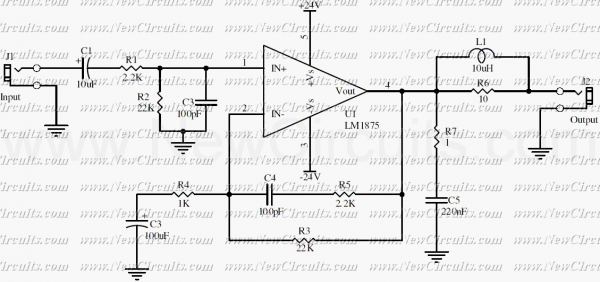
20 Watt Audio Amplifier
This simple 20 watts audio power amplifier is designed for home-brewed purpose. The L1 should be able to handle a current up to 4A to drive speaker in full load. The distortion is 0.015% @ 1KHz / 20W. This circuit...