


Pro Maniac Guitar tube power amplifier
#guitar amplifier
#tube amplifier
#power amplifier
#audio
#SR AB763
#driver circuit
#resistor
#capacitor
#potentiometer

Description: For SR AB763 driver replace: 25k pot, 0.1uF cap and 4k7 resistor with 100 ohm resistor to ground. 56k resistor with 820 to 4k7 resistor. More: 6k8 resistor with 22k resistor.
The circuit modification described involves specific component replacements and adjustments within the SR AB763 driver circuit. The original configuration includes a 25k potentiometer, a 0.1μF capacitor, and a 4.7kΩ resistor. The proposed changes suggest replacing these components with a 100Ω resistor connected to ground, which will likely alter the input impedance and affect the overall gain of the circuit.
In addition, a 56kΩ resistor is to be replaced with a combination of an 820Ω resistor in series with a 4.7kΩ resistor. This modification is intended to adjust the voltage divider ratio, potentially impacting the biasing conditions of the driver stage.
Furthermore, the circuit also mentions replacing a 6.8kΩ resistor with a 22kΩ resistor. This change will affect the feedback network and could lead to changes in the frequency response and stability of the circuit.
The overall effect of these modifications may result in improved performance characteristics of the SR AB763 driver, such as altered frequency response, gain adjustments, and potentially improved linearity or distortion levels. Careful consideration should be given to the impact of these changes on the circuit's operation and its integration into the broader system. Proper testing and validation should be conducted post-modification to ensure desired performance outcomes are achieved.For SR AB763 driver replace: 25k pot, 0.1uF cap and 4k7 resistor with 100 ohm resistor to ground. 56k resistor with 820 to 4k7 resistor. 6k8 resistor with 22k resistor
The circuit modification described involves specific component replacements and adjustments within the SR AB763 driver circuit. The original configuration includes a 25k potentiometer, a 0.1μF capacitor, and a 4.7kΩ resistor. The proposed changes suggest replacing these components with a 100Ω resistor connected to ground, which will likely alter the input impedance and affect the overall gain of the circuit.
In addition, a 56kΩ resistor is to be replaced with a combination of an 820Ω resistor in series with a 4.7kΩ resistor. This modification is intended to adjust the voltage divider ratio, potentially impacting the biasing conditions of the driver stage.
Furthermore, the circuit also mentions replacing a 6.8kΩ resistor with a 22kΩ resistor. This change will affect the feedback network and could lead to changes in the frequency response and stability of the circuit.
The overall effect of these modifications may result in improved performance characteristics of the SR AB763 driver, such as altered frequency response, gain adjustments, and potentially improved linearity or distortion levels. Careful consideration should be given to the impact of these changes on the circuit's operation and its integration into the broader system. Proper testing and validation should be conducted post-modification to ensure desired performance outcomes are achieved.For SR AB763 driver replace: 25k pot, 0.1uF cap and 4k7 resistor with 100 ohm resistor to ground. 56k resistor with 820 to 4k7 resistor. 6k8 resistor with 22k resistor

DIY Single-Ended (SE) 6L6 / 5881 Tube Amplifier
This past summer, an inspiration arose from watching "Transformers: Revenge of the Fallen" to construct an enclosure for a vacuum tube amplifier featuring the Decepticon logo. The tube amplifier replaces a solid-state amplifier that was driven by a tube preamplifier....
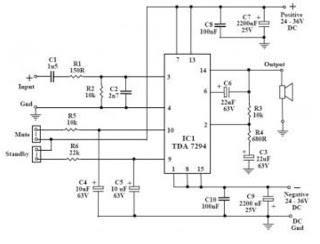
amplifier circuit
This audio amplifier circuit utilizes the TDA7294, a power integrated circuit designed for high-quality audio applications. The TDA7294 operates as a class AB amplifier, characterized by low noise and distortion levels, a wide bandwidth, and robust output current capability. It...

Fast Audio Peak Limiter
The circuit devised by Phil Allison still has some input voltage limitations, since it is based on a FET. Junction FET VCAs also create considerable distortion, with the worst of it appearing when the signal is attenuated by 6dB. The...
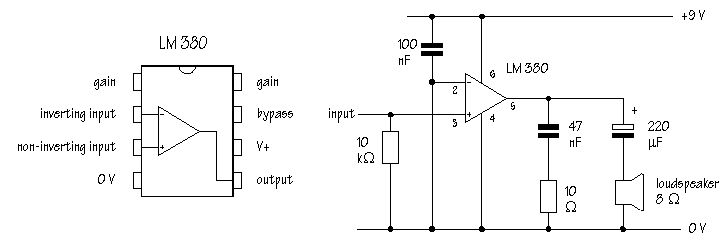
own capacitor
The capacitor is composed of two sheets of aluminum foil. It is essential to keep the foil within the plastic packets and connect them using crocodile clips, ensuring that the clips do not touch each other. The initial frequency of...
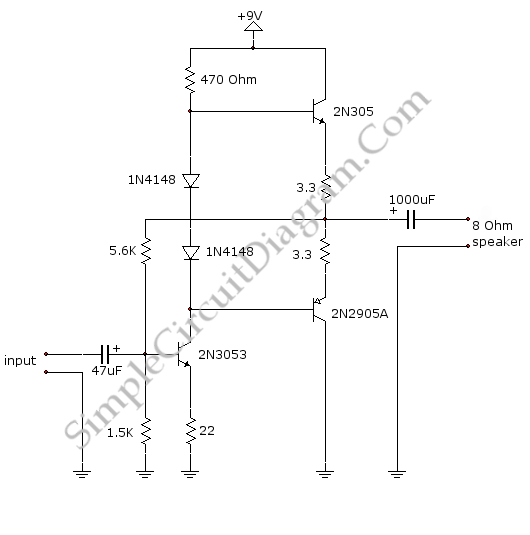
Small Discrete Audio Power Amplifier
This is a small audio amplifier, similar to those used in small transistor radios. The circuit draws approximately 30 milliamps from a 9-volt supply and consists of two stages. The first stage is the input stage using a 2N3053 transistor,...

potentiometer Making an adjustable resistance
This part of the circuit is isolated from any other component, except for the 5V and ground connections. It includes LEDs and a shift register, which may not interact significantly. The LDR (Light Dependent Resistor) is utilized solely as a...

Audio mV Meter
This project is an Audio Millivolt Meter designed to measure small audio signals from various equipment and circuits. The circuit features a four-step attenuator at the input, providing ranges of 10mV, 100mV, 1V, and 10V. The gain stage amplifies the...

6418 Tube RIAA Phono Preamplifier
Last year, a low-cost tube stereo headphone amplifier kit from Oatley Electronics (located in New South Wales, Australia) was built and reviewed. This kit gained significant popularity and was sold globally. The headphone amplifier is based on new old stock...
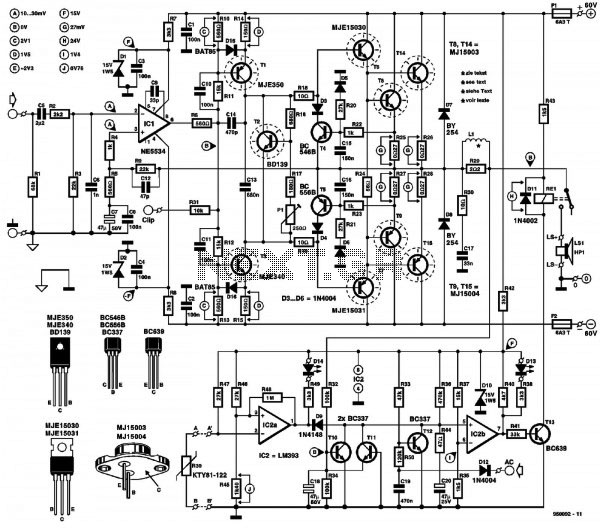
300w Amplifier Diagram With MJ15003 and MJ15004
A conventional power amplifier featuring both high-pass and low-pass filters. Powered by a 60V DC supply, this circuit can deliver approximately 300W of sound power. The operational amplifier NE5534 is utilized in the configuration.
The described power amplifier circuit integrates both...