


Programmable-gain-differential-input-amplifier
#programmable gain
#differential input
#CD4051
#CMOS
#analog multiplexer
#operational amplifier
#signal conditioning
#gain control
#decoder
#analog circuit

Description: This programmable gain circuit utilizes a CD4051 CMOS Analog Multiplexer as a two to four line decoder, featuring appropriate FET drive for switching between feedback resistors to set the gain to one of four selectable values.
The described programmable gain circuit is designed to enhance signal processing by allowing for adjustable gain levels based on the selected feedback resistor configuration. The CD4051 CMOS Analog Multiplexer serves as the core component, functioning as a decoder that translates binary inputs into a corresponding output line, enabling the selection of one of four feedback resistors.
In this circuit, the gain settings are determined by the configuration of resistors connected to the feedback loop of an operational amplifier (op-amp). Each feedback resistor corresponds to a specific gain value, and the multiplexer facilitates the switching between these resistors based on control signals. The FET drive circuitry is crucial for ensuring that the switching action is fast and efficient, minimizing signal distortion and maintaining the integrity of the amplified signal.
The operation of the circuit can be summarized as follows: when a binary input is applied to the CD4051, it activates one of its output lines, allowing the corresponding feedback resistor to be connected to the op-amp. This selection process determines the gain of the amplifier, which can be adjusted dynamically during operation, making it suitable for applications requiring variable amplification based on changing signal conditions.
To further enhance performance, careful consideration should be given to the choice of feedback resistors, as their values will directly influence the gain settings. Additionally, the layout of the circuit should minimize parasitic capacitance and inductance, which can adversely affect the switching speed and overall performance of the programmable gain circuit. Proper power supply decoupling and grounding techniques should also be implemented to ensure stable operation.This programmable gain circuit employs a CD4051 CMOS Analog Multiplexer as a two to four line decoder, with appropriate FET drive for switching between feedback resistors to program the gain to any one of four values.
The described programmable gain circuit is designed to enhance signal processing by allowing for adjustable gain levels based on the selected feedback resistor configuration. The CD4051 CMOS Analog Multiplexer serves as the core component, functioning as a decoder that translates binary inputs into a corresponding output line, enabling the selection of one of four feedback resistors.
In this circuit, the gain settings are determined by the configuration of resistors connected to the feedback loop of an operational amplifier (op-amp). Each feedback resistor corresponds to a specific gain value, and the multiplexer facilitates the switching between these resistors based on control signals. The FET drive circuitry is crucial for ensuring that the switching action is fast and efficient, minimizing signal distortion and maintaining the integrity of the amplified signal.
The operation of the circuit can be summarized as follows: when a binary input is applied to the CD4051, it activates one of its output lines, allowing the corresponding feedback resistor to be connected to the op-amp. This selection process determines the gain of the amplifier, which can be adjusted dynamically during operation, making it suitable for applications requiring variable amplification based on changing signal conditions.
To further enhance performance, careful consideration should be given to the choice of feedback resistors, as their values will directly influence the gain settings. Additionally, the layout of the circuit should minimize parasitic capacitance and inductance, which can adversely affect the switching speed and overall performance of the programmable gain circuit. Proper power supply decoupling and grounding techniques should also be implemented to ensure stable operation.This programmable gain circuit employs a CD4051 CMOS Analog Multiplexer as a two to four line decoder, with appropriate FET drive for switching between feedback resistors to program the gain to any one of four values.

Signal Conditioners Information
Signal conditioning involves a series of operations applied to a signal to make it compatible for interfacing with other devices or systems. Signal conditioners are the devices that execute this operation, featuring both an input and an output. Typically, the...

Magic Wand Conjuring Trick
The operation of the circuit is fairly simple. Three AND logic gates of a 4081 CMOS IC are employed, with gates IC1a to IC1c being configured as a standard cascaded latch circuit. S1 to S3 serve as reset switches. The...

TA-1500 fever amplifier circuit
Only the R channel is shown, with the original reference PCB label. Figure (a) illustrates the front tone circuit, which consists of a common negative feedback operational amplifier in an RC circuit configuration. The microphone signal is amplified by VTz,...

dozen small cmos alarm circuits
This is a collection of compact, self-sufficient alarm circuits designed for low standby current, making them ideal for battery operation. Some circuits are activated by normally-open and normally-closed switches, while others respond to variations in light or temperature. This leads...
operational amplifier op amp oscillator
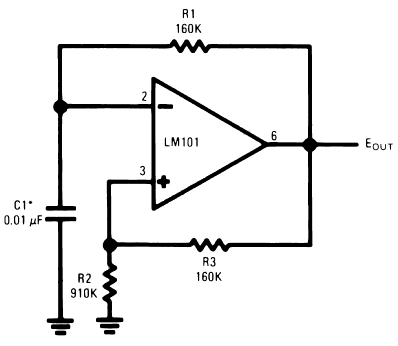
The timing capacitor (C1) generates multiple time constants, facilitating substantial voltage fluctuations at the input, attributable to the LM101's extensive input voltage range. It is advisable to decrease the value of resistor R2 and to increase the capacitance of C1...
SimpleTimer with Musical Alarm
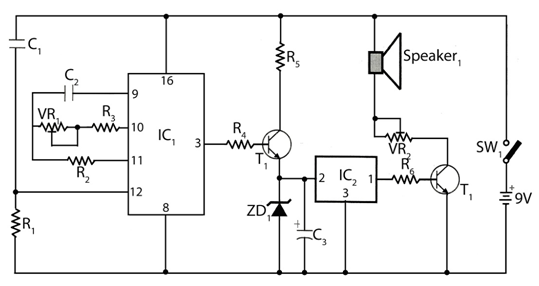
The circuit timer with a musical alarm utilizes a well-known CMOS oscillator/divider integrated circuit (IC1). Although this circuit operates at 9V, its standby current drain is minimal. The time delay of the timer circuit can be adjusted by modifying the...

Using C-MOS light emitting diode drive circuit NAND gate pulse
The 4000 Series 4011B is a NAND gate used in conjunction with a 4AI NAND gate circuit group to create two loops of an unstable multivibrator. The first NAND gate and the second NAND gate operate at approximately 1 kHz,...

Square transform circuit diagram
At the input of the operational amplifier, a resistor-diode network can be constructed to create a square-law function conversion circuit. This resistor-diode network acts as a voltage divider, where the input voltage variations lead to different partial pressures. The three...

Electronic potentiometer schematic
Electronic potentiometer using a standard CMOS logic and analog multiplexers. Pot have low distortion (0.005% less at 1 V rms) and is it easy for beginners to understand. In the beginning, the art of Hi-Fi, in the absence of high-quality...