


TDA2009 single power amplifier circuit diagram
#TDA2009
#single power
#high-power
#battery powered
#audio amplifier
#morning exercise machine
#power amplifier
#circuit diagram

Description: The intention was to develop a morning exercise machine, but the challenge was the absence of a suitable high-power amplifier. Since the exercise machine operates on battery power, the search for a solution persisted for several months. Eventually, the TDA2009 single-supply amplifier IC was discovered. This IC is a commonly used and cost-effective hi-fi amplifier. It has a rated power output of 2 x 10W and operates with a supply voltage ranging from 8 to 28V, with a maximum output current of 3.5A. The circuit includes an overheating protection feature. The author has successfully utilized this amplifier design for several years without any issues. However, it is crucial to ensure proper grounding in the design, and although the heat generation is minimal, attention to heat management is still necessary. The circuit schematic follows.
The TDA2009 is a versatile amplifier IC that is well-suited for battery-operated applications due to its single-supply operation and efficient power management. The amplifier can deliver up to 20W of output power per channel, making it ideal for driving speakers in portable exercise machines. The input voltage range of 8V to 28V allows for flexibility in battery selection, accommodating different battery chemistries and configurations.
In the typical application circuit, the TDA2009 is connected to a power supply that provides the necessary voltage. Bypass capacitors should be placed close to the power pins of the IC to filter out any high-frequency noise and ensure stable operation. The output stage is designed to drive speakers directly, and it is recommended to use speakers with an impedance of 4 to 8 ohms to match the amplifier's specifications.
An important feature of the TDA2009 is its built-in thermal overload protection, which automatically reduces the output power if the chip overheats, thus preventing damage. This feature is particularly beneficial in applications where the amplifier may be subjected to continuous operation, such as in an exercise machine.
The schematic should include a feedback network to stabilize the gain and improve linearity, typically achieved using resistors and capacitors in a specific configuration. Additionally, a coupling capacitor may be used at the input to block any DC offset from the source signal, ensuring that only the AC audio signal is amplified.
Heat dissipation is a critical consideration in the design. Although the TDA2009 generates minimal heat under normal operating conditions, it is advisable to use a heatsink or ensure adequate airflow around the IC to maintain optimal performance. Proper grounding techniques must also be employed to minimize noise and ensure reliable operation.
Overall, the TDA2009 amplifier IC provides a robust solution for battery-powered audio applications, delivering high-quality sound while maintaining efficiency and reliability.Always wanted to do morning exercise machine, also suffering no single power can not find high-power amplifier, as morning exercise machine is battery powered, so thinking abou t for several months, but finally found a TDA2009 single-supply amplifier IC, and now to share with you the application circuit TDA2009. TDA2009 is a more common and affordable hi-fi amplifier manifold. Rated power of 2 10W. Supply voltage 8 ~ 28V. The maximum output current of 3.5A. Overheating protection circuit. (2 10W, THD 0.5%) According to the author uses the chip sets made amplifier, the effect is still very good, has been used now, for several years, not out of any trouble.
Of course, such ground Design Tips chapter introduction, provided that the design must be reasonable ground, while its heat is very small though, still have to pay attention to heat. Its circuit is as follows:
The TDA2009 is a versatile amplifier IC that is well-suited for battery-operated applications due to its single-supply operation and efficient power management. The amplifier can deliver up to 20W of output power per channel, making it ideal for driving speakers in portable exercise machines. The input voltage range of 8V to 28V allows for flexibility in battery selection, accommodating different battery chemistries and configurations.
In the typical application circuit, the TDA2009 is connected to a power supply that provides the necessary voltage. Bypass capacitors should be placed close to the power pins of the IC to filter out any high-frequency noise and ensure stable operation. The output stage is designed to drive speakers directly, and it is recommended to use speakers with an impedance of 4 to 8 ohms to match the amplifier's specifications.
An important feature of the TDA2009 is its built-in thermal overload protection, which automatically reduces the output power if the chip overheats, thus preventing damage. This feature is particularly beneficial in applications where the amplifier may be subjected to continuous operation, such as in an exercise machine.
The schematic should include a feedback network to stabilize the gain and improve linearity, typically achieved using resistors and capacitors in a specific configuration. Additionally, a coupling capacitor may be used at the input to block any DC offset from the source signal, ensuring that only the AC audio signal is amplified.
Heat dissipation is a critical consideration in the design. Although the TDA2009 generates minimal heat under normal operating conditions, it is advisable to use a heatsink or ensure adequate airflow around the IC to maintain optimal performance. Proper grounding techniques must also be employed to minimize noise and ensure reliable operation.
Overall, the TDA2009 amplifier IC provides a robust solution for battery-powered audio applications, delivering high-quality sound while maintaining efficiency and reliability.Always wanted to do morning exercise machine, also suffering no single power can not find high-power amplifier, as morning exercise machine is battery powered, so thinking abou t for several months, but finally found a TDA2009 single-supply amplifier IC, and now to share with you the application circuit TDA2009. TDA2009 is a more common and affordable hi-fi amplifier manifold. Rated power of 2 10W. Supply voltage 8 ~ 28V. The maximum output current of 3.5A. Overheating protection circuit. (2 10W, THD 0.5%) According to the author uses the chip sets made amplifier, the effect is still very good, has been used now, for several years, not out of any trouble.
Of course, such ground Design Tips chapter introduction, provided that the design must be reasonable ground, while its heat is very small though, still have to pay attention to heat. Its circuit is as follows:

TBA820 Amplifier
A very useful audio amp in an 8-pin DIL package. The IC features a very low minimum working supply voltage of 3V, low quiescent current, good ripple rejection, no crossover distortion and low power dissipation. More: Maximum supply voltages is...

Audio Power Amplifier Circuit
The circuit is designed around an LM741 operational amplifier configured as an inverting amplifier. It is utilized to drive complementary transistors (Q1 and Q2). The feedback loop of the op-amp incorporates the base-emitter junctions of both transistors, which aids in...

Electronic Cricket Match Game
This electronic cricket is a gift for children. This simple battery-powered circuit can be utilized to play cricket matches with friends. Each LED in the circuit...
This electronic cricket circuit is designed as an engaging and interactive toy for children, promoting...

10 w amplifier using tda2003
This is a circuit diagram of an audio amplifier circuit featuring a 10W power amplifier using the TDA2003 integrated circuit from SGS Thomson. The IC is capable of delivering 10W into a 4-ohm load at a supply voltage of 18V...

170 Watt audio amplifier
In the drawing, a simple but powerful power amplifier is presented. Its difference from classic designs, which use differential amplifiers in their input, is that this amplifier uses a complete NE5534 at its input. Thus, it is necessary to reduce...
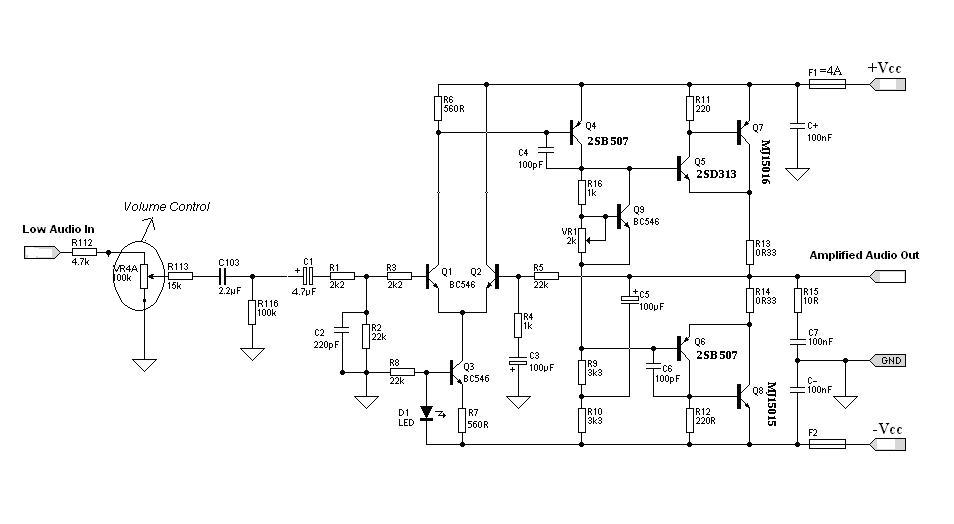
Hi-fi Audio Amplifier Circuit Design and implementation
Designing an audio amplifier from scratch using discrete components is an engaging task, as it enables users to create amplifiers that meet diverse requirements. Audio amplifiers can enhance low-level sounds from mobile devices, making them louder and more vibrant. Based...
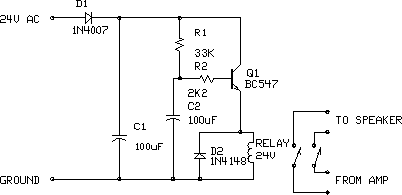
Audio Amplifier Output Relay Delay
This circuit is designed for an audio amplifier project to control the speaker output relay. Its primary function is to activate the relay that connects the speaker output to the amplifier after a delay of approximately 5 seconds following power-up,...
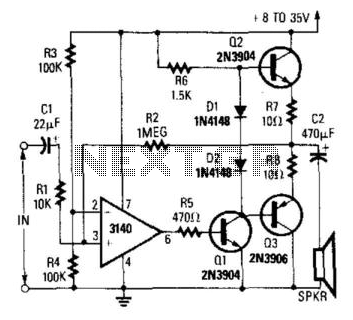
Simple Op Amp Audio Amplifier
A CA3140 operational amplifier drives a complementary output stage consisting of transistors Q1, Q2, and Q3. The output power is influenced by the supply voltage and the thermal dissipation limits of transistors Q2 and Q3. Under optimal conditions, the output...

Simple home audio power amplifier circuit schematic
This document presents a new audio power amplifier schematic utilizing TIP darlington pair transistors. It is suitable for both home audio and car audio amplifiers. The TIP142 and TIP147 darlington pair transistors create a push-pull high-power amplifier configuration, while two...