


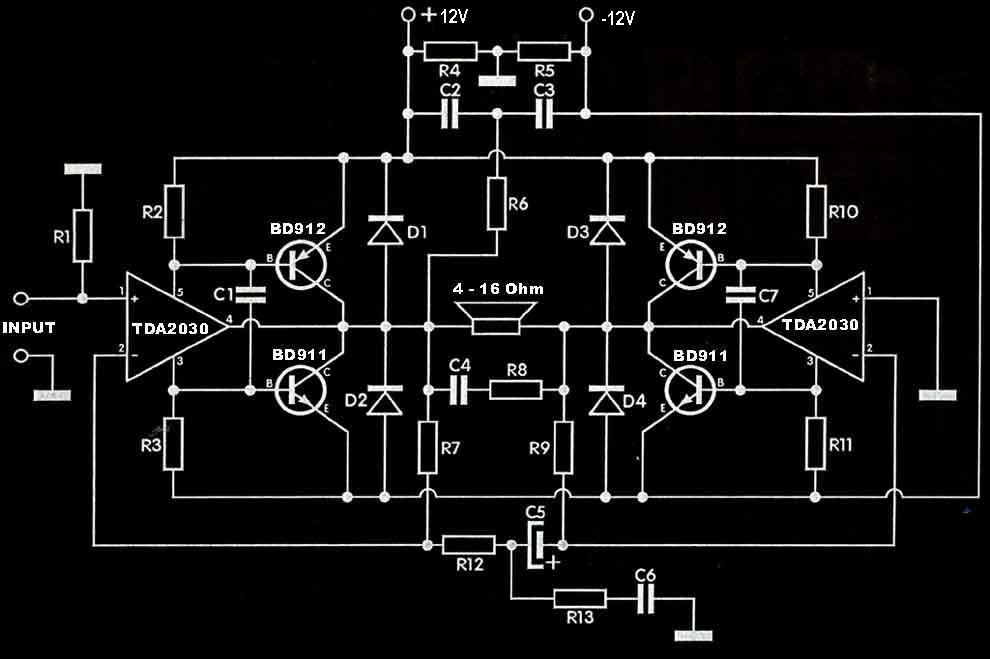
TDA2030 200 watt amp low cost audio power amplifier
#TDA2030
#audio amplifier
#high power
#bridge mode
#low cost
#200 watt
#4 ohm
#2 ohm
#sound system
#IC

Description: The TDA2030 is a low-cost audio power amplifier capable of delivering high output audio power up to 200 watts with a load impedance of 2 to 4 ohms. This high-power audio amplifier is built around the TDA2030 audio amplifier IC, which typically delivers up to 14 watts on a 4-ohm load. However, when used in bridge mode and combined with inexpensive power transistors, it can be configured to achieve a 200-watt output. It is essential to mount all transistors and ICs on a heatsink to prevent damage due to overheating. For small value resistors (1 ohm, 2.2 ohms), it is recommended to use resistors rated for 2 to 5 watts.
The TDA2030 audio amplifier IC is widely used in various audio amplification applications due to its efficiency and performance. In bridge mode configuration, the amplifier utilizes two TDA2030 ICs, where one operates as a positive output and the other as a negative output. This arrangement effectively doubles the output voltage, thereby increasing the power delivered to the load.
The circuit typically includes a power supply capable of delivering sufficient current to support the high output demands. A dual power supply with positive and negative voltage rails is often used to provide the necessary voltage levels for the TDA2030 in bridge mode. Capacitors are included at the power supply input to filter out noise and stabilize the voltage.
In addition to the TDA2030 ICs, the circuit design incorporates several discrete components, including power transistors that handle the higher output power. These transistors are selected based on their voltage and current ratings to ensure they can handle the demands of the amplifier without failure. Proper biasing of these transistors is crucial for optimal performance and linearity.
Heatsinks are critical in this design to dissipate heat generated by the ICs and transistors during operation. The thermal management strategy must account for the maximum power output and the ambient conditions in which the amplifier will operate. Adequate airflow around the heatsinks is necessary to maintain safe operating temperatures.
Resistors used in the circuit, particularly those with low resistance values (such as 1 ohm and 2.2 ohms), should be rated for higher wattage (2 to 5 watts) to handle the power dissipation without overheating. Proper resistor selection is vital for maintaining circuit stability and performance.
Overall, this TDA2030-based amplifier circuit offers a cost-effective solution for achieving high audio power output, making it suitable for various audio applications where budget constraints are a consideration. The design emphasizes the importance of thermal management and component selection to ensure reliable and efficient operation.This TDA2030 200 watt amp low cost audio power amplifier can deliver high output audio power up to 200 watts on a 2 4 ohms load impedance. This 200 watt amp high power audio amplifier is build around the TDA2030 audio amplifier IC which normally can deliver up to 14 watts on a 4 ohm load, but if is used in bridge mode an if we use some cheap
power transistors can be created a 200 watts high power audio amplifier. All transistors and the ICs must be mounted on a heatsink to prevent over temperature damage. For small value resistors ( 1 ohm, 2. 2 ohms ) use 2 -5 watts resistors.
The TDA2030 audio amplifier IC is widely used in various audio amplification applications due to its efficiency and performance. In bridge mode configuration, the amplifier utilizes two TDA2030 ICs, where one operates as a positive output and the other as a negative output. This arrangement effectively doubles the output voltage, thereby increasing the power delivered to the load.
The circuit typically includes a power supply capable of delivering sufficient current to support the high output demands. A dual power supply with positive and negative voltage rails is often used to provide the necessary voltage levels for the TDA2030 in bridge mode. Capacitors are included at the power supply input to filter out noise and stabilize the voltage.
In addition to the TDA2030 ICs, the circuit design incorporates several discrete components, including power transistors that handle the higher output power. These transistors are selected based on their voltage and current ratings to ensure they can handle the demands of the amplifier without failure. Proper biasing of these transistors is crucial for optimal performance and linearity.
Heatsinks are critical in this design to dissipate heat generated by the ICs and transistors during operation. The thermal management strategy must account for the maximum power output and the ambient conditions in which the amplifier will operate. Adequate airflow around the heatsinks is necessary to maintain safe operating temperatures.
Resistors used in the circuit, particularly those with low resistance values (such as 1 ohm and 2.2 ohms), should be rated for higher wattage (2 to 5 watts) to handle the power dissipation without overheating. Proper resistor selection is vital for maintaining circuit stability and performance.
Overall, this TDA2030-based amplifier circuit offers a cost-effective solution for achieving high audio power output, making it suitable for various audio applications where budget constraints are a consideration. The design emphasizes the importance of thermal management and component selection to ensure reliable and efficient operation.This TDA2030 200 watt amp low cost audio power amplifier can deliver high output audio power up to 200 watts on a 2 4 ohms load impedance. This 200 watt amp high power audio amplifier is build around the TDA2030 audio amplifier IC which normally can deliver up to 14 watts on a 4 ohm load, but if is used in bridge mode an if we use some cheap
power transistors can be created a 200 watts high power audio amplifier. All transistors and the ICs must be mounted on a heatsink to prevent over temperature damage. For small value resistors ( 1 ohm, 2. 2 ohms ) use 2 -5 watts resistors.

Three-Level Audio Power Indicator circuit
This circuit is designed to indicate the power output level of any audio amplifier. It is simple, portable, and displays three power levels that can be set to any desired value.
The circuit operates by utilizing a combination of resistive voltage...

sound simple audio amplifier
The sound quality was poor, and then it stopped functioning. Can anyone explain which part of the circuit may have malfunctioned? Any suggestions to enhance the sound quality and restore functionality? The transistors used are both BC546, and the microphone...

Direct coupling audio power amplifier configuration A741 circuit
The direct coupling audio power amplifier utilizes an integrated operational amplifier. There are typically two practical configurations. The first configuration, depicted in (a), features a circuit structure that includes the output of the operational amplifier and a complementary symmetry emitter...

4 Watt Amplifier with preamplifier
A small amplifier with nice characteristics: Tendency of catering: 15V. Force of expense: 4.2Wrms in the 4W. Minimal signal of entry: 94mVp-p with preamplifier, 0.65Vp-p without the preamplifier. More: Materially: R1=2.2kΩ R2=330kΩ R3=4.7kΩ logarithmic potentiometer R4=330Ω R5=1kΩ R6=1.5Ω C1, C6=100nF...

20 watt amplifier with LM1875
This is a nice amplifier and very easy to make it. Its an 20W Audio Amplifier based on LM1875 IC. More: Power supply - 48 VDC Output - 20 W, 4 ? Very low distortion (THD - 0.015%), good channel...

5 watt class a audio amplifier circuit
This solid-state push-pull single-ended Class A circuit is capable of providing sound quality comparable to that of valve amplifiers. It delivers an output power of 6.9W when measured across an 8 Ohm loudspeaker cabinet load, with reduced total harmonic distortion...

8 watts audio amplifier circuit
What value of potentiometer should be used for the volume control of this audio amplifier circuit, and where should it be connected? Thank you.
In audio amplifier circuits, the choice of potentiometer value for volume control is crucial for achieving optimal...

Small class b audio amplifier circuit diagram
When the power supply reaches the circuit and the input signal is applied, the sound signal is processed through capacitor C1 and resistor R1 for signal coupling and noise reduction. The modified signal then reaches pin 3 (non-inverting) of operational...
TDA2030 Subwoofer Amplifier Circuit PCB
The TDA2030 amplifier circuit is suitable for driving low-frequency subwoofer speakers in home theater systems. The TDA2030 is a monolithic integrated circuit designed for use as a low-frequency class AB amplifier. This TDA2030 amplifier design requires a dual power supply...