


Vinyl Pre-Amplifier

Many designers assert that NFB loop controlled amplifiers are inferior because they degrade the sound. However, it's worth considering what these individuals believe they are actually listening to. The reality is that most vinyl waveforms and CD pits, as part of their own disc collections, have already been mastered through a variety of NFB loop controlled pre-amplifier and mixer stages. This happens long before anyone starts listening. In fact, the Mullard-developed TDA1034NB integrated circuit, which initially cost half of £67 for ten, was later used by the hundred in what became a classic series of world-renowned Neve mixing consoles.
Negative Feedback (NFB) loop controlled amplifiers are a widely used technology in audio processing. The main function of NFB is to reduce distortion and increase the stability of the system. While some critics argue that it degrades the sound quality, it's important to understand that NFB has been a fundamental component in the mastering process of many audio formats, including vinyl and CDs. This means that the sound that listeners are used to, and often appreciate, is the result of NFB loop controlled amplification.
The TDA1034NB integrated circuit, developed by Mullard, is a prime example of a device that utilizes NFB loops. Initially priced at half of £67 for a set of ten, its affordability and efficiency led to its widespread use in the audio industry. Notably, it was incorporated by the hundreds into the design of the globally acclaimed Neve mixing consoles. These consoles, renowned for their superior sound quality and reliability, have been used in many professional recording studios around the world.
In conclusion, while the debate on the sound quality produced by NFB loop controlled amplifiers continues, it's evident that this technology has played a significant role in shaping the audio industry. Furthermore, the success of devices like the TDA1034NB integrated circuit and Neve mixing consoles, which employ NFB loops, is a testament to the efficacy and reliability of this technology.Many designers opinionate that NFB loop controlled amplifiers are inferior because they degrade the sound, and yet I wonder what it is that these individuals think they actually listen to ? The fact is that most vinyl waveforms and CD pits, as pressed into their own disc collections, have already been mastered through a myriad of NFB loop controlled pre-amplifier and mixer stages - this long before anyone can start listening.
Indeed, that Mullard developed TDA1034NB integrated circuit which initially cost me ½`£67 for ten, went on to be used by the hundred within what became a classic series of world famous Neve mixing consoles.
Negative Feedback (NFB) loop controlled amplifiers are a widely used technology in audio processing. The main function of NFB is to reduce distortion and increase the stability of the system. While some critics argue that it degrades the sound quality, it's important to understand that NFB has been a fundamental component in the mastering process of many audio formats, including vinyl and CDs. This means that the sound that listeners are used to, and often appreciate, is the result of NFB loop controlled amplification.
The TDA1034NB integrated circuit, developed by Mullard, is a prime example of a device that utilizes NFB loops. Initially priced at half of £67 for a set of ten, its affordability and efficiency led to its widespread use in the audio industry. Notably, it was incorporated by the hundreds into the design of the globally acclaimed Neve mixing consoles. These consoles, renowned for their superior sound quality and reliability, have been used in many professional recording studios around the world.
In conclusion, while the debate on the sound quality produced by NFB loop controlled amplifiers continues, it's evident that this technology has played a significant role in shaping the audio industry. Furthermore, the success of devices like the TDA1034NB integrated circuit and Neve mixing consoles, which employ NFB loops, is a testament to the efficacy and reliability of this technology.Many designers opinionate that NFB loop controlled amplifiers are inferior because they degrade the sound, and yet I wonder what it is that these individuals think they actually listen to ? The fact is that most vinyl waveforms and CD pits, as pressed into their own disc collections, have already been mastered through a myriad of NFB loop controlled pre-amplifier and mixer stages - this long before anyone can start listening.
Indeed, that Mullard developed TDA1034NB integrated circuit which initially cost me ½`£67 for ten, went on to be used by the hundred within what became a classic series of world famous Neve mixing consoles.
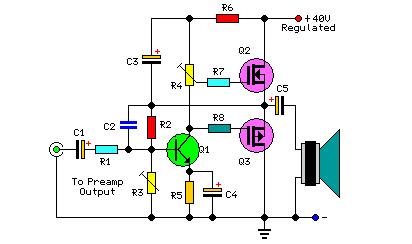
30 Watt Audio Power Amplifier
This project includes a preamplifier, tone controls, a regulated DC power supply, and delivers 18 watts into an 8-ohm load and 30 watts into a 4-ohm load.
The circuit design comprises several key components that work together to create a...

Small High Quality Audio Power Amplifier
This audio power amplifier is highly suitable for portable devices or as a headphone amplifier. The circuit design of this audio power amplifier is straightforward.
This audio power amplifier circuit is designed to enhance audio signals for portable devices and headphones,...

FFT audio amplifier design
For all the subsequent tests, a high-quality signal generator from BlackStar was utilized. The PicoScope trace displayed below illustrates a pure 1 kHz tone from the signal generator. It is important to note that while the screenshots below depict the...

simple sound to light converter schematic
A simple circuit for converting an audio signal (such as one that comes from the output terminals of a CD player). The circuit basically consists of a buffer/amplifier stage and three filter circuits: a high-pass filter, a mid-pass filter, and...
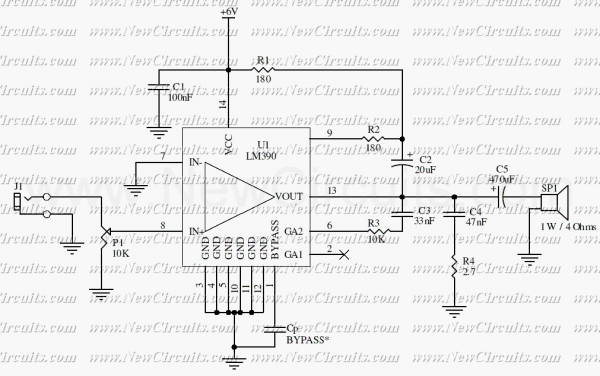
LM390 Bass Amplifier
This circuit is a mono audio amplifier that will boost low frequencies as you see at the frequency response. The circuit is suitable for driving a subwoofer speaker for example. The output power of the circuit is about 1 Watt...
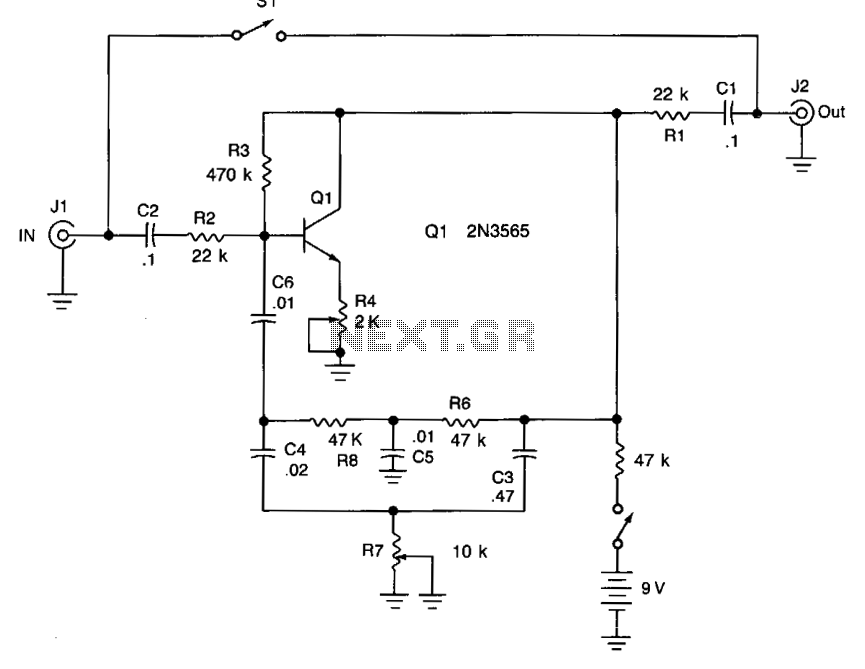
Funk box
Adjusting potentiometer R7 introduces additional tonal variation from low to high frequencies. To configure the unit, adjust potentiometer R4 until an oscillation or whistle is heard, then reduce R4 until the oscillation stops. The tonal effect can be modified from...

RC Audio Oscillator
This document presents the design of an audio oscillator that operates at approximately 1 kHz. The circuit is likely sourced from EMFRD, as Wes's book contains a wealth of valuable circuits. This versatile oscillator serves as a signal source for...

Audio-oscillator
The circuit's frequency of oscillation is given by the formula: f = 2.8 / [C1 x (R1 + R2)]. By adjusting the potentiometer R2, the output frequency can be varied from 60 Hz to 20 kHz. A portion of the...
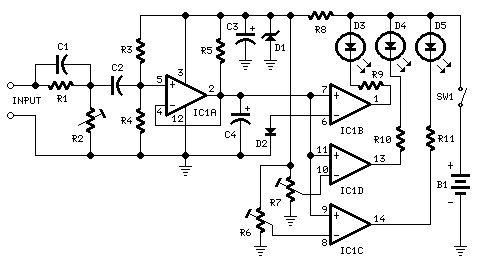
Three-Level Audio Power Indicators
This circuit indicates audio output power using three LEDs. It serves as a useful addition to an amplifier.
The audio output power indicator circuit is designed to visually represent the power level of an audio amplifier through the use of three...