


Arduino Light Sensors

Description: A project is underway to determine the number of sun hours available at a specific location and to track this data over time as part of solar power installation design. The concept involves utilizing a light detector exposed to sunlight to record the duration of full intensity illumination and correlate this information with photovoltaic equivalence. Various light detection methods will be explored, including photovoltaic cells, CdS cells, photodiodes, and others. Results from these methods will be shared, and a tutorial on the available options will be provided. Light sensors measure radiant energy within a narrow frequency range referred to as "light," which spans from infrared to visible and ultraviolet light. These sensors are passive devices that convert light energy, whether visible or infrared, into electrical signal outputs. Commonly known as "photoelectric devices" or "photosensors," they can be classified into two main categories: those that generate electricity when illuminated, such as photovoltaics or photoemissives, and those that alter their electrical properties, such as photoresistors or photoconductors.
In the context of the project, the selection of light sensors is crucial for accurately measuring solar exposure. Photovoltaic cells directly convert light into electricity and can provide a straightforward method for quantifying solar energy. However, alternatives such as CdS cells and photodiodes may offer different advantages, such as sensitivity to specific light wavelengths or ease of integration into existing systems.
A typical circuit for this solar tracking project would include a microcontroller to process the signals from the chosen light sensor. The light sensor would be connected to an analog input pin of the microcontroller, allowing it to read the voltage output corresponding to the light intensity. An additional real-time clock (RTC) module would be integrated to timestamp the recorded data, enabling the tracking of sun hours over time.
The circuit may also incorporate a display module, such as an LCD or OLED screen, to present the data in a user-friendly format. A power supply, potentially utilizing a small solar panel or battery, would be necessary to ensure the system operates independently. For data logging and further analysis, a memory module, like an SD card shield, could be included to store the recorded sun hour data for later retrieval.
When selecting the components, it is essential to consider factors such as the range of light intensity the sensor can detect, the response time, and the environmental conditions in which the system will operate. Proper calibration of the light sensor will also be necessary to ensure accurate readings, which may involve comparing the sensor output against known light intensity values.
In summary, the project aims to create a system that effectively measures and tracks solar exposure using various light sensors, with the potential to enhance solar power installation designs through accurate data collection and analysis.I`ve been working on a project that will allow me to determine the number of sun hours available in a given spot, and track that over time, as a component of solar power installation design. The idea is to get a light detector in the sun, record the number of hours it is lit at full intensity, and map that to photovoltaic equivalence.
One could use a pv cell, but there are other alternatives. The CdS cell, photodiode and others come to mind. We will try each of these methods and post our results, meanwhile, here is a great tutorial on the options: Light Sensors are used to measure the radiant energy that exists in a very narrow range of frequencies basically called "light", and which ranges in frequency from "Infrared" to "Visible" up to "Ultraviolet" light. Light sensors are passive devices that convert this "light energy" whether visible or in the infrared parts of the spectrum into an electrical signal output.
Light sensors are more commonly known as "Photoelectric Devices" or "Photosensors" which can be grouped into two main categories, those which generate electricity when illuminated, such as Photovoltaics or Photoemissives etc, and those which change their electrical properties such as Photoresistors or Photoconductors. This leads to the following classification of devices.
In the context of the project, the selection of light sensors is crucial for accurately measuring solar exposure. Photovoltaic cells directly convert light into electricity and can provide a straightforward method for quantifying solar energy. However, alternatives such as CdS cells and photodiodes may offer different advantages, such as sensitivity to specific light wavelengths or ease of integration into existing systems.
A typical circuit for this solar tracking project would include a microcontroller to process the signals from the chosen light sensor. The light sensor would be connected to an analog input pin of the microcontroller, allowing it to read the voltage output corresponding to the light intensity. An additional real-time clock (RTC) module would be integrated to timestamp the recorded data, enabling the tracking of sun hours over time.
The circuit may also incorporate a display module, such as an LCD or OLED screen, to present the data in a user-friendly format. A power supply, potentially utilizing a small solar panel or battery, would be necessary to ensure the system operates independently. For data logging and further analysis, a memory module, like an SD card shield, could be included to store the recorded sun hour data for later retrieval.
When selecting the components, it is essential to consider factors such as the range of light intensity the sensor can detect, the response time, and the environmental conditions in which the system will operate. Proper calibration of the light sensor will also be necessary to ensure accurate readings, which may involve comparing the sensor output against known light intensity values.
In summary, the project aims to create a system that effectively measures and tracks solar exposure using various light sensors, with the potential to enhance solar power installation designs through accurate data collection and analysis.I`ve been working on a project that will allow me to determine the number of sun hours available in a given spot, and track that over time, as a component of solar power installation design. The idea is to get a light detector in the sun, record the number of hours it is lit at full intensity, and map that to photovoltaic equivalence.
One could use a pv cell, but there are other alternatives. The CdS cell, photodiode and others come to mind. We will try each of these methods and post our results, meanwhile, here is a great tutorial on the options: Light Sensors are used to measure the radiant energy that exists in a very narrow range of frequencies basically called "light", and which ranges in frequency from "Infrared" to "Visible" up to "Ultraviolet" light. Light sensors are passive devices that convert this "light energy" whether visible or in the infrared parts of the spectrum into an electrical signal output.
Light sensors are more commonly known as "Photoelectric Devices" or "Photosensors" which can be grouped into two main categories, those which generate electricity when illuminated, such as Photovoltaics or Photoemissives etc, and those which change their electrical properties such as Photoresistors or Photoconductors. This leads to the following classification of devices.

arduino How can I display a scoreboard on stage for a play
A scoreboard is located in the center of the room, which will be controlled from backstage. The scoreboard features two individual 3-digit numbers. Whenever the score changes, a sound will be emitted. The simplest, most efficient, and cost-effective solution identified...

Light Activated SwitchCircuit Based On The LM311 IC
The following circuit illustrates a Light Activated Switch Circuit Diagram. This circuit is based on the LM311 integrated circuit, which functions as a voltage comparator.
The Light Activated Switch Circuit utilizes the LM311 voltage comparator to control the switching of a...

Arduino DAC Signal Generator project
Once the circuit receives power, all variables are initialized, and the loop function runs continuously. Initially, all LEDs are off, and there is no output signal. Pressing the signal switch activates the first LED, indicating the output signal. The D0-D7...

microcontroller Arduino 230v Light bulb dimming
Have you verified whether you can see the zero crossings on your input pin? It may be beneficial to write a sketch that toggles the LED on pin 13 every 50 or 60 zero crossings. This should result in a...

Arduino Blinky LED Intro Circuit
The schematic for this project consists of adding a single 5mm LED to one digital output port on the Arduino. The main components in the schematic include the Arduino Uno, a 5mm LED, and a USB cable. The left side...

Analog Clock And Temperature sensor On An Oscilloscope using Arduino
Scopeclock is a user-friendly hardware device designed to enhance the functionality of X-Y capable analog oscilloscopes. This hardware allows for the conversion of an analog oscilloscope into a scope clock. The project was developed by a team at CEDT NSIT,...

AJAX read switches analog
Flicker-free updating of analog input and the status of switches using Ajax and the Arduino Ethernet Shield. The Arduino Uno is configured as a web server.
The described system utilizes an Arduino Uno microcontroller, which operates as a web server to...

cheap motors with arduino
Motor shields functioned effectively; however, they are priced around $50 each, which is more than the cost of the Arduino itself. While this is acceptable for a single unit, it presents a challenge for an Arduino workshop aimed at high...
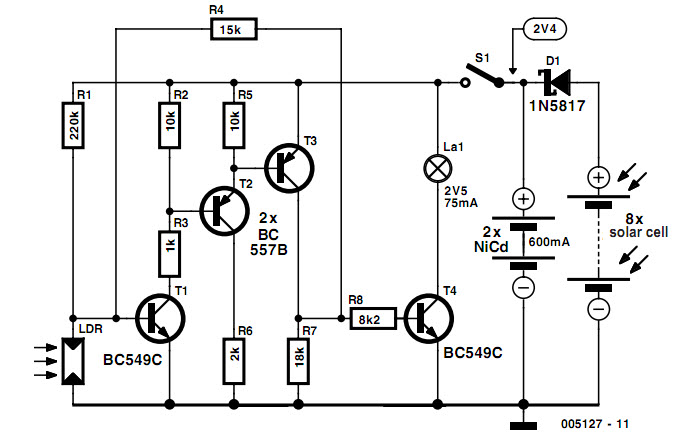
garden lighting
Completely self-supporting garden lamps that utilize solar cells as their energy source are becoming increasingly common. These lamps operate by harnessing sunlight, which is freely available during the day, to provide the necessary energy for illumination during the evening. Their...