


DIY FSK RFID Reader using Arduino

Description: This document describes the construction of an RFID reader utilizing an Arduino (specifically tested with the Nano 3.0, although other models may also be compatible), a hand-wound wire coil, and various low-cost common components. RFID readers are devices manufactured by companies like Parallax to read RFID tags containing embedded identification circuits, focusing on passive tags that are activated by the RF energy transmitted by the reader. The design outlined here demonstrates how to manually wind a simple wire loop (or create an equivalent printed circuit spiral version), connect it to an Arduino (or its microcontroller chip), incorporate a few inexpensive common components, and ultimately construct a DIY RFID reader. To enhance the challenge, this project will concentrate on the Frequency Shift Keying (FSK) class of RFID tags, which are relatively common among 125kHz devices but are not supported by Parallax kits. Micah Dowty has proposed a design for an FSK/Amplitude Shift Keying (ASK) RFID reader based on a Parallax Propeller device. His assembly language code implements a complex algorithm that generates a dynamically variable analog bias voltage, allowing the weak RFID signal to be amplified for binary signal discrimination by the Propeller's digital input circuitry. Additionally, it dynamically adjusts the transmit/receive RF frequency to maintain the antenna's tank circuit in peak resonance for optimal signal-to-noise performance. However, there are three significant issues with this approach: first, the passive detection circuit lacks amplification, making it highly sensitive to noise and raising reliability concerns; second, the design relies on the Propeller chip, excluding enthusiasts of Arduino or Atmel AVR chips; and third, the dynamic adjustment of frequencies and bias voltage is overly complicated, complicating debugging efforts. Despite these drawbacks, the overall concept of using a microcontroller and a custom wire loop to create a complete DIY RFID reader with simple components and appropriate coding is appealing. Asher Glick has offered a solution for reading and decoding FSK RFID tags using the Arduino/AVR family, termed AVRFID, which, while effective, necessitates the modification of an existing Parallax RFID reader device that only supports ASK natively. The objective of this project is to present a straightforward solution for reading FSK tags that addresses the aforementioned limitations: ensuring robustness and reliability in real-world noisy environments, basing the design on the Arduino platform, and constructing the RFID reader using a few simple, low-cost components instead of purchasing or modifying an existing device.
The RFID reader project described utilizes an Arduino Nano 3.0 as the central microcontroller, which is known for its compact size and versatility. The hand-wound wire coil serves as the antenna, playing a crucial role in the transmission and reception of RF signals. The construction of the coil can be achieved by winding insulated copper wire into a loop; the number of turns and the diameter of the coil will influence the reader's efficiency and range. The Arduino will be programmed to generate the appropriate signals to power the coil and to process the incoming data from the RFID tags.
Key components required for this project include passive components such as resistors, capacitors, and possibly a diode for signal rectification. The circuit design will include a simple amplifier stage to boost the weak signals received from the RFID tags, thereby improving reliability in noisy environments. The software will be developed to implement the FSK decoding algorithm, allowing the microcontroller to interpret the signals received from the RFID tags effectively.
The design will also consider the power supply requirements for the Arduino and associated components, ensuring that the system operates within safe voltage and current limits. Furthermore, attention will be given to the layout of the circuit to minimize interference and enhance performance. By focusing on these elements, the project aims to create a robust and effective RFID reader that can be built with minimal investment and technical complexity.This page is describes the construction of an RFID reader using only an Arduino (Nano 3. 0 was tested, but others may work), a hand-wound wire coil, and some assorted low cost common components. RFID readers are devices sold by companies such as Parallax to read RFID tags with embedded identification circuits (we focus here on passive tags, activat
ed by the reader`s transmitted RF energy). The design presented here shows how to wind a simple wire loop by hand (or create an equivalent printed circuit spiral version), connect it to an Arduino (or its chip), add a few low cost common components and create your own RFID reader. To make it more interesting (i. e. challenging), we will focus on the FSK class of RFID tags, which are fairly common among the 125kHz devices, but for some reason are not supported by the Parallax kits.
Micah Dowty has shown a design for an FSK/ASK RFID reader built around a Parallax Propeller device. His code, which is in assembly language, implements an ingenious (but complex) algorithm to create a dynamically variable analog bias voltage, which is used to pull the weak RFID signal into range, so it can be discriminated into binary signals by the Propeller`s digital input circuitry. He also dynamically tweaks the transmit/receive RF frequency to keep the antenna`s tank circuit in peak resonance for optimal signal to noise.
There are three problems with his approach: first, the passive detection circuit lacks amplification, which makes it very sensitive to noise and therefore raises reliability issues. Second, the design is based on the Propeller chip, and if you are a fan of the Arduino and/or associated Atmel AVR chips, it leaves you out.
And third, the dynamic slewing of frequencies and bias voltage is overly complicated, making it hard to debug. His general concept is attractive, however: use a microcontroller chip and wind your own wire loop to create, with some simple components and appropriate code, a complete DIY RFID reader.
Asher Glick has presented a solution for reading and decoding FSK RFID tags using the Arduino/AVR family (which he calls AVRFID), which is good except it apparently requires obtaining and modifying an existing Parallax RFID reader device (which natively only supports ASK). Our goal here is to present a simple solution for reading FSK tags which addresses the above shortcomings: make it robust and reliable for real-world noise environments, base it on the Arduino, and build the RFID reader ourselves using a few simple low-cost parts, rather than buying and/or modifying one.
The RFID reader project described utilizes an Arduino Nano 3.0 as the central microcontroller, which is known for its compact size and versatility. The hand-wound wire coil serves as the antenna, playing a crucial role in the transmission and reception of RF signals. The construction of the coil can be achieved by winding insulated copper wire into a loop; the number of turns and the diameter of the coil will influence the reader's efficiency and range. The Arduino will be programmed to generate the appropriate signals to power the coil and to process the incoming data from the RFID tags.
Key components required for this project include passive components such as resistors, capacitors, and possibly a diode for signal rectification. The circuit design will include a simple amplifier stage to boost the weak signals received from the RFID tags, thereby improving reliability in noisy environments. The software will be developed to implement the FSK decoding algorithm, allowing the microcontroller to interpret the signals received from the RFID tags effectively.
The design will also consider the power supply requirements for the Arduino and associated components, ensuring that the system operates within safe voltage and current limits. Furthermore, attention will be given to the layout of the circuit to minimize interference and enhance performance. By focusing on these elements, the project aims to create a robust and effective RFID reader that can be built with minimal investment and technical complexity.This page is describes the construction of an RFID reader using only an Arduino (Nano 3. 0 was tested, but others may work), a hand-wound wire coil, and some assorted low cost common components. RFID readers are devices sold by companies such as Parallax to read RFID tags with embedded identification circuits (we focus here on passive tags, activat
ed by the reader`s transmitted RF energy). The design presented here shows how to wind a simple wire loop by hand (or create an equivalent printed circuit spiral version), connect it to an Arduino (or its chip), add a few low cost common components and create your own RFID reader. To make it more interesting (i. e. challenging), we will focus on the FSK class of RFID tags, which are fairly common among the 125kHz devices, but for some reason are not supported by the Parallax kits.
Micah Dowty has shown a design for an FSK/ASK RFID reader built around a Parallax Propeller device. His code, which is in assembly language, implements an ingenious (but complex) algorithm to create a dynamically variable analog bias voltage, which is used to pull the weak RFID signal into range, so it can be discriminated into binary signals by the Propeller`s digital input circuitry. He also dynamically tweaks the transmit/receive RF frequency to keep the antenna`s tank circuit in peak resonance for optimal signal to noise.
There are three problems with his approach: first, the passive detection circuit lacks amplification, which makes it very sensitive to noise and therefore raises reliability issues. Second, the design is based on the Propeller chip, and if you are a fan of the Arduino and/or associated Atmel AVR chips, it leaves you out.
And third, the dynamic slewing of frequencies and bias voltage is overly complicated, making it hard to debug. His general concept is attractive, however: use a microcontroller chip and wind your own wire loop to create, with some simple components and appropriate code, a complete DIY RFID reader.
Asher Glick has presented a solution for reading and decoding FSK RFID tags using the Arduino/AVR family (which he calls AVRFID), which is good except it apparently requires obtaining and modifying an existing Parallax RFID reader device (which natively only supports ASK). Our goal here is to present a simple solution for reading FSK tags which addresses the above shortcomings: make it robust and reliable for real-world noise environments, base it on the Arduino, and build the RFID reader ourselves using a few simple low-cost parts, rather than buying and/or modifying one.

Crescendo ampilifier elektor1982
The Elector Crescendo was the first DIY amplifier that was not a kit. The design was sourced from the Elector magazines available at a local library.
The Elector Crescendo is an innovative audio amplifier designed for DIY enthusiasts. It features a...

5 Minute Signal
For the past year and a half, a group based in Ann Arbor, Michigan, named GO-Tech has been formed, uniting individuals interested in creating projects using technology, such as hardware, software, metal, and wood. This initiative is referred to as...

MePADS
If you are considering building the Desert Ratt 2, it is advisable to read all the accompanying text, as it contains relevant construction details. Engaging with the comments and replies can also provide additional insights, as previous blog posts have...

Fsk-data-receiver
The various signal frequencies are obtained for an incoming carrier centered at 49.86 MHz. The receiver employs double conversion, with intermediate frequencies (i-fs) at 10.7 MHz and 455 kHz. Ceramic filters are used in both intermediate frequencies for selectivity and...

GlueLogix Technical Services
A wireless interface for your next project. With a coil, a capacitor, and a transistor, it is possible to create a device that emulates a Radio Frequency Identification Device (RFID), commonly referred to as a "tag" or "RFID tag." A...

Human-Computer Interface Technology 1
A habit-acquisition system that tags physical objects, such as dumbbells and medicine bottles, with RF tags or microcontrollers to detect and log user interactions with these items. It includes virtual plants and creatures that simulate the health of real-world aspects...

Interfacing RFID Reader with AVR MCUs
RFID technology is highly versatile, has numerous applications, and has become affordable and easy to implement in recent times. This tutorial outlines the process of interfacing an RFID Reader with a standard Atmel AVR microcontroller.
RFID (Radio Frequency Identification) systems consist...

Low-cost-fsk-generator
In Frequency Shift Keying (FSK), two distinct frequencies are utilized to represent the binary digits 0 and 1. The core of the circuit comprises two Wien-bridge oscillators constructed with a dual operational amplifier LM1458, each generating one of the two...
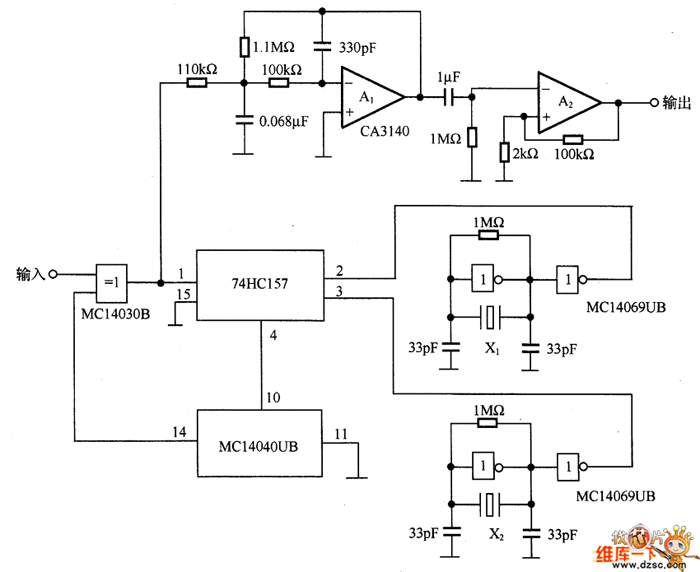
The FSK signal demodulation circuit composed of the digital phase-lock
Figure 7-2 illustrates the FSK (Frequency Shift Keying) signal demodulation circuit, which is built using a digital phase-locked loop. This circuit features two oscillators operating at distinct frequencies: crystal oscillator X with a frequency of 983.04 kHz and crystal oscillator...