


4 lines Stereo Mixer
#stereo mixer
#audio mixer
#audio input
#gain adjustment
#impedance matching
#mono switch
#potentiometer
#signal mixing
#audio processing

Description: With this circuit you can mix four separate audio inputs. Each input will accept high or low impedance microphones, phonograph, tape or aux signals. You can adjust the gain of each input by adjusting each respective pot. With the Stereo/Mono switch you can combine just inputs 1,2 and 3,4 or in the Mono position combine all four inputs. More: Signal response is 20 Hz. to 20kHz. with very high input impedance and very low distortion with complete output short circuit protection. This circuit will drive any power amp with an input impedance of 2,000 ohms.
The circuit described functions as a four-channel audio mixer, capable of handling various audio sources such as microphones, phonographs, tape players, and auxiliary signals. Each of the four input channels is designed to accommodate both high and low impedance devices, ensuring versatility in audio source compatibility.
The gain for each input channel is adjustable via a potentiometer (pot), allowing for fine-tuning of audio levels before they are mixed together. This feature is crucial for achieving a balanced output, particularly when dealing with sources that have differing output levels.
A Stereo/Mono switch is incorporated into the design, enabling the user to select between stereo operation and mono mixing. In stereo mode, inputs 1 and 2 can be mixed separately from inputs 3 and 4, providing a dual-channel output suited for stereo applications. Conversely, when the switch is set to mono, all four inputs are combined into a single output, which is beneficial for applications that require a unified audio signal.
The circuit boasts a frequency response range of 20 Hz to 20 kHz, which covers the full spectrum of human hearing and ensures high fidelity in audio reproduction. The design includes a very high input impedance, which minimizes loading effects on the audio sources and preserves signal integrity. Additionally, the circuit is engineered to maintain very low distortion levels, contributing to clear and accurate audio mixing.
To enhance reliability, the circuit features complete output short circuit protection, safeguarding the mixer and connected components from damage due to unexpected faults. This protection is particularly important in live sound applications where equipment may be subject to various stresses.
Finally, the output stage of the mixer is capable of driving any power amplifier with an input impedance of 2,000 ohms, making it suitable for a wide range of audio amplification systems. This compatibility ensures that the mixer can seamlessly integrate into existing audio setups without the need for additional matching devices.With this circuit you can mix four separate audio inputs. Each input will accept high or low impedance microphones, phonograph, tape or aux signals. You can adjust the gain of each input by adjusting each respective pot. With the Stereo/Mono switch you can combine just inputs 1,2 and 3,4 or in the Mono position combine all four inputs. Signal response is 20 Hz. to 20kHz. with very high input impedance and very low distortion with complete output short circuit protection. This circuit will drive any power amp with an input impedance of 2,000 ohms.
The circuit described functions as a four-channel audio mixer, capable of handling various audio sources such as microphones, phonographs, tape players, and auxiliary signals. Each of the four input channels is designed to accommodate both high and low impedance devices, ensuring versatility in audio source compatibility.
The gain for each input channel is adjustable via a potentiometer (pot), allowing for fine-tuning of audio levels before they are mixed together. This feature is crucial for achieving a balanced output, particularly when dealing with sources that have differing output levels.
A Stereo/Mono switch is incorporated into the design, enabling the user to select between stereo operation and mono mixing. In stereo mode, inputs 1 and 2 can be mixed separately from inputs 3 and 4, providing a dual-channel output suited for stereo applications. Conversely, when the switch is set to mono, all four inputs are combined into a single output, which is beneficial for applications that require a unified audio signal.
The circuit boasts a frequency response range of 20 Hz to 20 kHz, which covers the full spectrum of human hearing and ensures high fidelity in audio reproduction. The design includes a very high input impedance, which minimizes loading effects on the audio sources and preserves signal integrity. Additionally, the circuit is engineered to maintain very low distortion levels, contributing to clear and accurate audio mixing.
To enhance reliability, the circuit features complete output short circuit protection, safeguarding the mixer and connected components from damage due to unexpected faults. This protection is particularly important in live sound applications where equipment may be subject to various stresses.
Finally, the output stage of the mixer is capable of driving any power amplifier with an input impedance of 2,000 ohms, making it suitable for a wide range of audio amplification systems. This compatibility ensures that the mixer can seamlessly integrate into existing audio setups without the need for additional matching devices.With this circuit you can mix four separate audio inputs. Each input will accept high or low impedance microphones, phonograph, tape or aux signals. You can adjust the gain of each input by adjusting each respective pot. With the Stereo/Mono switch you can combine just inputs 1,2 and 3,4 or in the Mono position combine all four inputs. Signal response is 20 Hz. to 20kHz. with very high input impedance and very low distortion with complete output short circuit protection. This circuit will drive any power amp with an input impedance of 2,000 ohms.

6 channel audio mixer
This circuit is a 6-channel audio mixer. Three channels are designated for microphone inputs, while the remaining three channels accommodate audio inputs from devices such as CD players, computers, or televisions. The circuit includes six potentiometers to control the volume...

Using tap potentiometer loudness circuit
Figure 1.88 illustrates the loudness control circuit utilizing multiple taps on a potentiometer. In Figure (A), the connection is made between the tap and the potentiometer's input, along with the ground. An RC compensation network is employed, where the slide...
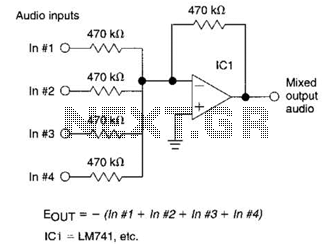
Unity-Gain Four-Input Audio Mixer Circuit
The circuit has four inputs. The voltage gain between each input and the output is maintained at unity by the relative values of the 470 kΩ input resistor and the 470 kΩ feedback resistor.
The described circuit operates as a voltage...
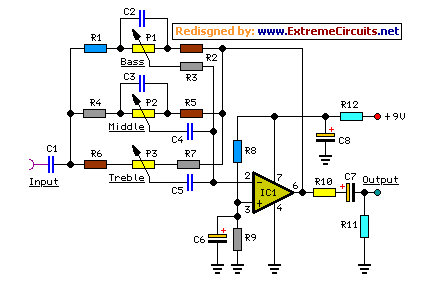
4 Channel Portable Audio Mixer
High-quality modular design, powered by a 9V battery, with very low current consumption. The objective of this project was to design a small, portable mixer.
The project focuses on creating a compact audio mixer that operates efficiently on a 9V battery,...
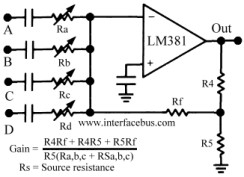
Audio Mixer Circuit
The circuit schematic below represents a method for designing an audio mixer. The active component is an LM318, although any operational amplifier could be used in its place. The circuit is a classic design for an operational amplifier summing amplifier....

Audio Mixer with 2N3819
This simple circuit mixes two or more channels into one channel (eg. stereo into mono). The circuit can mix as many or as few channels as you like and consumes very little power. The mixer is shown with two inputs,...
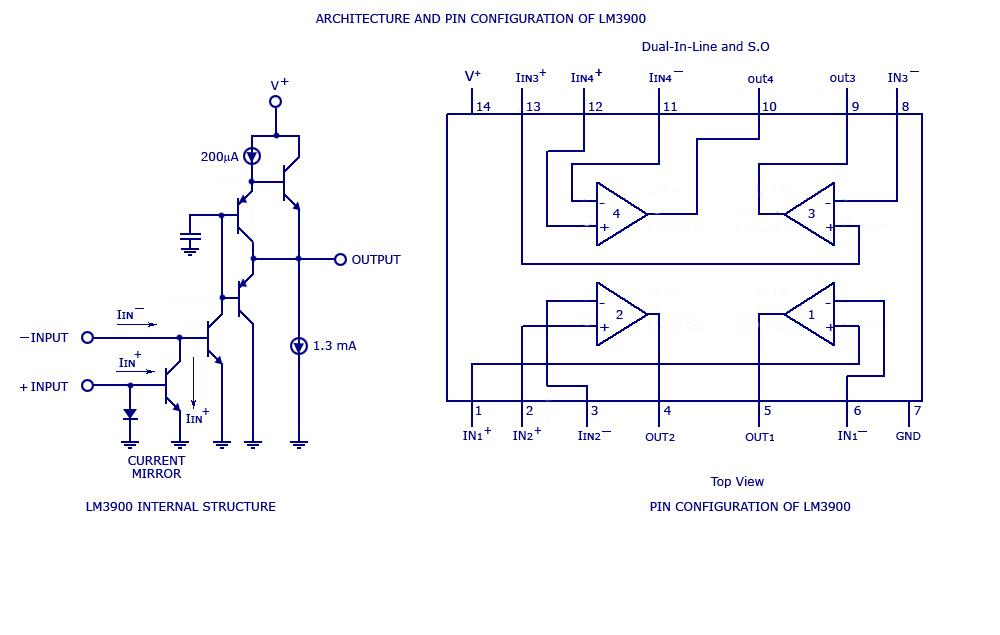
multi channel audio mixer using lm 3900
By adding the same circuit in parallel, the number of inputs can be increased according to the applications. Each input is connected to the inverting terminal of the LM3900. The built-in amplifier of each section amplifies every audio input separately...

3 channel audio mixer (2N3904)
That circuit will provide an overall gain of one between the output and each input channel. Each input channel includes a single 0.1uf capacitor and 100-Kilohms resistor to provide an output impedance of 100K. The number of input channels to...

3 channel audio mixer
A 3-channel audio mixer circuit operates on a 9V DC voltage, which can be supplied by a battery. This mixer is specifically designed for use in public amplification applications. The audio circuit of this mixer is tailored for portable audio...