


Audio Limiter Circuit

Description: An optoisolator is utilized as an attenuator in this circuit. When the LM386 draws more current from audio signals, the 2N3638 activates, which biases the optoisolator on, thereby reducing the volume.
The circuit employs an optoisolator to achieve signal attenuation, effectively isolating the audio signal path while controlling volume levels. The LM386 is a low-voltage audio power amplifier that outputs audio signals. Under normal operating conditions, it draws a certain amount of current based on the input audio signal.
In this configuration, the 2N3638, a general-purpose NPN transistor, is used to sense the current drawn by the LM386. When the audio signal increases, the LM386's current draw also increases, causing the 2N3638 to turn on. This action results in the biasing of the optoisolator, which then modulates the signal passing through it.
The optoisolator functions by using an LED and a phototransistor within its structure. When the LED is forward-biased by the current from the 2N3638, it emits light that activates the phototransistor. This activation allows the phototransistor to conduct, thereby providing a controlled output signal that is proportional to the input signal's amplitude.
As the optoisolator is biased on, it effectively reduces the overall gain of the audio signal, leading to a decrease in volume. This method of attenuation is beneficial as it provides electrical isolation between the input and output, protecting sensitive components from high voltages or currents that may occur in the audio path.
This circuit design is particularly useful in applications where volume control is required without compromising signal integrity, making it suitable for various audio processing systems. The combination of the LM386, 2N3638, and optoisolator creates a reliable and efficient means to manage audio levels dynamically. An optoisolator is used as an attenuator in this circuit. When the LM386 draws more current on audio signals, the 2N3638 turns on, which biases the optoisolator on, and reduces the volume.
The circuit employs an optoisolator to achieve signal attenuation, effectively isolating the audio signal path while controlling volume levels. The LM386 is a low-voltage audio power amplifier that outputs audio signals. Under normal operating conditions, it draws a certain amount of current based on the input audio signal.
In this configuration, the 2N3638, a general-purpose NPN transistor, is used to sense the current drawn by the LM386. When the audio signal increases, the LM386's current draw also increases, causing the 2N3638 to turn on. This action results in the biasing of the optoisolator, which then modulates the signal passing through it.
The optoisolator functions by using an LED and a phototransistor within its structure. When the LED is forward-biased by the current from the 2N3638, it emits light that activates the phototransistor. This activation allows the phototransistor to conduct, thereby providing a controlled output signal that is proportional to the input signal's amplitude.
As the optoisolator is biased on, it effectively reduces the overall gain of the audio signal, leading to a decrease in volume. This method of attenuation is beneficial as it provides electrical isolation between the input and output, protecting sensitive components from high voltages or currents that may occur in the audio path.
This circuit design is particularly useful in applications where volume control is required without compromising signal integrity, making it suitable for various audio processing systems. The combination of the LM386, 2N3638, and optoisolator creates a reliable and efficient means to manage audio levels dynamically. An optoisolator is used as an attenuator in this circuit. When the LM386 draws more current on audio signals, the 2N3638 turns on, which biases the optoisolator on, and reduces the volume.

Digitally-programmable-attenuator
The first stage is a simple buffer used to isolate the signal source from the following attenuator stages. Each subsequent stage is preceded by a voltage divider formed by two resistors and a CMOS switch. When the CMOS switch for...
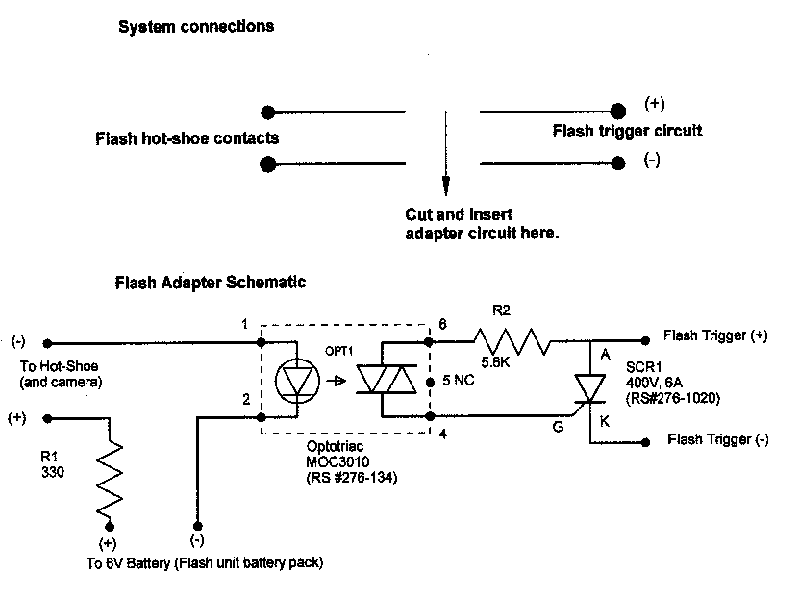
optoisolated adapter
This design modifies a high voltage flash for use with a low voltage camera by employing an optocoupler to provide electronic isolation between the camera's contacts and the high voltage. The flash can be triggered using the 6-volt supply from...
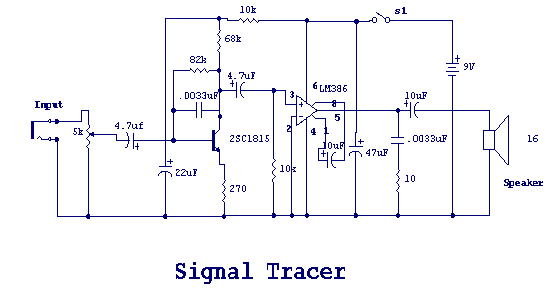
Simple LM386 amplifier
The main part of this circuit is the LM386 amplifier chip. It also uses a transistor input to buffer the input signal and provide extra gain for the LM386. The little unit has helped me out on numerous occasions when...

LM386 Audio Amplifier Circuit
The integrated circuit LM386 is a low-power audio frequency amplifier that requires a low-level power supply, typically batteries. It is available in an 8-pin mini-DIP package. The IC is designed to provide a voltage amplification of 20 without the need...

oscillator Is this a suitable sine wave osc? how would I control the frequency
The design utilizes the LM386n-1 integrated circuit, powered by a single power supply to maintain a compact layout. There is a need to control the frequency, and the user is inquiring about which component values should be adjusted for this...

LM 386 Audio Amplifier
The LM386 Audio Amplifier is one of the earliest audio integrated circuits (ICs) and remains widely used. It operates with a minimal number of external components and is essential for general hobby circuits.
The LM386 is a low-voltage audio power amplifier...

LM386 Audio Amplifier Chip
Terminals 1 and 8 serve as the gain control for the amplifier. Adjustments to the gain can be made by connecting a resistor and capacitor, or just a capacitor, between these terminals. In this circuit, a 10 µF capacitor will...
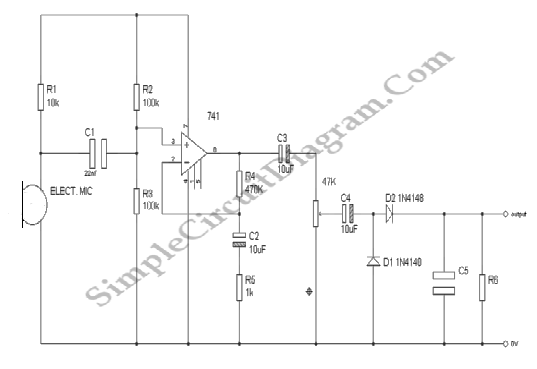
Audio Signal Strength Detector/Converter
Below is the schematic diagram of an audio input module. This module is capable of producing a DC output voltage that is proportional to the amplitude of the input signal.
The audio input module typically consists of several key components that...

Optical-ttl-coupler
For higher speed applications, up to 1-MHz NRZ, the Schmitt-trigger output HllL series optoisolator provides many features. The 1.6-mA drive current allows fan-in circuitry to drive the IRED, while the 5-V, 270-0 sink capability and 100ns transition times of the...