


auto off for audio gear
#LM358
#comparator
#monostable
#4538
#audio signal
#coupling capacitor
#loudspeaker
#headphones
#timer
#delay
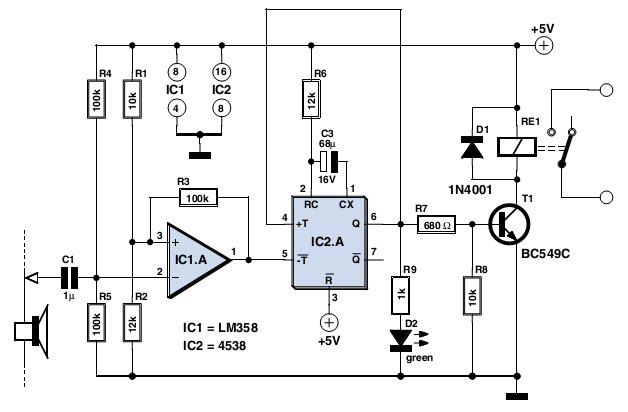
Description: The circuit features a sensitive LM358-based comparator, IC1A, which keeps the monostable IC2A (a 4538) activated as long as an audio signal is detected at the input. The input signal is taken from the hot side of the loudspeaker or headphones in the audio equipment through coupling capacitor C1. The monostable will time out 2 seconds after being triggered, with the delay determined by resistors R6 and capacitor C3.
The circuit utilizes the LM358 operational amplifier in a comparator configuration. The output of the comparator, IC1A, is connected to the trigger input of the 4538 monostable multivibrator, IC2A. When an audio signal is present, the voltage level at the non-inverting input of the LM358 rises above the reference voltage set at the inverting input, causing the output to switch high. This high output activates the 4538 monostable, which is designed to generate a single pulse of a specific duration—in this case, 2 seconds.
The timing characteristics of the 4538 are determined by the external resistor R6 and capacitor C3. The time period (T) for which the monostable remains in the high state can be calculated using the formula T = 0.7 * R6 * C3. In this configuration, R6 and C3 should be selected to provide the desired timing interval of 2 seconds.
The coupling capacitor C1 serves to block any DC component from the audio signal while allowing the AC audio signal to pass through. This ensures that only the variations in the audio signal are detected by the comparator, preventing false triggering from any DC offset that may be present in the audio source.
Overall, this circuit can be effectively used in applications where it is necessary to detect audio signals and generate a timed output, such as in audio signal processing, sound-activated devices, or other related electronic systems. Proper selection of components and careful layout design will ensure reliable operation and performance in the intended application.The circuit consists of a sensitive LM358 based comparator, IC1A, which keeps monostable IC2A (a 4538) triggered as long as an audio signal is detected at the input. Via coupling capacitor C1 the circuit takes its input signal from the hot` side of the loudspeaker or headphones in your audio gear.
The monostable will time out 2 s after being triggered, the delay being deter-mined by R6 and C3.
The circuit utilizes the LM358 operational amplifier in a comparator configuration. The output of the comparator, IC1A, is connected to the trigger input of the 4538 monostable multivibrator, IC2A. When an audio signal is present, the voltage level at the non-inverting input of the LM358 rises above the reference voltage set at the inverting input, causing the output to switch high. This high output activates the 4538 monostable, which is designed to generate a single pulse of a specific duration—in this case, 2 seconds.
The timing characteristics of the 4538 are determined by the external resistor R6 and capacitor C3. The time period (T) for which the monostable remains in the high state can be calculated using the formula T = 0.7 * R6 * C3. In this configuration, R6 and C3 should be selected to provide the desired timing interval of 2 seconds.
The coupling capacitor C1 serves to block any DC component from the audio signal while allowing the AC audio signal to pass through. This ensures that only the variations in the audio signal are detected by the comparator, preventing false triggering from any DC offset that may be present in the audio source.
Overall, this circuit can be effectively used in applications where it is necessary to detect audio signals and generate a timed output, such as in audio signal processing, sound-activated devices, or other related electronic systems. Proper selection of components and careful layout design will ensure reliable operation and performance in the intended application.The circuit consists of a sensitive LM358 based comparator, IC1A, which keeps monostable IC2A (a 4538) triggered as long as an audio signal is detected at the input. Via coupling capacitor C1 the circuit takes its input signal from the hot` side of the loudspeaker or headphones in your audio gear.
The monostable will time out 2 s after being triggered, the delay being deter-mined by R6 and C3.

Automatic sprinkler controller circuit diagram 1
The automatic sprinkler controller circuit consists of a clock timing controller, a monostable flip-flop, a bistable flip-flop, an electronic switch, a self-excited multivibrator, a counter, a solenoid valve control circuit, and a power supply circuit. The power supply circuit includes...

Window Comparator Circuit
IC1-c functions as a non-inverting comparator, while IC1-a operates as an inverting comparator. Potentiometer R1 and fixed resistors R2 and R3 create a voltage divider chain that provides slightly different voltages to the two comparators. These voltages establish the upper...
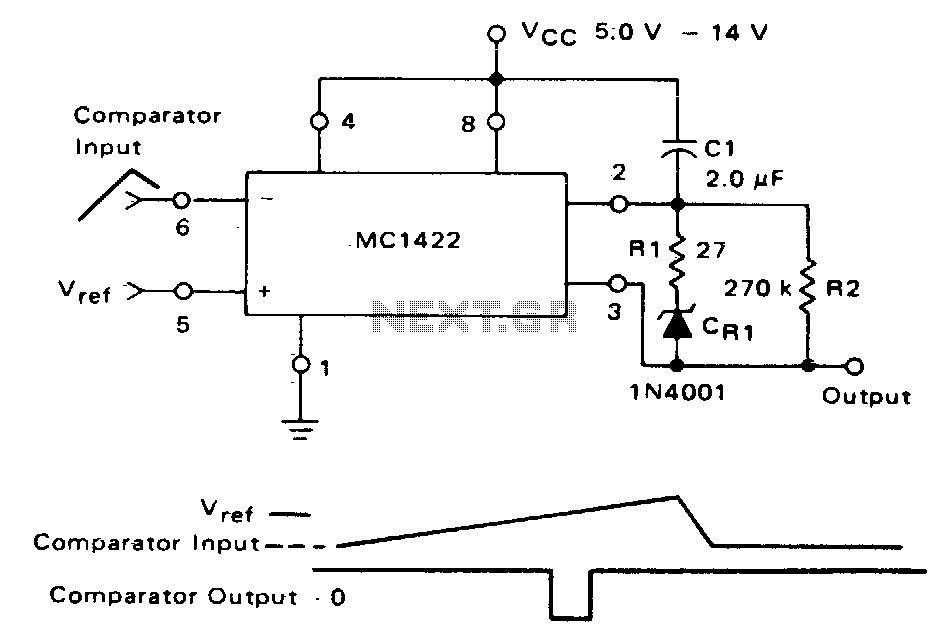
Comparator with time out
The MC1422 functions as a comparator with the input at Pin 5. The frequency of the output pulses, dependent on the values of R2 and C1 as indicated, is approximately 2 Hz, with a pulse width of 0 ms at...

Circuit audio pre-amplifier integrated circuit LM358 dual op amp
The LM358 series consists of two independent, high-gain, internally frequency-compensated operational amplifiers designed specifically to operate from a single power supply over a wide range of voltages. Operation from split power supplies is also possible, and the low power supply...
Automatic sprinkler controller circuit diagram 1
The automatic sprinkler controller circuit consists of a clock timing controller, a monostable flip-flop, a bistable flip-flop, an electronic switch, a self-excited multivibrator, a counter, a solenoid valve control circuit, and a power supply circuit. The power supply circuit includes...
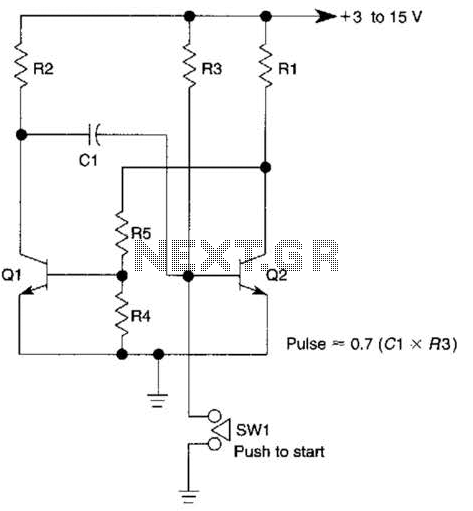
Monostable Multivibrator I Circuit
This circuit is activated when switch SW1 is pressed, grounding the base of transistor Q2. The pulse rate is approximately equal to 0.7 multiplied by the product of resistor R3 and capacitor C1.
The described circuit features a transistor Q2, which...

Headlights Timer
This device is a simple timer that allows the headlights of a vehicle to remain on for approximately 1 minute and 30 seconds. This feature is useful when accessing dark areas without the need to return to turn off the...

Reaction Timer
This circuit utilizes a timer to produce pulses at a 5-ms clock rate. The pulses are sequentially shifted into a shift register, illuminating an LED. An auxiliary timer generates one pulse per second to activate the "go" LED and initiate...

Digital Stop Watch and Digital Timer Circuit
A digital stopwatch or digital timer circuit schematic is constructed using the timer IC LM555 and the 4-digit counter IC MM74C926, which is paired with a multiplexed 7-segment LED display.
The digital stopwatch circuit utilizes the LM555 timer IC configured in...