


Better-Sounding Active Crossovers
#active crossover
#transistors
#audio signal
#sound quality
#McBride schematic
#amplifier
#filter
#stereo
#electronics
#circuit design

Description: Can anyone explain the function of the four transistors located on the right-hand side of each of McBride's schematics?
The presence of four transistors on the right-hand side of McBride's schematics typically indicates a specific function related to signal amplification, switching, or signal processing. In many electronic circuits, transistors serve as crucial components for controlling electrical signals.
In this context, the transistors may be configured in various arrangements such as common emitter, common collector, or common base configurations, each serving distinct purposes. For example, if they are arranged in a common emitter configuration, they could be used for signal amplification, where a small input signal can control a larger output signal. Conversely, if they are configured as switches, they may be utilized to turn on or off different parts of the circuit based on control signals.
Additionally, if these transistors are part of a differential amplifier configuration, they could be employed to amplify the difference between two input signals while rejecting any common-mode signals. This is particularly useful in applications where noise reduction is critical.
The specific function of these transistors can be further clarified by examining their connections to other components in the schematic, such as resistors, capacitors, and power supply lines. Understanding the overall circuit design and the role of each component will provide insights into the operation of the transistors and their contribution to the circuit's functionality.Hi, can anyone explain what the four transistors on the right hand side of each of McBride`s schematics are doing?..
The presence of four transistors on the right-hand side of McBride's schematics typically indicates a specific function related to signal amplification, switching, or signal processing. In many electronic circuits, transistors serve as crucial components for controlling electrical signals.
In this context, the transistors may be configured in various arrangements such as common emitter, common collector, or common base configurations, each serving distinct purposes. For example, if they are arranged in a common emitter configuration, they could be used for signal amplification, where a small input signal can control a larger output signal. Conversely, if they are configured as switches, they may be utilized to turn on or off different parts of the circuit based on control signals.
Additionally, if these transistors are part of a differential amplifier configuration, they could be employed to amplify the difference between two input signals while rejecting any common-mode signals. This is particularly useful in applications where noise reduction is critical.
The specific function of these transistors can be further clarified by examining their connections to other components in the schematic, such as resistors, capacitors, and power supply lines. Understanding the overall circuit design and the role of each component will provide insights into the operation of the transistors and their contribution to the circuit's functionality.Hi, can anyone explain what the four transistors on the right hand side of each of McBride`s schematics are doing?..

Active-limiting-amplifier
The modified inverting amplifier employs an active clamp to precisely limit the output swing. Consideration must be given to the VBE of the transistors. The output swing is restricted by the base-emitter breakdown of the transistors. A straightforward circuit configuration...

DC-Coupled Audio Amplifier circuit
Designs for audio amplifiers with DC coupling to the load are not frequently seen today, despite offering distinct advantages.
Audio amplifiers that employ DC coupling to the load provide several benefits that can enhance performance in specific applications. In traditional audio...
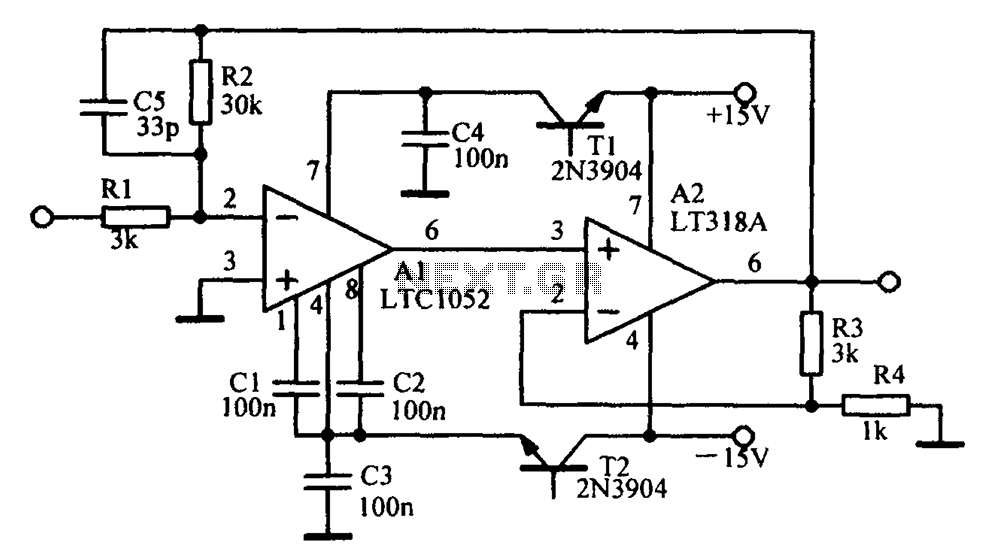
A circuit diagram of an amplifier circuit to enhance the output current and voltage
Amplifying circuit diagram to enhance the output current and voltage.
An amplifying circuit is designed to increase the amplitude of an input signal, resulting in a higher output current and voltage. This type of circuit is commonly utilized in various electronic...

Amplifier Compressor MC3340P
The output is rectified, and TR2 controls the gain of the ICL. This audio compressor circuit uses an MC3340P as a variable gain amplifier.
The audio compressor circuit described utilizes an MC3340P integrated circuit, which functions as a variable gain amplifier...

USB Powered Audio Power Amplifier
This circuit for multimedia speakers designed for PCs utilizes a single-chip architecture, operates on a low-voltage power supply, is compatible with USB power, facilitates easy heat dissipation, is cost-effective, offers high flexibility, and has a wide temperature tolerance. Central to...

SYNCHRONOUS FILTER FOR ADF
Separates 130-cps motor drive voltage from voice frequencies in the output of an ADF receiver. P. V. Sparks, Servo Filter and Gain Control Improve Automatic Direction Finder, Electronics, 34:23, p 110-113.
The circuit described functions as a filter that effectively separates...

Stereo-indicator
On most FM tuners, the stereo indicator activates upon detection of the 19-kHz pilot tone. However, this does not guarantee that the program is actually stereophonic, as the pilot tone is frequently transmitted alongside mono programs. A similar scenario occurs...
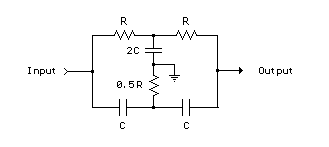
Twin-T RC Notch Filter
The two T-notch filter can be utilized to block unwanted frequencies or, when incorporated into an operational amplifier, function as a bandpass filter. The notch frequency occurs when the capacitive reactance equals the resistance (Xc = R), and if these...

Amplifier Clipping Indicator
At some stage, we will all find ourselves pushing hi-fi equipment just a little too hard, and if lucky, will just find that the sound has become "dirty". If this happens too often or is too severe, tweeters are the...