


chopper tremolo effect
#tremolo effect
#guitar signal
#amplitude modulation
#square waveform
#audio effect
#music effects
#signal processing
#guitar pedal
#sound modulation

Description: A tremolo is an effect unit that modulates the amplitude of the guitar signal, typically using a triangular waveform. This particular version employs a square waveform, resulting in a more abrupt, chopping effect. Such effects are prominently featured in the beginning of "Plant Telex" by Radiohead. Tom Morello from Rage Against the Machine also utilizes this effect, although he employs a kill switch on his guitar that he operates manually. This circuit is quite simple and of low quality, as demonstrated in a video. It can be constructed in about an hour due to its simplicity. The design is based on a basic NAND oscillator from an LED chaser circuit that was previously built. The circuit diagram is created using GIMP. The fundamental concept involves the NAND gate generating a square wave pulse, which is connected to a 4066 integrated circuit (IC). The 4066 contains four analog switches, each controlled by a single input pin. Two of the 4066 switches are utilized in this design. The first switch connects the input signal to the output signal, while the second connects the output signal to the ground. One switch is driven by the oscillator's output, and the other is controlled by the inverted output. Consequently, the output signal alternates between the input signal and no signal (ground connected to positive). The popping noise observed is a result of the abrupt switching from a non-zero value to zero. To mitigate this issue, a zero-crossing circuit should be added to trigger the switching. Some digital potentiometers include an integrated zero-crossing detector, such as the MAX5457, which also features a mute input that could be incorporated into the circuit.
The tremolo effect circuit described is a straightforward design that leverages the properties of a NAND oscillator to create a square wave signal. The use of a 4066 analog switch IC allows for effective modulation of the guitar signal's amplitude. In this configuration, the NAND oscillator generates a square wave that toggles the state of the two switches within the 4066 IC. The first switch connects the guitar's input signal to the output, while the second switch provides a path to ground, effectively silencing the output when activated.
The abrupt transitions between the signal and ground can introduce undesirable popping noises, which is a common issue in switching circuits. To address this, incorporating a zero-crossing detection mechanism can ensure that switching occurs only when the signal is at zero volts. This approach minimizes audible clicks by synchronizing the switch activation with the waveform's zero crossings, resulting in smoother transitions.
The MAX5457 digital potentiometer is an excellent candidate for this application, as it includes a built-in zero-crossing detector, which can simplify the design process. Additionally, its mute input feature allows for direct integration into the tremolo circuit, providing further control over the output signal. Overall, this tremolo effect circuit exemplifies a practical application of basic electronic components to achieve a desired audio effect, showcasing the balance between simplicity and functionality in circuit design.A Tremolo is an effect unit that modulates the amplitude of the guitar signal, usually in a triangular waveform. This version uses a square waveform, for a more switching, choppingkind of effect. This kind of effect can be heard in the beginning of Plant Telex by Radiohead. Tom Morello of Rage Against the Machine uses this kind of effect too, he, however, uses a kill switch on his guitar, which he controls manually.
T his is a very simple and low quality circuit, whose problems can be seen in the following video. I built it in about an hour, that`s how simple it is. It is based on a simple NAND oscillator from an LED Chaser circuit that I had built maybe a year ago. Here`s the circuit diagram(proudly drawn in GIMP): The idea behind the circuit is quite simple. The NAND provides a square wave pulse (and there are better places where you can understand how it works, google NAND oscillator ) that is then hooked up to the 4066 IC.
The 4066 is contains 4 analog switches, where each switch is controlled by a single input pin as seen in the following diagram: I used 2 of the 4066 switches. The first one, connects the input signal + and the output signal +, while the second one connects the output signal + and the ground.
One switch is controlled by the output of the oscillator, and the other is controlled by the same output, but inverted. The result is that the output signal switches between the input signal, and no signal (ground connected to +).
the popping noise you describe is due to abrupt switching of the signal from some non null value to zero. To remove this, you need to add a zero-crossing circuit to trigger the switching. A number of digital potentiometers have a built-in zero-crossing detector. For example the max5457, which also has a mute input which you could use directly in your circuit.
The tremolo effect circuit described is a straightforward design that leverages the properties of a NAND oscillator to create a square wave signal. The use of a 4066 analog switch IC allows for effective modulation of the guitar signal's amplitude. In this configuration, the NAND oscillator generates a square wave that toggles the state of the two switches within the 4066 IC. The first switch connects the guitar's input signal to the output, while the second switch provides a path to ground, effectively silencing the output when activated.
The abrupt transitions between the signal and ground can introduce undesirable popping noises, which is a common issue in switching circuits. To address this, incorporating a zero-crossing detection mechanism can ensure that switching occurs only when the signal is at zero volts. This approach minimizes audible clicks by synchronizing the switch activation with the waveform's zero crossings, resulting in smoother transitions.
The MAX5457 digital potentiometer is an excellent candidate for this application, as it includes a built-in zero-crossing detector, which can simplify the design process. Additionally, its mute input feature allows for direct integration into the tremolo circuit, providing further control over the output signal. Overall, this tremolo effect circuit exemplifies a practical application of basic electronic components to achieve a desired audio effect, showcasing the balance between simplicity and functionality in circuit design.A Tremolo is an effect unit that modulates the amplitude of the guitar signal, usually in a triangular waveform. This version uses a square waveform, for a more switching, choppingkind of effect. This kind of effect can be heard in the beginning of Plant Telex by Radiohead. Tom Morello of Rage Against the Machine uses this kind of effect too, he, however, uses a kill switch on his guitar, which he controls manually.
T his is a very simple and low quality circuit, whose problems can be seen in the following video. I built it in about an hour, that`s how simple it is. It is based on a simple NAND oscillator from an LED Chaser circuit that I had built maybe a year ago. Here`s the circuit diagram(proudly drawn in GIMP): The idea behind the circuit is quite simple. The NAND provides a square wave pulse (and there are better places where you can understand how it works, google NAND oscillator ) that is then hooked up to the 4066 IC.
The 4066 is contains 4 analog switches, where each switch is controlled by a single input pin as seen in the following diagram: I used 2 of the 4066 switches. The first one, connects the input signal + and the output signal +, while the second one connects the output signal + and the ground.
One switch is controlled by the output of the oscillator, and the other is controlled by the same output, but inverted. The result is that the output signal switches between the input signal, and no signal (ground connected to +).
the popping noise you describe is due to abrupt switching of the signal from some non null value to zero. To remove this, you need to add a zero-crossing circuit to trigger the switching. A number of digital potentiometers have a built-in zero-crossing detector. For example the max5457, which also has a mute input which you could use directly in your circuit.

Boss DD-2 Digital Delay Guitar Pedal Schematic Diagram
The DD-2 is a highly regarded digital delay pedal that emulates an analog sound. It was initially sold from 1983 until it was discontinued in 1986, after which it was relaunched without any modifications as the DD-3 (noting that later...

Boss GE-7 Equalizer guitar pedal schematic diagram
The Boss GE-7 Equalizer pedal modifies the harmonic content of an instrument across 7 distinct frequency bands, spanning from 100Hz to 6.4kHz, with a boost or cut of up to 15dB for each band. An additional Level control knob allows...
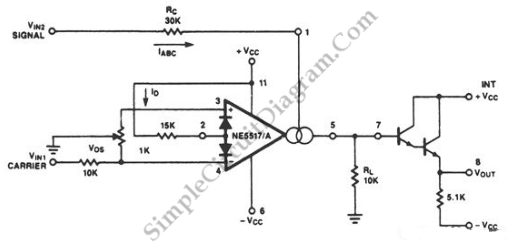
Amplitude Modulator with OTA
The circuit depicted in the schematic diagram below can achieve 99% modulation with a maximum frequency of 200 kHz. The amplification of this circuit can be...
This circuit is designed for high-efficiency amplitude modulation, capable of achieving a modulation depth of...
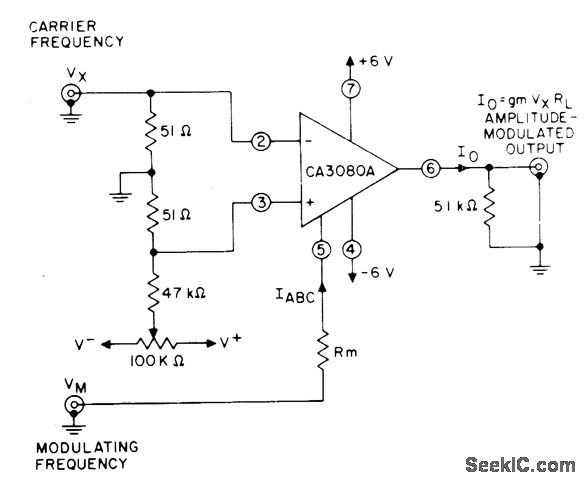
AMPLITUDE MODULATOR 1
The circuit utilizes a controlled variation of amplifier bias current (IABC) in the CA3080A variable operational amplifier to achieve effective gain control of the signal. Changes in the amplitude of the modulating voltage (Vm) alter the bias current through resistor...

DIY Tremolo Effect
This tremolo effect circuit utilizes the XR2206 and TCA730 integrated circuits, designed for electronic balance and volume regulation with frequency correction. It is suitable for stereo channels and can simulate the Lesley effect, also known as the rotating loudspeaker effect....

Methods for generating Amplitude Modulation
Amplitude Modulation (AM) is the first type of modulation that impressed audio onto a radio frequency (RF) carrier. Before AM, information was transmitted using on/off keying of a continuous wave transmitter, typically through Morse code or similar methods. 1. Low-level...

Sound-modulated light source
This circuit modulates a light beam using audio signals from an amplifier's output. By adjusting the 10 K potentiometer to a value slightly less than the Vbe of the transistor, the circuit operates as a peak detector. This configuration drives...

Buffer Issues
Currently, there is a prototype of a guitar pedal in development. There are issues with the input buffer, and assistance is needed to address these problems.
The input buffer in a guitar pedal is a critical component that serves to isolate...

diy tremolo effect circuit
This tremolo effect circuit utilizes the XR2206 and TCA730 integrated circuits, designed for electronic balance and volume regulation with frequency correction. The circuit is beneficial for stereo channels and can simulate the Lesley effect, also known as the rotating loudspeaker...