


hiwatt custom 20 tube amp hum
#tube amp
#amplifier
#Fender
#repair
#hum
#audio circuit
#guitar amp
#60W
#combo
#electronics repair

Description: A friend purchased a relatively new Fender 60W combo amplifier for £5 from an acquaintance. The previous owner had taken it to three different repair shops, where it was deemed not worth repairing. Prior to receiving the amplifier, it was correctly diagnosed that it required anode load resistors, which are essential in valve amplifiers. Additionally, the electrolytic capacitor responsible for filtering the B+ voltage for the preamp stage is likely dried out. The preamp stage may have a B+ power supply that is connected through a second RC filter. It is advisable to suspect the electrolytic capacitors in any old equipment, as they typically have shorter lifespans compared to other electronic components. To maintain the functionality of the amplifier, replacing all power supply filter capacitors is recommended. The type of hum present in the amplifier should be identified; if it is 60 or 120 hertz, and if the power supply is of the full-wave rectifier type, the hum is expected to have a 120 hertz fundamental frequency if the filter capacitors are faulty. There may also be heater-to-cathode leakage that basic tube testers might not detect. If the preamp tubes share the same designation as later models, interchanging them could help determine if the hum level varies.
The Fender 60W combo amplifier utilizes a valve-based architecture, which is characteristic of many traditional guitar amplifiers. The anode load resistors are critical for the proper operation of the output stage, as they influence the voltage and current characteristics of the output tubes. In valve amplifiers, the performance and sound quality can significantly degrade if these resistors are faulty or out of specification.
The electrolytic capacitors, particularly those involved in the power supply filtering, are crucial for maintaining stable voltage levels within the amplifier. Over time, these components can dry out due to heat and age, leading to increased ripple voltage and potential hum in the output. The B+ voltage filtering is typically managed through a series of capacitors and resistors (RC filters), which smooth out the rectified AC voltage to provide a clean DC supply for the amplifier’s preamp and power stages.
In troubleshooting the hum, it is essential to determine its frequency. A 60 hertz hum suggests issues related to the AC mains supply, while a 120 hertz hum indicates problems with the power supply filtering. The use of a full-wave rectifier should ideally produce a 120 hertz ripple frequency if the filter capacitors are functioning correctly. If the hum persists, it may be indicative of additional issues such as heater-to-cathode leakage in the output tubes, which can introduce noise into the signal path.
To mitigate these issues, a comprehensive approach involves inspecting and potentially replacing all electrolytic capacitors in the power supply circuit. Additionally, testing the preamp tubes by interchanging them can help isolate the source of the hum, as different tubes may exhibit varying levels of performance and noise. Regular maintenance and component replacement are vital for preserving the longevity and sound quality of vintage amplifiers like the Fender 60W combo.A friend of mine bought a fairly new (only a couple of years old) Fender 60W combo off a guy he knew for £5. The original owner had taken it to three different repair shops, and been told it wasn`t worth repairing.
I told my mate it couldn`t be much, and even told him EXACTLY what was wrong with it before he brought it me. I was dead right, it wa nted anode load resistors, as valve amps always have. The electrolytic cap that filters the B+ for the preamp stage is probably dried out. The preamp stage probably has a B+ power that`s behind a second RC filter. +1 Anytime you have an old piece of equipment, suspect the electrolytic caps. They have very short life spans compared to most electronics. If you want to keep and use the piece, replace all the power supply filter caps. is the hum 60 or 120 hertz Is the power supply a full wave rectifier type If so, it seems the hum should have a 120 hertz fundamental if the filter caps are bad. Might have some heater to cathode leakage that many basic tube tester don`t catch. If the preamp tubes have the same number as later tubes, you can try interchanging them to see if the hum level changes.
The Fender 60W combo amplifier utilizes a valve-based architecture, which is characteristic of many traditional guitar amplifiers. The anode load resistors are critical for the proper operation of the output stage, as they influence the voltage and current characteristics of the output tubes. In valve amplifiers, the performance and sound quality can significantly degrade if these resistors are faulty or out of specification.
The electrolytic capacitors, particularly those involved in the power supply filtering, are crucial for maintaining stable voltage levels within the amplifier. Over time, these components can dry out due to heat and age, leading to increased ripple voltage and potential hum in the output. The B+ voltage filtering is typically managed through a series of capacitors and resistors (RC filters), which smooth out the rectified AC voltage to provide a clean DC supply for the amplifier’s preamp and power stages.
In troubleshooting the hum, it is essential to determine its frequency. A 60 hertz hum suggests issues related to the AC mains supply, while a 120 hertz hum indicates problems with the power supply filtering. The use of a full-wave rectifier should ideally produce a 120 hertz ripple frequency if the filter capacitors are functioning correctly. If the hum persists, it may be indicative of additional issues such as heater-to-cathode leakage in the output tubes, which can introduce noise into the signal path.
To mitigate these issues, a comprehensive approach involves inspecting and potentially replacing all electrolytic capacitors in the power supply circuit. Additionally, testing the preamp tubes by interchanging them can help isolate the source of the hum, as different tubes may exhibit varying levels of performance and noise. Regular maintenance and component replacement are vital for preserving the longevity and sound quality of vintage amplifiers like the Fender 60W combo.A friend of mine bought a fairly new (only a couple of years old) Fender 60W combo off a guy he knew for £5. The original owner had taken it to three different repair shops, and been told it wasn`t worth repairing.
I told my mate it couldn`t be much, and even told him EXACTLY what was wrong with it before he brought it me. I was dead right, it wa nted anode load resistors, as valve amps always have. The electrolytic cap that filters the B+ for the preamp stage is probably dried out. The preamp stage probably has a B+ power that`s behind a second RC filter. +1 Anytime you have an old piece of equipment, suspect the electrolytic caps. They have very short life spans compared to most electronics. If you want to keep and use the piece, replace all the power supply filter caps. is the hum 60 or 120 hertz Is the power supply a full wave rectifier type If so, it seems the hum should have a 120 hertz fundamental if the filter caps are bad. Might have some heater to cathode leakage that many basic tube tester don`t catch. If the preamp tubes have the same number as later tubes, you can try interchanging them to see if the hum level changes.
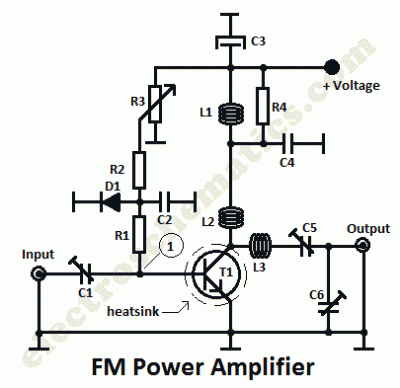
Radio Amplifiers Circuits
This is a 1 watt FM amplifier with a robust design that can be used to amplify an RF signal in the 88 to 108 MHz band. It is highly sensitive when utilizing quality RF power amplifier transistors, trimmers, and...

Self Oscillating Amplifier for Distortion Testing
The circuit is based on a simple inductor-capacitor filter circuit, and needs only a pot and a small light bulb to set and stabilise the oscillation. The frequency is fixed, and with a good inductor should be capable of very...
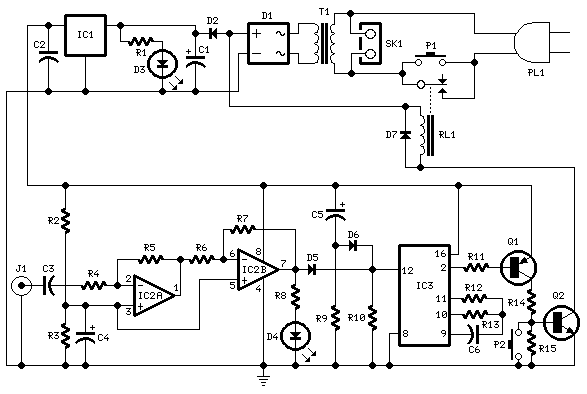
Amplifier Timer
Turns off your amplifier when idle for 15 minutes. Fed by amplifier tape-output. This circuit turns off an amplifier or any other device when a low-level audio signal fed to its input is absent for 15 minutes at least. Pushing...

Stabilized-amplifier
This amplifier operates across a broad range of gains, typically from 1 to 10. It integrates the LT1010 with a fast discrete stage and an LT1008-based destabilizing loop. Transistors Q1 and Q2 create a differential stage that converts to a...
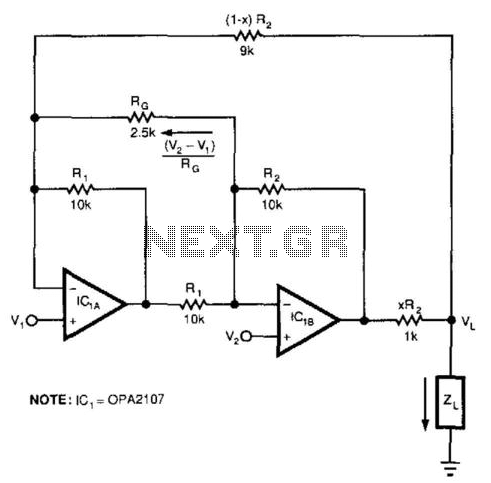
Bootstrapped Amp Current Source
This circuit responds to the difference between Vj and V2. Rq sets the gain. Resistors XR2 and (1 - X) R2 produce the bootstrap effect. These two resistors convert the circuit's output voltage to a current. IC1 and IC2 are...

amplifier timer
This circuit deactivates an amplifier or any other device when a low-level audio signal at its input is absent for at least 15 minutes. By pressing P1, the device is powered on, allowing any appliance connected to SK1 to operate....
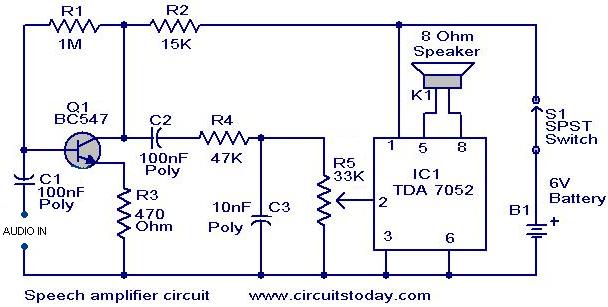
Speech amplifier circuit
This circuit can be housed within a box containing a speaker to create a convenient microphone amplifier. It is suitable for use by teachers, guides, lecturers, and others in crowded or noisy environments. The design is based on the audio...

Amplifier Timer Circuit Schematic
This circuit deactivates an amplifier or any connected device when a low-level audio signal is absent at its input for at least 15 minutes. Activating switch P1 powers the device, enabling operation of any appliance connected to SK1. The input...

Amplifier Bridging
The primary advantage of this method of bridging is that no additional components are needed, which means that it is cheap, and there is no signal degradation from additional opamps in the circuit path. The results are at least as...