


KD9562 octave analog sound music circuit
#KD9562
#analog sound
#music circuit
#sound effects
#doorbell
#game sounds
#alarm sounds
#tone generator
#sound synthesis

Description: The KD9562 music octave circuit is an analog sound circuit capable of producing various sound effects including rifle shots, space shots, game console sounds, dual-tone doorbells, bomb explosions, machine gunfire, and ambulance sirens. The main electrical parameters are as follows: operating voltage of 2.4 to 5V, quiescent current of 2 to 10µA, operating current of approximately 110mA at around 3V, and about 165mA at 4.5V. It includes application circuits and a circuit board.
The KD9562 music octave circuit is designed to generate a variety of sound effects suitable for applications in toy devices, sound effects in gaming systems, and other electronic projects requiring audio output. This circuit utilizes analog technology to create high-fidelity sound effects that are both engaging and realistic.
The operational voltage range of 2.4 to 5V allows for flexibility in power supply options, making it compatible with a wide range of battery types and power sources. The quiescent current, which ranges from 2 to 10µA, indicates low power consumption when the circuit is not actively generating sound, thus enhancing battery life in portable applications.
When the circuit is activated, it draws approximately 110mA at 3V and up to 165mA at 4.5V, which is suitable for driving small speakers or piezoelectric elements commonly used in sound output devices. The inclusion of application circuits facilitates easy integration into various projects, while the circuit board provides a compact and organized layout for assembling components.
This circuit can be particularly useful in creating immersive experiences in electronic toys or as sound modules in artistic installations. Overall, the KD9562 music octave circuit is a versatile component for generating a wide range of sound effects in electronic designs.KD9562 music octave circuit is analog sound circuits can be issued rifle sound, space shots, game console sound, dual-tone door so sound, the sound of bomb explosions, machine gunfire and the sound of an ambulance. The main electrical parameters: Working voltage 2.4 ~ 5v; quiescent current 2 ~ lOv: A + approximately 3V the circuit operating current llOmA, about 165mA at 4.5V. Application circuit and circuit board
The KD9562 music octave circuit is designed to generate a variety of sound effects suitable for applications in toy devices, sound effects in gaming systems, and other electronic projects requiring audio output. This circuit utilizes analog technology to create high-fidelity sound effects that are both engaging and realistic.
The operational voltage range of 2.4 to 5V allows for flexibility in power supply options, making it compatible with a wide range of battery types and power sources. The quiescent current, which ranges from 2 to 10µA, indicates low power consumption when the circuit is not actively generating sound, thus enhancing battery life in portable applications.
When the circuit is activated, it draws approximately 110mA at 3V and up to 165mA at 4.5V, which is suitable for driving small speakers or piezoelectric elements commonly used in sound output devices. The inclusion of application circuits facilitates easy integration into various projects, while the circuit board provides a compact and organized layout for assembling components.
This circuit can be particularly useful in creating immersive experiences in electronic toys or as sound modules in artistic installations. Overall, the KD9562 music octave circuit is a versatile component for generating a wide range of sound effects in electronic designs.KD9562 music octave circuit is analog sound circuits can be issued rifle sound, space shots, game console sound, dual-tone door so sound, the sound of bomb explosions, machine gunfire and the sound of an ambulance. The main electrical parameters: Working voltage 2.4 ~ 5v; quiescent current 2 ~ lOv: A + approximately 3V the circuit operating current llOmA, about 165mA at 4.5V. Application circuit and circuit board

Two-tone electronic doorbell 1
The two-tone electronic doorbell circuit consists of an input trigger circuit and an audio output circuit. The input trigger circuit includes a doorbell button (S), a transistor (V1), resistors (R1-R3), a capacitor (C1), and a dual D flip-flop integrated circuit...

Memory doorbell circuit
When the doorbell switch K1 is pressed, the doorbell rings and LED D3 lights up. If there is no one to answer the door, guests will leave, but D3 remains illuminated, indicating that visitors have arrived. The circuit includes a...

Doorbell Warning Switch
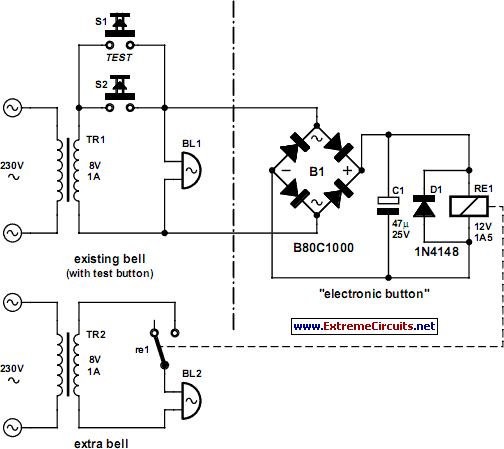
This circuit activates a lamp at a remote location when the doorbell switch is pressed. It is designed specifically for solenoid-type doorbells, as electronic doorbells that play tunes are incompatible. The circuit addresses the issue of potentially missing the sound...

Remote Doorbell Warning Switch circuit
It is easy to miss the sound of a doorbell while watching TV. This circuit addresses the issue by providing a visual indication, such as a lamp or an LED. Connecting a lamp directly in parallel with the doorbell could...
Doorbell Cascade
In certain situations, it may be necessary to adopt a more complex approach, even when simpler alternatives exist. This applies in the current scenario, where the objective is to install a second doorbell.
To implement the addition of a second doorbell,...

Sound Effects Generator Circuit
The circuit comprises four main components: a binary counter, a digital-to-analog (D/A) converter, a voltage-controlled oscillator (VCO), and an audio output amplifier. The counting speed of the binary counter is influenced by the frequency output from the VCO, which is...

Twin Bell Circuit Circuit
It is often desirable for a single doorbell to be operated by two buttons, for instance, one at the front door and the other at the back door. The additional button, S2 in series with the break contact of relay...
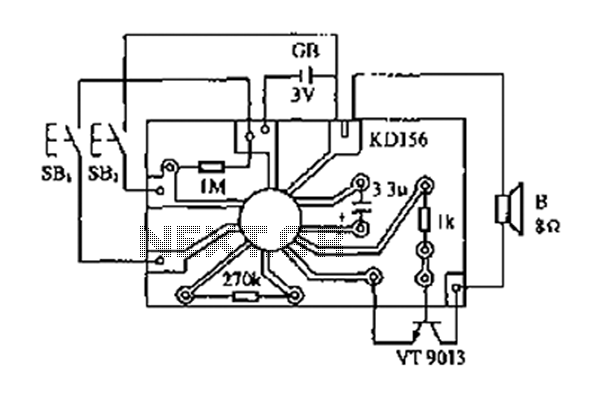
Analog sound KD156 have lingering Ding Dong sound of birds singing and the integrated circuit
The analog sound KD156 produces a lingering "Ding Dong" sound reminiscent of birds singing, utilizing an integrated circuit.
The KD156 is an analog sound generator designed to replicate natural soundscapes, particularly the soothing and familiar tones of birds singing. The integrated...

Tone Generator Circuit-Simple Calling Bell Circuit
A tone generator circuit, which can be used to create a simple calling bell circuit, is illustrated here. It is constructed using the 8021 integrated circuit (IC), which includes built-in circuitry for producing a "ding-dong" sound.
The tone generator circuit utilizing...