


Mic Pre-Amp with Clipping
#pre-amp
#clipping
#audio processing
#signal processing
#audio amplifier
#sound engineering
#music production
#analog circuit
#distortion

Description: Signal clipping is typically avoided in most applications; however, there are specific instances in audio processing where clipping is intentionally utilized for beneficial effects.
Signal clipping is a phenomenon that occurs when an audio signal exceeds the maximum amplitude that a system can handle, resulting in the distortion of the waveform. In professional audio processing, clipping can be used creatively to enhance sound characteristics. For example, in electric guitar amplifiers, clipping is often employed to produce a "crunchy" sound that is desirable in rock music. This is achieved by intentionally driving the amplifier to its limits, causing the peaks of the waveform to flatten, which adds harmonic content and sustain to the sound.
In digital audio processing, clipping can also be used as a technique to increase perceived loudness without increasing the average level of the audio signal. By applying a soft clipping algorithm, the signal can be shaped in a way that adds warmth and richness, making it more engaging to the listener. This approach is commonly implemented in various audio effects processors and plugins.
Moreover, while clipping can enhance certain audio characteristics, it is essential to use it judiciously. Excessive clipping can lead to unwanted artifacts and a loss of audio fidelity. Therefore, understanding the context in which clipping is applied, as well as the desired outcome, is crucial for achieving the best results in audio engineering. Proper monitoring and metering during the mixing and mastering stages can help ensure that clipping is used effectively without compromising the overall sound quality.Signal clipping is usually avoided in most application, but we can find some useful examples where clipping is intentionally employed in audio processing. One..
Signal clipping is a phenomenon that occurs when an audio signal exceeds the maximum amplitude that a system can handle, resulting in the distortion of the waveform. In professional audio processing, clipping can be used creatively to enhance sound characteristics. For example, in electric guitar amplifiers, clipping is often employed to produce a "crunchy" sound that is desirable in rock music. This is achieved by intentionally driving the amplifier to its limits, causing the peaks of the waveform to flatten, which adds harmonic content and sustain to the sound.
In digital audio processing, clipping can also be used as a technique to increase perceived loudness without increasing the average level of the audio signal. By applying a soft clipping algorithm, the signal can be shaped in a way that adds warmth and richness, making it more engaging to the listener. This approach is commonly implemented in various audio effects processors and plugins.
Moreover, while clipping can enhance certain audio characteristics, it is essential to use it judiciously. Excessive clipping can lead to unwanted artifacts and a loss of audio fidelity. Therefore, understanding the context in which clipping is applied, as well as the desired outcome, is crucial for achieving the best results in audio engineering. Proper monitoring and metering during the mixing and mastering stages can help ensure that clipping is used effectively without compromising the overall sound quality.Signal clipping is usually avoided in most application, but we can find some useful examples where clipping is intentionally employed in audio processing. One..

Classroom Microphone System Circuit
This audio amplifier circuit is designed for use in classrooms to alleviate the strain of lecturing in noisy environments. It incorporates the power amplifier IC LM380, which delivers an output of 2 watts, adequate for confined spaces. The amplifier is...
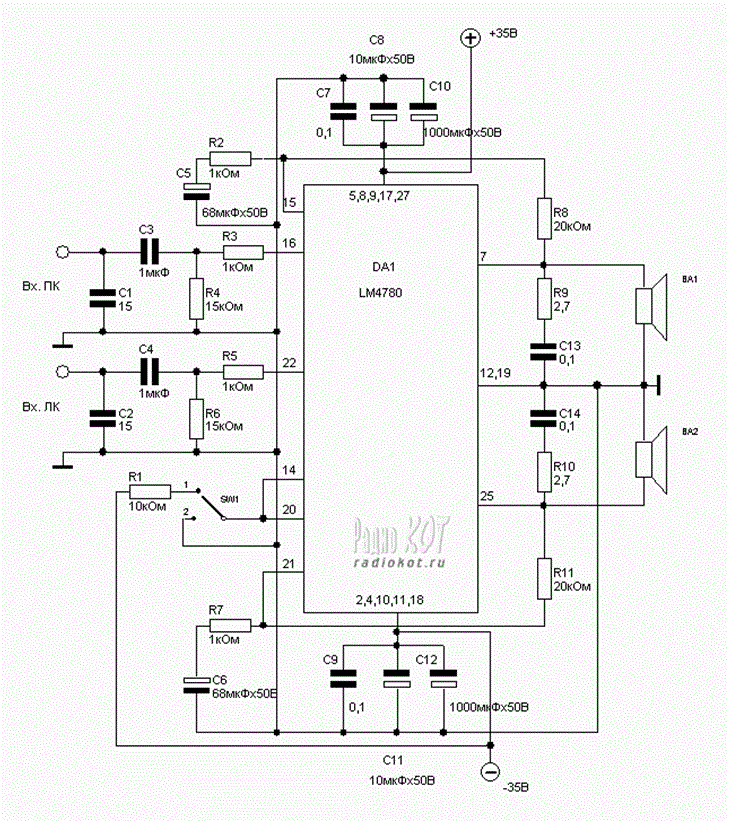
audio amplifier using ic lm4780
Explore the power amplifier integrated circuit from National Semiconductor, the LM4780. What is noteworthy about this component is its very low harmonic distortion. Typically, manufacturers specify the maximum power of their products with a harmonic content of around 10%. However,...

LA4440 audio amplifier circuit design electronic project
The LA4440 audio amplifier IC can be utilized to design a straightforward stereo power audio amplifier project, capable of delivering 6 watts of output power into an 8-ohm load. This audio amplifier IC features a minimal number of external components,...

20W audio amplifier using TDA7240
The audio amplifier presented here is based on the TDA7240 integrated circuit from ST Microelectronics. The TDA7240 is capable of delivering 20 watts of audio output power into a 4-ohm load. It requires a minimal number of external components and...

36 Watt Audio Power Amplifier Using TDA1562Q circuit
It is based on a Philips class-H audio amplifier IC and can deliver 36W RMS or 70W music power, all from a 13.8V supply. The Mighty Midget Amplifier can provide approximately 36W RMS continuous power into a 4-ohm load when...

1.5W Audio Amplifier with IC SSM2211
The SSM22111 is a high-performance audio amplifier that delivers 1 W RMS of low distortion audio power into a bridge-connected 8-ohm speaker load (or 1.5 W RMS into a 4-ohm load). The SSM2211 operates over a wide temperature range and...

4-channel amplifier
The rear channel "ambience" can be incorporated into an existing stereo system to extract a difference signal (R - L or L - R). When this signal is combined with a direct signal (R or L), it enhances the fullness...

10 Watt Power Amplifier (TDA2030)
This simple 10 watts audio power amplifier is designed for home-brewed purpose. It is based on an Audio Power Amplifier IC that is called TDA2030. It is a monolithic integrated circuit in Pentawatt package, intended for use as a low...
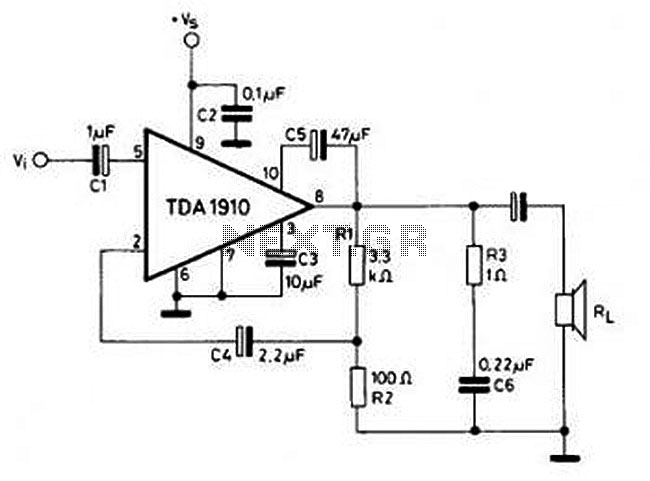
10w audio amplifier circuit
This circuit is simple and inexpensive, which is its primary advantage. Although the output power is not high, the audio quality is good due to the TDA1910's very low noise feature. This circuit is suitable for use as a student...